




About this worksheet
This guided practice focuses on one repeatable idea: divide the numerator by the denominator. The quotient tells the number of wholes, and the remainder becomes the numerator of the leftover fraction. Children begin with direct conversions, check with choices, and apply the same steps to short measurement contexts. Each answer is in simplest form, with units shown for the word problems.
How does division make a mixed number?
An improper fraction names a quantity at least one whole. Divide its numerator by its denominator. The quotient counts complete wholes; the remainder counts leftover parts, with the original denominator. For example, 11 ÷ 4 is 2 remainder 3, so 11/4 = 2 3/4.
How does the guided practice build?
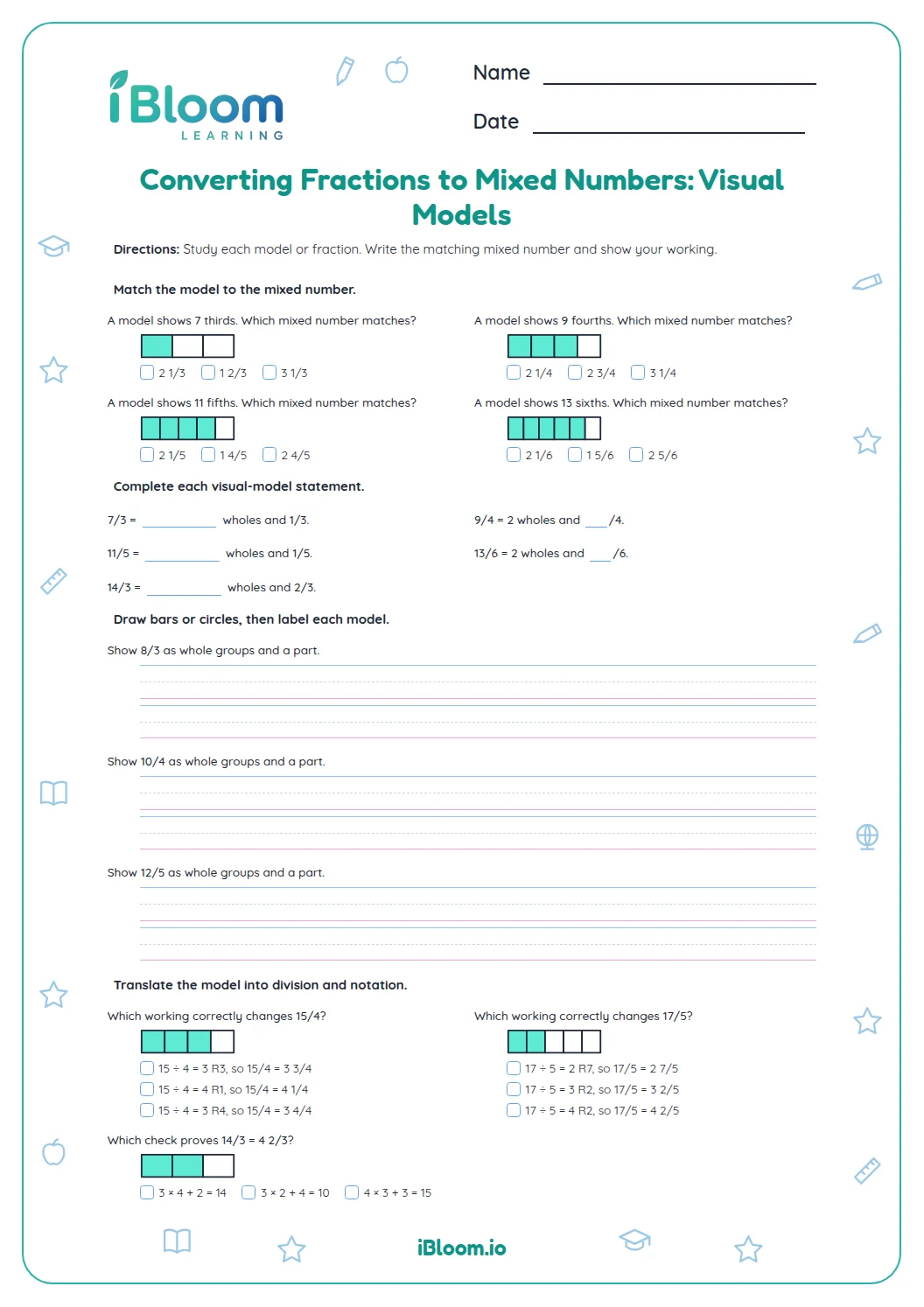
Part A gives direct conversions. Part B asks children to choose the matching mixed number. Parts C and D use the same quotient-and-remainder steps in short measurement settings. The context does not change the conversion rule; it only adds a unit to the answer.
How can children check a conversion?
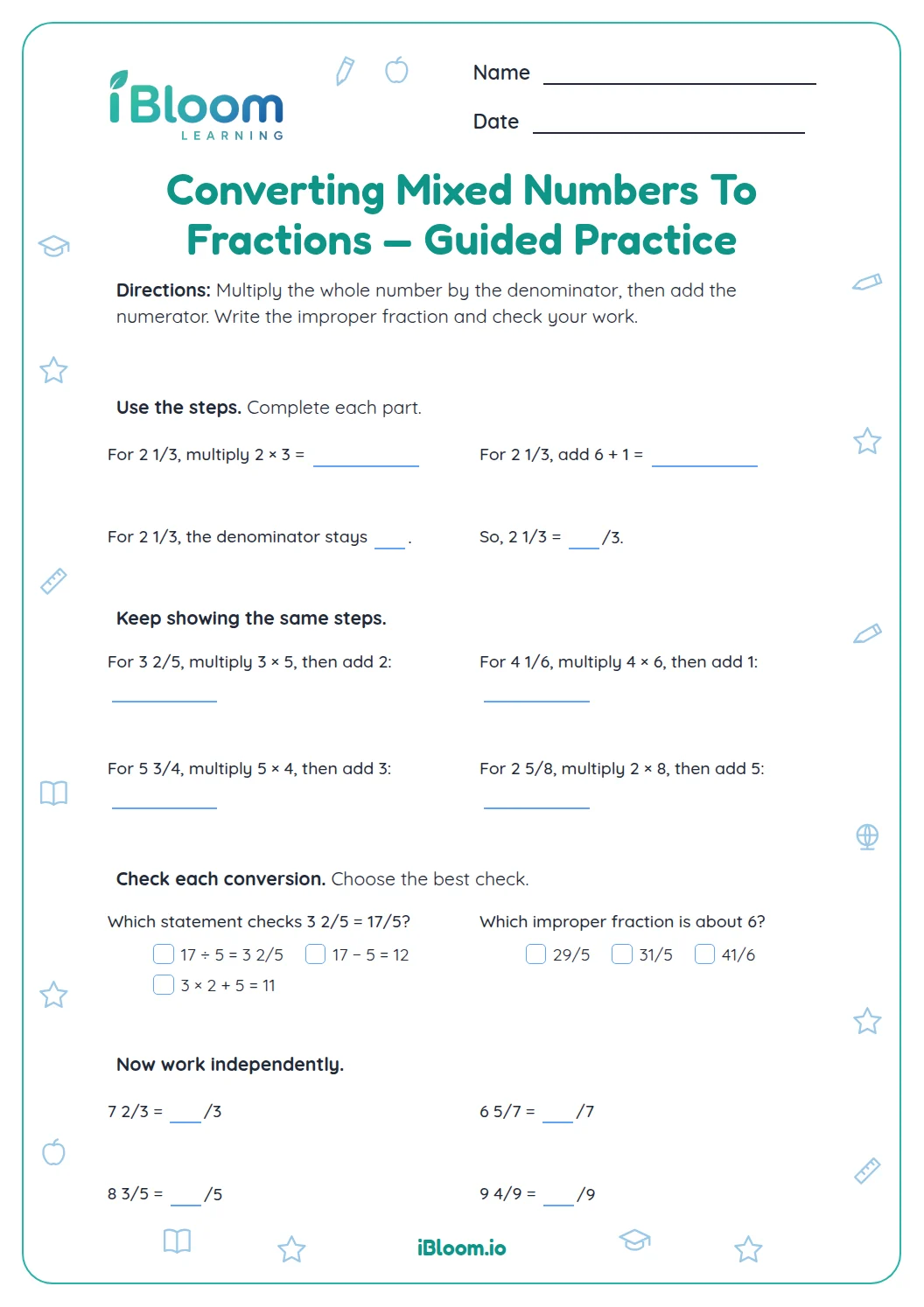
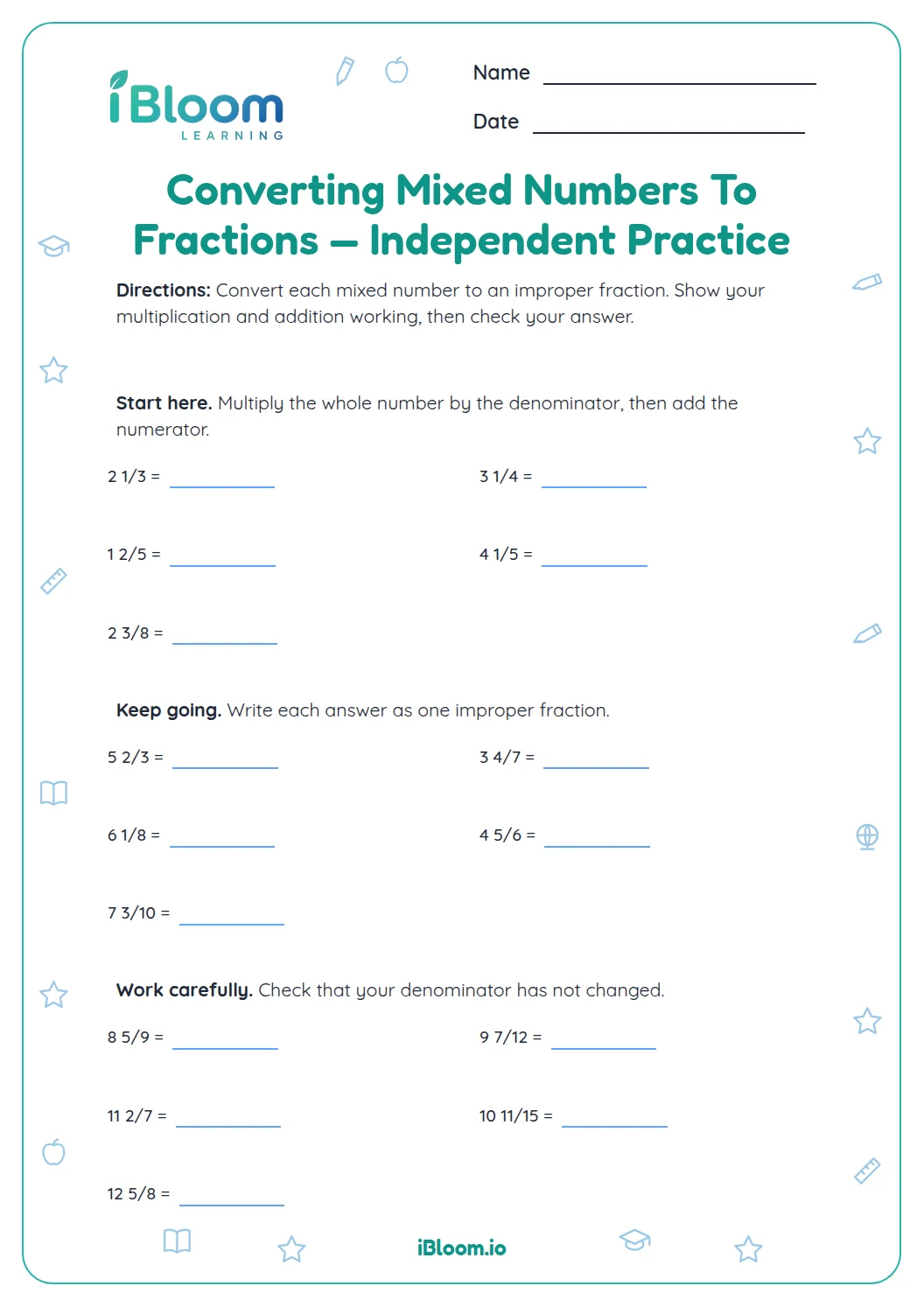
Multiply the whole-number part by the denominator and add the numerator of the fractional part. The result should equal the original numerator. Keep the denominator the same, then simplify the leftover fraction when possible.
How to use this worksheet
- 1For each improper fraction, divide the numerator by the denominator.
- 2Write the quotient as the whole number.
- 3Place the remainder over the original denominator.
- 4Choose the matching mixed number in Part B.
- 5In Part C, include the unit from the story.
- 6Check by multiplying the whole number by the denominator and adding the numerator.
Common mistakes and quick fixes
The mistake
Writing the remainder as the denominator.
The fix
Keep the original denominator; the remainder becomes the new numerator.
The mistake
Using the numerator as the whole number.
The fix
The quotient, not the numerator, counts complete wholes.
The mistake
Forgetting to simplify the fractional part.
The fix
Reduce the leftover fraction when its numerator and denominator have a common factor.
What to practice next
Make more practice
Questions parents and teachers ask
How do I convert an improper fraction to a mixed number?
Divide the numerator by the denominator. The quotient is the whole number, and the remainder goes over the original denominator. The quotient counts complete groups of the denominator, while the remainder counts parts still left. Keeping that relationship visible makes the mixed number easier to interpret.
Why does the denominator stay the same?
The leftover parts are still the same size as the original fraction parts, so the denominator does not change during the conversion. For example, 9/4 has two whole groups of fourths and one fourth left. This is why the answer is 2 1/4, not 2 1/2.
How can I check my answer?
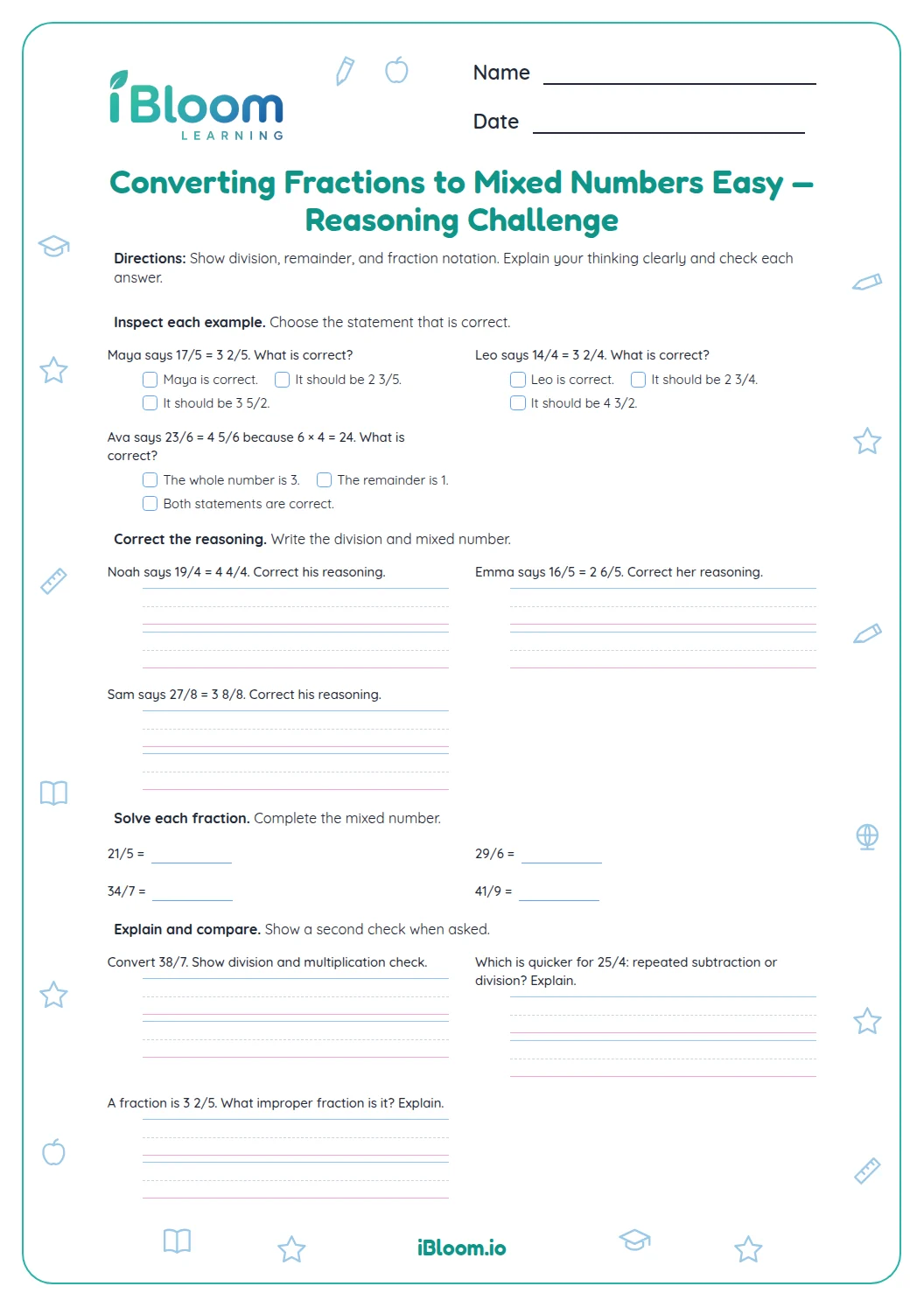
Multiply the whole number by the denominator and add the fractional numerator. That total should match the original numerator. The reverse check works because a whole number contains that many denominator-sized parts. Adding the leftover numerator should rebuild the original improper fraction.
Why does the answer key sometimes show a unit?
The final six questions use measurements, so the key includes the unit named in each problem. For example, 15/4 meters becomes 3 3/4 meters. Adding the unit after the mixed number keeps the quantity clear without changing the fraction conversion.
How many problems are on the worksheet?
There are 14 problems in four parts: direct conversions, multiple-choice checks, and measurement contexts. A separate answer key shows each mixed number and includes the units named in the story problems. Children can use the key to check the quotient, remainder, and final form.