






About this worksheet
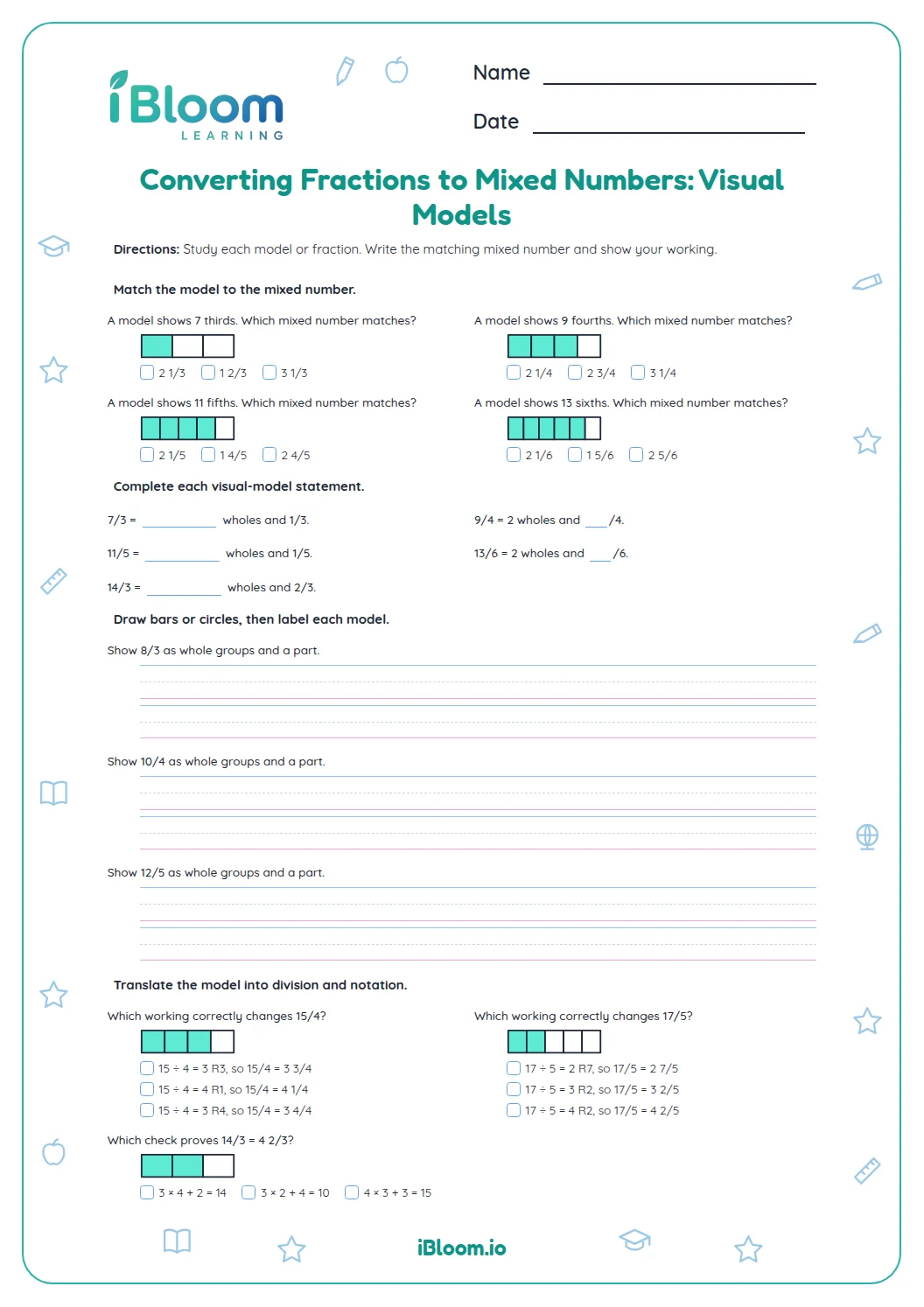
This Grade 6 worksheet builds the connection between an improper fraction and a mixed number. Students read four fraction models, then convert ten more fractions by dividing the numerator by the denominator and using the remainder as the fractional part. It practices the fraction-as-division connection in CCSS 5.NF.B.3 and includes a separate answer key.
Aligned to 5.NF.B.3
How are the conversions organized?
The first four questions pair an improper fraction with a fraction model. Part B moves to ten symbolic conversions. Students divide the numerator by the denominator, then use the quotient and remainder to write a mixed number.
- 1Question 1: 9/4
- 2Four fourths make one whole, with one fourth left after two wholes.
- 39/4 = 2 1/4
How does division make a mixed number?
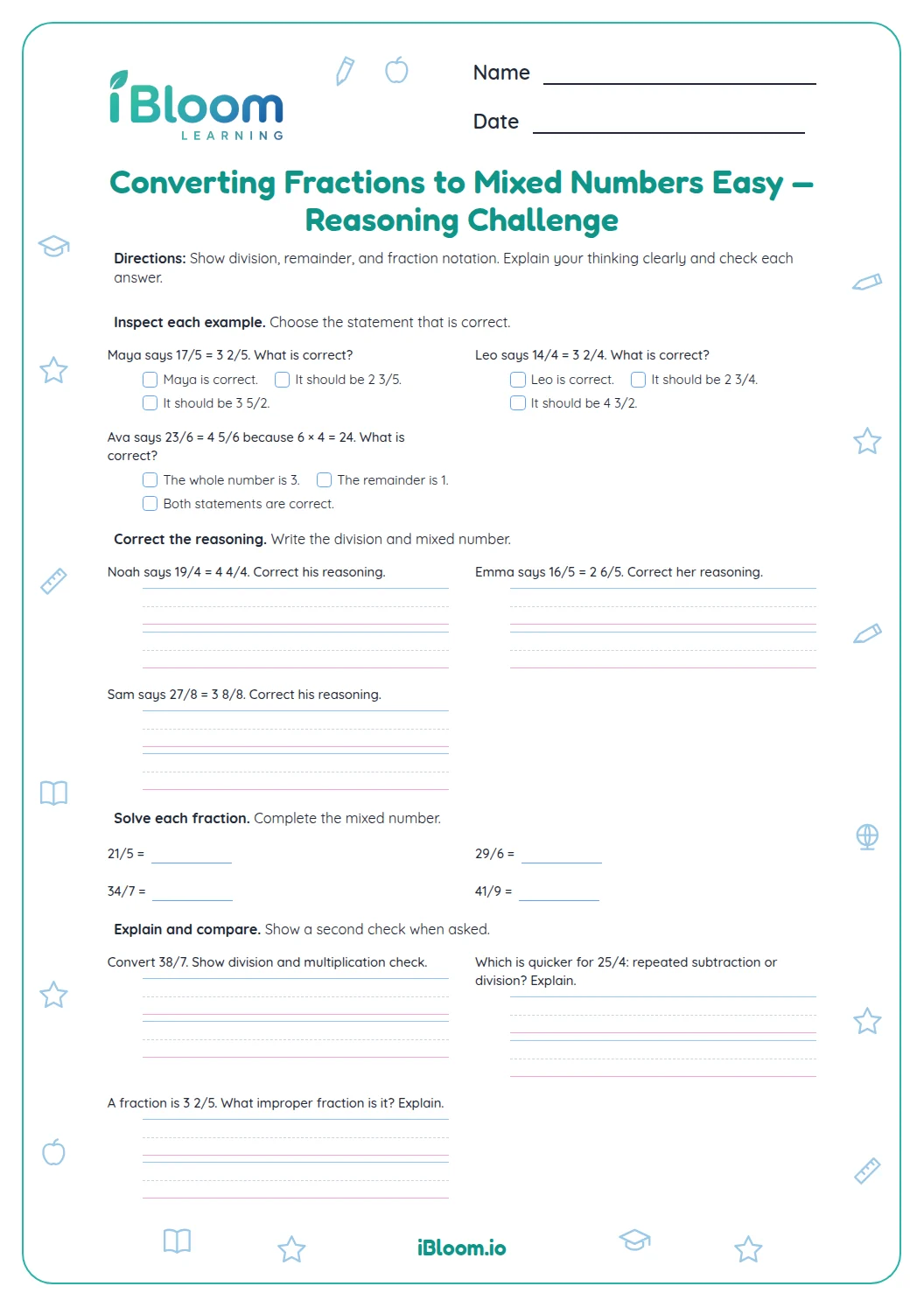
Divide the numerator by the denominator. The quotient counts complete wholes; the remainder counts parts left over, and the original denominator names each part. For 17/5, three groups of five use 15 fifths, leaving 2/5: 17/5 = 3 2/5.
How can I check a mixed-number answer?
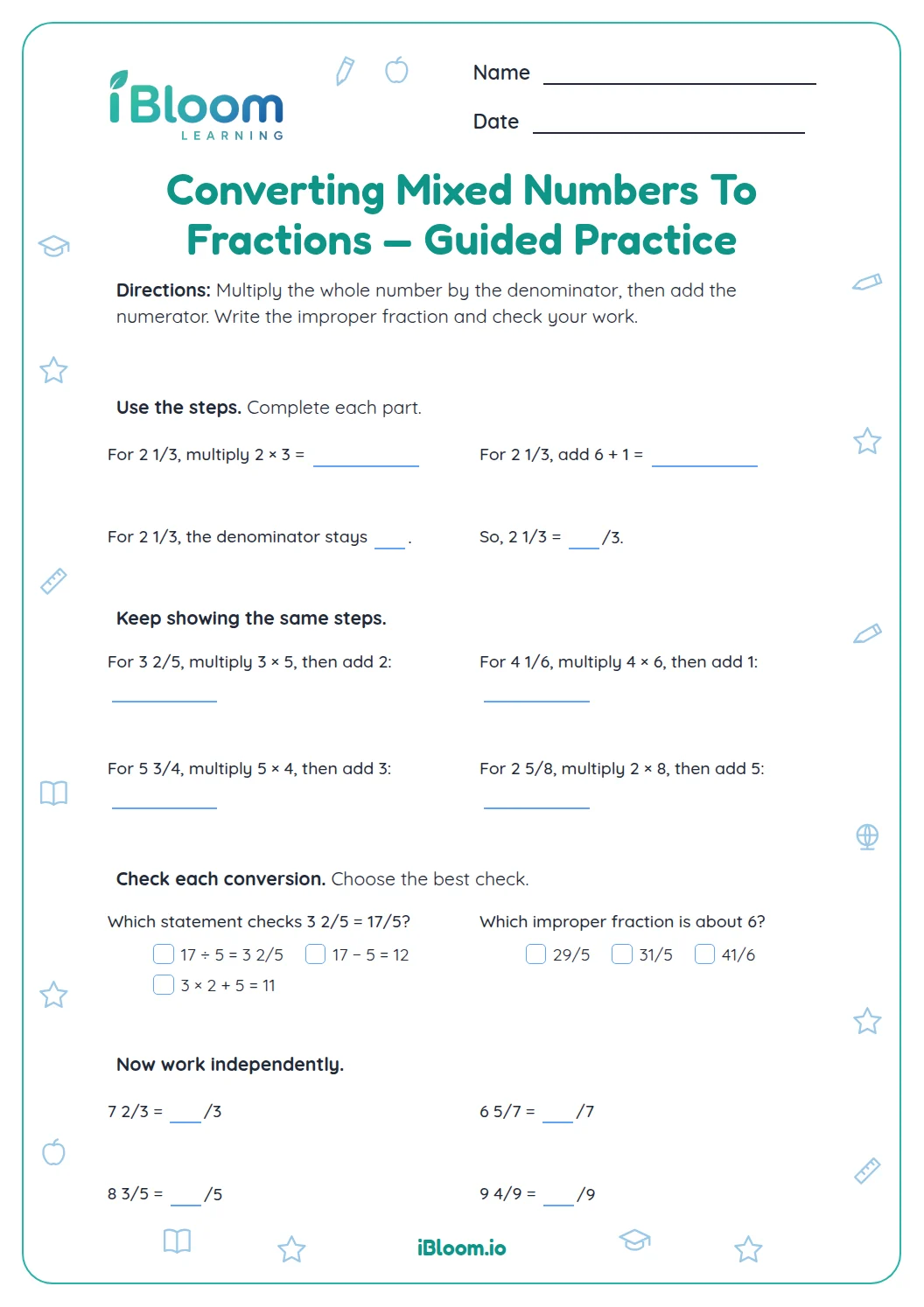
Multiply the whole-number part by the denominator, then add the numerator of the remaining fraction. The result should equal the original numerator. For 3 2/5, compute 3 × 5 + 2 = 17, so it matches 17/5.
How to use this worksheet
- 1Identify the denominator and use it as the size of each whole group.
- 2Divide the numerator by the denominator.
- 3Write the quotient as the whole-number part.
- 4Write the remainder over the original denominator.
- 5Multiply back to check the improper fraction.
Common mistakes and quick fixes
The mistake
Using the remainder as the whole number.
The fix
The quotient counts full groups; the remainder is what is left after those groups.
The mistake
Changing the denominator to the remainder.
The fix
Keep the original denominator because the size of each part has not changed.
The mistake
Forgetting a zero remainder means the fraction is a whole number.
The fix
Check whether the numerator divides evenly before writing any leftover part.
Common Core alignment
The conversions connect numerator divided by denominator with a fraction or mixed-number result.
Connect an improper fraction to division and express the result as a mixed number.
On this sheet: Students express each numerator divided by its denominator as whole groups plus a remaining fractional part.
Show the official wordingHide the official wording
Interpret a fraction as division of the numerator by the denominator (a/b = a ÷ b). Solve word problems involving division of whole numbers leading to answers in the form of fractions or mixed numbers, e.g., by using visual fraction models or equations to represent the problem.
What to practice next
Make more practice
Further reading
Questions parents and teachers ask
How do I convert an improper fraction to a mixed number?
Divide the numerator by the denominator. Write the quotient as the whole number, then write the remainder over the original denominator. For example, 17/5 is 3 with 2 fifths left, so it equals 3 2/5. The model questions show this grouping visually.
Why does the denominator stay the same?
The denominator names how many equal parts make one whole. Conversion groups those same parts into complete wholes and leftover parts; it does not change their size. That is why 17/5 becomes 3 2/5 rather than a fraction with a new denominator.
What do the first four pictures show?
Each model shows one or more fully shaded wholes and a remaining shaded part. Students match the model to an improper fraction and select the equal mixed number. The models make the quotient and remainder visible before the later symbolic questions.
How can a student check the answer?
Multiply the whole number by the denominator, then add the numerator of the fractional part. For 3 2/5, 3 × 5 + 2 equals 17, which returns the numerator of 17/5. This check confirms the whole groups and leftover parts.
Does the worksheet include an answer key?
Yes. A separate answer key lists the mixed number for each of the 14 questions. The first four answers match the fraction models, and the remaining ten are conversions from equation blanks. Students can compare the final value after showing their division work.