






About this worksheet
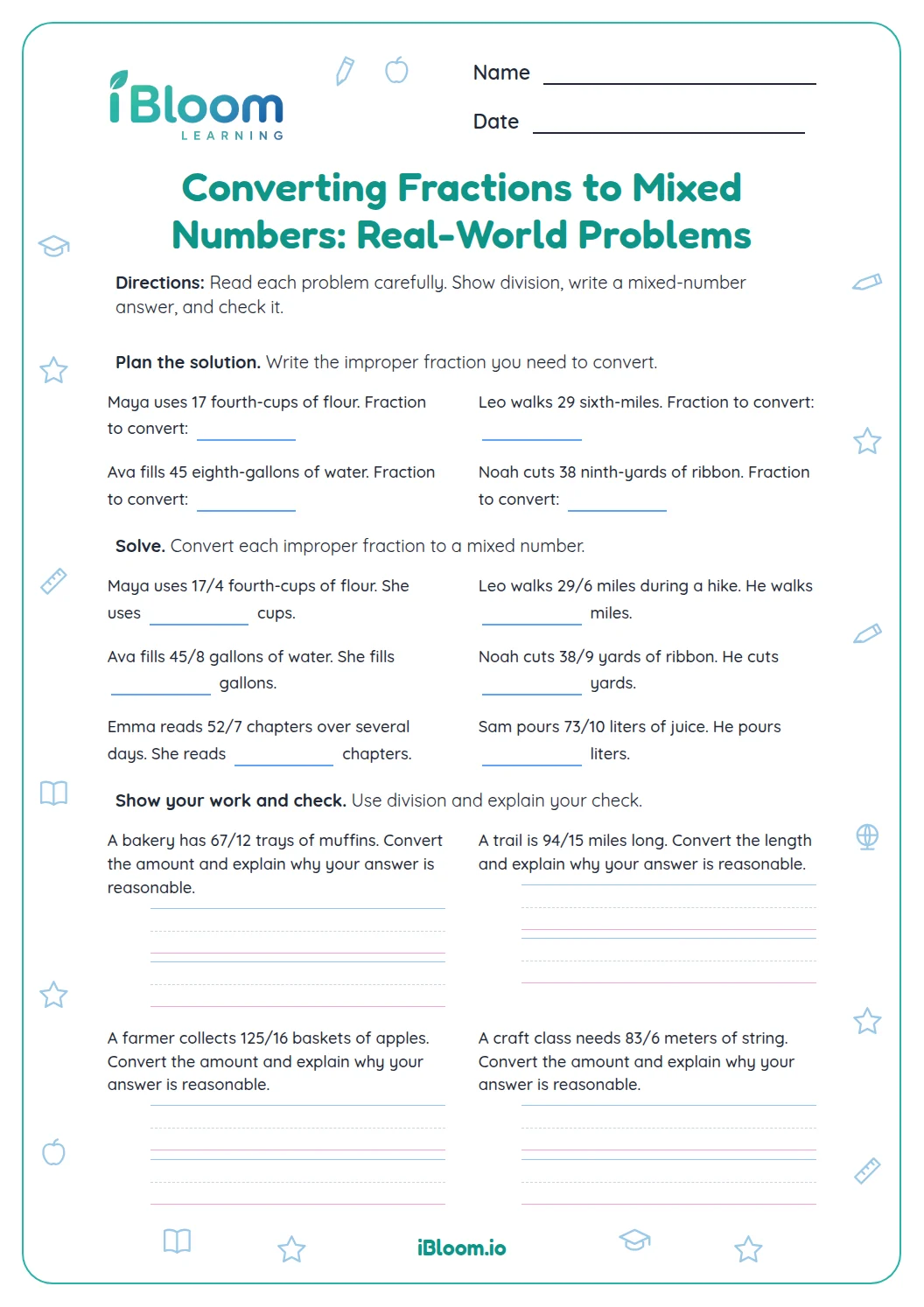
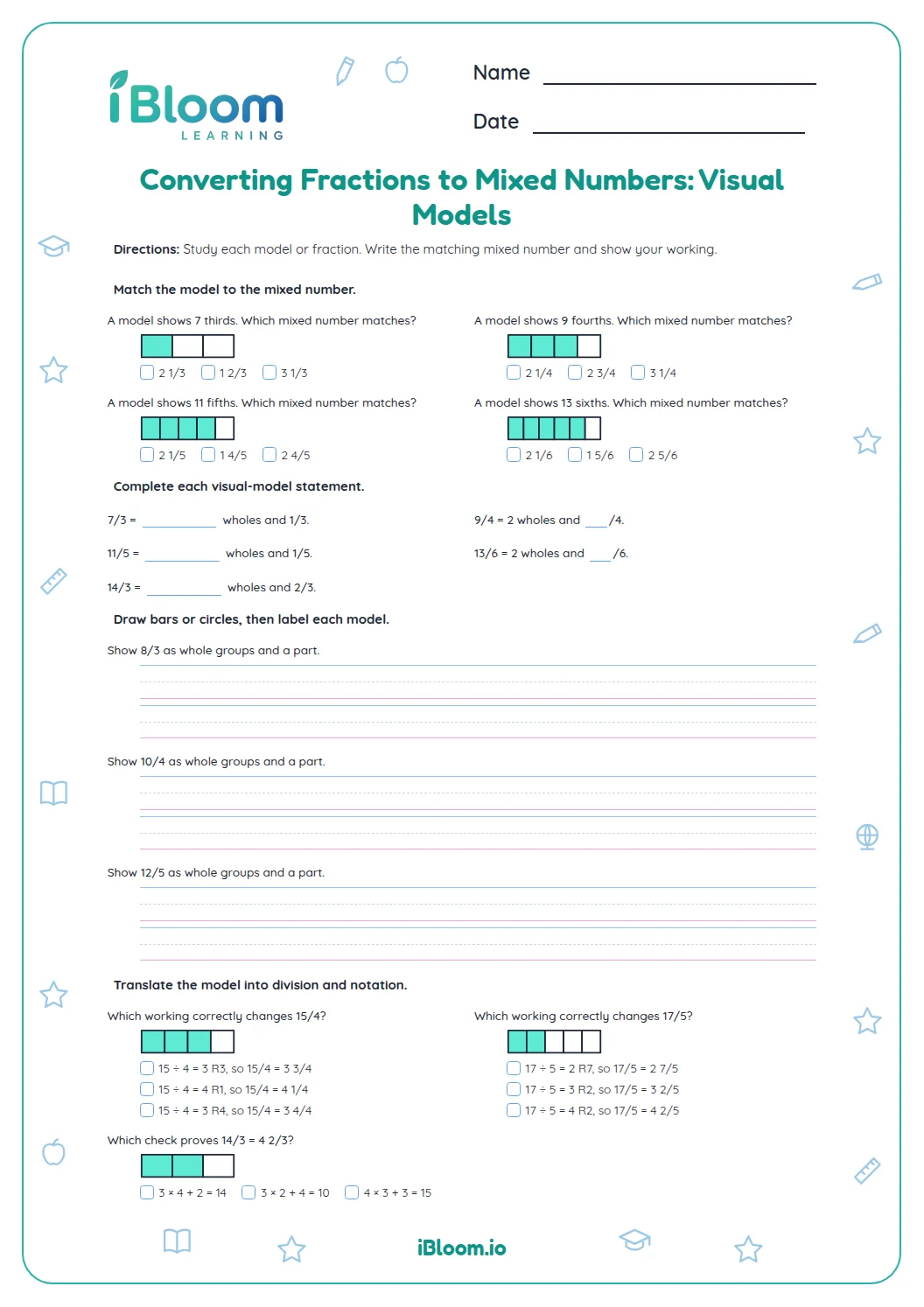
Divide the numerator by the denominator. The quotient is the whole-number part, and the remainder stays over the original denominator. For 17/5, 17 ÷ 5 is 3 remainder 2, so 17/5 = 3 2/5. The worksheet is for Grade 6 students and has 16 questions: 12 conversions with remainders and 4 that ask students to simplify the result. It prints on two worksheet pages and includes a separate two-page answer key. It practices CCSS 5.NF.B.3 through these equations and checks.
Aligned to 5.NF.B.3
How do you rename an improper fraction as a mixed number?
Divide the numerator by the denominator. The quotient is the whole-number part, and the remainder stays over the original denominator. For 17/5, 17 ÷ 5 is 3 remainder 2, so 17/5 = 3 2/5.
The worksheet has three parts. Part A: Divide, then rename: 6 questions, Part B: Convert larger fractions: 6 questions, and Part C: Simplify when possible: 4 questions. The examples progress from direct calculations to using the same idea in a less familiar equation.
- 117/5 = ___
- 217 ÷ 5 = 3 remainder 2
- 317/5 = 3 2/5
What practice is on each part?
16 questions: 12 conversions with remainders and 4 that ask students to simplify the result. Students can finish one part at a time and use the separate key to check their work.
- Part A: Divide, then rename: 6 questions
- Part B: Convert larger fractions: 6 questions
- Part C: Simplify when possible: 4 questions
How can an adult make the practice useful?
Ask the student to explain one step or check aloud. When an answer is off, return to the equation and locate the first step where the relationship changed. This keeps the correction tied to the skill on the page.
How to work through this worksheet
- 1Divide the numerator by the denominator.
- 2Write the quotient as the whole-number part.
- 3Put the remainder over the original denominator.
- 4Reduce the fractional part when numerator and denominator share a factor.
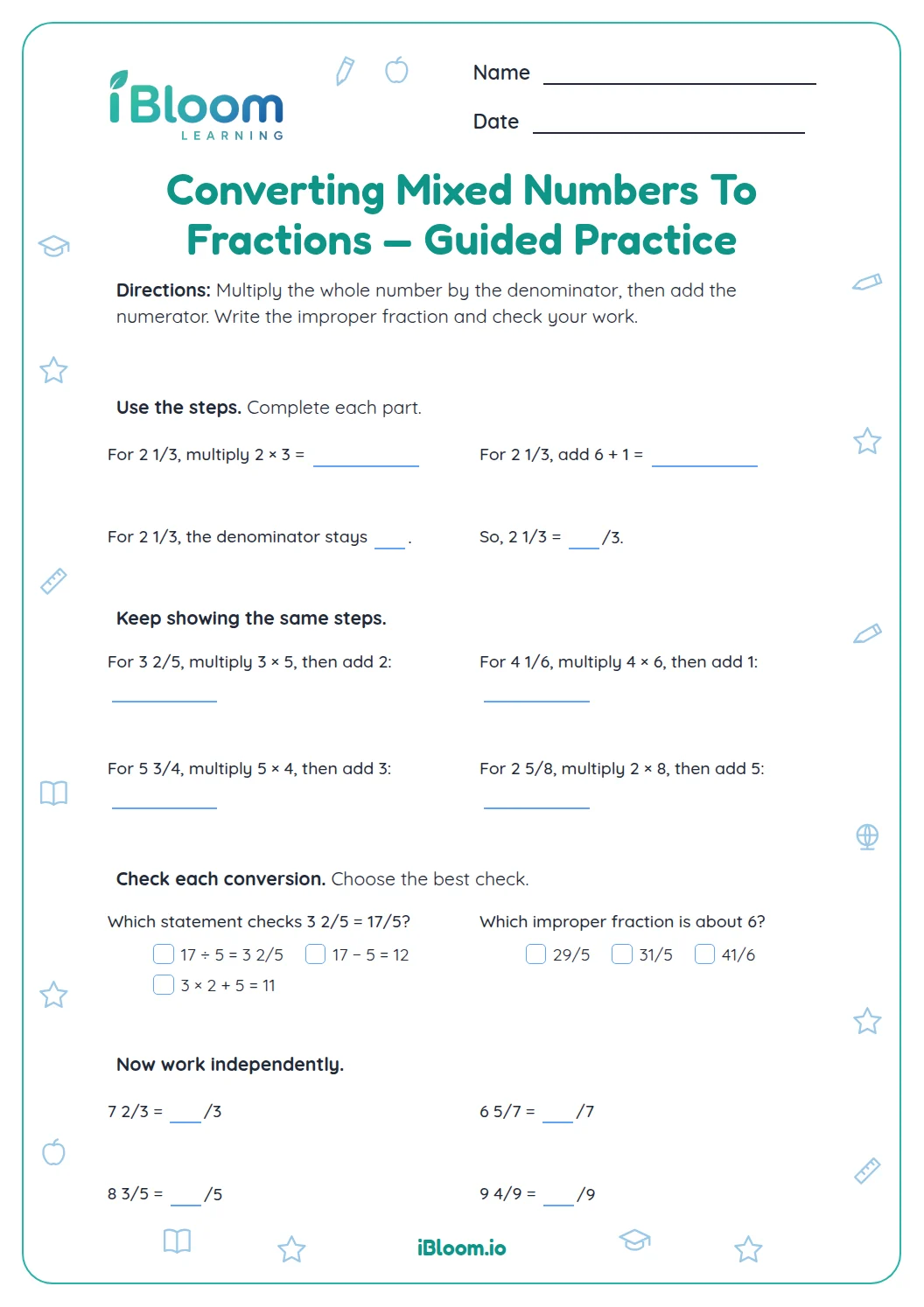
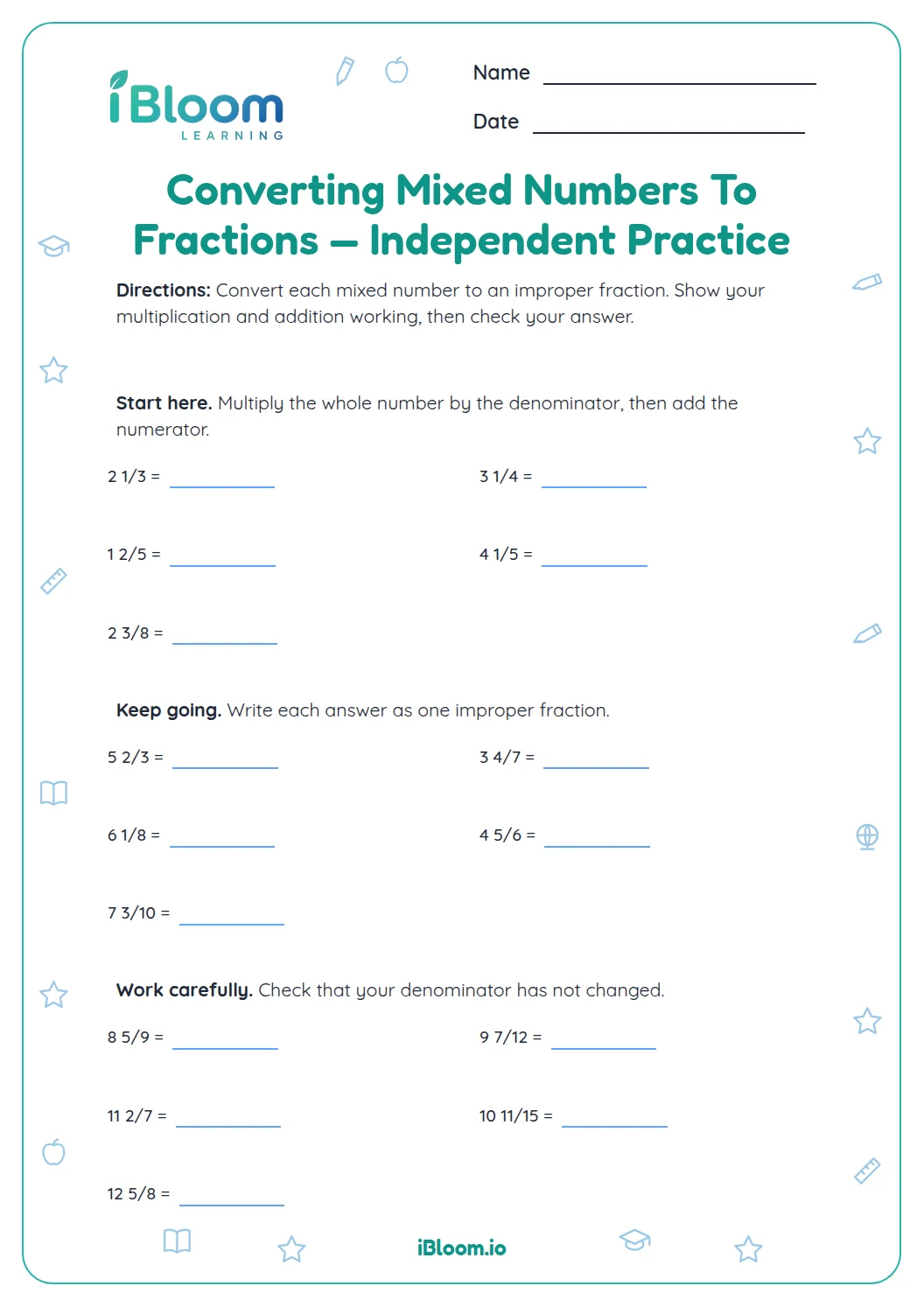
- 5Check by multiplying the whole number by the denominator and adding the numerator.
Common mistakes and quick fixes
The mistake
Using the divisor as the remainder.
The fix
Check the division: the remainder must be smaller than the denominator.
The mistake
Changing the denominator to the remainder.
The fix
Keep the original denominator under the remainder, then reduce only if possible.
The mistake
Leaving a reducible fractional part.
The fix
Look for a common factor in the remainder and denominator; simplify the fraction.
Common Core alignment
This worksheet practices the stated Common Core math skill through its equations and worked checks.
Divide the numerator by the denominator. The quotient is the whole-number part, and the remainder stays o
On this sheet: Divide the numerator by the denominator. The quotient is the whole-number part, and the remainder stays o
Show the official wordingHide the official wording
Interpret a fraction as division of the numerator by the denominator (a/b = a ÷ b). Solve word problems involving division of whole numbers leading to answers in the form of fractions or mixed numbers, e.g., by using visual fraction models or equations to represent the problem.
What to practice next
Make more practice
Further reading
Questions parents and teachers ask
How do you convert an improper fraction to a mixed number?
Divide the numerator by the denominator. The quotient becomes the whole number, and any remainder is written over the original denominator. For 17/5, the quotient is 3 and the remainder is 2, so the mixed number is 3 2/5. Students can use the printed equation to show the relationship clearly.
Should students simplify the fractional part?
Yes, when the remainder and denominator have a common factor. For example, 44/6 gives 7 2/6, which simplifies to 7 1/3. Part C includes fractions where students need to simplify, and the answer key shows the reduced form. Students can use the printed equation to show the relationship clearly.
What is in the guided practice?
The 16 questions appear in three parts. The first two parts build conversion fluency with increasingly larger numerators and denominators; the last part includes results that can be simplified, including one fraction that converts to a whole number. Students can use the printed equation to show the relationship clearly.
How can a student check a mixed number?
Multiply the whole-number part by the denominator, then add the numerator. For 3 2/5, calculate 3 × 5 + 2 = 17, which recovers the numerator of 17/5. This check confirms the conversion and keeps the denominator unchanged. Students can use the printed equation to show the relationship clearly.
Why does the remainder become the numerator?
After making as many full groups of the denominator as possible, the remainder is the part left over. In 17/5, three groups of fifths use 15 fifths, leaving 2 fifths. That is why 17/5 equals 3 2/5. This inverse check confirms the conversion and helps students keep the original denominator in the fractional part.