





About this worksheet
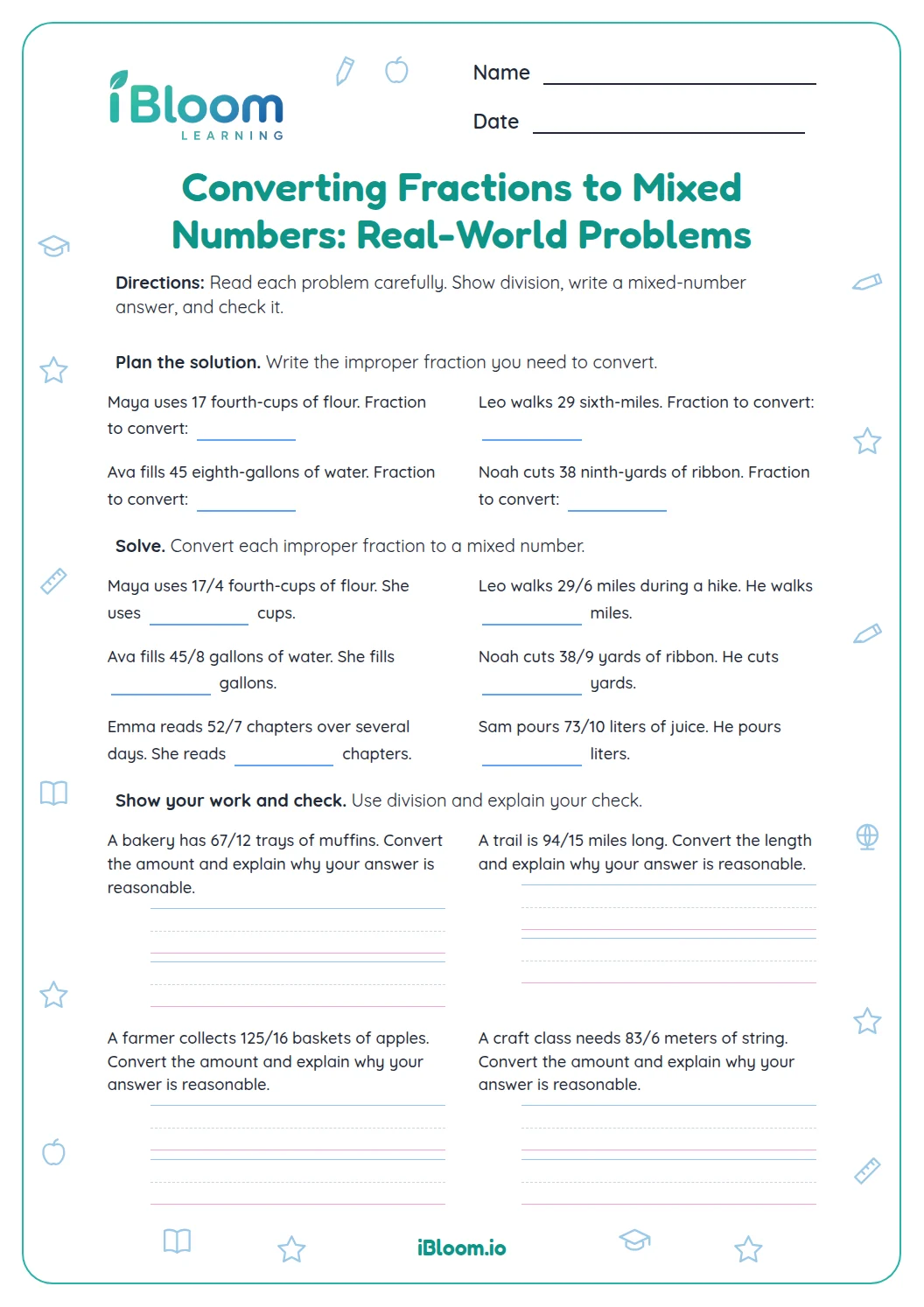
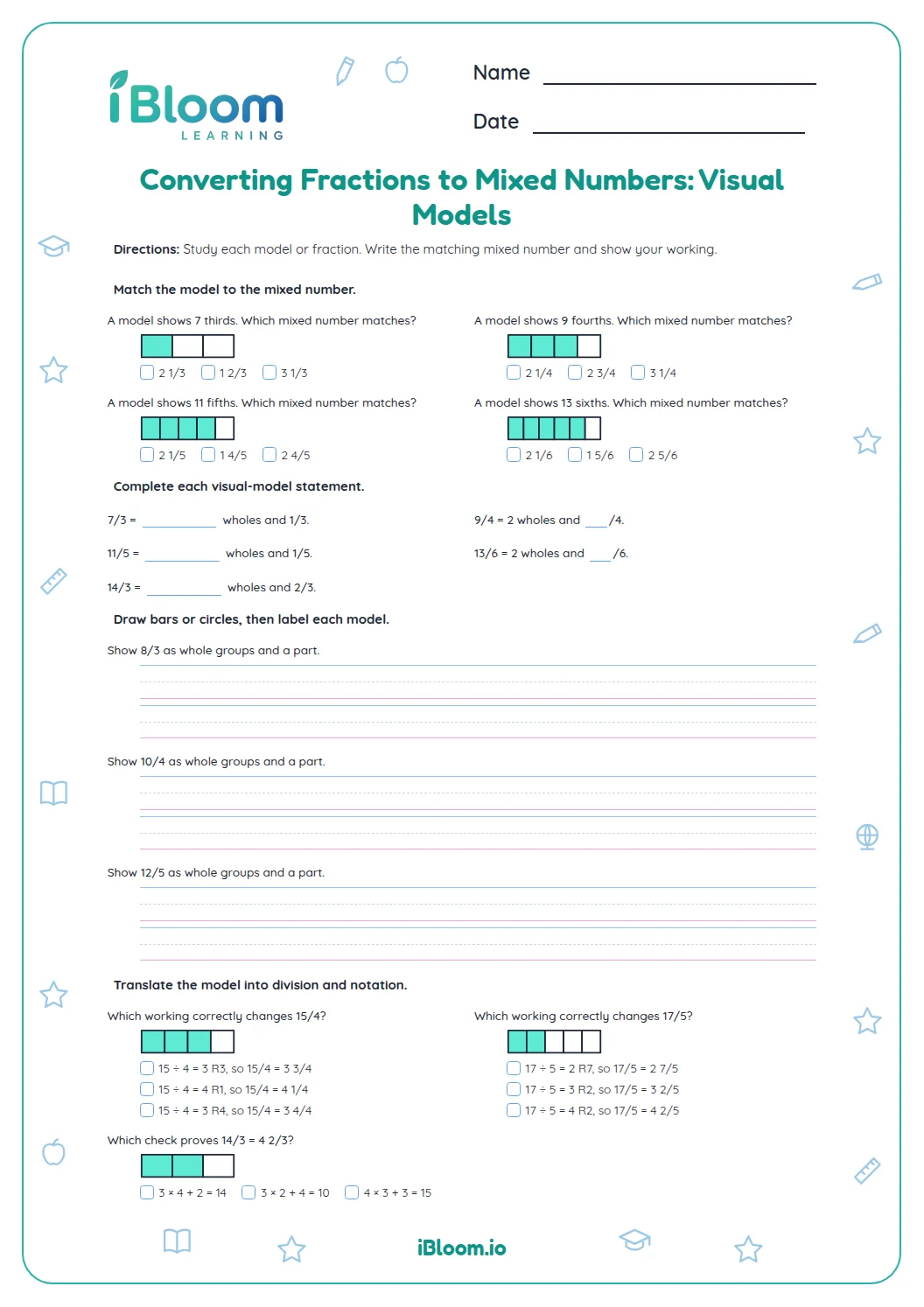
This free printable Grade 6 worksheet practices converting improper fractions to mixed numbers and converting mixed numbers back. Learners use division to find a quotient and remainder, then apply multiplication and addition to check the reverse conversion. The final questions ask them to correct and compare fraction forms. A separate answer key includes answers and sample reasoning.
Aligned to 5.NF.B.3
How do you convert an improper fraction?
Divide the numerator by the denominator. In question 1, 19 ÷ 4 = 4 remainder 3, so 19/4 = 4 3/4. The denominator stays 4 because the pieces are fourths.
- 119 ÷ 4 = 4 R3
- 219/4 = 4 3/4
- 3Check: (4 × 4 + 3)/4 = 19/4
How do you change a mixed number back?
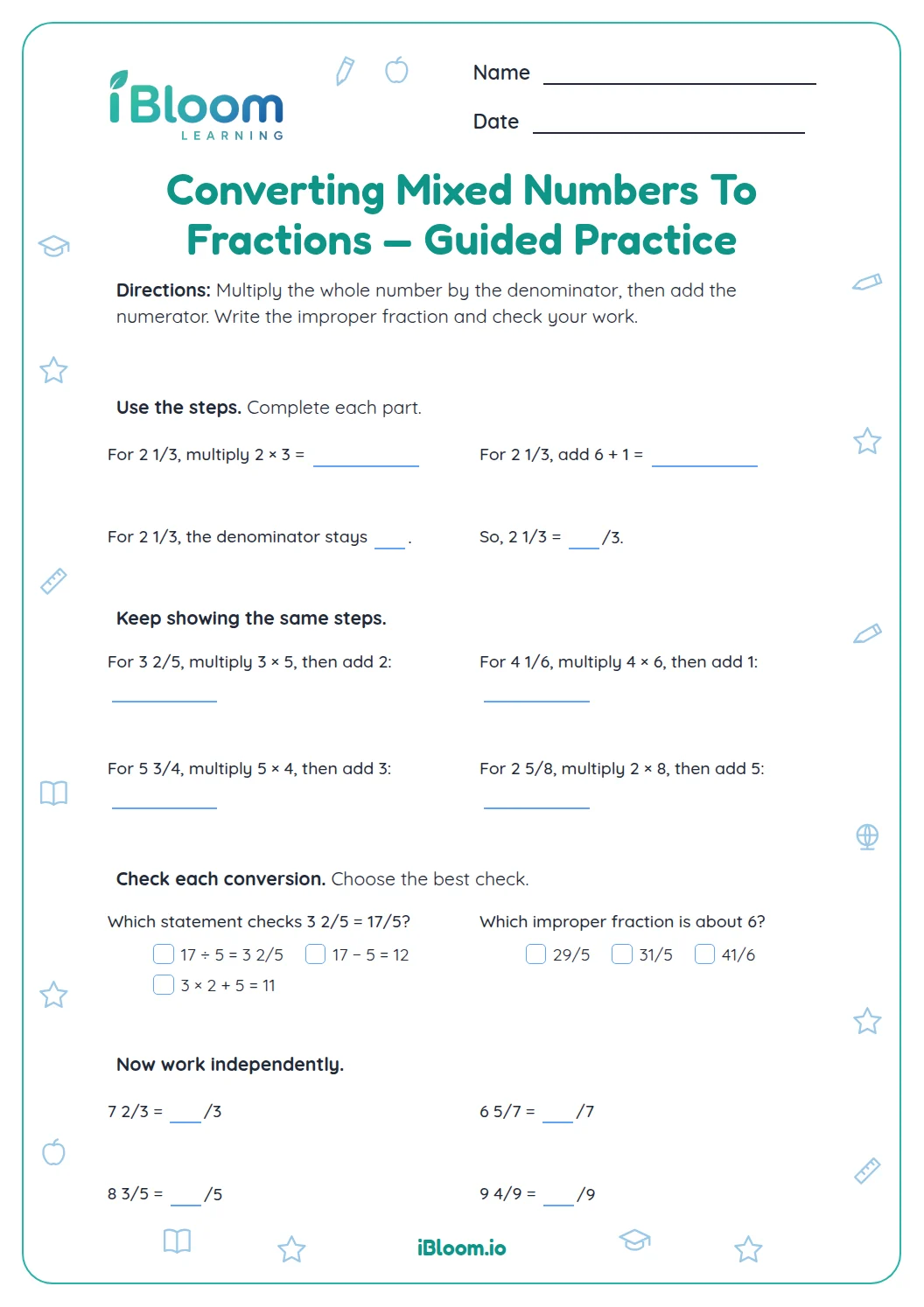
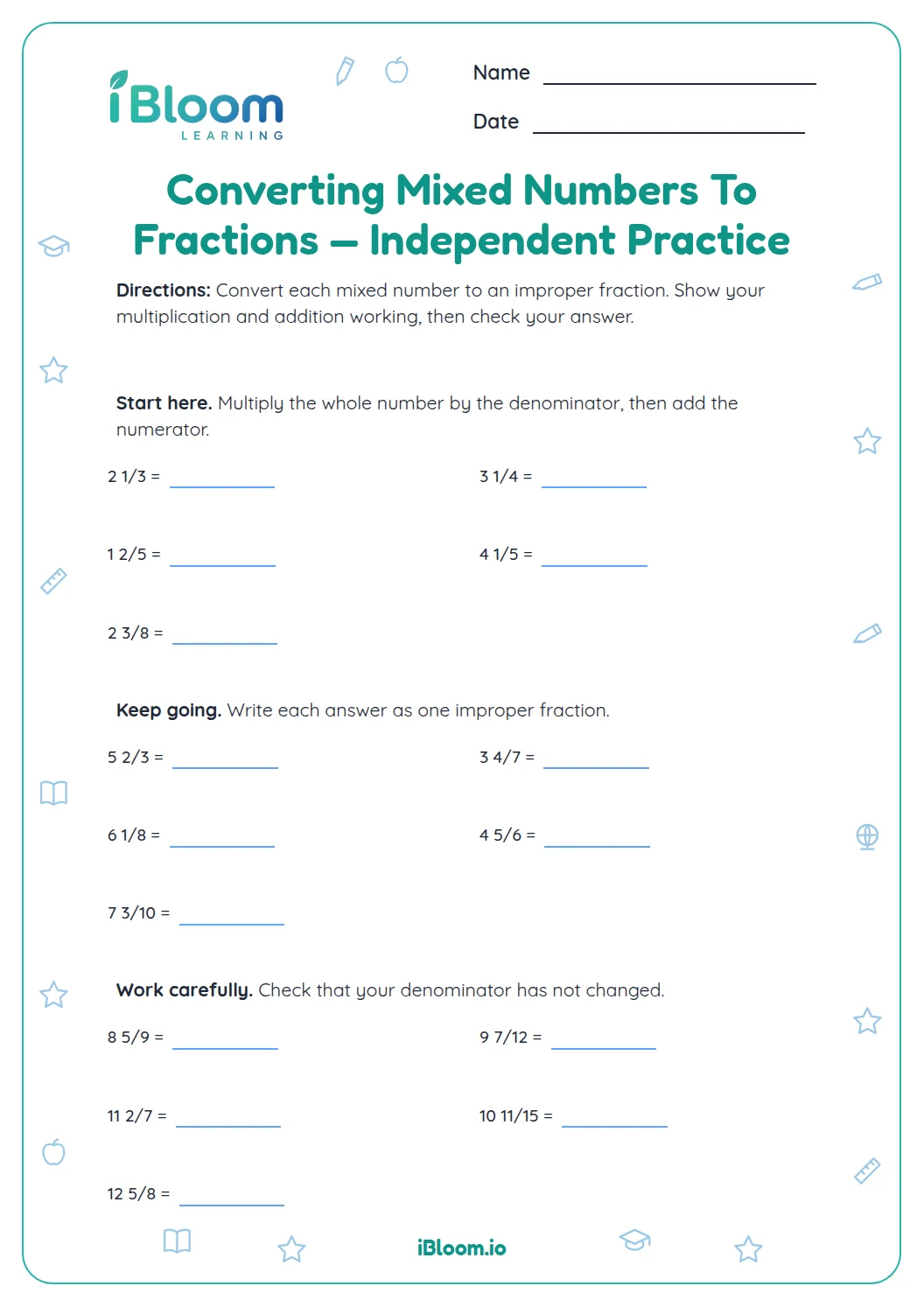
Multiply the whole number by the denominator, then add the numerator. For question 10, 6 3/7 becomes (6 × 7 + 3)/7 = 45/7. Keep the denominator unchanged.
What reasoning appears on the sheet?
The last questions ask learners to correct a quotient-and-remainder error, compare two values, and identify equivalent fraction forms. They connect conversion to division and multiplication without changing the fraction’s value.
How to use this worksheet
- 1Read the denominator first; it names the size of each part.
- 2Divide the numerator by that denominator.
- 3Write the quotient as the whole number.
- 4Write the remainder over the original denominator.
- 5For a mixed number, multiply the whole by the denominator, then add the numerator.
- 6Check by converting back or multiplying.
Common mistakes and quick fixes
The mistake
Changing the denominator during conversion.
The fix
Keep the denominator; only regroup the numerator into wholes and leftover parts.
The mistake
Writing the quotient and remainder in reverse order.
The fix
The quotient is the whole number; the remainder is the top number of the fraction.
The mistake
For reverse conversion, multiplying and forgetting to add the numerator.
The fix
Use whole × denominator + numerator before writing the fraction.
Interpret a fraction as division and express quotients as mixed numbers.
On this sheet: The worksheet uses numerator divided by denominator to convert between improper fractions and mixed numbers.
Show the official wordingHide the official wording
Interpret a fraction as division of the numerator by the denominator (a/b = a ÷ b). Solve word problems involving division of whole numbers leading to answers in the form of fractions or mixed numbers, e.g., by using visual fraction models or equations to represent the problem. For example, interpret 3/4 as the result of dividing 3 by 4, noting that 3/4 multiplied by 4 equals 3, and that when 3 wholes are shared equally among 4 people each person has a share of size 3/4.
What to practice next
Make more practice
Further reading
Questions parents and teachers ask
How do you convert 19/4 to a mixed number?
Divide 19 by 4: the quotient is 4 and the remainder is 3. Write 4 as the whole number and 3/4 as the leftover part, so 19/4 = 4 3/4. Question 1 uses this method, and the separate key lists the answer.
Why does the denominator stay the same?
The denominator names the size of each piece. In 19/4, each piece is one fourth, so a remainder of 3 means 3/4. Converting regroups the numerator into whole groups and leftover pieces; it does not change the size of the pieces.
How do I change 6 3/7 to an improper fraction?
Multiply the whole number by the denominator, then add the numerator: 6 × 7 + 3 = 45. Put 45 over the original denominator to get 45/7. Question 8 practices this reverse conversion, and multiplication checks that 6 3/7 and 45/7 have the same value.
Which is greater, 23/4 or 5 2/3?
23/4 is greater. It converts to 5 3/4, while 5 2/3 is a little less than 5 3/4. Question 13 asks for the greater value as a mixed number, so the answer is 5 3/4. Learners can check by comparing the leftover fractions.
Is an answer key included?
Yes. The answer key is printed separately and gives all 16 answers, including sample reasoning for the written response. Learners can finish both worksheet pages first, then use the key to check the quotient, remainder, and denominator in each conversion.