






About this worksheet
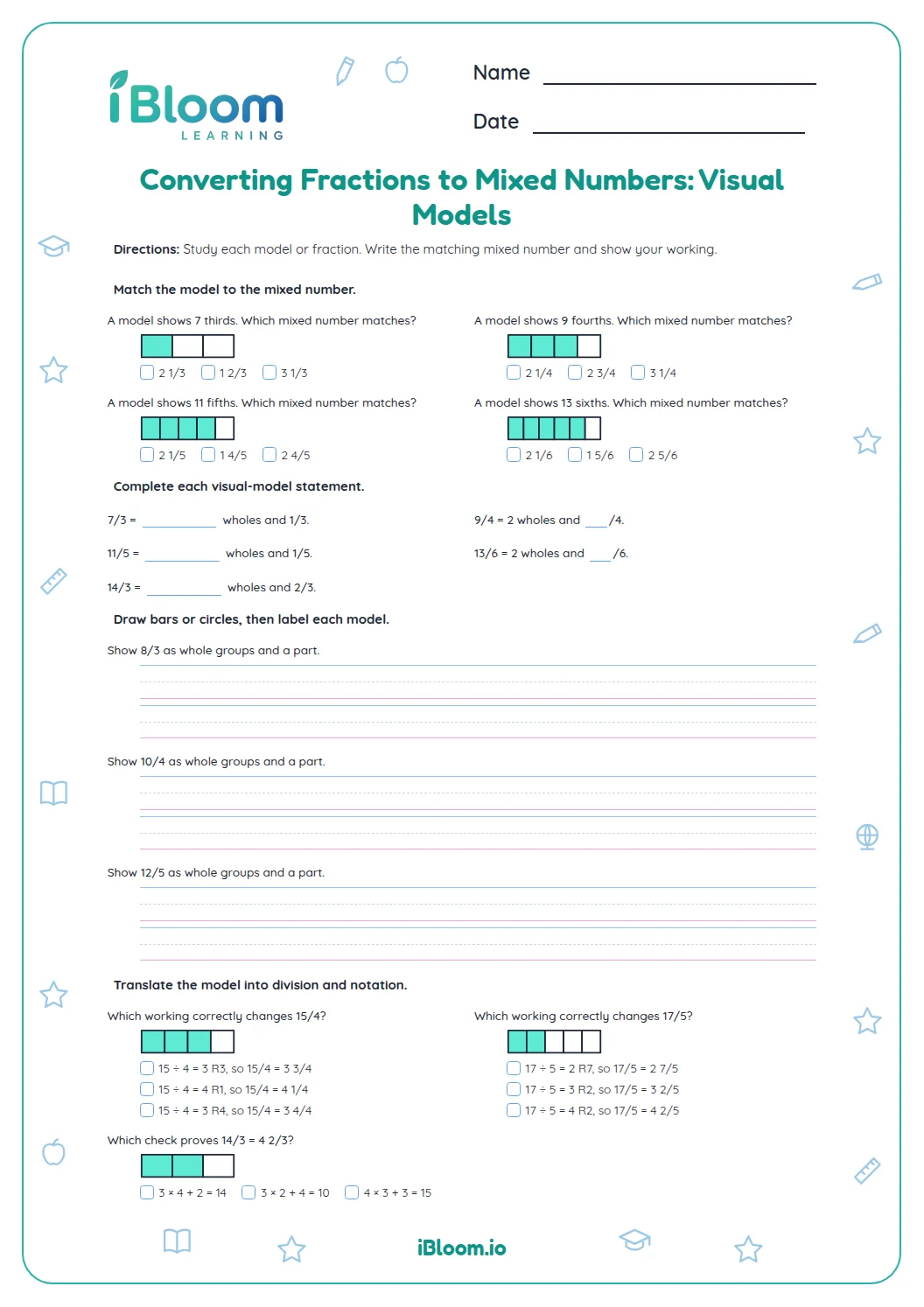
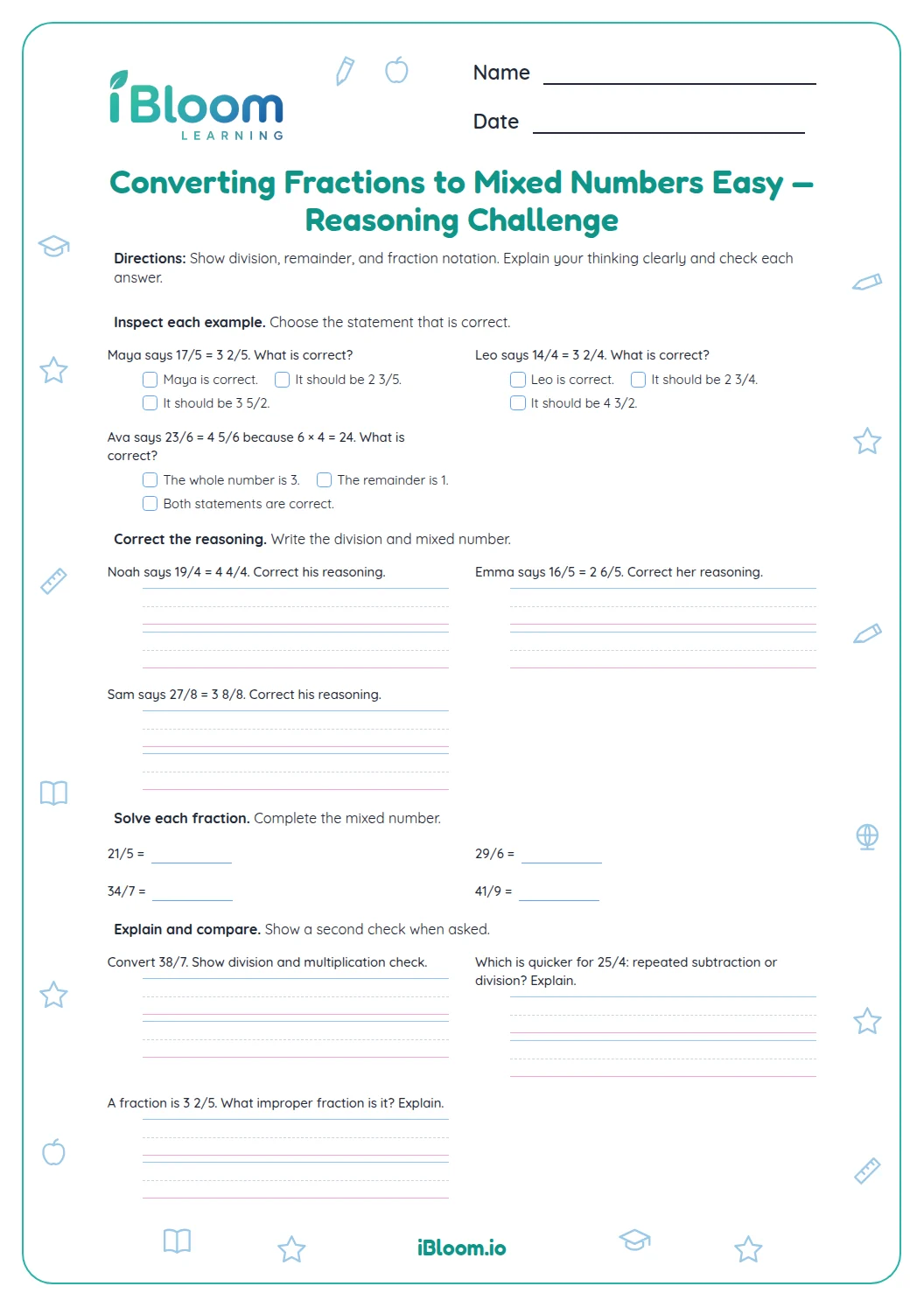
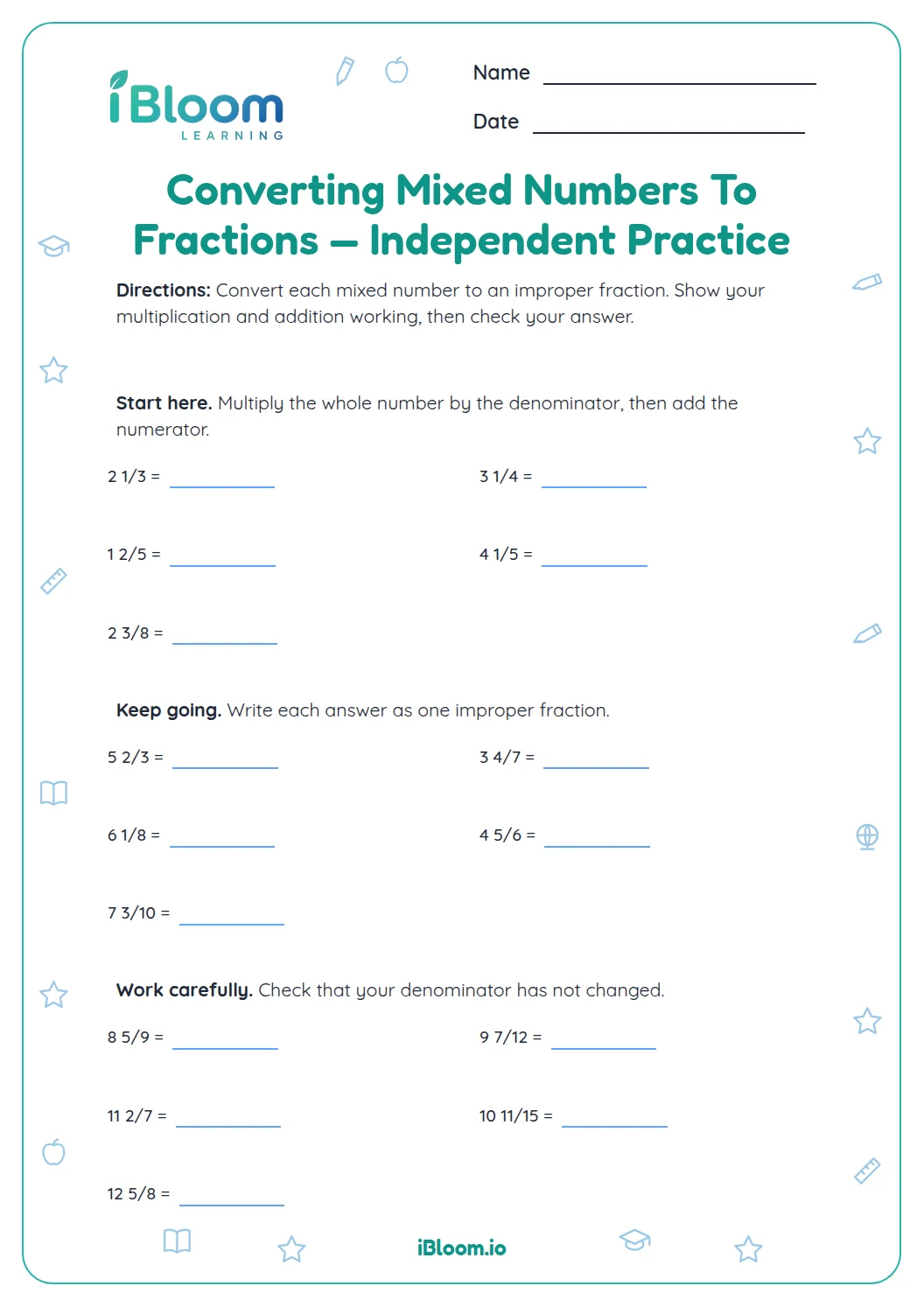
This Grade 6 independent practice sheet builds fluency converting improper fractions to mixed numbers. Six fraction bars begin the page, followed by direct conversions and a short check-your-thinking section. Each answer records the whole-number quotient and the leftover fraction. The answer key is provided separately. The work draws on the fraction-as-division idea in CCSS 6.NS.A.1.
Aligned to 5.NF.B.3
How do the bar models show an improper fraction?
Each bar is divided into equal parts. Fully shaded bars show complete wholes, and the remaining shaded pieces show the fraction left over. Count the full bars first, then name the leftover pieces using the bar’s denominator.
Question 4 has 17 sixths: two full bars use 12 sixths, leaving 5 sixths. That gives 2 5/6.
- 117 ÷ 6 = 2 remainder 5
- 22 full wholes and 5 sixths remain
- 317/6 = 2 5/6
How can division check a conversion?
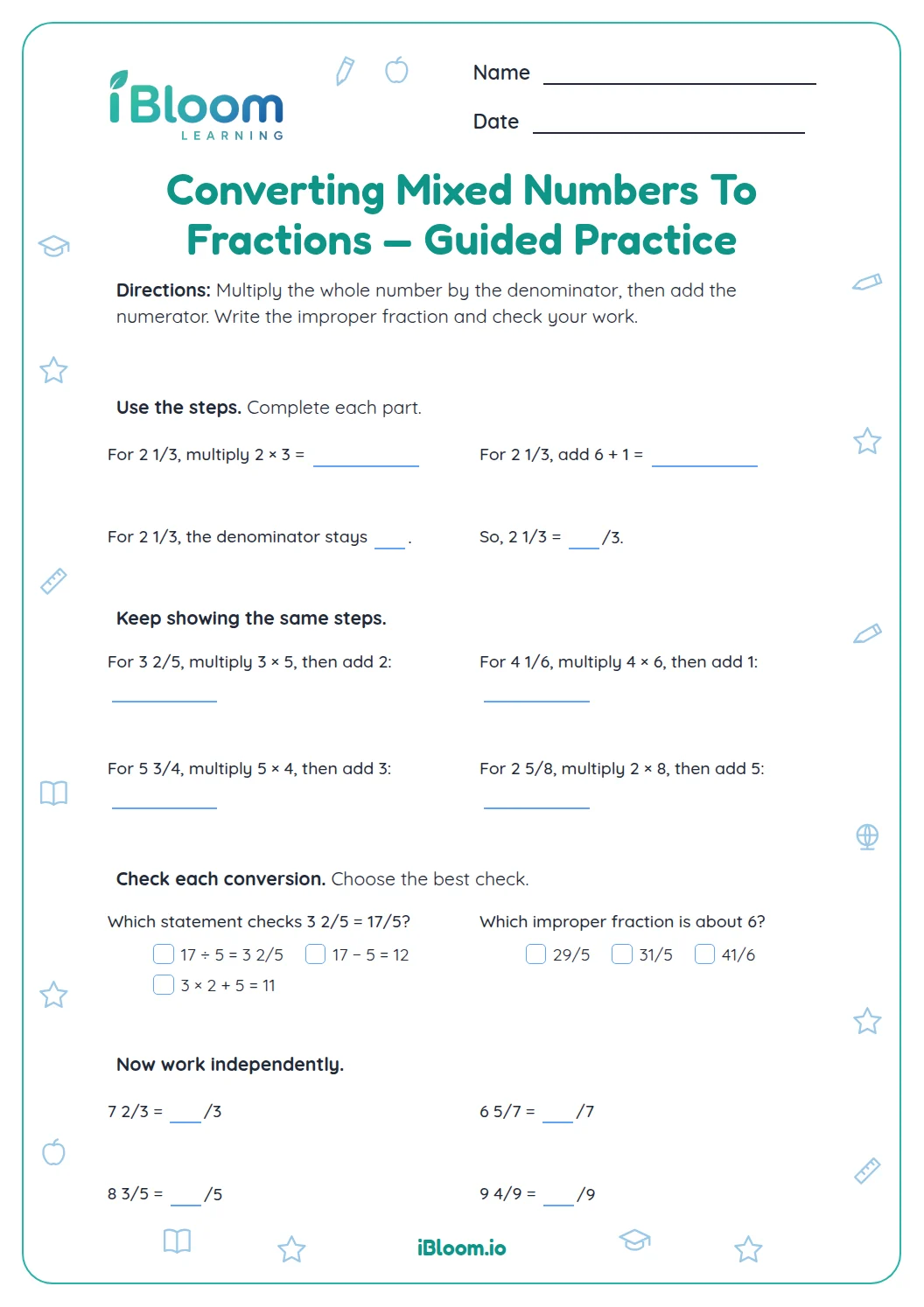
Divide the numerator by the denominator. The quotient tells how many groups fit; the remainder tells how many parts remain. Multiplying the whole number by the denominator and adding the remainder should return the original numerator.
What kinds of practice are included?
The sheet moves from pictured models to direct conversion and then equivalent-form checks. Denominators vary, so learners must read each denominator rather than assume all pieces are the same size.
- Part A: convert six bar models
- Part B: convert six written improper fractions
- Part C: check four equivalent forms
How to use this worksheet
- 1Read the denominator to identify the size of each part.
- 2Count complete groups of that size in the numerator.
- 3Write the quotient as the whole number.
- 4Write the remainder over the original denominator.
- 5Check by multiplying the whole number by the denominator and adding the numerator remainder.
Mistakes to watch for
The mistake
Using the remainder as the whole-number part.
The fix
Write the quotient first, then the remainder as the fraction numerator.
The mistake
Changing the denominator when converting.
The fix
Keep the denominator because the leftover pieces retain their size.
The mistake
Writing a fraction part equal to one whole, such as 3 4/4.
The fix
If the numerator remainder equals the denominator, regroup one more whole.
Common Core alignment
The worksheet connects fraction notation with division and visual fraction models.
Interpret a fraction as division of its numerator by its denominator.
On this sheet: Each improper fraction is divided into whole groups and a leftover fractional part.
Show the official wordingHide the official wording
Interpret a fraction as division of the numerator by the denominator (a/b = a ÷ b). Solve word problems involving division of whole numbers leading to answers in the form of fractions or mixed numbers, e.g., by using visual fraction models or equations to represent the problem.
What to practice next
Make more practice
Further reading
Questions parents and teachers ask
What does the remainder become?
The remainder becomes the numerator of the leftover fraction, and the original denominator stays the same. For 17/6, division gives 2 remainder 5, so the mixed number is 2 5/6. The whole-number quotient tells how many complete wholes fit.
How can the bar drawings help?
Each full bar represents one whole made from equal parts. Shaded parts beyond the full bars show the remainder. Count those leftover parts for the numerator, and use the number of equal divisions in each whole as the denominator.
Should the fraction part be simplified?
Keep the original denominator when you write the remainder fraction. For example, 20/6 is 3 2/6. That fractional part can be simplified to 1/3, but 3 2/6 shows the remainder directly and matches the conversion method on this page.
How can I check a mixed number?
Multiply the whole number by the denominator, then add the numerator. For 2 5/6, calculate 2 × 6 + 5 = 17, so it converts back to 17/6. This check confirms both the whole-number quotient and the leftover fraction.
What is included in the answer key?
The separate answer key gives the mixed number for each pictured and written improper fraction, plus the equivalent forms in the final section. Try each conversion first, then use the key to check the quotient, remainder, and equivalent choice.