







About this worksheet
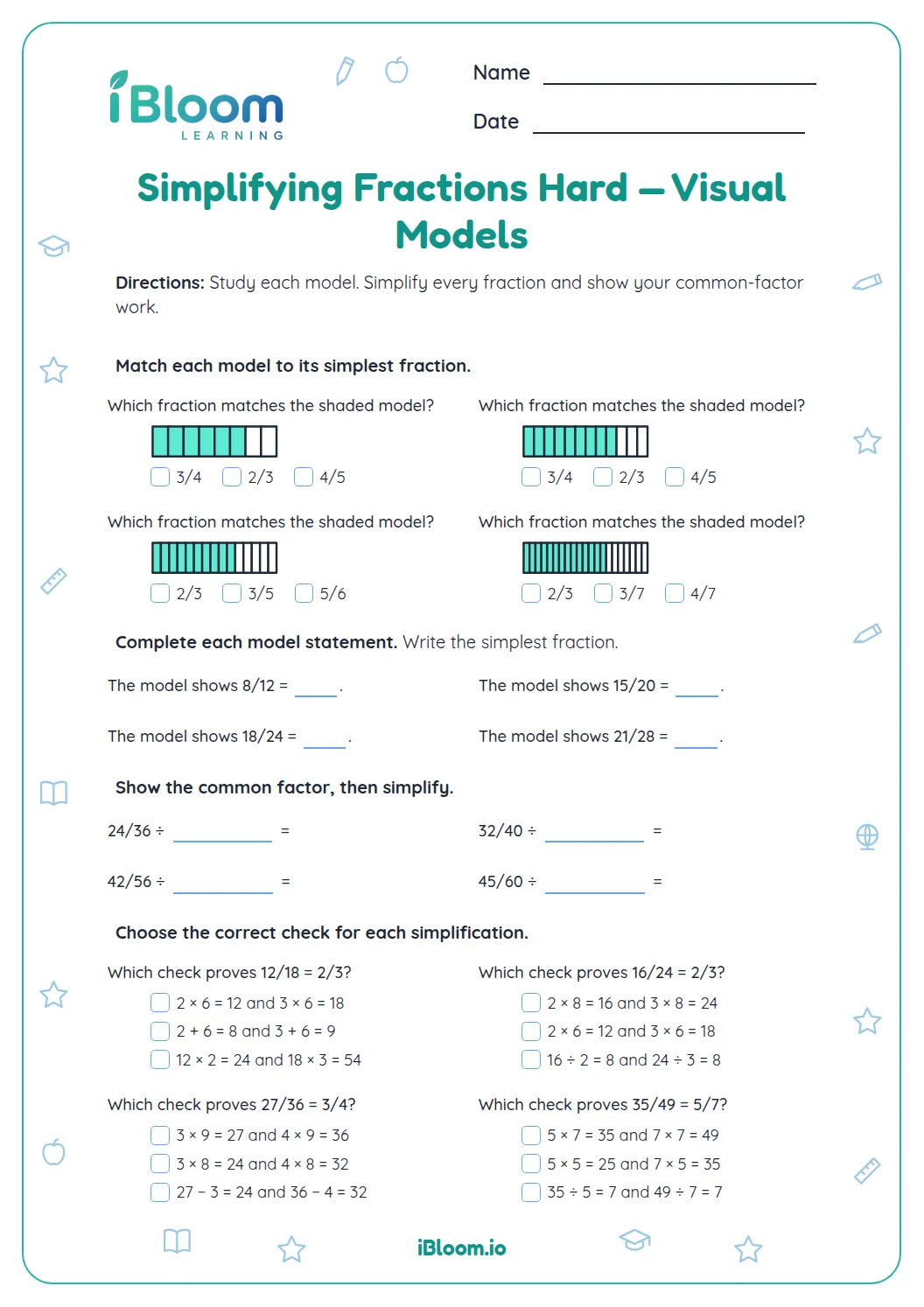
This introductory worksheet connects shaded fraction bars to equivalent fractions, then builds toward reducing fractions numerically. Students divide numerator and denominator by the same factor and check whether a fraction is fully reduced. The visual items and reduction practice focus on recognizing and generating equivalent fractions.
Aligned to 4.NF.A.1
Simplifying keeps the fraction’s value
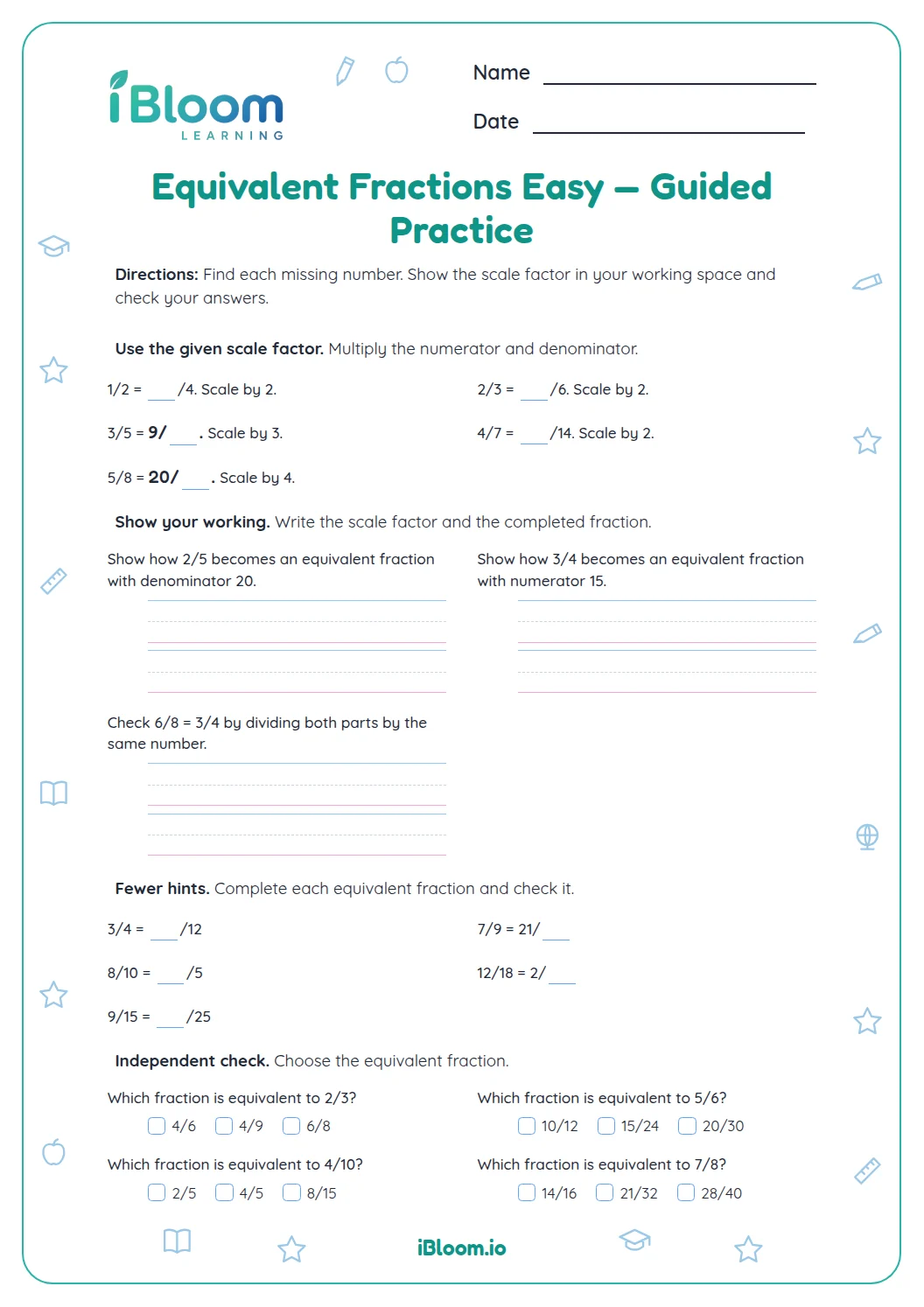
Equivalent fractions name the same amount with different numbers of parts. For example, 4/8 and 1/2 cover the same amount.
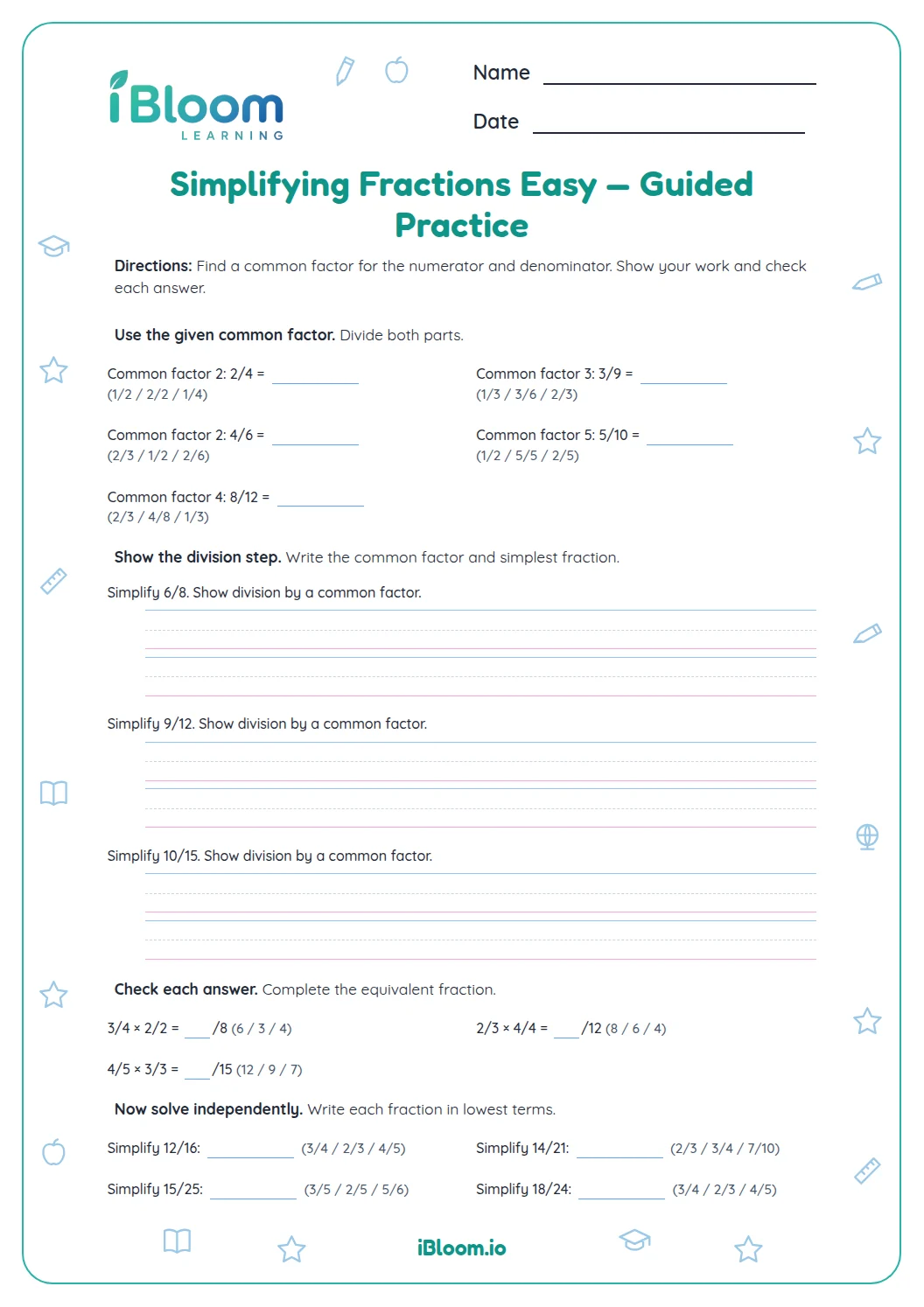
To simplify, divide numerator and denominator by the same common factor. For 12/18, divide both terms by 6 to get 2/3. Dividing only one term changes the value; stopping at 6/9 does not reach simplest form.
Move from models to factors
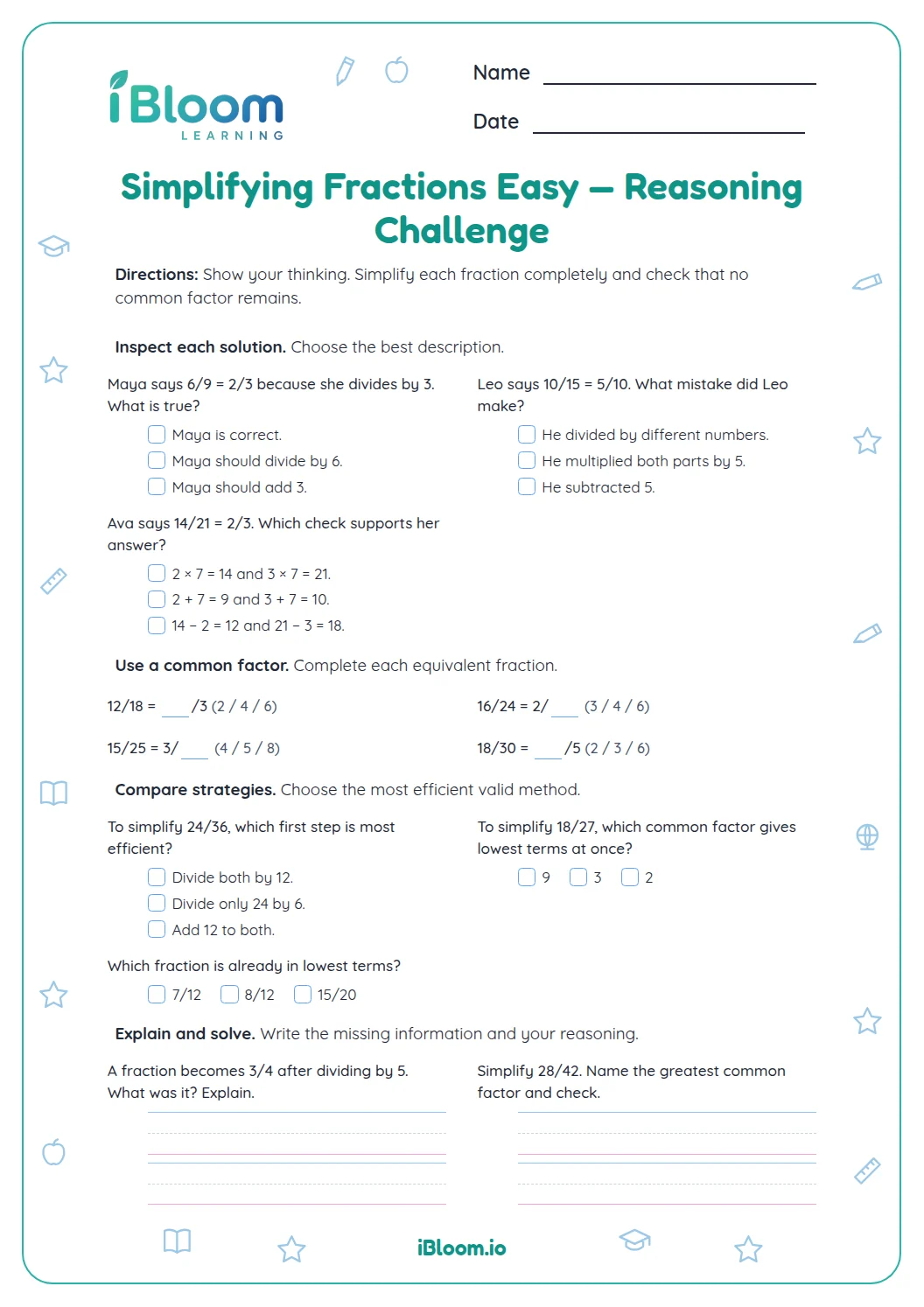
Part A names shaded amounts in simplest form. Part B reduces fractions directly. Part C checks whether a fraction is fully simplified and whether both terms were changed correctly.
- Connect shaded parts to simplest form
- Divide both terms by a common factor
- Check for a shared factor greater than 1
Know when a fraction is finished
A fraction is in simplest form when the numerator and denominator have no shared factor greater than 1. If both are even, try dividing by 2, then check again.
How to use this worksheet
- 1Read each bar model and compare shaded parts with the whole.
- 2Find a factor that divides numerator and denominator evenly.
- 3Divide top and bottom by the same factor.
- 4Check whether the new terms still share a factor greater than 1.
Common mistakes and quick fixes
The mistake
Dividing only the numerator.
The fix
Use the same factor on both terms to keep the value.
The mistake
Stopping at 6/9 when simplifying 12/18.
The fix
Both 6 and 9 divide by 3, so reduce again to 2/3.
The mistake
Subtracting the same number from top and bottom.
The fix
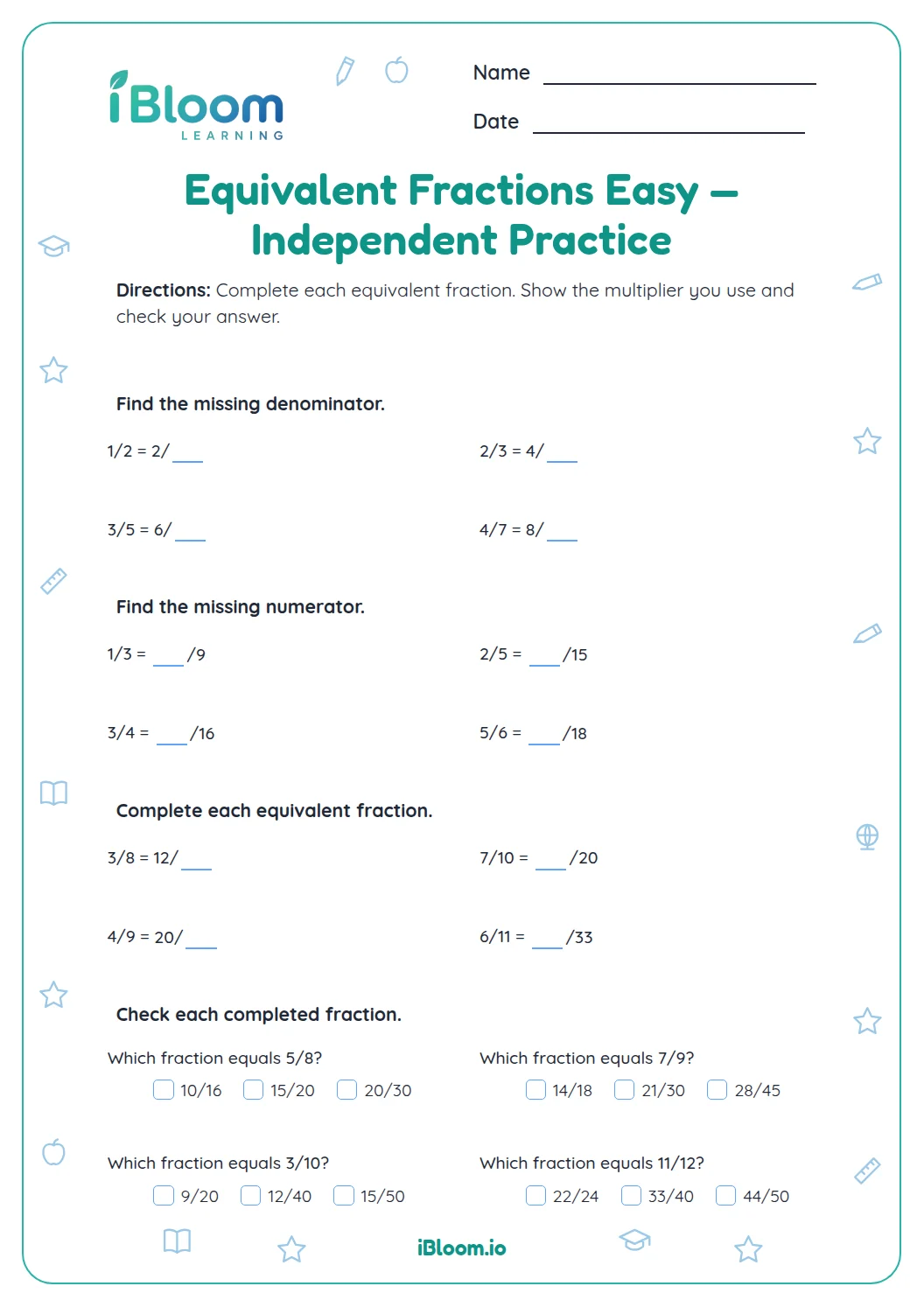
Equivalent fractions come from multiplying or dividing both terms by the same factor.
Common Core alignment
Students use fraction models and equivalent fractions to explain and practice simplification.
Students use shaded fraction bars and divide both terms by a common factor to make equivalent fractions.
On this sheet:
Show the official wordingHide the official wording
Explain why a fraction a/b is equivalent to a fraction (n × a)/(n × b) by using visual fraction models, with attention to how the number and size of the parts differ even though the two fractions themselves are the same size. Use this principle to recognize and generate equivalent fractions.
What to practice next
Make more practice
Further reading
Questions parents and teachers ask
What does simplest form mean?
A fraction is in simplest form when its numerator and denominator have no common factor greater than 1. For instance, 4/8 can be reduced because 4 and 8 are both divisible by 4. Their quotient, 1/2, names the same amount and cannot be reduced further.
Why divide both terms by the same number?
Dividing both terms by the same factor preserves the fraction’s value. If only the numerator or only the denominator changes, the fraction usually names a different amount. Visual models help show why 4/8 and 1/2 cover the same part of a whole.
Is 6/9 simplified?
No. The numerator 6 and denominator 9 share the factor 3. Divide both terms by 3 to get 2/3. Since 2 and 3 have no common factor greater than 1, 2/3 is now in simplest form. A quick factor check confirms it.
Can a fraction already be simplest?
Yes. A fraction may already be reduced. For 7/9, the numerator and denominator have no shared factor greater than 1, so there is no whole-number factor that divides both terms evenly. The fraction is already in simplest form and needs no further change.
What do the shaded bars show?
The shaded bars represent the numerator’s number of equal parts out of the denominator’s total parts. Students identify that amount, then write an equivalent fraction in simplest form. For example, four shaded parts out of eight equal parts simplify to one half.
Is an answer key included?
Yes. The answer key lists the simplest form for each model and number fraction, along with the correct reasoning choices. When reviewing, ask which common factor was used and whether it divides both the numerator and denominator without a remainder.