








About this worksheet
This Grade 6 worksheet practices simplifying fractions from everyday quantities and from number problems. Students identify a part and its whole, reduce both terms by a common factor, and check that the result is in simplest form. Fifteen questions move from beads, a trail, a recipe, and other contexts to direct fraction practice. A separate answer key is included.
Aligned to 6.NS.B.4
How do you simplify a fraction?
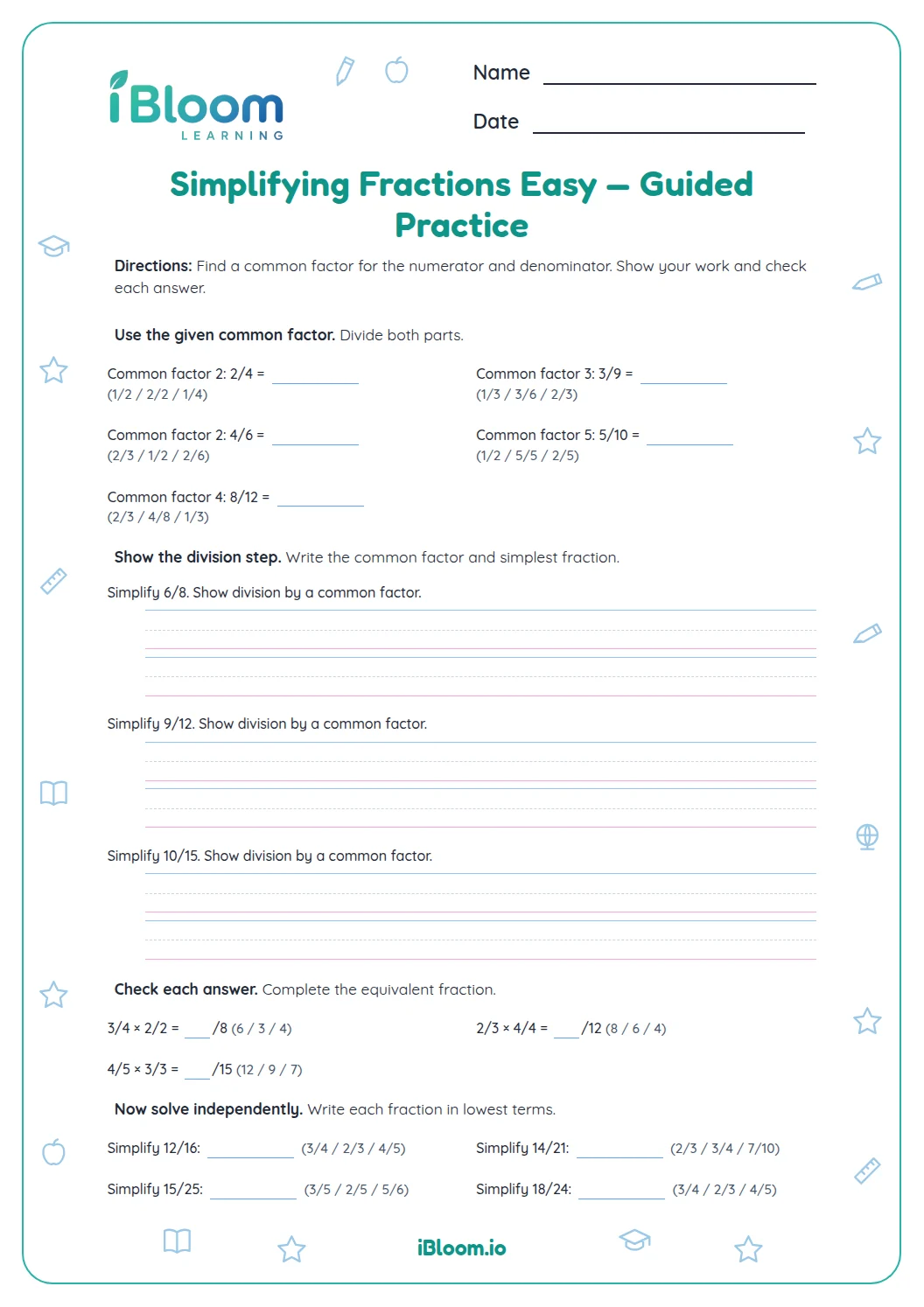
A fraction stays the same size when its numerator and denominator are divided by the same nonzero number. Continue until no common factor greater than 1 remains.
For question 1, 18 of 42 beads are red, so write 18/42. Divide both terms by 6 to get 3/7.
- 118 red beads out of 42 total: 18/42
- 218 ÷ 6 = 3 and 42 ÷ 6 = 7
- 3Simplest form: 3/7
How can you find a useful common factor?
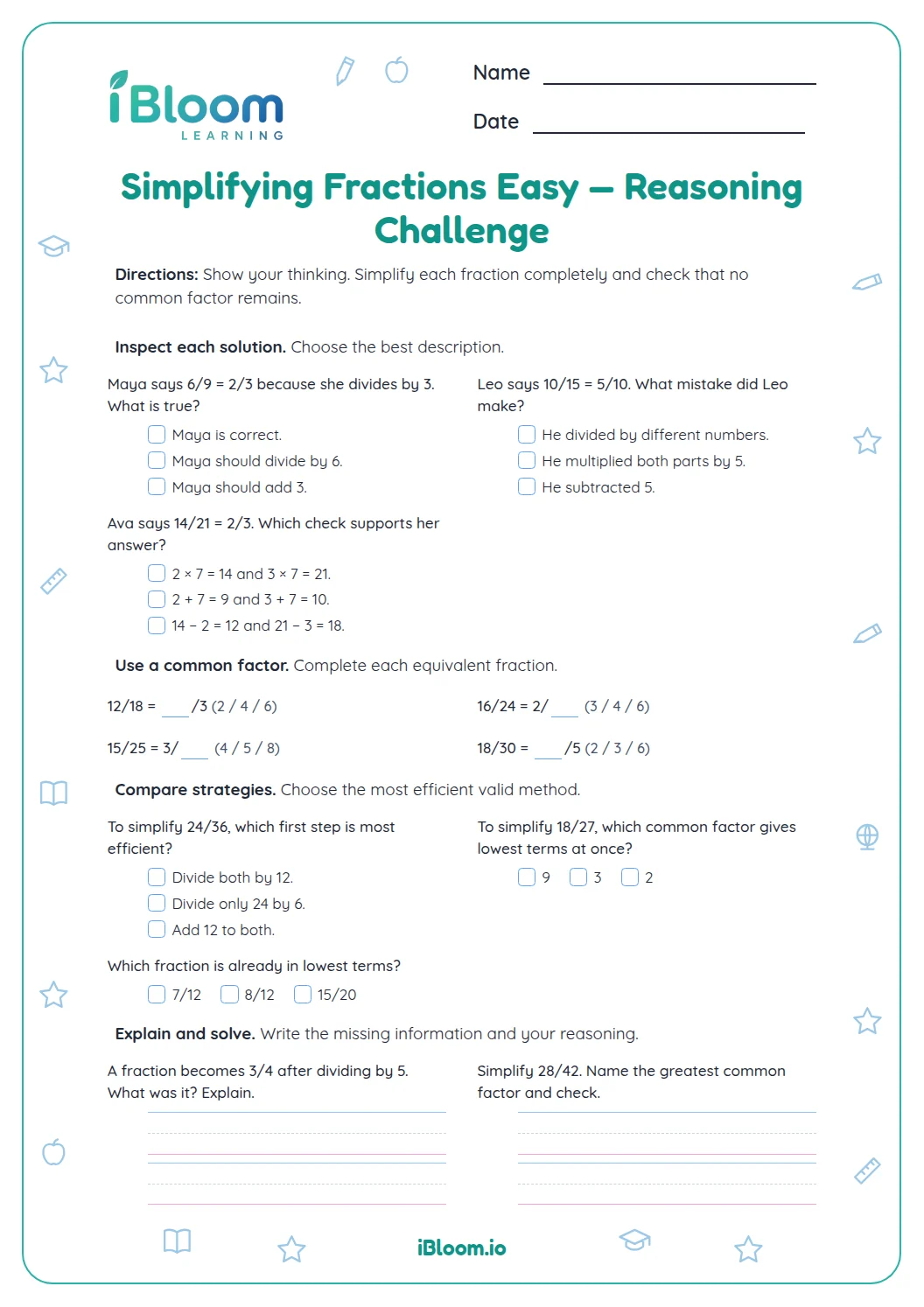
List factors of both terms or notice a shared factor. A large common factor gets you to simplest form in one step; smaller shared factors also work if you repeat the process.
What kinds of problems are included?
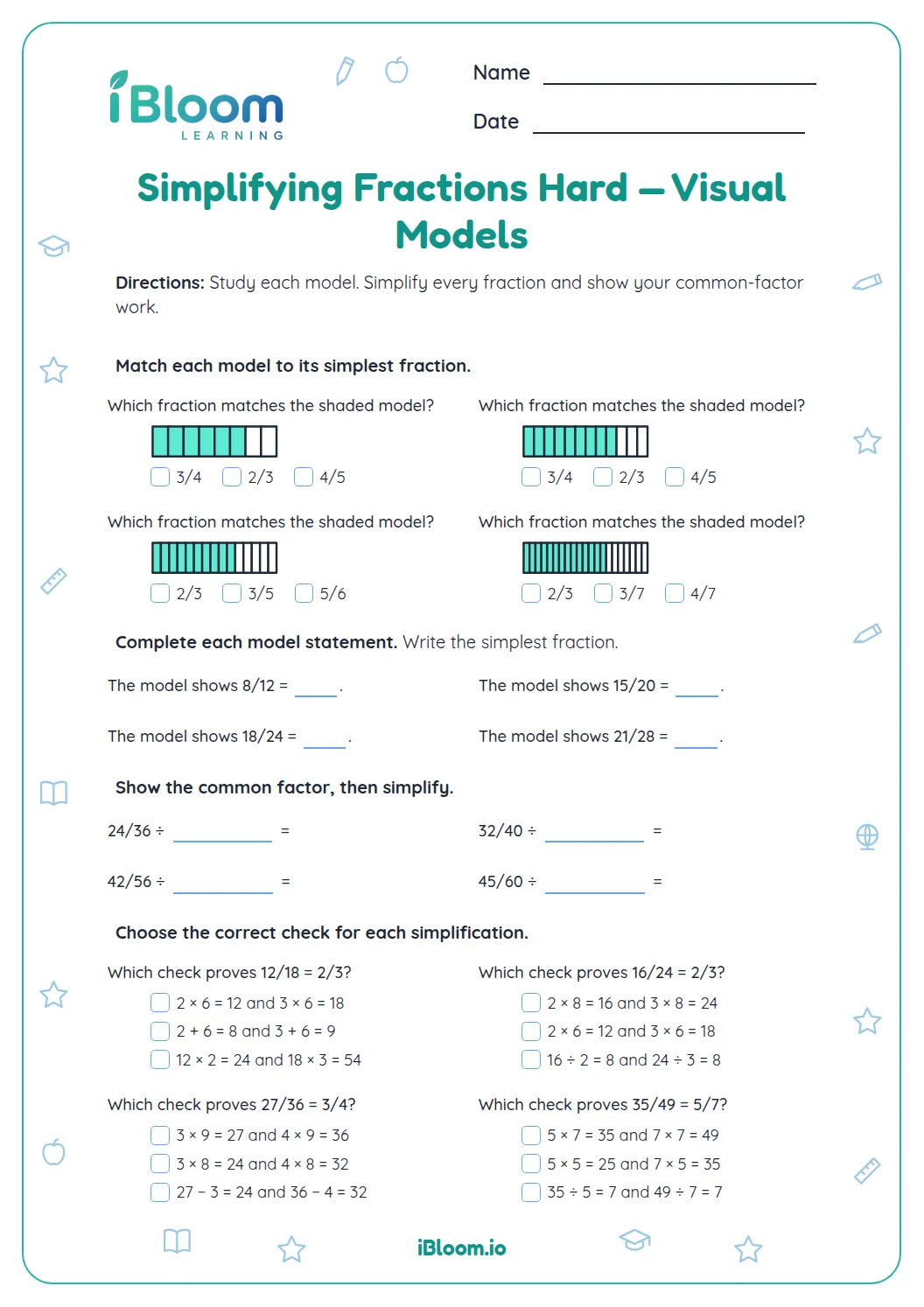
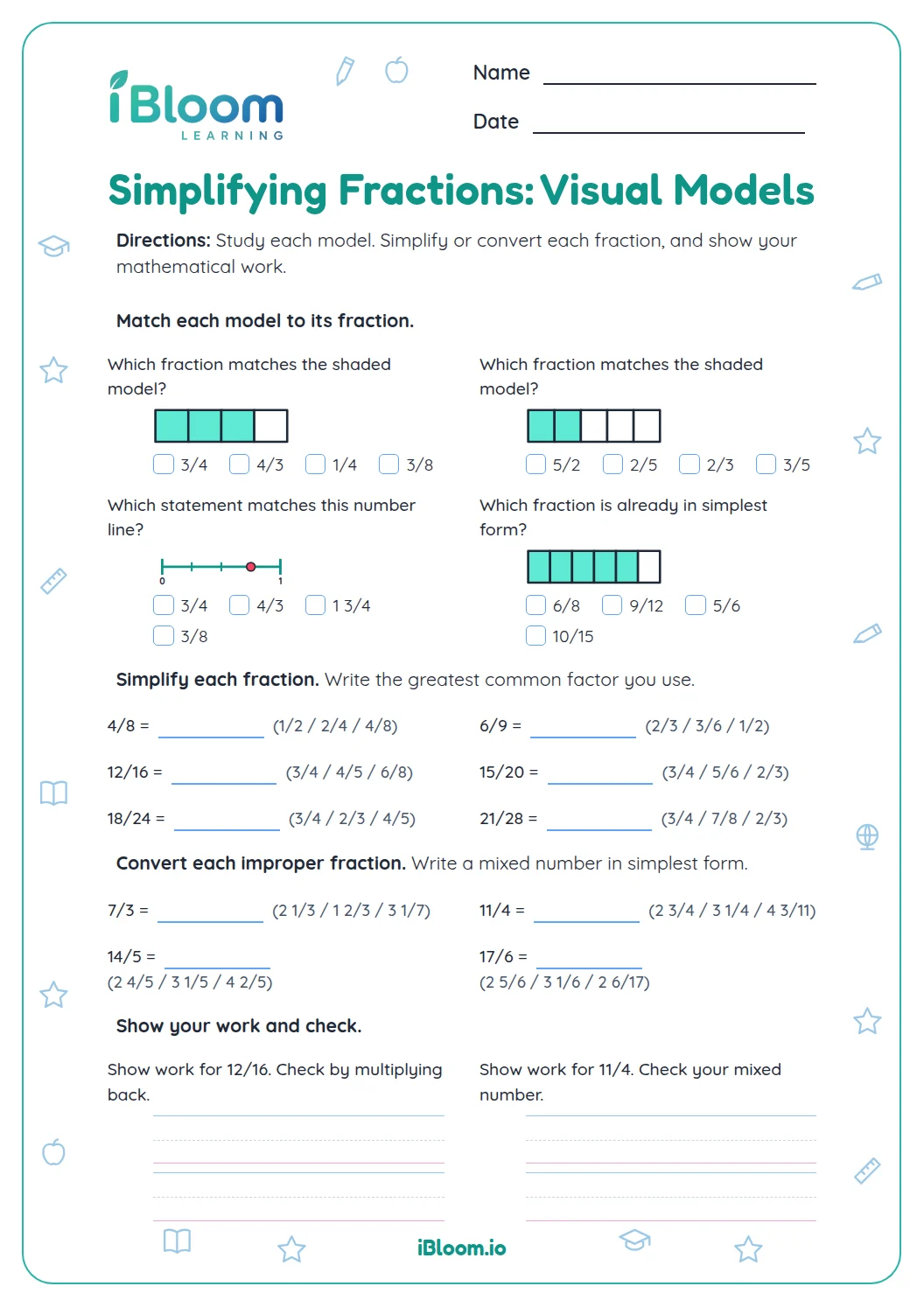
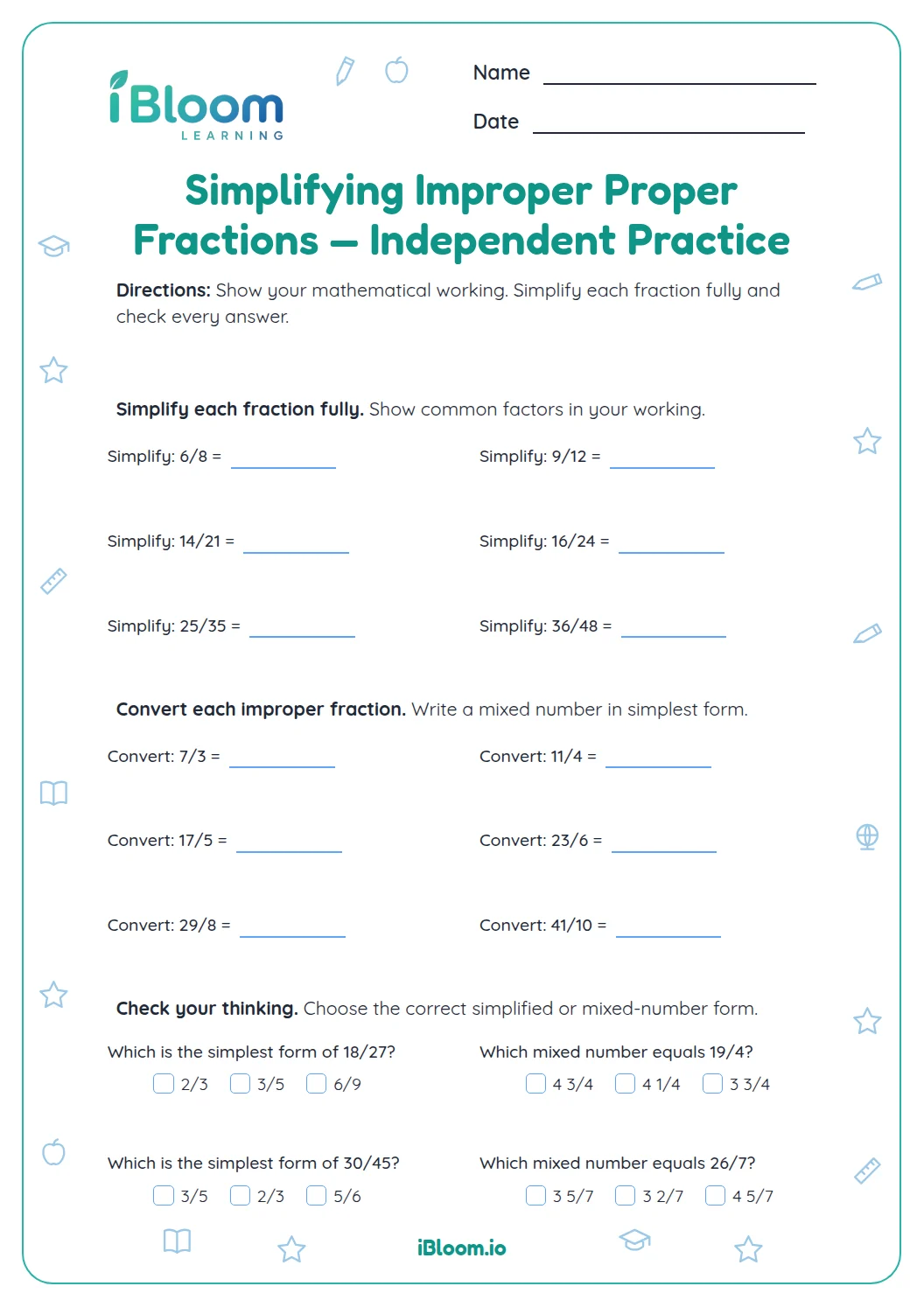
Part A builds and reduces fractions from real situations. Part B reduces fractions with common factors. Part C checks simplest form and applies the same reasoning to another part-whole situation.
How to work through the page
- 1Name the part and the whole before writing a fraction.
- 2Check that the numerator is the part and the denominator is the total.
- 3Find a number that divides both terms evenly.
- 4Divide top and bottom by that same number.
- 5Check that the reduced terms share no factor greater than 1.
Common mistakes and quick fixes
The mistake
Dividing only the numerator.
The fix
Use the same divisor on top and bottom to preserve the fraction’s value.
The mistake
Using the part as the denominator.
The fix
Count the entire set for the denominator.
The mistake
Stopping at an equivalent fraction that can still reduce.
The fix
Check whether numerator and denominator have another common factor.
Common Core alignment
This practice connects equivalent fractions with greatest common factors.
Use common factors to rewrite fractions in equivalent simplest form.
On this sheet: Students simplify fractions by using common factors of the numerator and denominator.
Show the official wordingHide the official wording
Find the greatest common factor of two whole numbers less than or equal to 100 and the least common multiple of two whole numbers less than or equal to 12. Use the distributive property to express a sum of two whole numbers 1–100 with a common factor as a multiple of a sum of two whole numbers with no common factor.
What to practice next
Make more practice
Further reading
Questions parents and teachers ask
How can I tell when a fraction is in simplest form?
Check whether any whole number greater than 1 divides both terms evenly. For example, 18/24 reduces to 3/4 because 6 divides both numbers. Since 3 and 4 share no factor other than 1, 3/4 is in simplest form. This check works for any fraction on the sheet.
What belongs in the denominator of a real-world fraction?
The denominator is the whole group or amount. In question 1, 18 of 42 beads are red, so the fraction is 18/42. Reducing both terms by 6 gives 3/7. Naming the whole first helps keep the part and total in the right places.
Can I simplify a fraction in more than one step?
Yes. You can divide by any common factor and repeat until none greater than 1 remains. For example, 18/30 can be divided by 2 and then by 3 to reach 3/5. Dividing by the greatest common factor is a shorter route.
Why do I divide the numerator and denominator by the same number?
Dividing both terms by the same nonzero factor keeps the fraction’s value unchanged. For example, 18/42 and 3/7 name the same share because both terms were divided by 6. Dividing only one term would change its value, so use the same factor on top and bottom every time.
What does the answer key include?
The separate key lists simplified answers for all 15 questions, including the real-world fraction situations and the simplest-form check. Students can compare their result and check whether the same common factor was used on the numerator and denominator. The key follows the method practiced on the page.