







About this worksheet
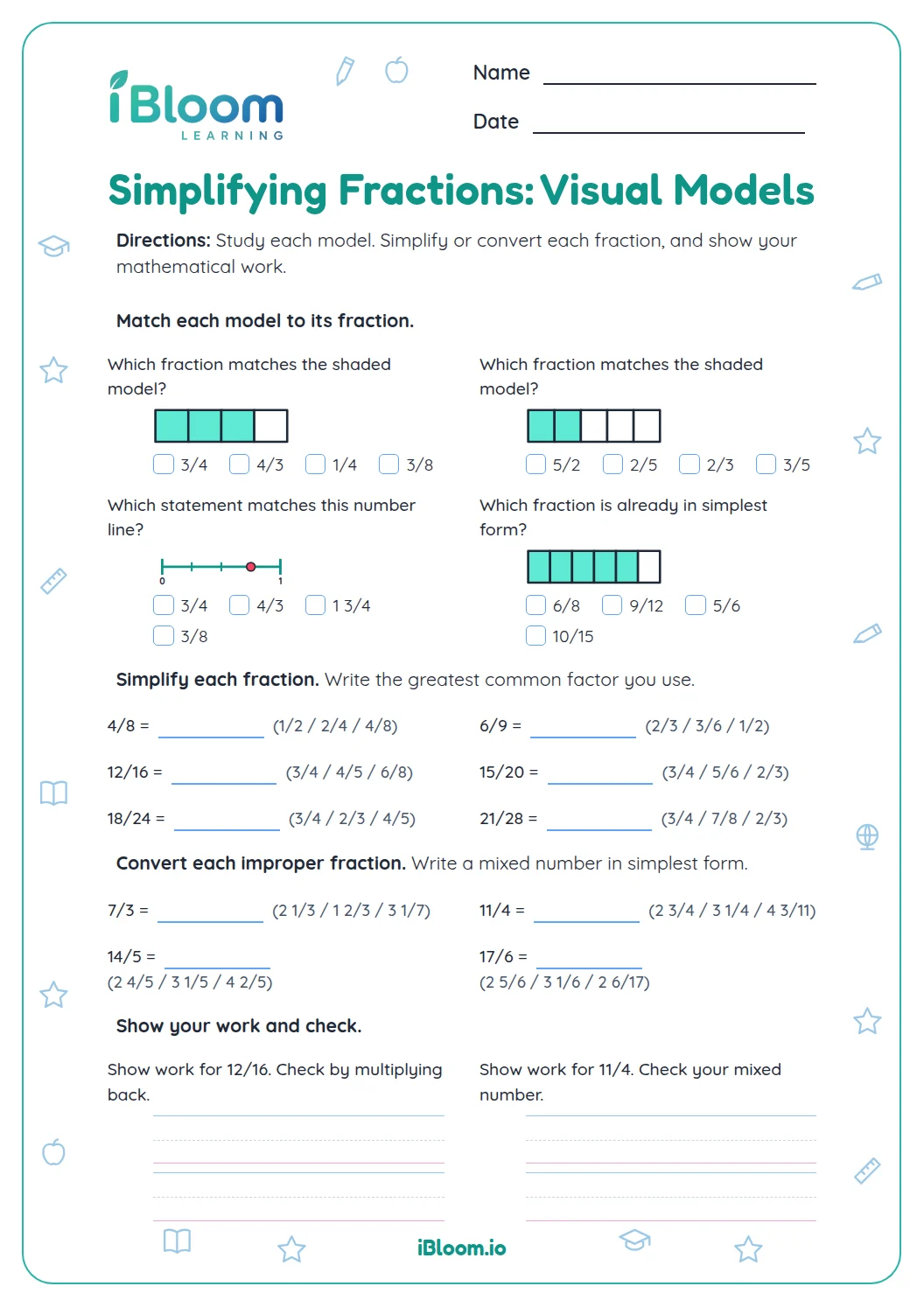
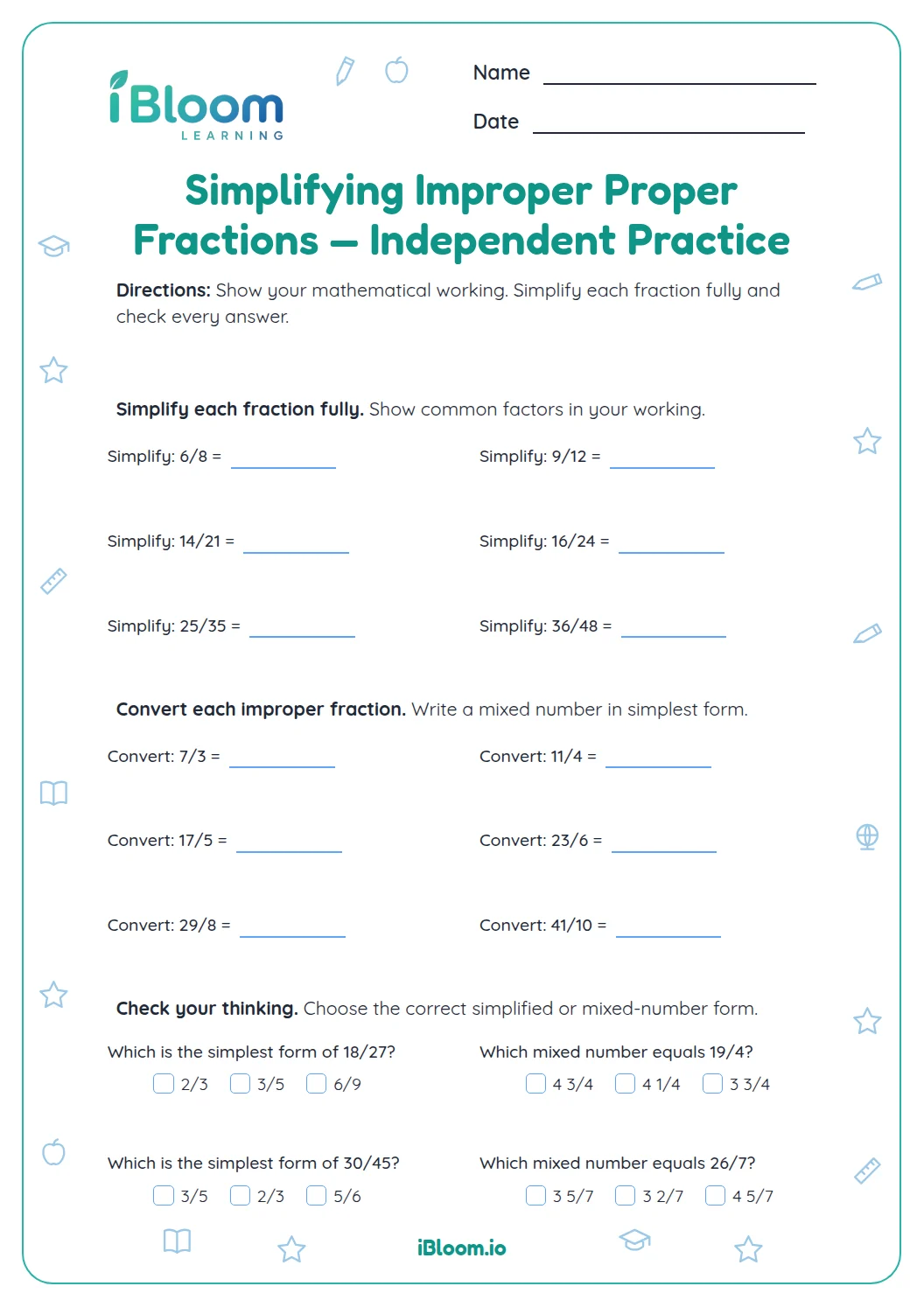
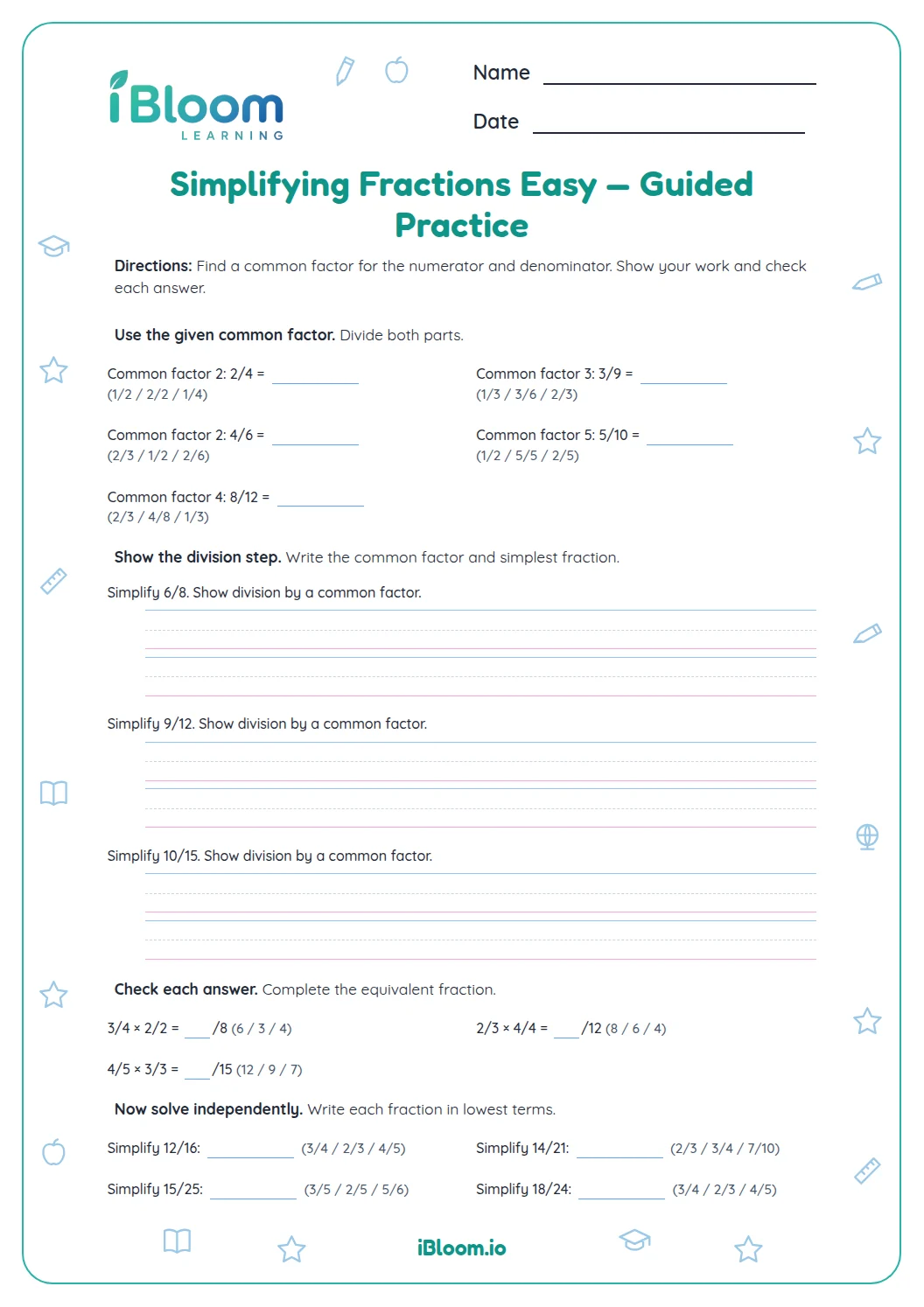
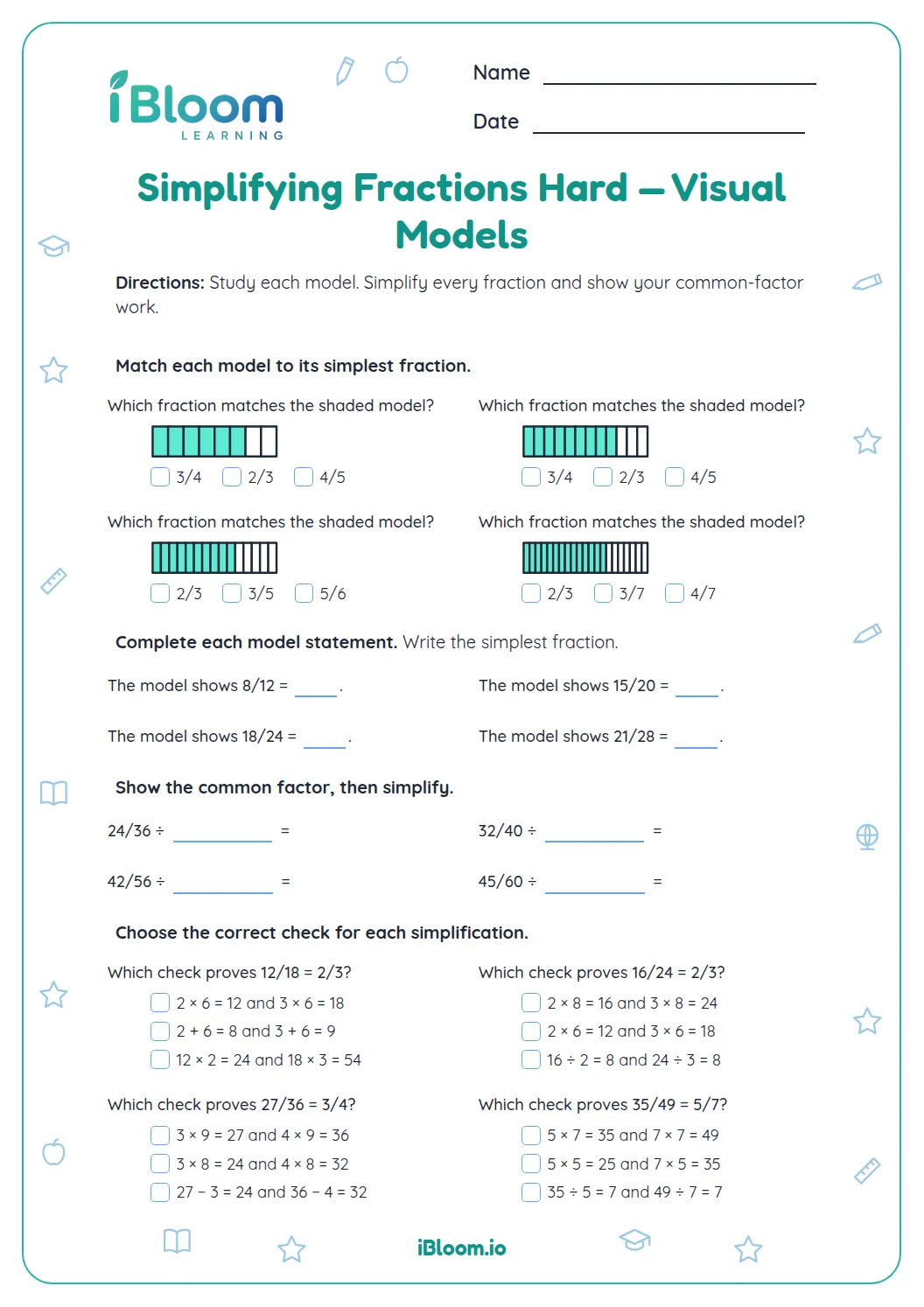
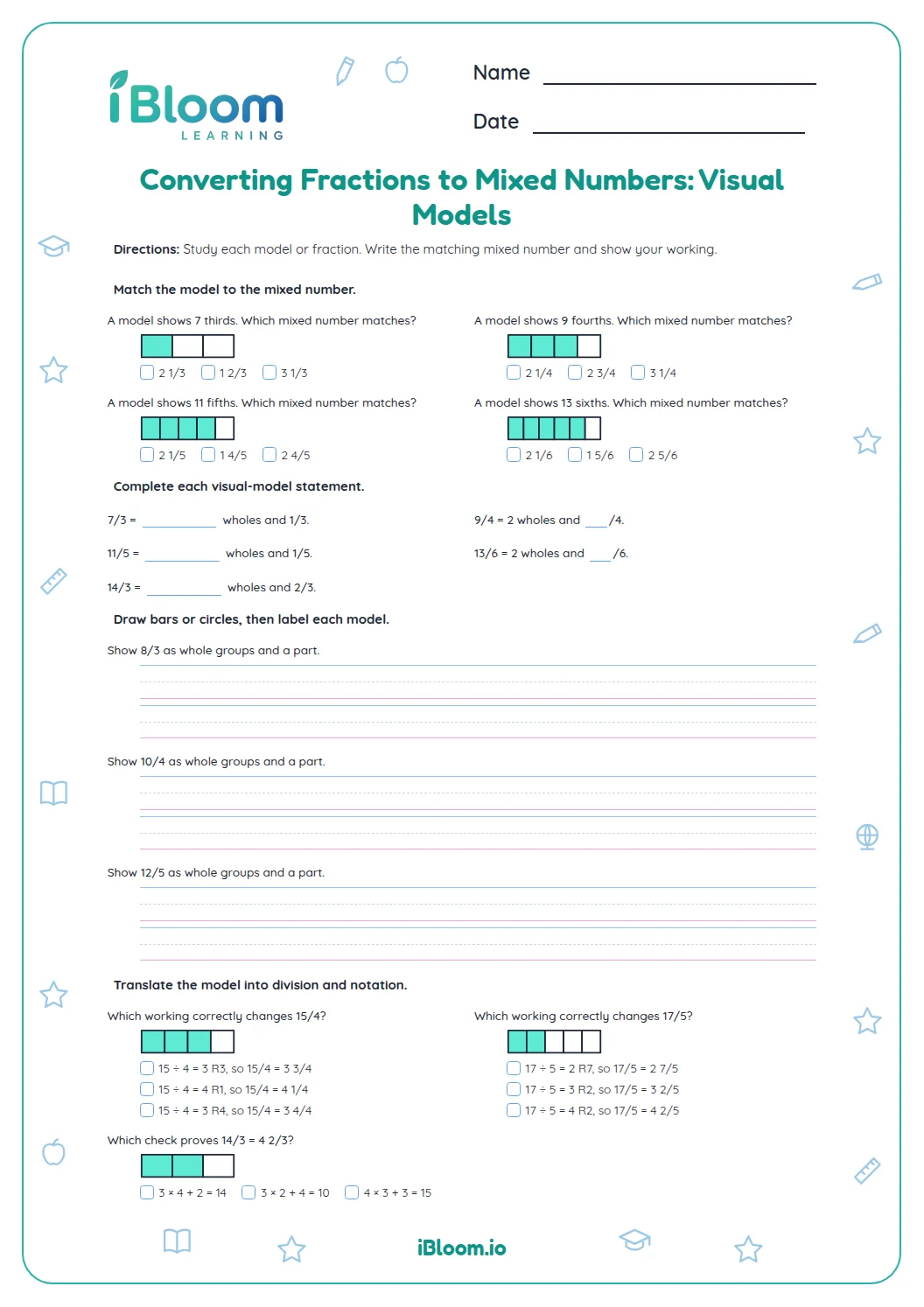
This free printable Grade 6 worksheet connects simplifying fractions to equal amounts and common factors. Students read two shaded models, find two greatest common factors, simplify eight fractions, and convert four improper fractions to mixed numbers. The examples include proper and improper fractions, plus an improper fraction equal to a whole number. The practice connects CCSS 6.NS.B.4 and 4.NF.A.1 through factor use and equivalent fractions. Four short parts move from recognizing an amount to changing its written form. A separate answer key gives all 16 answers.
Aligned to 6.NS.B.4 and 4.NF.A.1
What do the shaded bars tell us?
Part A shows 4/6 of one bar and 1 whole plus 2/4 of another bar. Students choose 2/3 and 3/2 as the simplest fraction names. The equal parts make it possible to check that simplifying keeps the amount unchanged.
For the first bar, group the six small pieces into three equal pairs. Two pairs are shaded. The pieces have new names, but the shaded area stays the same.
A proper fraction has a numerator smaller than its denominator, so its value is less than 1. An improper fraction has a numerator at least as large as its denominator. The first model is proper; the second is improper. Both use the same simplification rule.
How does a common factor simplify a fraction?
Part B asks for the greatest common factors of 12 and 18, then 16 and 24. A common factor divides both numbers evenly. Using the greatest one finishes the simplification in one step.
- 116/12 = ___
- 2The greatest common factor of 16 and 12 is 4.
- 316 ÷ 4 = 4 and 12 ÷ 4 = 3.
- 416/12 = 4/3; 4 and 3 have no common factor greater than 1.
When is an answer in simplest form?
The numerator and denominator must have no common factor greater than 1. Part C includes 18/24, which can first become 9/12, but still needs another division to reach 3/4.
Part C includes two final simplification checks. In question 11, divide 18/12 by 6 to get 3/2. Part D converts improper fractions to mixed numbers using division and the remainder; for 17/5, the result is 3 2/5.
- 117/5
- 25 goes into 17 three times, with 2 left.
- 3Write the quotient as the whole number and the remainder over the divisor.
- 417/5 = 3 2/5.
How to use this worksheet
- 1Read the first shaded bar together and group its six pieces into pairs.
- 2Ask students to identify the full bar before counting the extra fourths in question 2.
- 3List factors for one pair in Part B, then circle the greatest shared factor.
- 4In Part C, divide both numbers by the same factor and check for further common factors.
- 5For questions 13–16, divide the numerator by the denominator and write the remainder over that denominator.
Mistakes to discuss
The mistake
Dividing the numerator but leaving the denominator unchanged.
The fix
Write the divisor beside both numbers before dividing; 6/8 becomes 3/4, not 3/8.
The mistake
Stopping at 9/6 when simplifying 18/12.
The fix
Check whether 9 and 6 still share a factor. Divide both by 3 to reach 3/2.
The mistake
Subtracting 12 from both numbers in 24/36.
The fix
Simplify by dividing both by 12. Subtraction changes the amount from 2/3 to 1/2.
Common Core alignment
Find greatest common factors to choose a divisor for simplifying fractions.
On this sheet: Part B asks for greatest common factors; Part C uses common factors to simplify.
Show the official wordingHide the official wording
Find the greatest common factor of two whole numbers less than or equal to 100 and the least common multiple of two whole numbers less than or equal to 12. Use the distributive property to express a sum of two whole numbers 1-100 with a common factor as a multiple of a sum of two whole numbers with no common factor. For example, express 36 + 8 as 4 (9 + 2).
Use shaded models and equal fractions to preserve value while simplifying.
On this sheet: Part A connects shaded amounts with equivalent fractions; Parts C and D apply equivalence.
Show the official wordingHide the official wording
Explain why a fraction a/b is equivalent to a fraction (n × a)/(n × b) by using visual fraction models, with attention to how the number and size of the parts differ even though the two fractions themselves are the same size. Use this principle to recognize and generate equivalent fractions.
What to practice next
Make more practice
Further reading
Questions parents and teachers ask
Should improper answers become mixed numbers?
Use division to write an improper fraction as a mixed number. Question 13 has 7/3: 3 goes into 7 twice with 1 left, so 7/3 = 2 1/3. If there is no remainder, as with 20/5 in question 10, the answer is a whole number.
What makes a fraction simplest?
A fraction is simplest when its numerator and denominator share no factor greater than 1. In question 11, divide both 18 and 12 by 6 to get 3/2. The result is still improper, but its numerator and denominator have no shared factor beyond 1.
How can I explain the first shaded model?
Group the six equal pieces into three pairs. Four shaded pieces make two shaded pairs, so 4/6 has the same value as 2/3. Ask your child to point to each pair on the printed bar. The total bar and the shaded amount both stay the same.
Can students simplify in more than one step?
Yes, dividing by smaller common factors works when students continue until no shared factor remains. For 18/24, divide by 2 to get 9/12, then by 3 to get 3/4. Using the greatest common factor, 6, reaches that same answer in a single step.
What does the answer key help me check?
The key gives the model choices, greatest common factors, six simplified answers and two reasoning choices. Check that students preserve the fraction value and finish simplifying. If an answer is equivalent but unfinished, ask them to find one more factor rather than starting the entire problem again.