






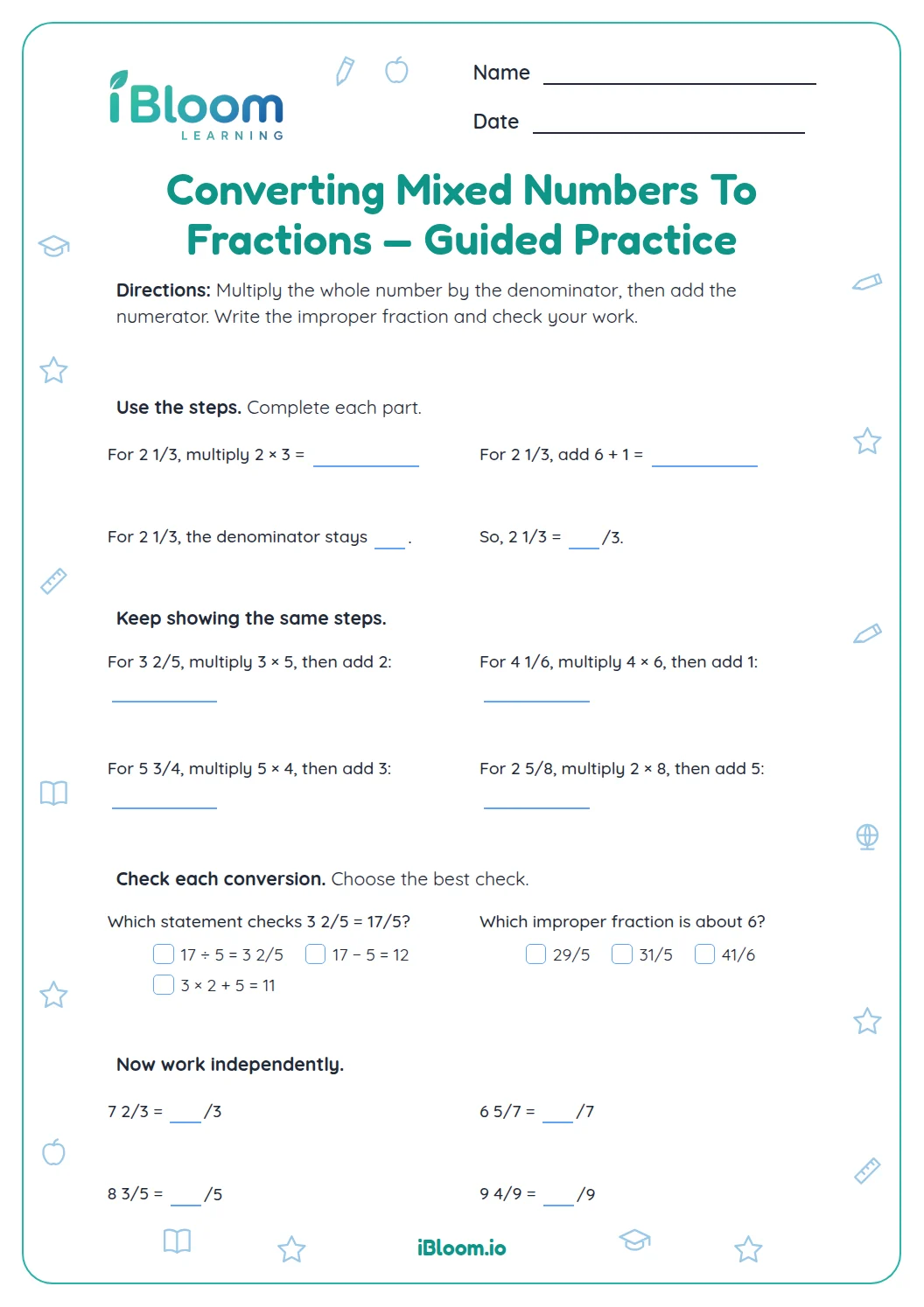

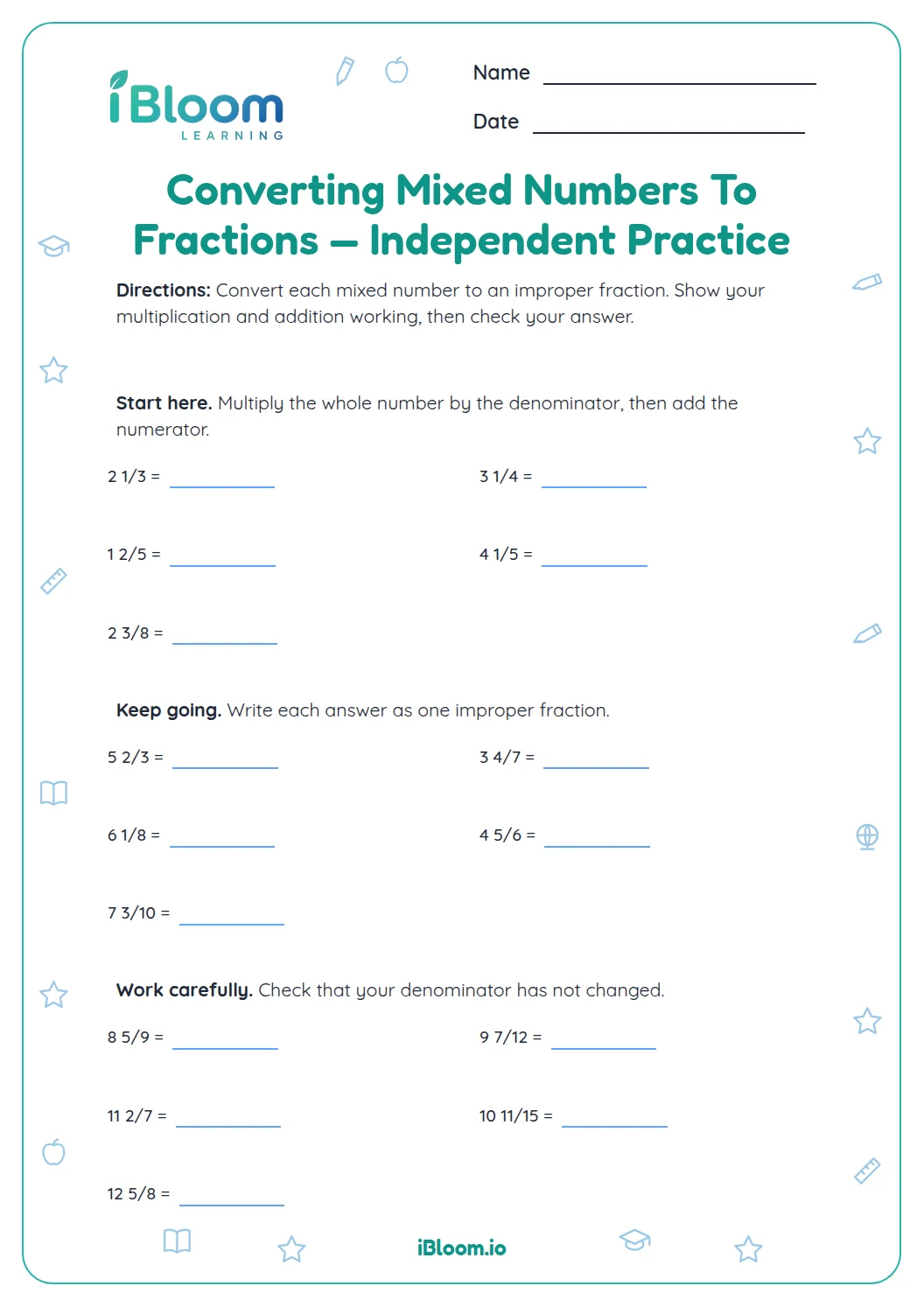
About this worksheet
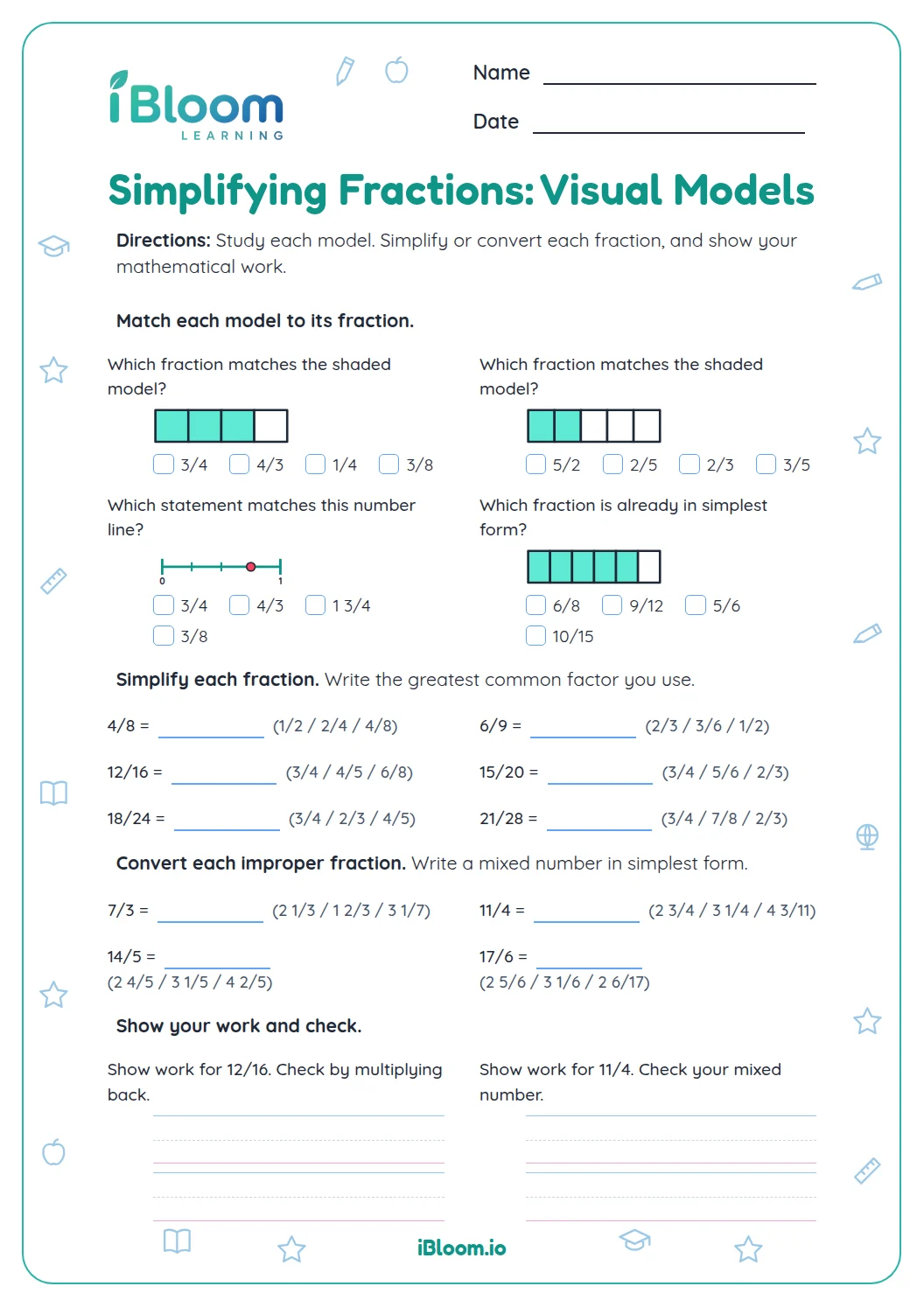
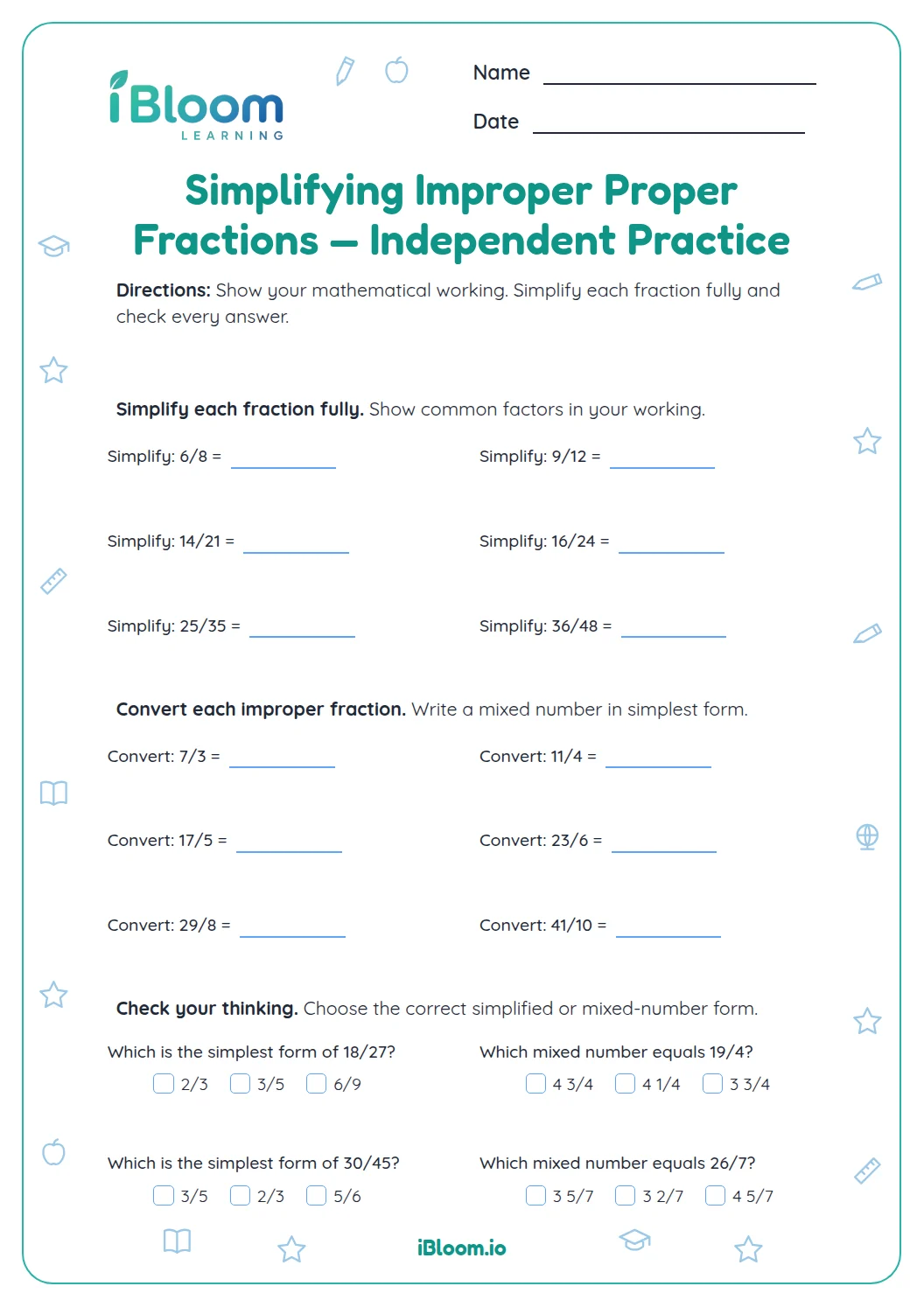
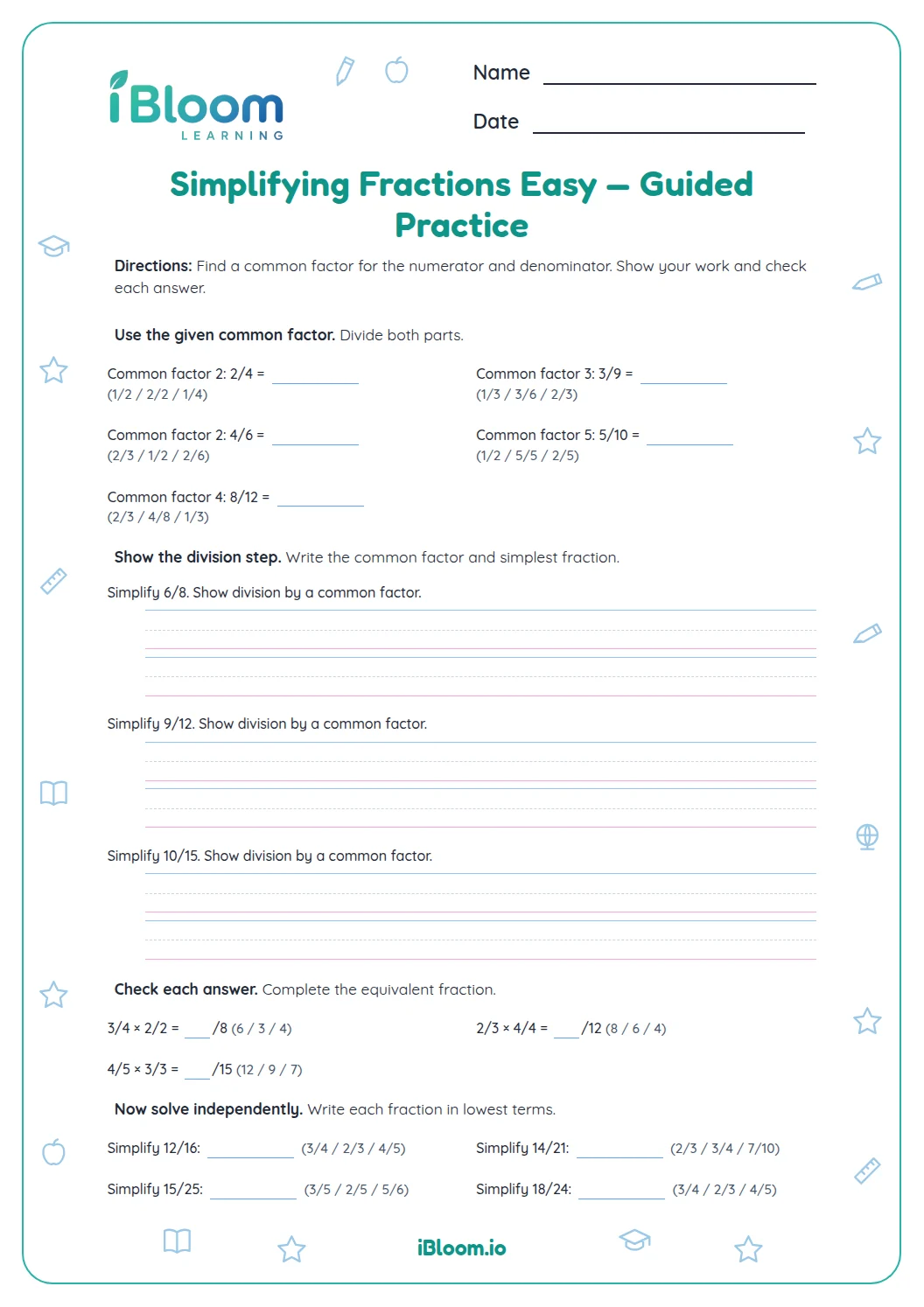
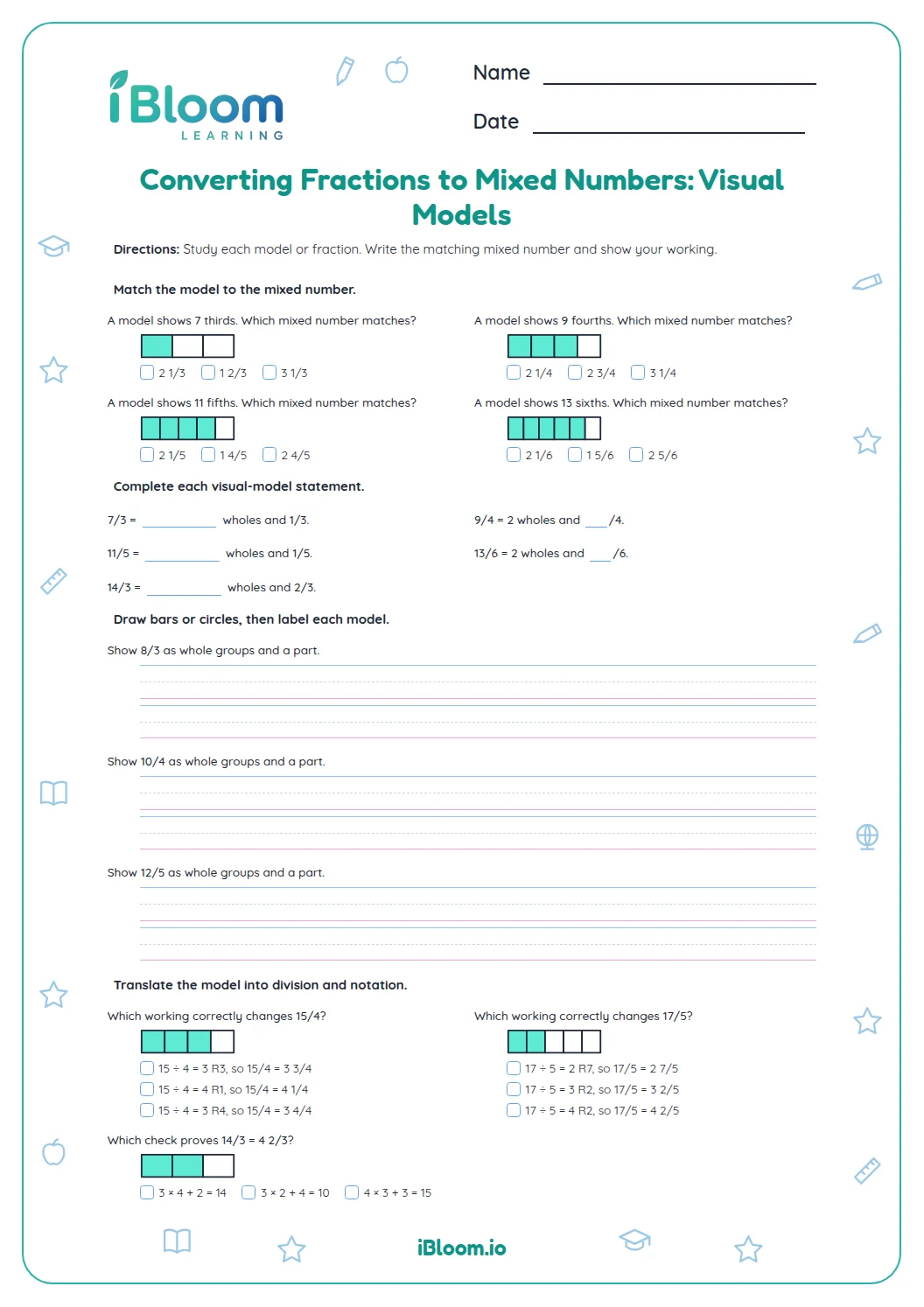
This Grade 6 printable has 6 fraction-simplification problems, 6 improper-to-mixed-number conversions, and 4 reasoning prompts. Students divide numerator and denominator by a common factor, use quotient and remainder, and reduce mixed-number parts. The separate key includes the working for open responses.
Aligned to 6.NS.B.4
How do you reduce a fraction?
Divide the numerator and denominator by the same common factor. Continue until they share no factor greater than 1. Part A practices reducing fractions this way.
- 118/24 ÷ 6/6 = 3/4.
How does an improper fraction become a mixed number?
Divide numerator by denominator. The quotient is the whole part, and the remainder is the numerator over the original denominator. Then simplify.
- 122/8 = 2 remainder 6, so 2 6/8 = 2 3/4.
How can you explain a conversion?
Show the quotient and remainder, then reduce the fractional part if needed. This makes the reasoning visible and checkable.
- 132/12 = 2 remainder 8; 8/12 reduces to 2/3.
How to use this worksheet
- 1Find a common factor of numerator and denominator.
- 2Divide both terms by the same factor.
- 3For an improper fraction, divide numerator by denominator.
- 4Use the remainder over the original denominator.
- 5Reduce the fractional part and check by converting back.
Common mistakes and quick fixes
The mistake
Dividing only the numerator while simplifying.
The fix
Divide the numerator and denominator by the same common factor.
The mistake
Using the denominator instead of the remainder.
The fix
The remainder becomes the new numerator over the original denominator.
The mistake
Leaving a mixed number’s fractional part unreduced.
The fix
Reduce the fractional part until its numerator and denominator have no common factor greater than 1.
Curriculum alignment
This page practices the skill described in the listed standard.
Use common factors to reduce numerator and denominator together.
On this sheet: Use common factors to reduce numerator and denominator together.
Show the official wordingHide the official wording
Find the greatest common factor of two whole numbers less than or equal to 100 and the least common multiple of two whole numbers less than or equal to 12. Use the distributive property to express a sum of two whole numbers 1-100 with a common factor as a multiple of a sum of two whole numbers with no common factor. For example, express 36 + 8 as 4 (9 + 2).
What to practice next
Make more practice
Further reading
Questions parents and teachers ask
What does lowest terms mean?
A fraction is in lowest terms when its numerator and denominator share no factor greater than 1. For example, 18/24 reduces to 3/4 by dividing both terms by 6. Part A asks students to continue until no common factor remains.
How do you convert an improper fraction?
Divide the numerator by the denominator. The quotient is the whole part and the remainder becomes the numerator over the original denominator. Then reduce that fractional part. For 22/8, the result is 2 6/8, or 2 3/4. This sequence keeps the denominator tied to the original fraction.
Why simplify after converting?
The fractional part may still have a common factor. Reducing it gives a mixed number in lowest terms, as requested in Part B. For example, 6/8 reduces to 3/4, so 22/8 becomes 2 3/4. Ask the child to point to the exact word or phrase in the sentence that supports the answer before checking the key.
What should a reasoning answer include?
Show the operation supporting the answer. A simplification should name a common factor and divide both terms. A conversion should show quotient and remainder, followed by the mixed number. Ask the child to point to the exact word or phrase in the sentence that supports the answer before checking the key.
How can I check a mixed number?
Multiply its whole part by the denominator and add the numerator. For 2 3/4, that gives 2 × 4 + 3 = 11, so the mixed number represents 11/4. This checks the quotient and remainder. Ask the child to point to the exact word or phrase in the sentence that supports the answer before checking the key.