




About this worksheet
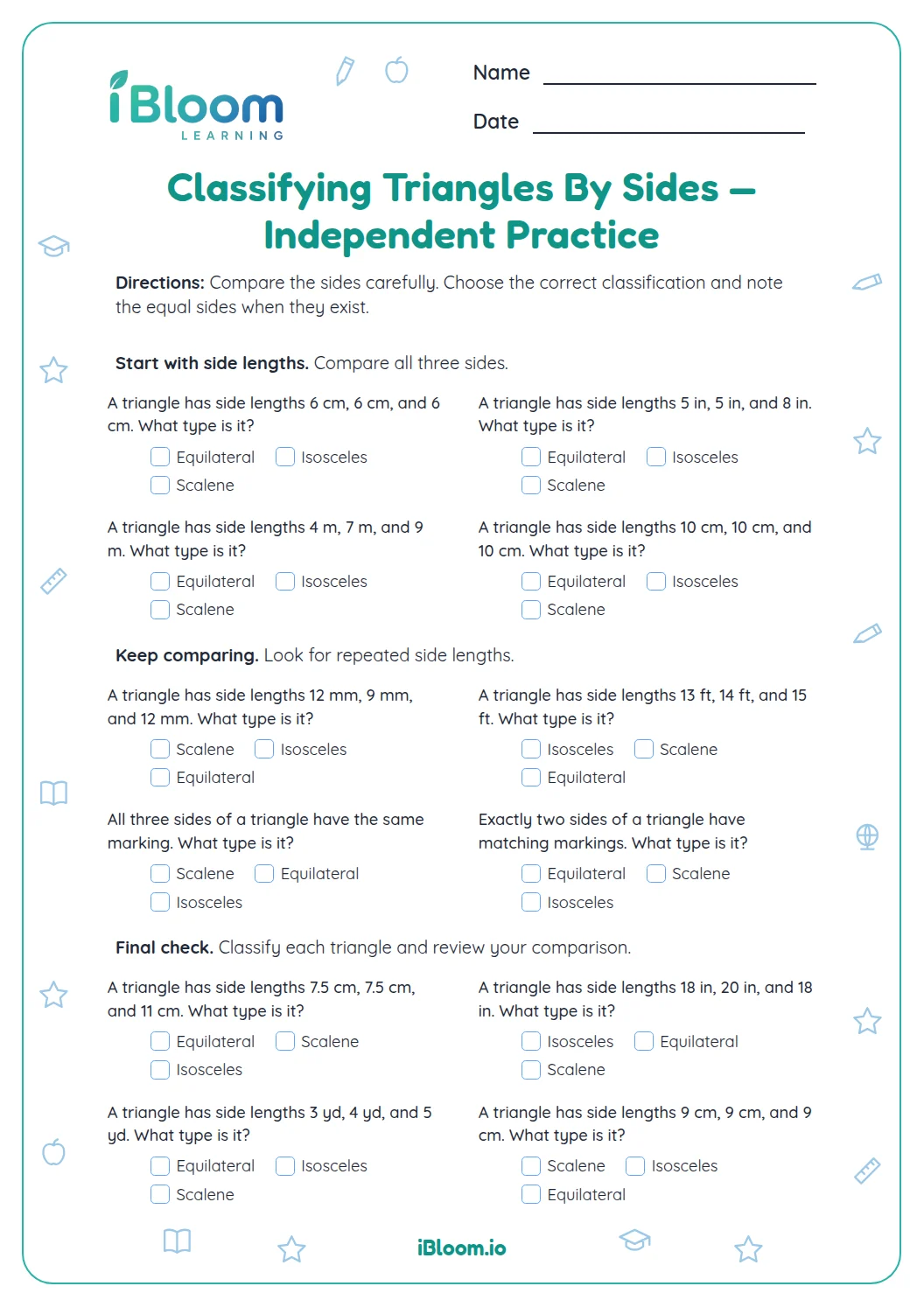
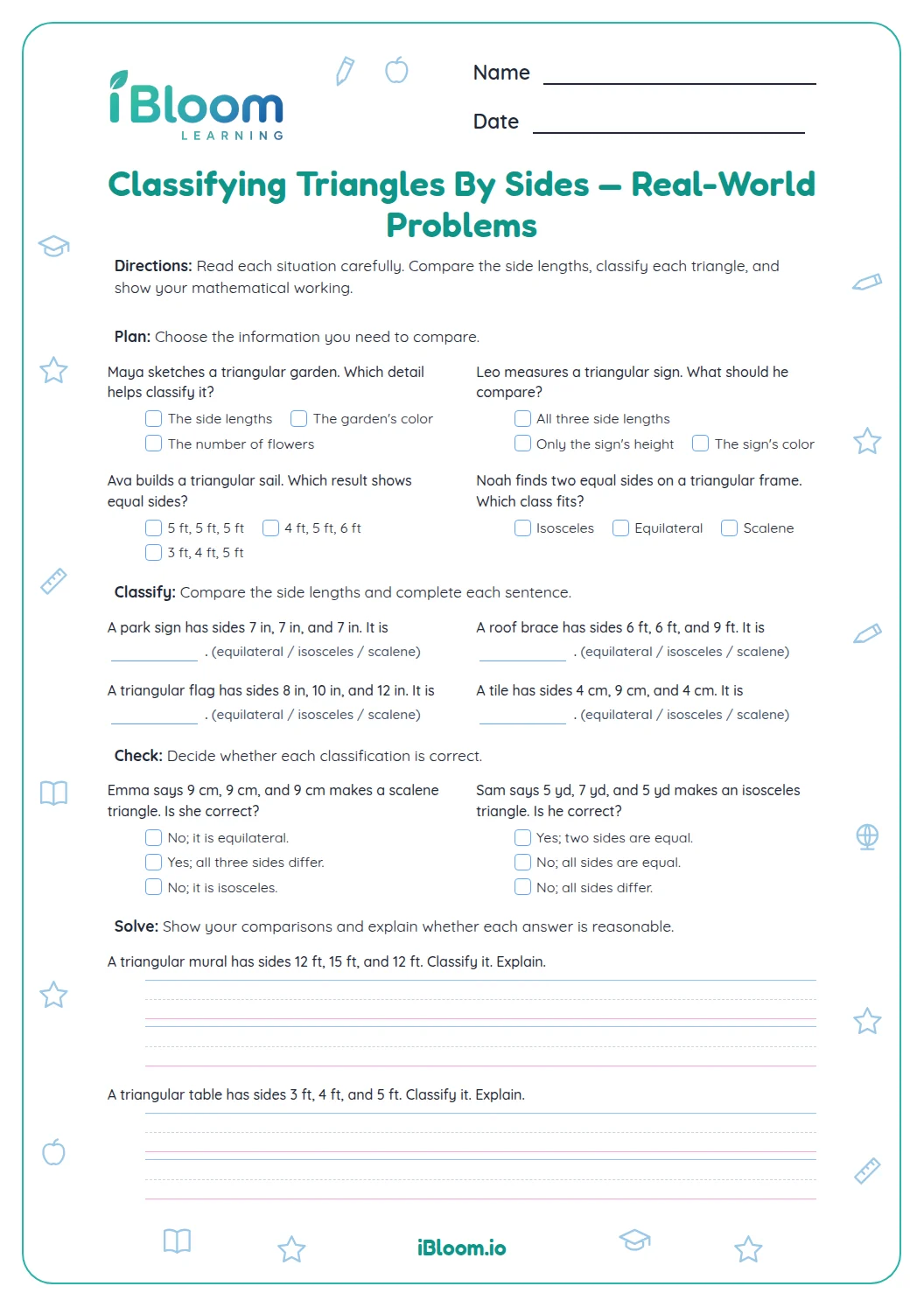
This Grade 6 geometry worksheet gives students 14 chances to classify triangles by side lengths. Students begin with direct comparisons, then name matching sides and check what each classification means. Equilateral triangles have three equal sides, isosceles triangles have two equal sides, and scalene triangles have no equal sides. A separate answer key provides concise responses.
What does each triangle type tell you?
Use the side lengths only. An equilateral triangle has three equal sides; an isosceles triangle has two equal sides; a scalene triangle has no equal sides.
- 1Sides: 5 cm, 5 cm, 5 cm
- 2Compare all three lengths
- 3All three match
- 4Classification: equilateral
How can a student show the classification is correct?
Name the side lengths that match. When no sides match, say that all three lengths are different. This makes the classification checkable.
What is included in guided practice?
The sheet moves from direct side-length comparisons to measured side lists and short explanations.
- Part A: classify four side-length sets
- Part B: classify four more sets and compare patterns
- Part C: explain four decisions and check two rules
How to use this worksheet
- 1Read all three side lengths before choosing a name.
- 2Compare each side with the other two, not just the first pair.
- 3Use the exact equality pattern: three equal, two equal, or none equal.
- 4For written answers, state which lengths match.
Common mistakes and quick fixes
The mistake
Calling a triangle equilateral when only two sides match.
The fix
Check the third side too; equilateral requires all three lengths to be equal.
The mistake
Calling any triangle with unequal first two sides scalene.
The fix
Compare the third side against both of the others before deciding.
The mistake
Using angle size to name a triangle in a sides task.
The fix
Ignore the corners here and compare side lengths only.
What to practice next
Make more practice
Questions parents and teachers ask
How many triangle questions are on this sheet?
There are 14 questions on two worksheet pages, plus a separate two-page answer key. Items include side-length comparisons, measured side lists, and short explanations. Students classify each set by checking whether three, two, or no side lengths match, then explain selected comparisons.
What does equilateral mean?
An equilateral triangle has three equal side lengths. Compare all three sides before choosing that name. For example, the set 5 cm, 5 cm, 5 cm is equilateral because every measurement matches. The worksheet includes several such comparisons for practice.
What does isosceles mean on this worksheet?
On this worksheet, isosceles means exactly two sides have the same length. A triangle with three equal sides is identified separately as equilateral. For instance, 7 in, 7 in, and 4 in has a matching pair, while the third length differs.
How is a scalene triangle identified?
A scalene triangle has three side lengths that are all different. A student can show this by listing the measurements and noting that no pair matches. The set 3 cm, 4 cm, and 5 cm is scalene because each of its three values differs.
Why do some questions ask for an explanation?
An explanation shows how the side lengths support the classification. A concise answer can name the equal sides or state that no pair of the three lengths is equal. The worksheet asks students to practice this reasoning after direct classification questions.