




About this worksheet
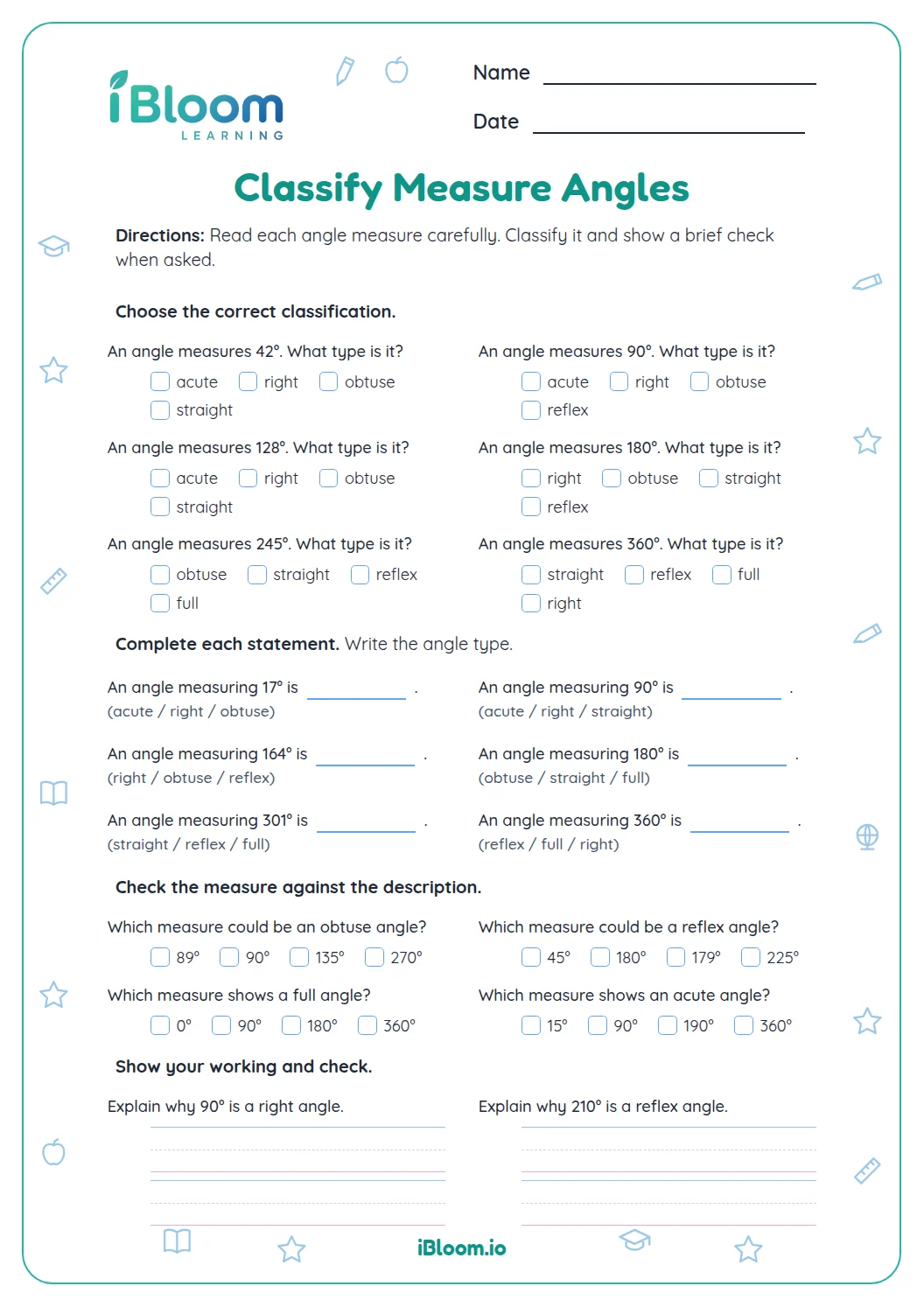
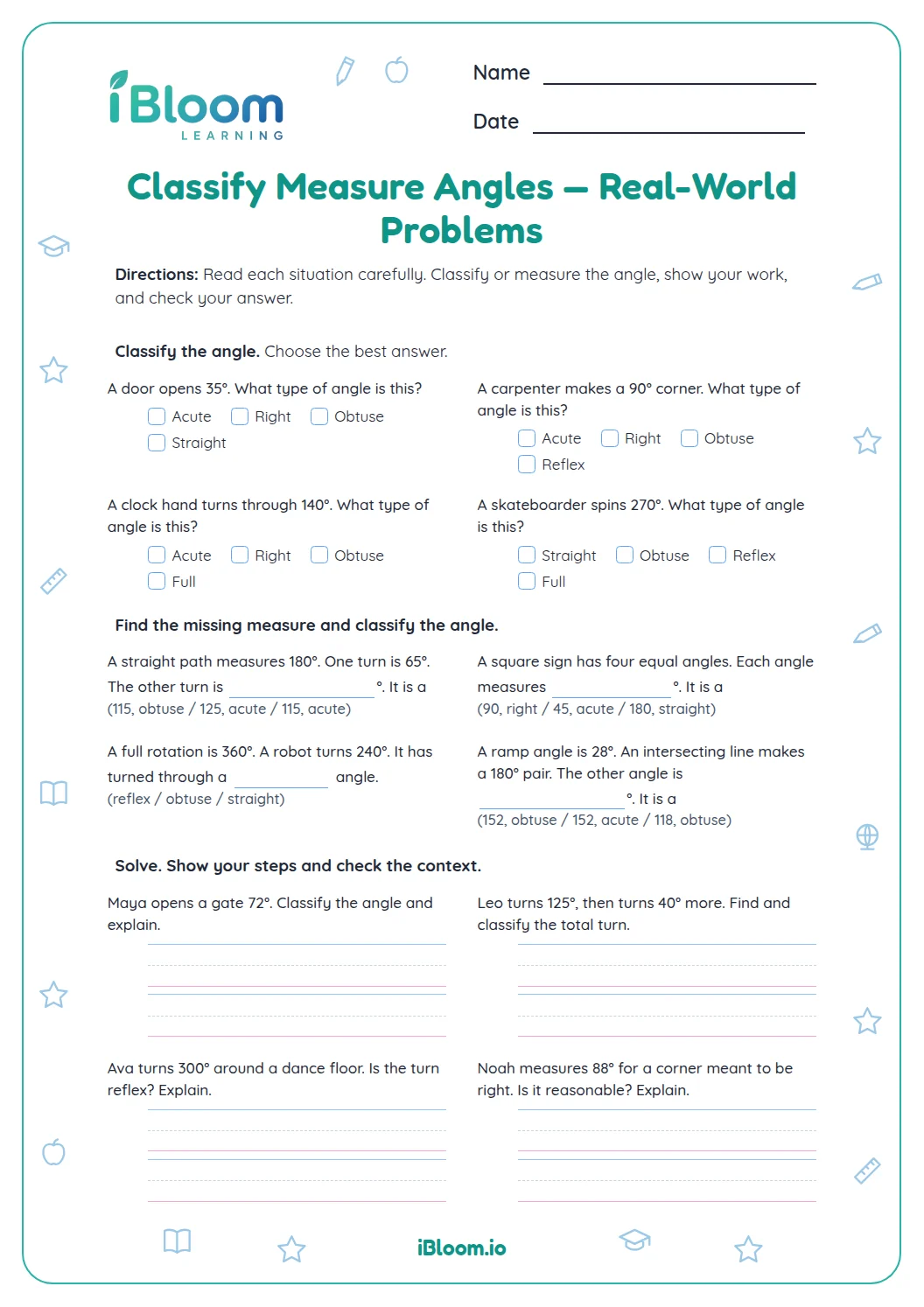
This Grade 6 angle worksheet has six classification questions and eight labeled angle drawings for measuring. Students identify acute, right, obtuse, and straight angles, then read whole-number measures from 24° through 180°. The drawings keep the classify-and-measure focus of the old sheet while replacing its unsupported reflex-angle tasks with angles the model can represent clearly.
Aligned to 4.MD.C.6
How do you classify an angle?
Compare the opening with a square corner. An acute angle is smaller than 90°, a right angle is exactly 90°, and an obtuse angle is larger than 90° but smaller than 180°. A straight angle measures 180°.
Question 1 shows 35°, which is less than 90°, so angle A is acute.
- 1Measure: 35°
- 235° is less than 90°
- 3Classification: acute
How do you read an angle measure?
The degree measure describes the opening between the two rays. Read the labeled angle model and write the number of degrees. Angle J in Part B measures 75°.
What is on the worksheet?
There are 14 questions and a separate answer key. Part A has six angle classifications from degree measures; Part B has eight illustrated angle measures. The old sheet’s reflex-angle requests have been replaced with straight or smaller angles supported by the drawing template.
- Part A: classify 6 angles
- Part B: measure 8 angles
How to use this worksheet
- 1Look for the vertex, where the rays meet.
- 2Compare the opening with a right angle.
- 3Use acute, right, obtuse, or straight for Part A.
- 4For Part B, read the degree label and include °.
- 5Check that an acute measure is below 90° and an obtuse measure is between 90° and 180°.
Common mistakes and quick fixes
The mistake
Calling every angle that looks like an L a right angle.
The fix
Use the model’s degree measure: only 90° is a right angle.
The mistake
Calling 180° obtuse.
The fix
A straight angle makes a straight line; reserve obtuse for measures under 180°.
The mistake
Leaving off the degree unit.
The fix
Write the degree symbol so the measurement unit is clear.
Common Core alignment
This worksheet connects angle names with degree measures.
Recognize angles as measurable turns and identify right angles.
On this sheet: The drawings show two rays meeting at a vertex and ask students to classify or read their measures.
Show the official wordingHide the official wording
Measure angles in whole-number degrees using a protractor. Sketch angles of specified measure.
What to practice next
Make more practice
Further reading
Questions parents and teachers ask
What is an acute angle?
An acute angle opens less than a right angle, so it measures less than 90°. Angle A is 35°, which makes it acute. Compare the space between its rays with the square corner at angle B; the smaller opening is acute.
What is the difference between a right and straight angle?
A right angle measures exactly 90° and forms a square corner. A straight angle measures 180° and forms a line. In Part A, angle B is right and angle D is straight, so the drawings show two distinct angle sizes.
How many angle drawings are included?
There are eight labeled angle drawings. The six questions in Part A give degree measures and ask students to classify acute, right, obtuse, or straight angles; Part B shows eight angle models to measure. The separate answer key marks each classification and lists every model’s measure.
How should students record a measure?
Write the number followed by the degree symbol. For example, angle I measures 42°, so record 42°. Read the angle’s opening from the two rays, then compare the response with the separate key if you are checking the work.
What do the angle models help students practice?
Each drawing labels two rays and their vertex, making the angle opening visible. Students connect that opening to a name or a degree measure. The worksheet includes measures from 24° through 180°, including a right angle and a straight angle.
Does the worksheet include an answer key?
Yes. The separate answer key identifies the six angle types in Part A and gives the degree measures for all eight models in Part B. Students can check each response and return to the labeled rays when they want to review an angle.