





About this worksheet
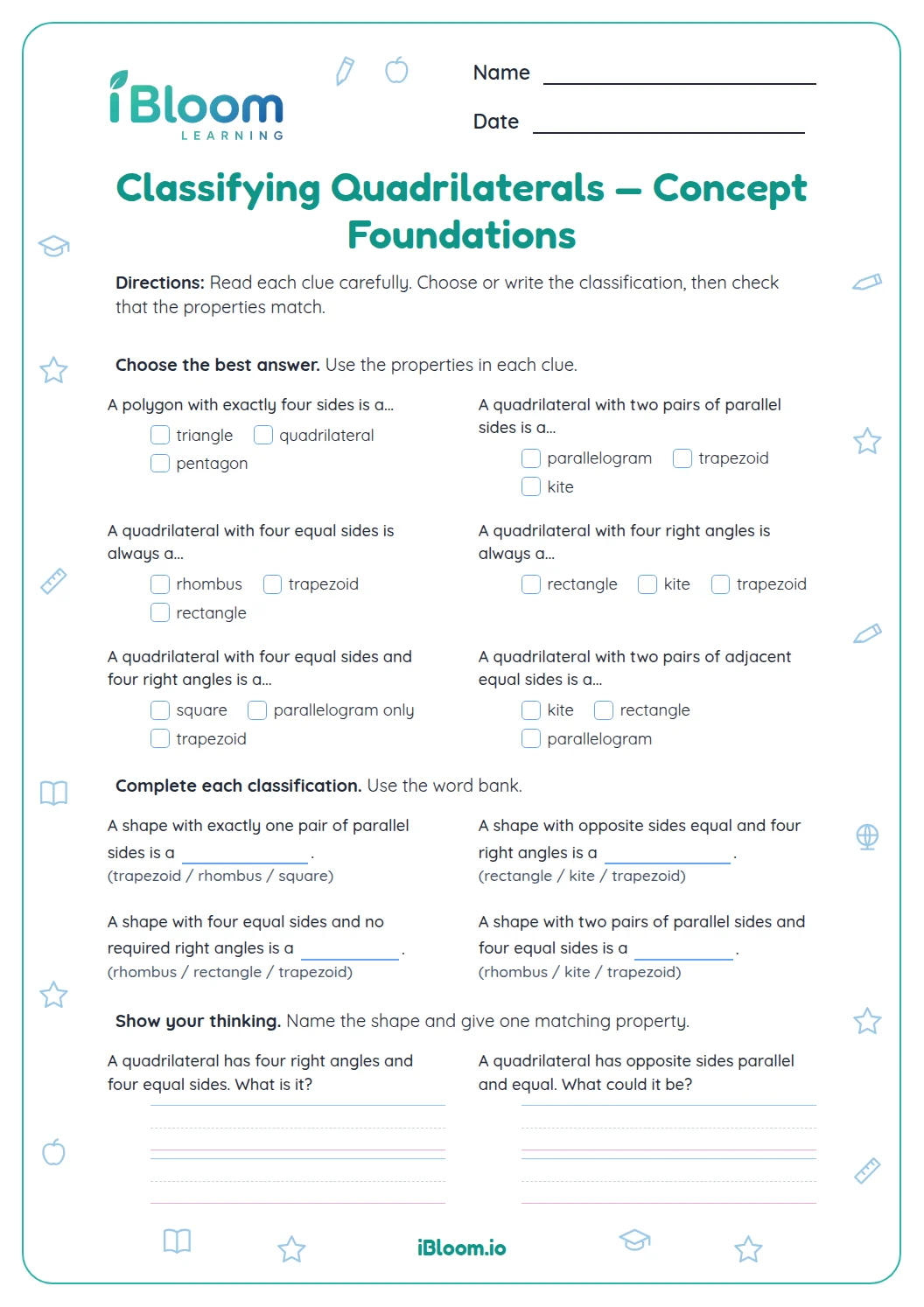
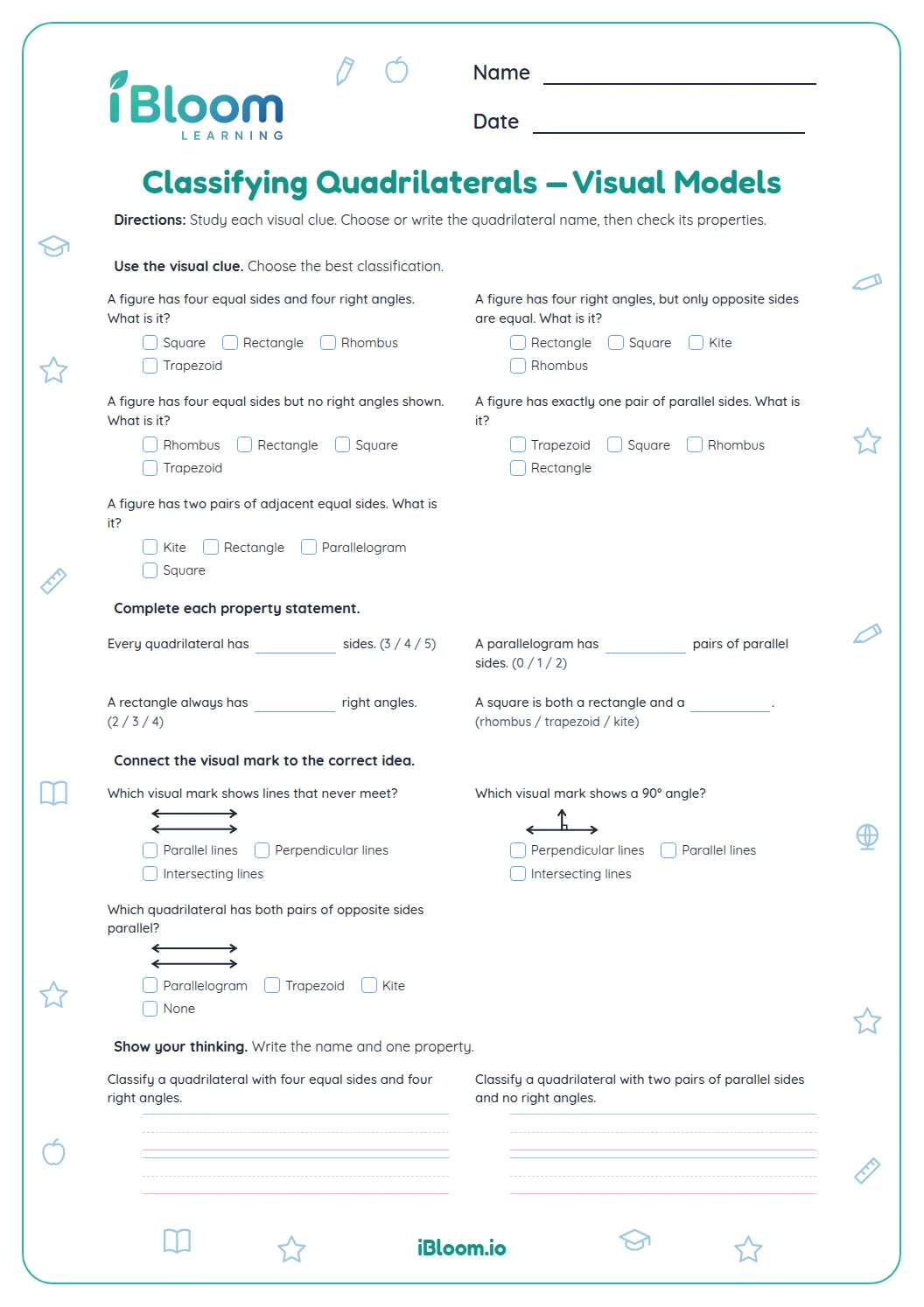
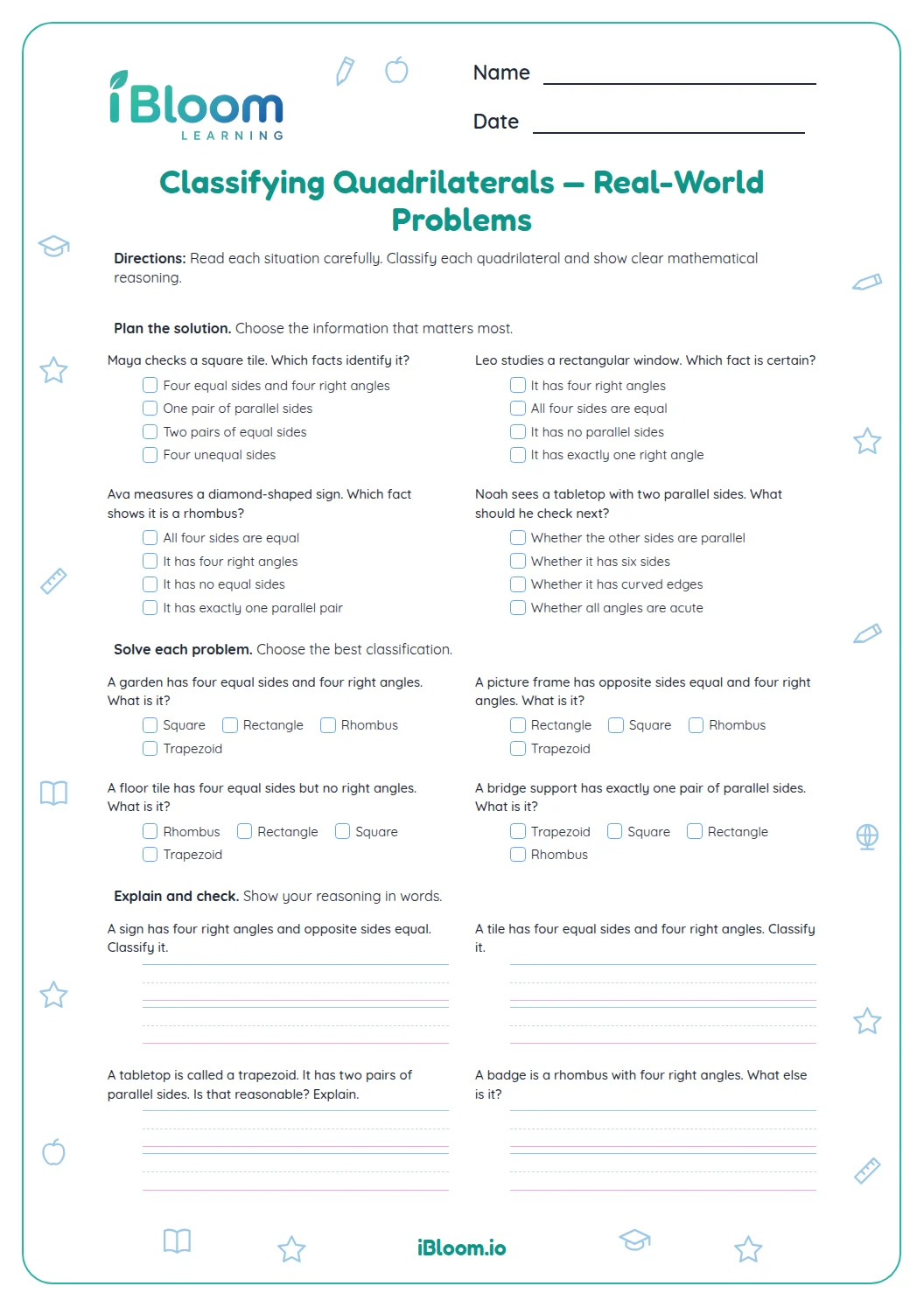
This Grade 6 geometry worksheet guides students through 14 questions about quadrilateral properties. Students use clues about parallel sides, equal sides, and right angles to name figures and connect categories such as squares, rectangles, rhombuses, trapezoids, kites, and parallelograms. Later questions build on the same properties to make category relationships clear. A separate answer key is included.
Aligned to 5.G.B.3
How do side and angle clues identify quadrilaterals?
Look for clues about parallel sides, equal sides, and right angles. A parallelogram has two pairs of parallel opposite sides; a rectangle has four right angles; a rhombus has four equal sides. A square has both the rectangle and rhombus properties.
Part A names categories from property clues. Later parts ask students to apply those properties and explain how category names can overlap.
- 1Clue: two pairs of parallel sides, no right angles.
- 2A trapezoid has exactly one pair of parallel sides.
- 3A parallelogram has two pairs.
- 4So the figure is a parallelogram.
Can one shape belong to more than one category?
Yes. A square has four right angles, so it is a rectangle. It also has four equal sides, so it is a rhombus. A figure can belong to more than one category when it has all of the required properties.
How should students explain a classification?
Name the category and state a defining property. For example, “This is a rhombus because all four sides are equal.” A clear property is stronger than relying on how a shape looks when rotated.
How to use this worksheet
- 1Read each clue carefully.
- 2Count the pairs of parallel sides.
- 3Check for equal sides and right angles.
- 4Name the figure that matches every clue.
- 5Use a shared property to explain how categories overlap.
Common mistakes and quick fixes
The mistake
Calling every slanted figure a parallelogram.
The fix
Check that both pairs of opposite sides are parallel.
The mistake
Thinking a square cannot be a rectangle.
The fix
Compare definitions: a square has the rectangle’s four right angles.
The mistake
Using the drawing orientation as the rule.
The fix
Use marked properties rather than whether a side looks horizontal.
Common Core alignment
This sheet classifies figures and uses shared attributes to connect categories.
Use shared attributes to recognize how quadrilateral categories relate.
On this sheet: Students classify quadrilaterals and recognize a square as a rectangle.
Show the official wordingHide the official wording
Understand that attributes belonging to a category of two-dimensional figures also belong to all subcategories of that category. For example, all rectangles have four right angles and squares are rectangles, so all squares have four right angles.
What to practice next
Make more practice
Further reading
Questions parents and teachers ask
Which quadrilaterals appear on this worksheet?
The questions use squares, rectangles, rhombuses, parallelograms, trapezoids, and kites. Students identify figures from their properties, complete statements about shared attributes, and explain classifications. Several items connect squares with broader categories by comparing their defining properties. The answer key gives the expected categories and property clues for checking.
Why are some sides or angles marked?
This guided practice states properties in words rather than marking sides and angles on a drawing. Students use clues such as four right angles, equal sides, and parallel sides to name or describe a quadrilateral. They then explain which clues support the answer.
Can a square also be a rectangle?
Yes. A rectangle has four right angles, and a square has four right angles plus four equal sides. Because a square has the rectangle’s defining angles, it belongs to the rectangle category. The questions ask students to use those shared properties.
How should students answer the explanation questions?
For the fill-in questions, write the category or property named by the clues. The final two responses ask students to state a figure and explain the properties that support it; the key gives sample explanations. Accept a more specific correct classification when appropriate.
What does “exactly one pair of parallel sides” mean here?
On this worksheet, a trapezoid has exactly one pair of parallel sides. A parallelogram has two pairs, so counting the parallel pairs distinguishes those definitions here. This convention is stated in the clue rather than left for students to guess.