



About this worksheet
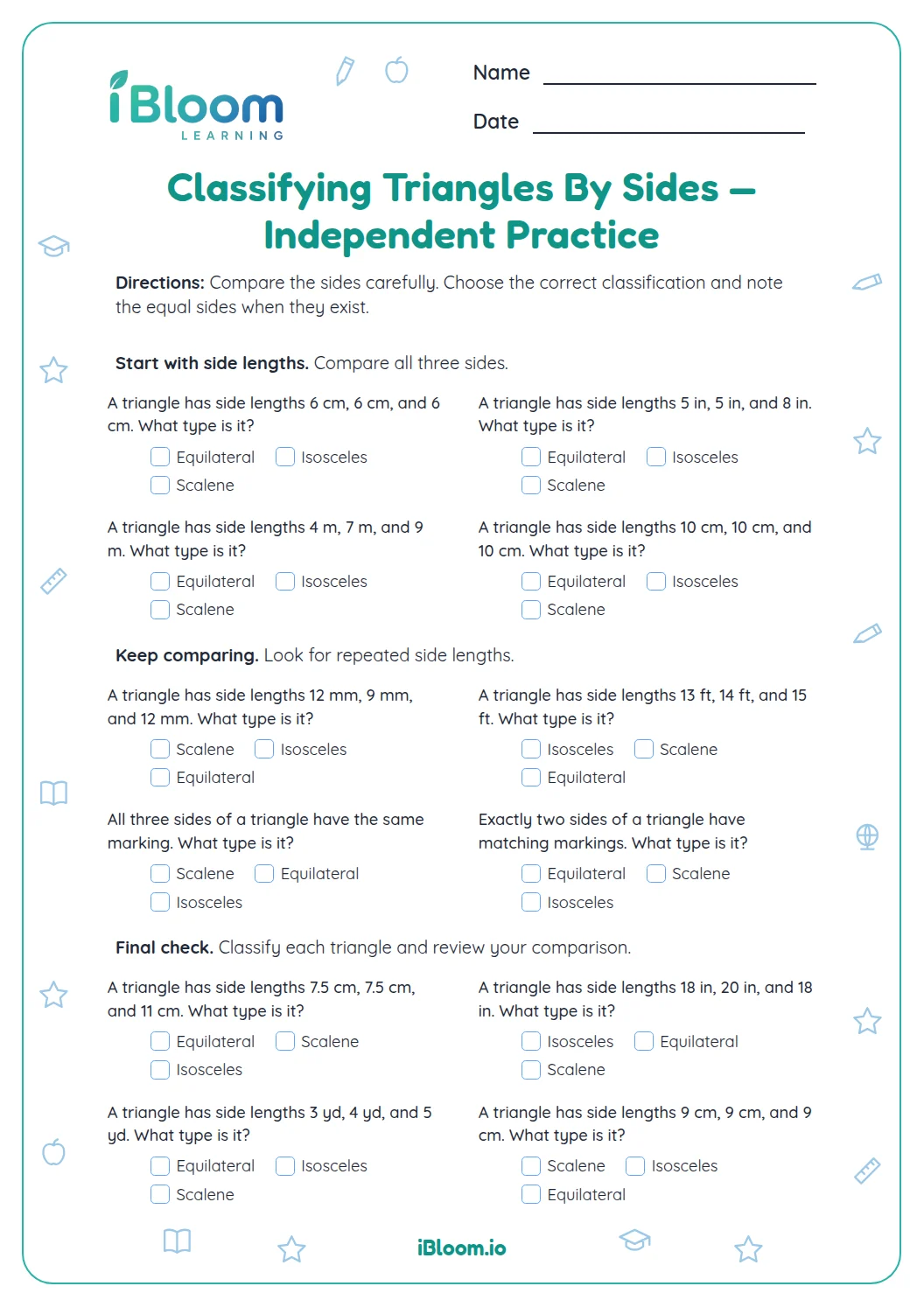
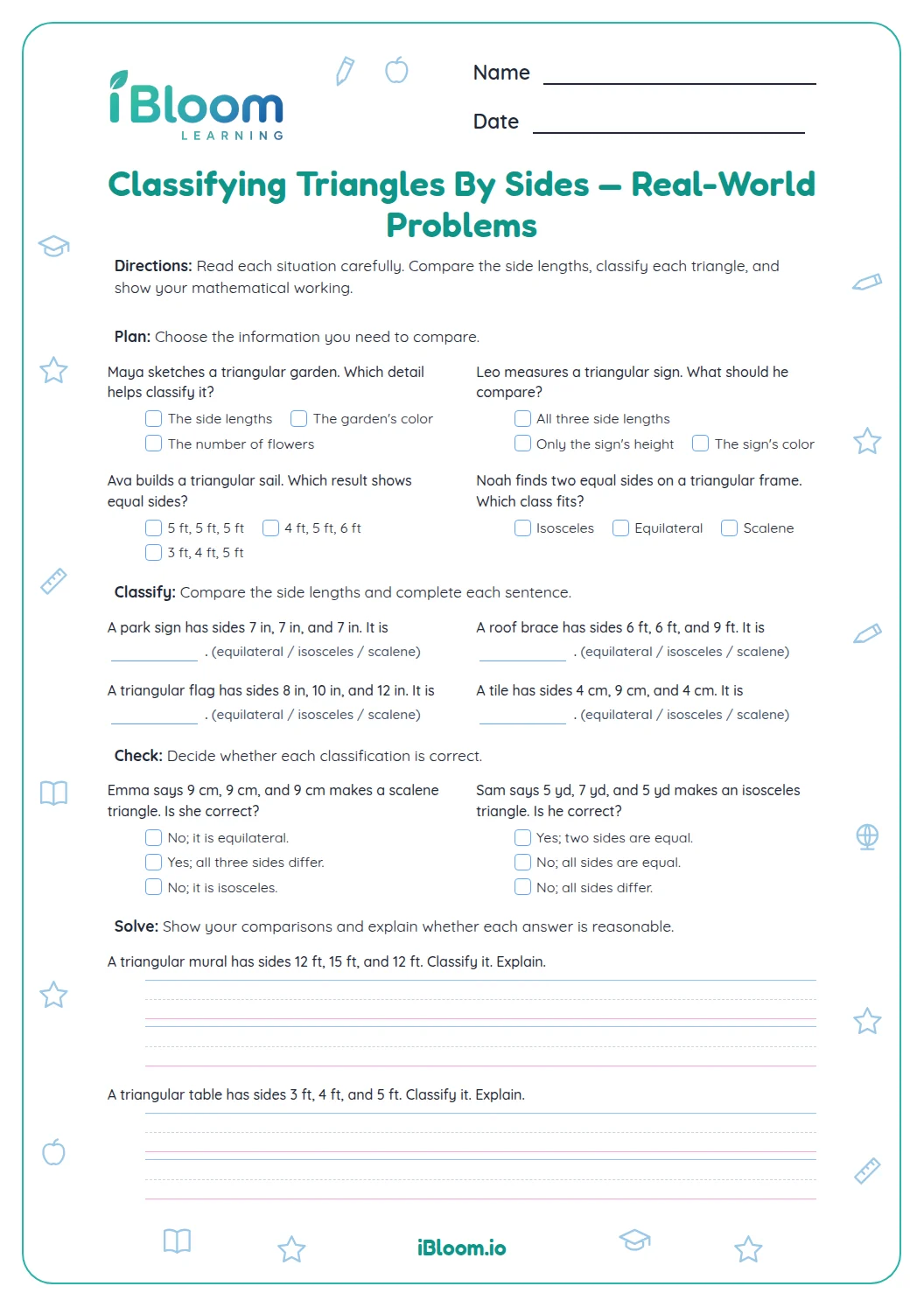
This printable Grade 6 geometry page builds fluency classifying triangles by their side lengths. Children first read matching side marks in three model questions, then compare 13 sets of side lengths and name each triangle. The answer key gives the class for every model and description, making it easy to check that equal marks mean equal lengths.
What do matching tick marks tell you?
Each small tick mark crosses a side to show its length relationship. Sides with the same number of ticks are equal in length. In question 1, all three sides of triangle A share a mark, so its classification is equilateral.
How many sides must match?
An equilateral triangle has three equal sides. An isosceles triangle has at least two equal sides; in this practice, the isosceles examples have exactly two. A scalene triangle has three different side lengths.
How can I check a classification?
List or compare all three lengths before naming the class. For example, 3 in, 5 in, 3 in has a matching pair and one different length, so it is isosceles.
What is on the printable page?
The first part has three marked-model questions. The second part gives 13 side-length sets in centimeters, inches and units for independent classification. A separate key covers all 16 answers.
How can I use this page?
- 1Look at every side mark in a model before choosing a name.
- 2For written lengths, circle equal values before classifying.
- 3Count three matching sides as equilateral, not merely isosceles.
- 4Check that scalene means all three lengths differ.
Common slips and quick fixes
The mistake
Treating any triangle with two matching sides as scalene.
The fix
Compare all three lengths and check for a matching pair.
The mistake
Calling a triangle isosceles when all three sides match.
The fix
Check whether all three, rather than only two, lengths are equal.
The mistake
Assuming a side looks longer in a sketch.
The fix
Use the tick marks or printed measurements, not the drawing scale.
What to practice next
Make more practice
Questions parents and teachers ask
What does each tick mark mean?
A matching tick mark indicates sides of equal length. Sides with a different number of marks represent a different length. In this worksheet, read the marks on each drawn model and compare the printed lengths in the second part. Compare each of the three letters above the models separately; the tick marks, not the drawing size, show the side-length relationship.
How is an equilateral triangle different from an isosceles triangle?
An equilateral triangle has three equal sides. An isosceles triangle in these questions has exactly two equal sides, so checking all three lengths helps distinguish the two names. For a quick check, point to each of the three values and say whether it matches another value before choosing a name.
Can a triangle be both equilateral and isosceles?
Some mathematical definitions include equilateral triangles within the isosceles family because they have at least two equal sides. This worksheet uses the common classroom categories shown in its directions: exactly two equal sides are isosceles, while three equal sides are equilateral.
Should children measure the model triangles?
No. The model drawings use matching marks to communicate equal lengths, and they are not intended to be measured with a ruler. For the written items, compare the side lengths printed in each prompt. This practice moves from labeled triangle drawings to printed lengths, so learners can use the same classification rule in either format.
What is included in the answer key?
The separate key identifies each marked model and gives the classification for every set of side lengths. Children can check one answer at a time and revisit which sides match when a name needs correction. Recheck the measurements in the question and match each repeated length before using the key to review the classification.