




About this worksheet
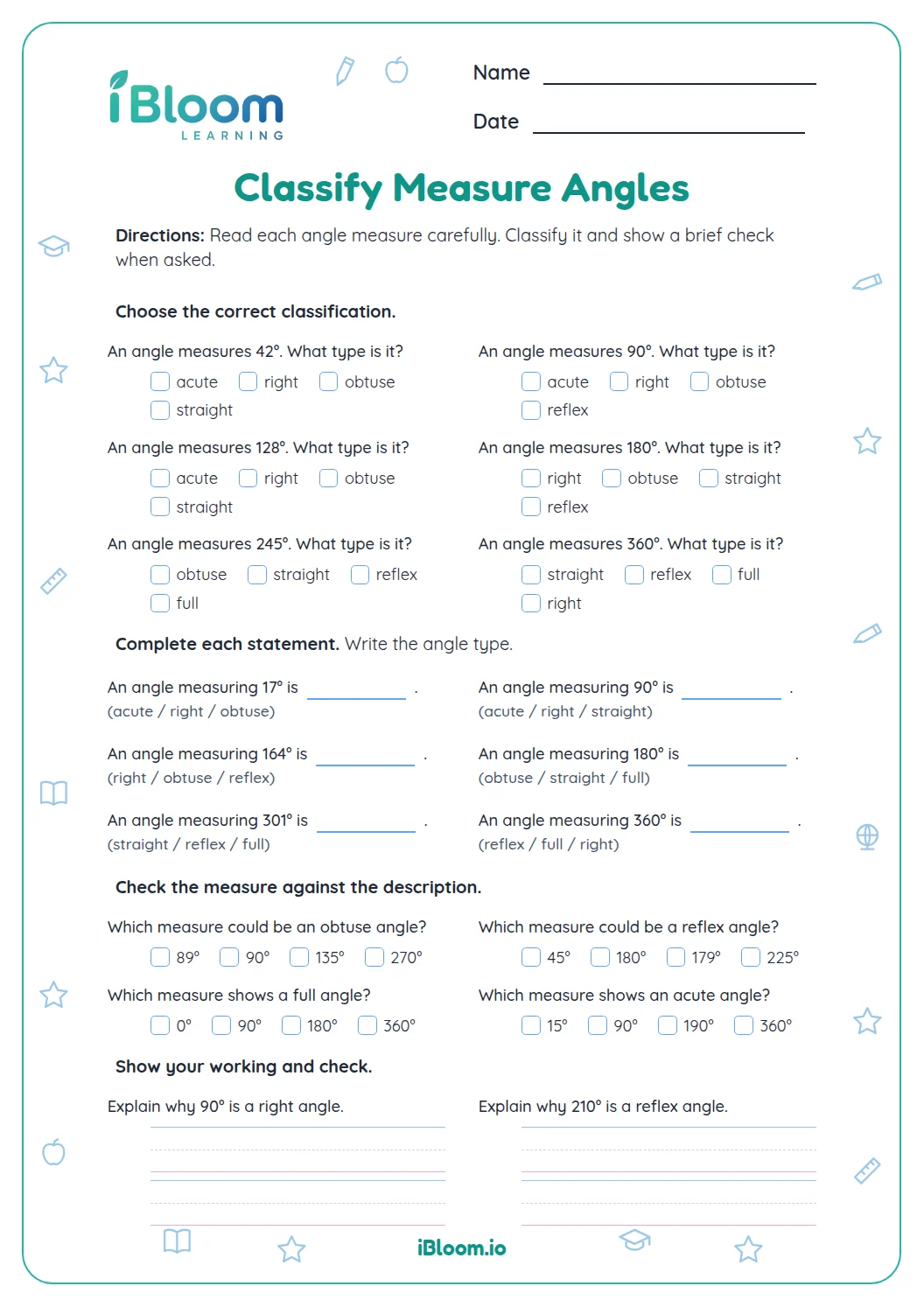
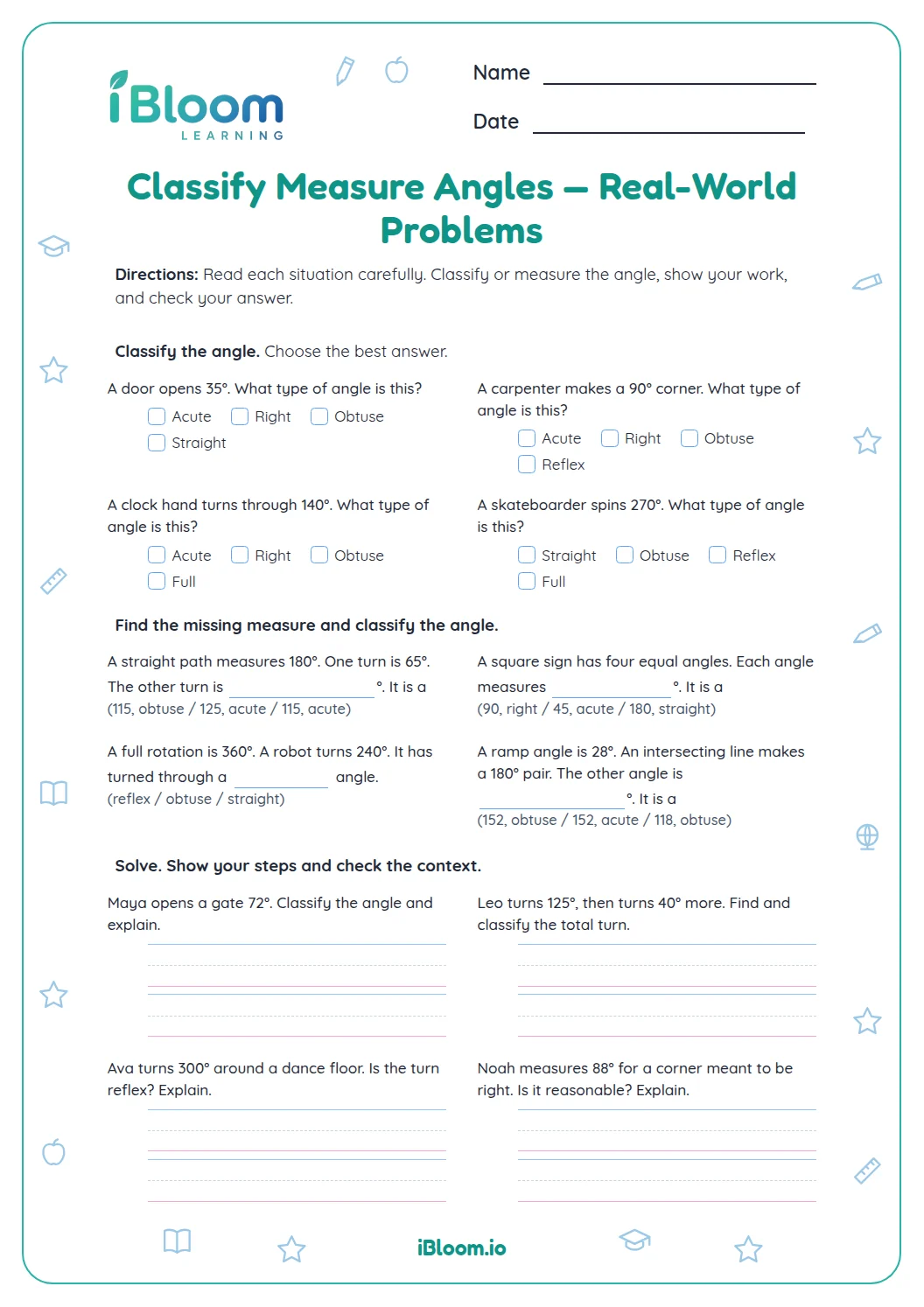
This free Grade 6 geometry worksheet gives students practice reading whole-number angle measures, naming acute, right, and obtuse angles, and reasoning with degree measures. Four illustrated questions ask for an exact measure or classification. Ten more compare measures and find missing angle parts using 90° and 180° benchmarks. A separate key lists each choice and result. The practice connects to CCSS 4.G.A.1.
Aligned to 4.G.A.1
How do students read and classify the drawings?
An acute angle is less than 90°, a right angle is exactly 90°, and an obtuse angle is greater than 90° but less than 180°. A straight angle measures 180°. Part A asks students to classify four angle drawings using these boundaries.
- 1Angle C is 117°.
- 2Since 117° is more than 90° and less than 180°, it is obtuse.
How should students read an angle measure?
Part B compares whole-number degree measures and uses 90° and 180° as benchmarks. Students can write an equation such as 180 − 65 = 115 to solve a straight-angle question.
How do benchmark angles help with reasoning?
A right angle is 90° and a straight angle is 180°. Students use those benchmarks to classify angles and find missing parts. For instance, a 65° part of a 180° angle leaves 115°, because 180 − 65 = 115. They also correct a mistaken classification using the same benchmarks.
How can I use this worksheet?
- 1Classify each angle drawing by comparing it with 90° and 180°.
- 2Read degree measures as whole numbers.
- 3Use 90° for a right angle and 180° for a straight angle.
- 4Subtract a known part from the whole to find an unknown measure.
- 5Check that your answer fits the angle described.
Common slips and how to fix them
The mistake
Calling 90° acute because it is not wide.
The fix
A right angle is exactly 90°; acute means less than 90°.
The mistake
Calling 91° acute because it is close to 90°.
The fix
Compare the measure, not the visual closeness: any measure above 90° is obtuse until 180°.
The mistake
Subtracting the known part from the wrong whole.
The fix
Use 90° for a right angle and 180° for a straight angle.
Common Core alignment
Identify and draw angles, including acute, right, and obtuse angles.
On this sheet: The first section identifies acute, right, obtuse, and straight angles.
Show the official wordingHide the official wording
Draw points, lines, line segments, rays, angles (right, acute, obtuse), and perpendicular and parallel lines. Identify these in two-dimensional figures.
What to practice next
Make more practice
Further reading
Questions parents and teachers ask
Which angles are classified on the sheet?
Students classify acute, right, obtuse, and straight angles. The first four questions include angle drawings, and later questions ask students to compare degree measures with 90° and 180°. The answer key names the angle type or gives the calculation for each item.
Do students need a protractor?
No protractor is needed for these questions. The illustrated angles are used for classification, while the other items give the degree measures in the prompt. Students solve the missing parts with subtraction or compare a measure with 90° and 180°.
How does the worksheet use 90° and 180°?
A right angle measures 90° and a straight angle measures 180°. Students use those benchmarks to classify angles and find missing parts. For instance, a 65° part of a 180° angle leaves 115°, because 180 − 65 = 115.
How can students check an acute-angle claim?
Compare the measure with 90°. For example, 89° is less than 90°, so it is acute rather than right. A right angle measures exactly 90°. This comparison gives students a clear way to check the classification before they select or write an answer.
How many questions and pages are included?
The worksheet has 14 questions across two pages, followed by a two-page answer key. Four questions use angle drawings; the remaining ten use given measures, missing parts, or short reasoning situations. Students can show calculations in the space beside the questions.