







About this worksheet
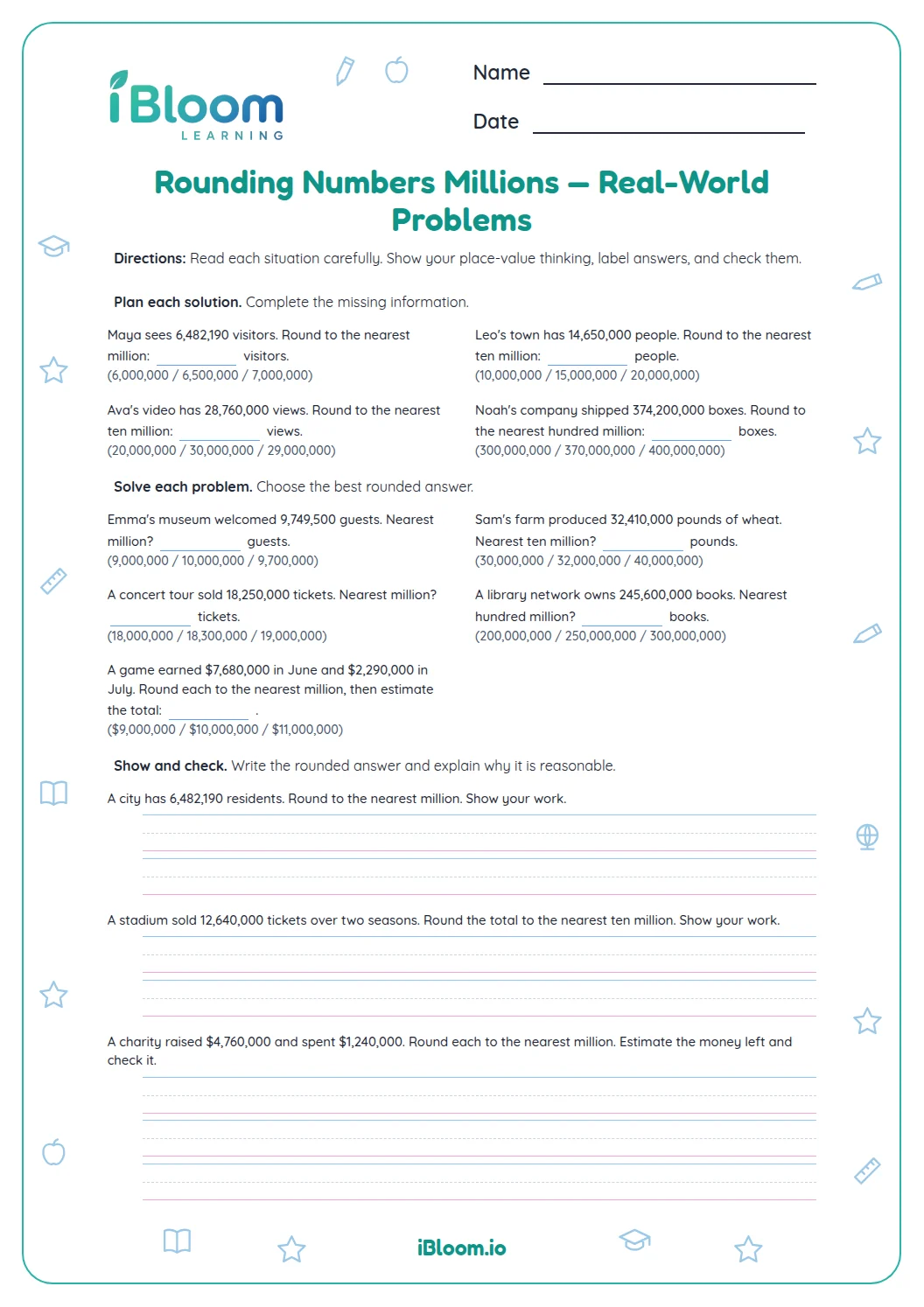
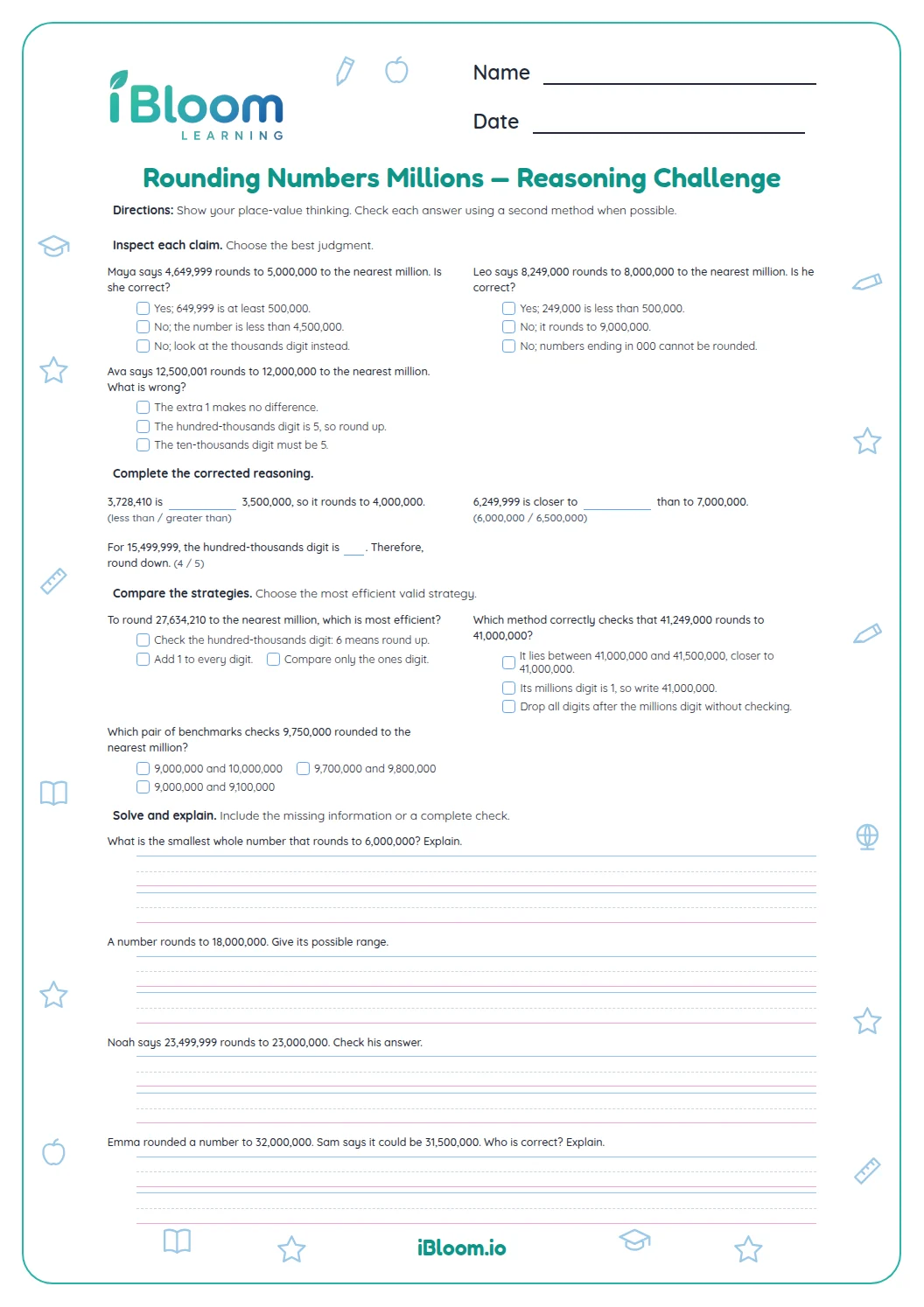
This Grade 6 place-value worksheet gives students 14 chances to round numbers in the millions. The first question uses a number line to locate decimal-million values between whole millions. Later items round whole numbers to the nearest thousand, ten thousand, hundred thousand, and million, including values that carry into a new million. Students use the digit to the right of the named place and check how the rounded value compares with the original. The separate key lists the rounded values. This practice aligns with CCSS 4.NBT.A.3.
Aligned to 4.NBT.A.3
Which digit decides how to round?
Identify the place named in the question, then inspect the digit immediately to its right. In question 5, 5,500,001 rounded to the nearest million becomes 6,000,000 because the hundred-thousands digit is 5.
What happens when rounding carries into a new place?
Rounding can change the digit in the named place and affect digits to its left. In question 9, 9,950,000 rounded to the nearest hundred thousand is 10,000,000. The 9 in the ten-thousands place tells you to round 9,900,000 upward.
How can students check a rounded value?
Question 1 uses a number line to show a value between whole millions. The point at 4.4 million lies closer to 4 million than 5 million, so it rounds to 4,000,000.
A reliable rounding check
- 1Underline the place named in the question.
- 2Look at the digit one place to its right.
- 3Keep the named digit if the next digit is 0–4; increase it by one if it is 5–9.
- 4Replace every digit to the right with zero.
- 5Compare the result with the halfway point to make sure it is nearby.
Common rounding mistakes
The mistake
Looking at the named digit instead of the digit to its right.
The fix
Circle the next-place digit first; it decides whether the named digit changes.
The mistake
Leaving nonzero digits to the right after rounding.
The fix
Replace all digits right of the rounding place with zeros.
The mistake
Missing a carry from 9 to 10.
The fix
Rename the value after rounding, as 9,950,000 to the nearest hundred thousand becomes 10,000,000.
Common Core alignment
Round whole numbers through the millions by checking the digit to the right.
On this sheet: The questions practice rounding numbers to millions through the printed tasks.
Show the official wordingHide the official wording
Use place value understanding to round multi-digit whole numbers to any place.
What to practice next
Make more practice
Further reading
Questions parents and teachers ask
How do you round to the nearest million?
Look at the hundred-thousands digit. If it is 5–9, increase the millions digit by one; if it is 0–4, keep it. In question 8, 1,249,999 rounds to 1,000,000 because the hundred-thousands digit is 2. Have the student explain the reasoning aloud before moving to the next item.
What does “nearest hundred thousand” mean?
Choose the closest multiple of 100,000. Check the ten-thousands digit to decide whether to keep the hundred-thousands digit or increase it. The questions include values that round upward, downward, and across a new million. Have the student explain the reasoning aloud before moving to the next item.
Why does 9,950,000 round to 10,000,000?
The question asks for the nearest hundred thousand, and the ten-thousands digit is 5, so 9,900,000 rounds up. The hundred-thousands digit rolls from 9 to 10, which makes the result 10,000,000. Have the student explain the reasoning aloud before moving to the next item.
What places are practiced?
The 14 questions ask students to round to the nearest thousand, ten thousand, hundred thousand, or million. Most are direct number questions; one uses a town population to put a rounded estimate in context. Have the student explain the reasoning aloud before moving to the next item.
Is there an answer key?
Yes. A separate key lists the correct rounded value for each question. After checking, students can revisit the digit immediately to the right of the named place to see whether it called for rounding up or keeping the value. Have the student explain the reasoning aloud before moving to the next item.
How can students check their rounding?
Compare the original number with the two neighboring multiples of the named place. The rounded answer should be the closer one. For example, 8,499,999 is just below 8,500,000, so the nearest million is 8,000,000. Have the student explain the reasoning aloud before moving to the next item.