



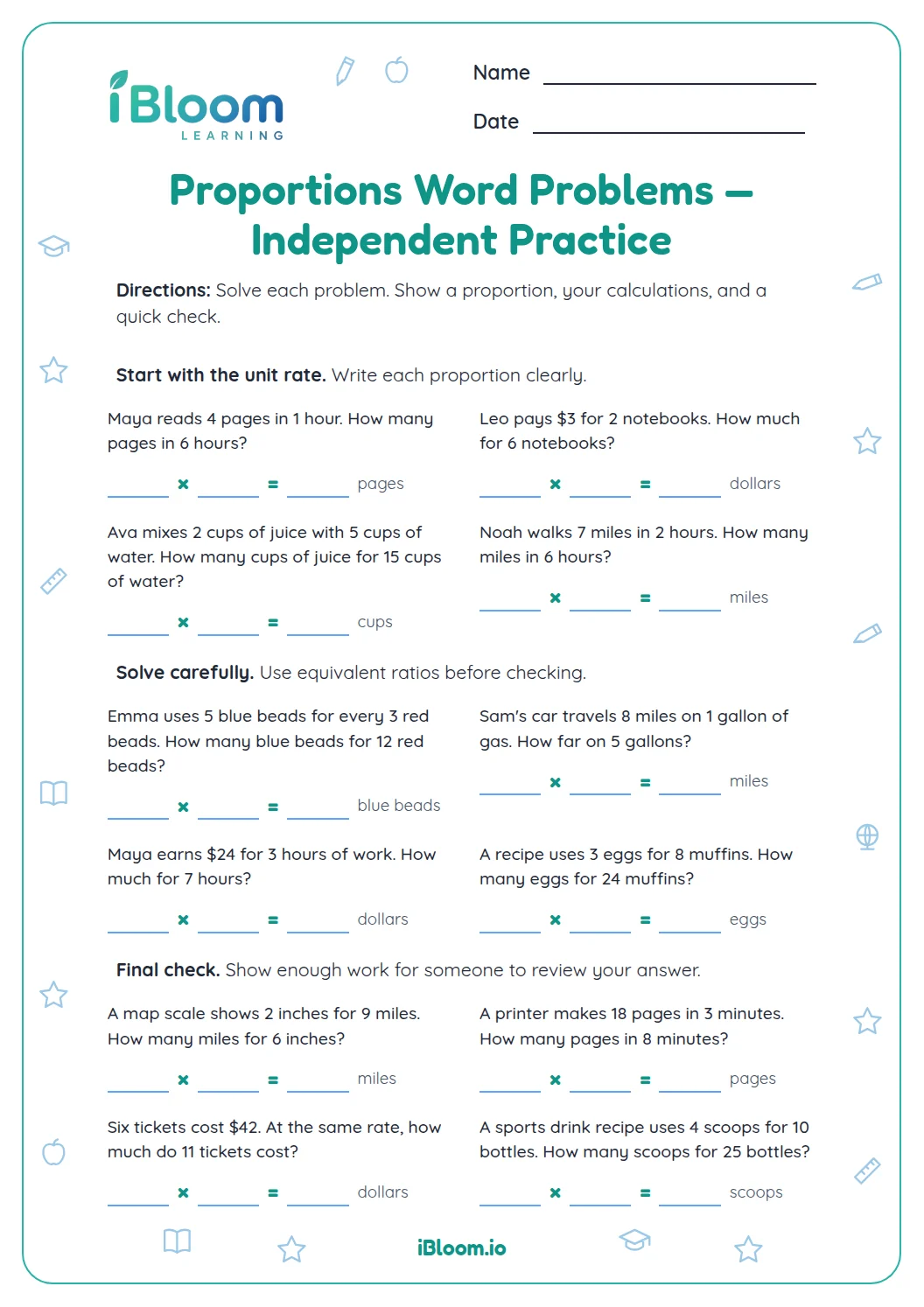
About this worksheet
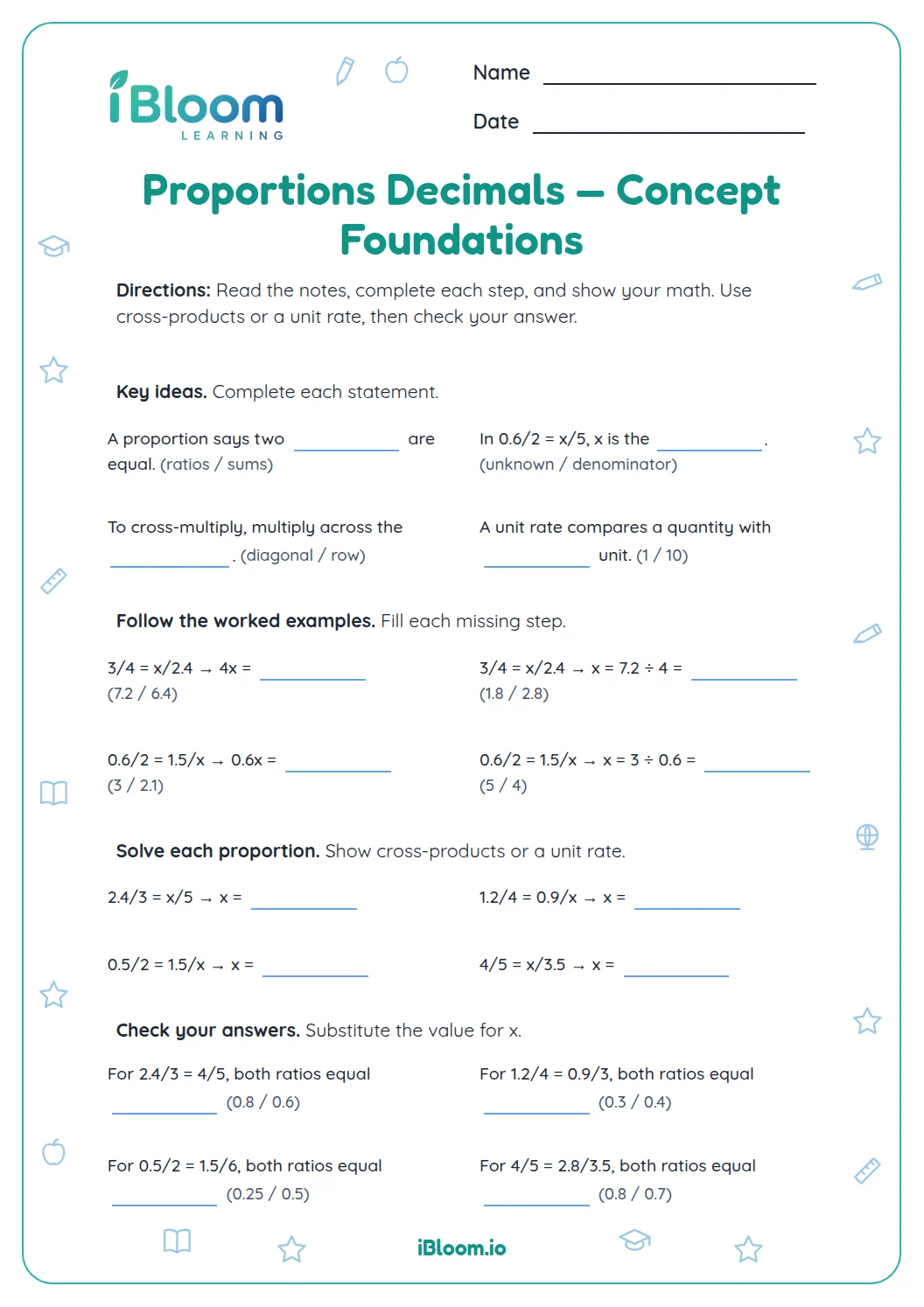
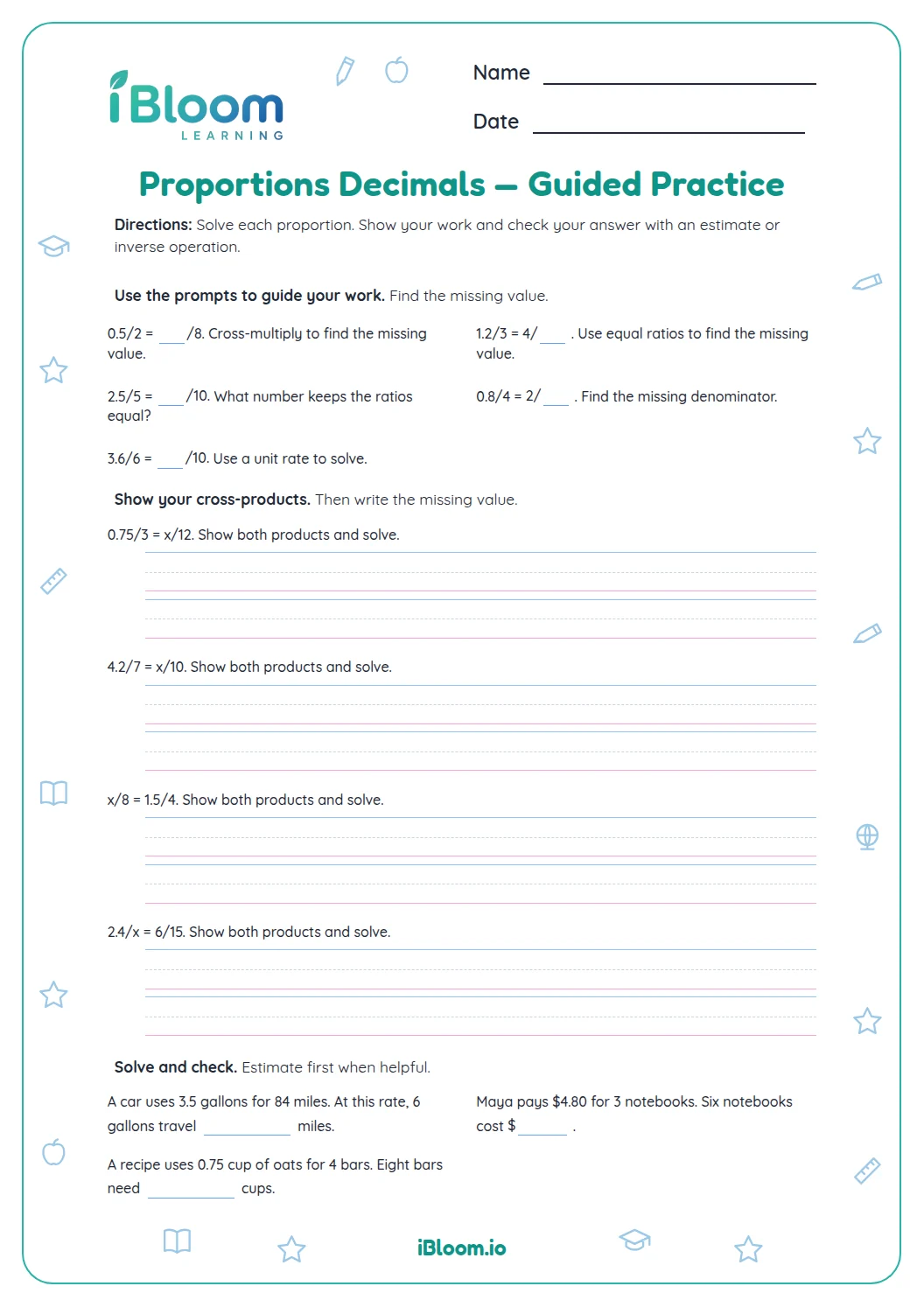
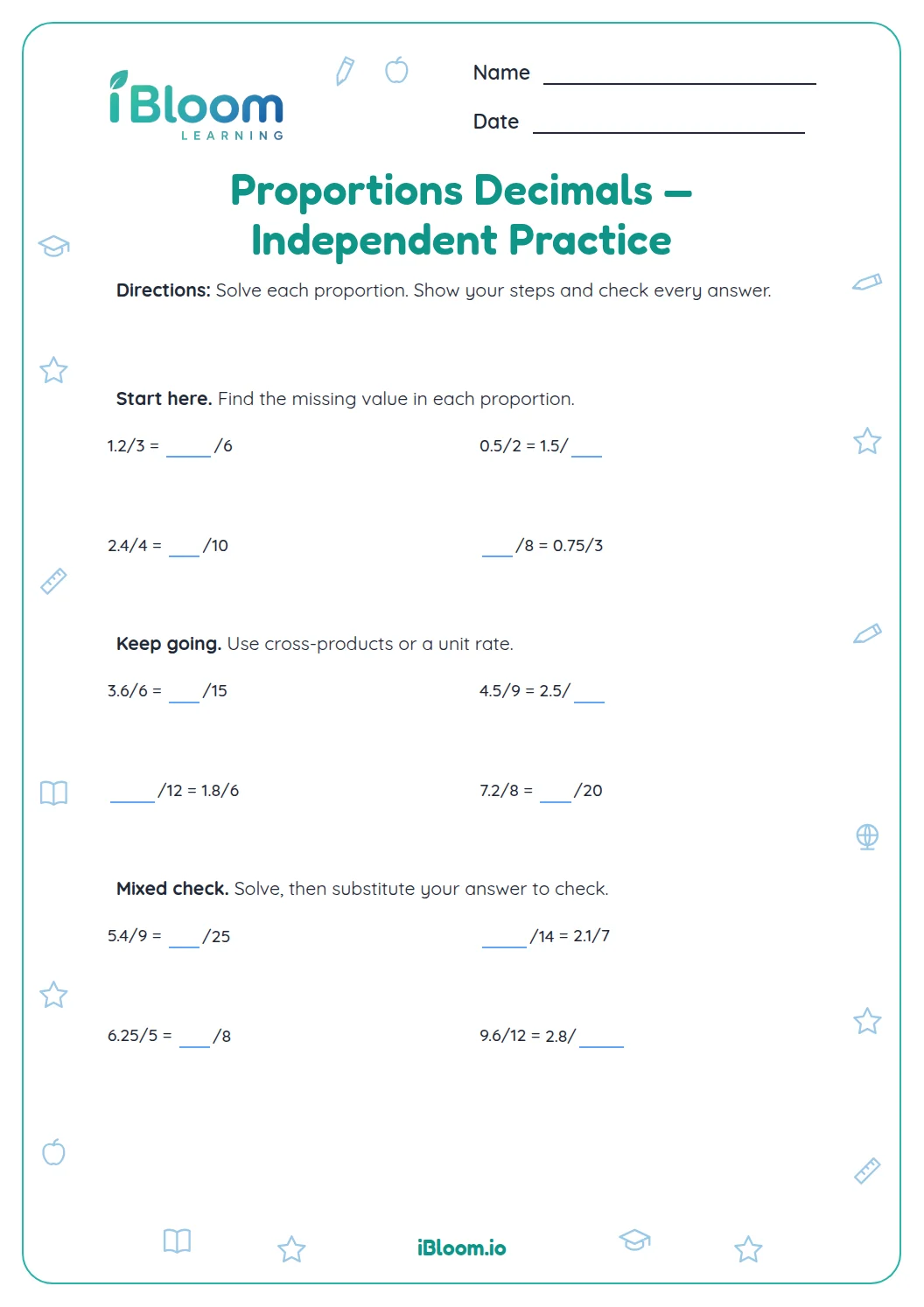
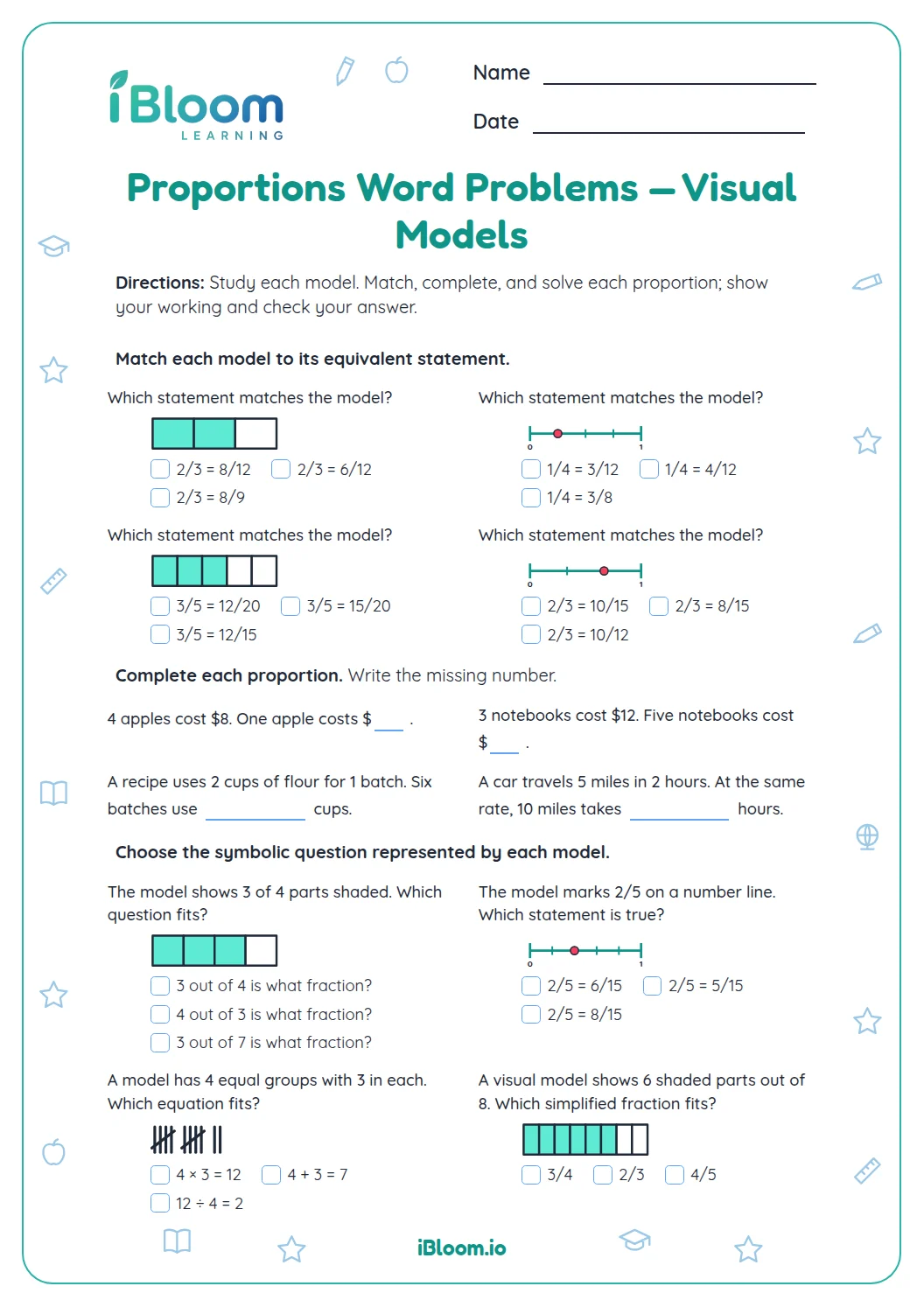
This practice sheet connects decimal ratios to everyday quantities. Learners complete a table, read a model, scale ratios, and find unit rates before solving more involved situations. Every answer follows a constant ratio.
Aligned to 6.RP.A.3
What this worksheet practices
This practice sheet connects decimal ratios to everyday quantities. Learners complete a table, read a model, scale ratios, and find unit rates before solving more involved situations. Every answer follows a constant ratio.
How to use the practice
The practice is organized into 3 parts, with 16 questions and a separate answer key.
Common Core alignment
This worksheet practices the grade-level skill named in the page title.
Decimal Proportions
On this sheet: The questions directly practice the skill described by this standard.
Show the official wordingHide the official wording
Use ratio and rate reasoning to solve real-world and mathematical problems, e.g., by reasoning about tables of equivalent ratios, tape diagrams, double number line diagrams, or equations.
What to practice next
Make more practice
Further reading
Questions parents and teachers ask
How does a ratio table help solve a decimal proportion?
A ratio table keeps matching quantities together. Scale both quantities by the same factor, or find the amount for one unit and scale up. For example, 0.6 cup for 2 servings is 0.3 cup per serving, so 5 servings need 1.5 cups.
What does a unit rate mean in these problems?
A unit rate tells how much corresponds to one unit, such as miles in one hour or dollars for one pound. Divide both quantities by the same number to find the amount for one unit, then multiply by the requested amount.
Should units be included in the answer?
Yes. Labeling cups, minutes, miles, or dollars shows what each number represents. It also helps catch a mismatch, such as giving a distance when the question asks for a travel time. Check that the final unit matches the quantity requested.
How can a learner check that a proportion is correct?
Compare the ratios by division, or check whether the same scale factor connects both quantities. If 2 servings use 0.6 cup, multiplying servings by 2.5 should also multiply the yogurt by 2.5. Both pairs then describe the same steady relationship.