



About this worksheet
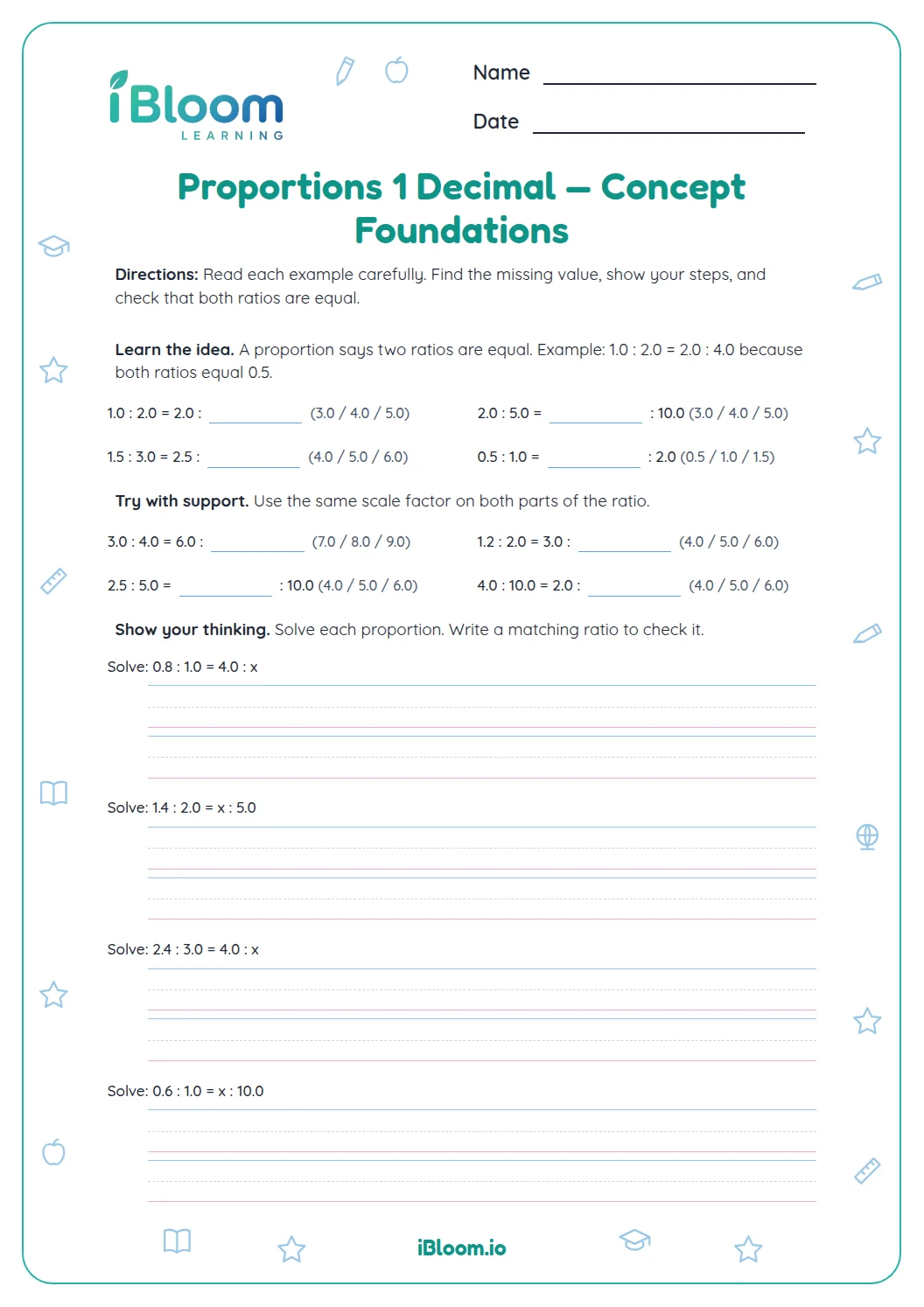
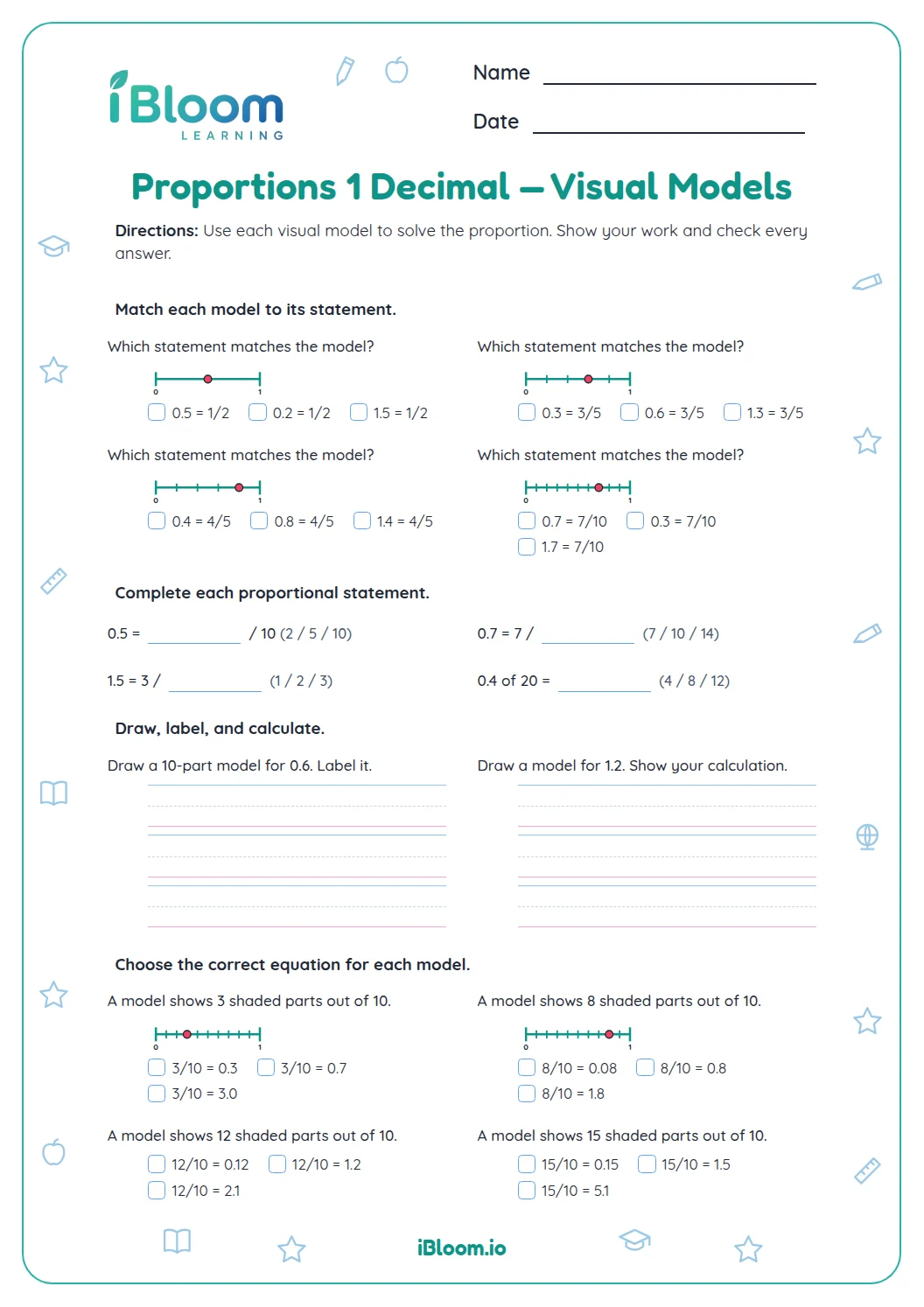
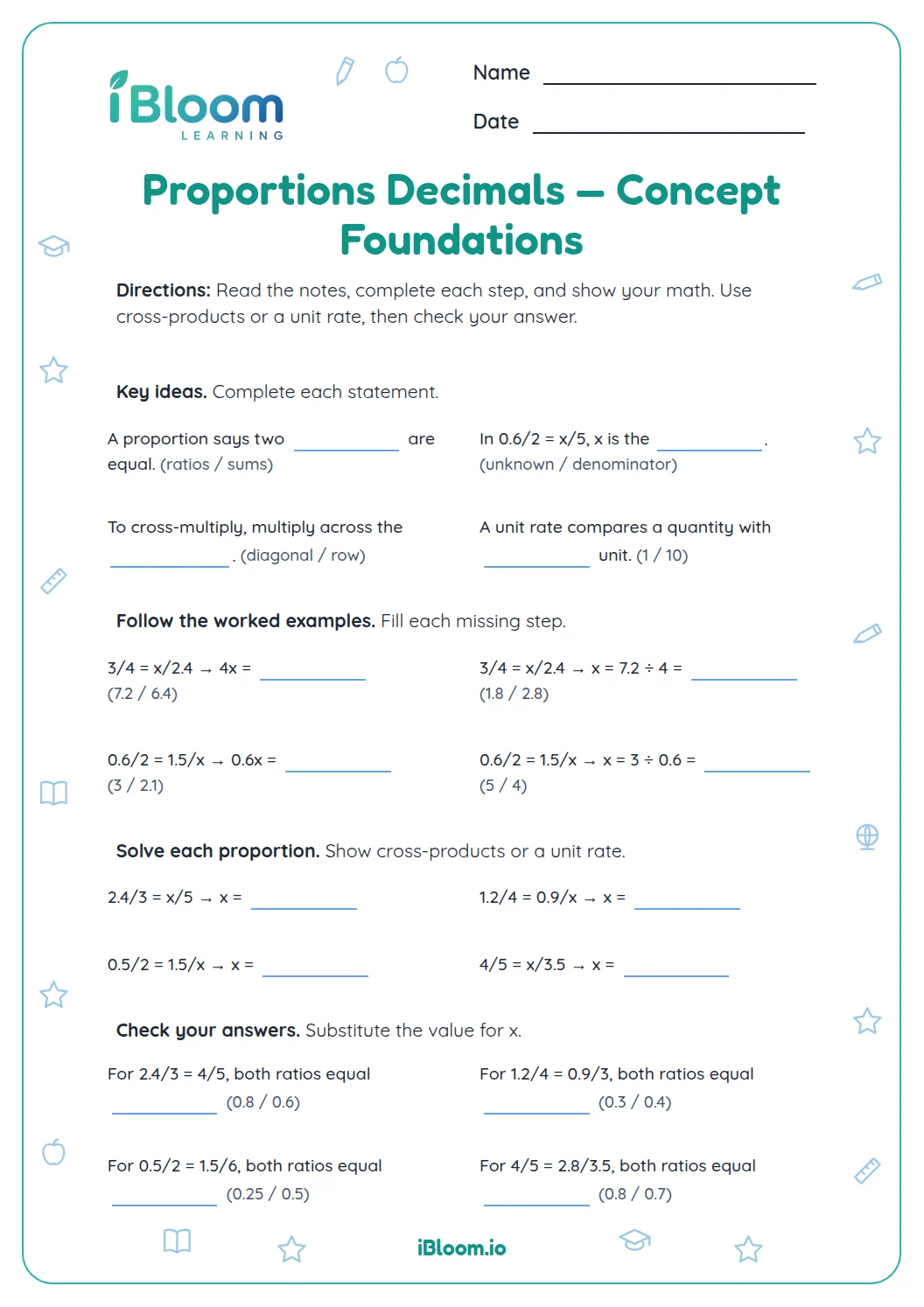
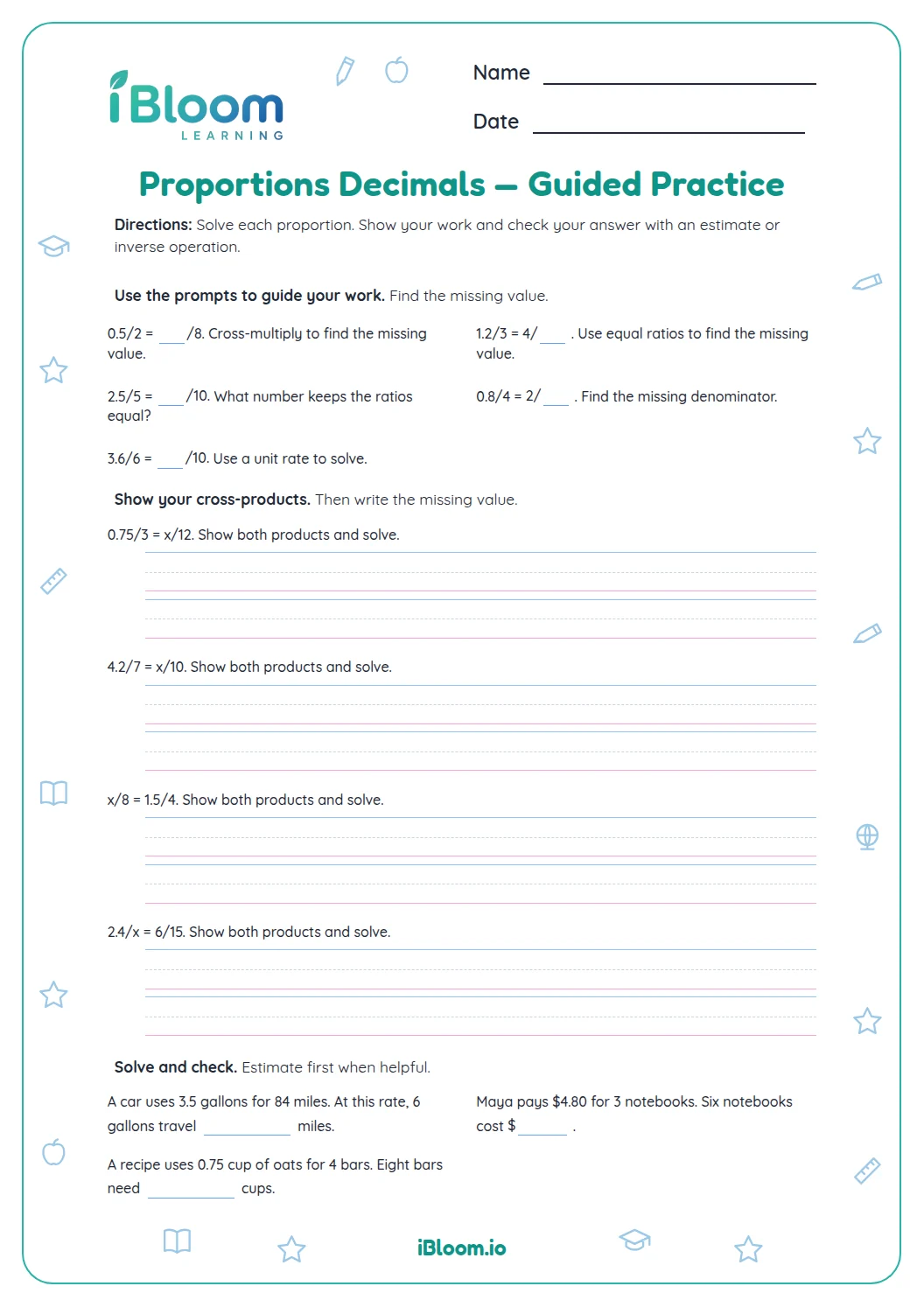
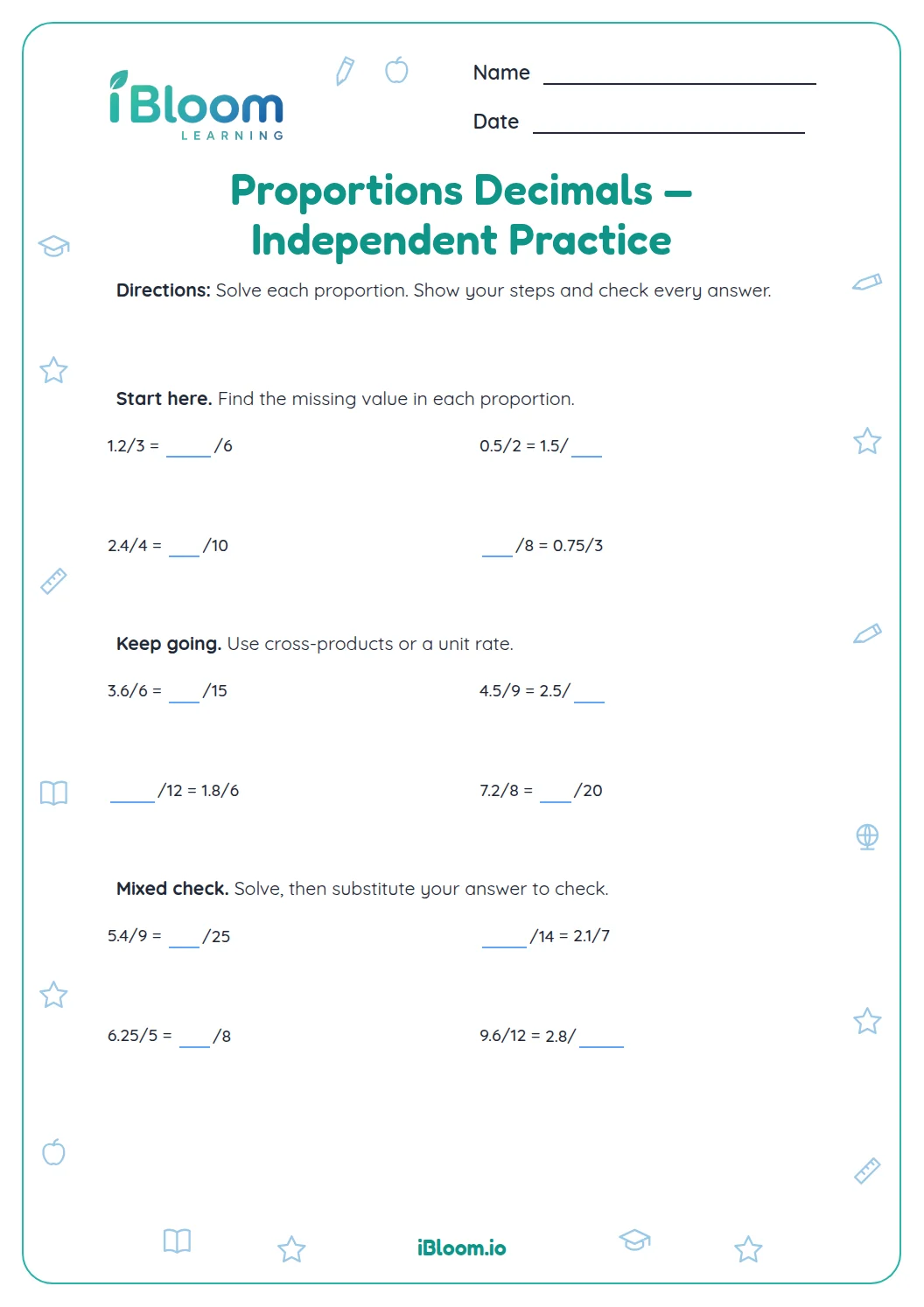
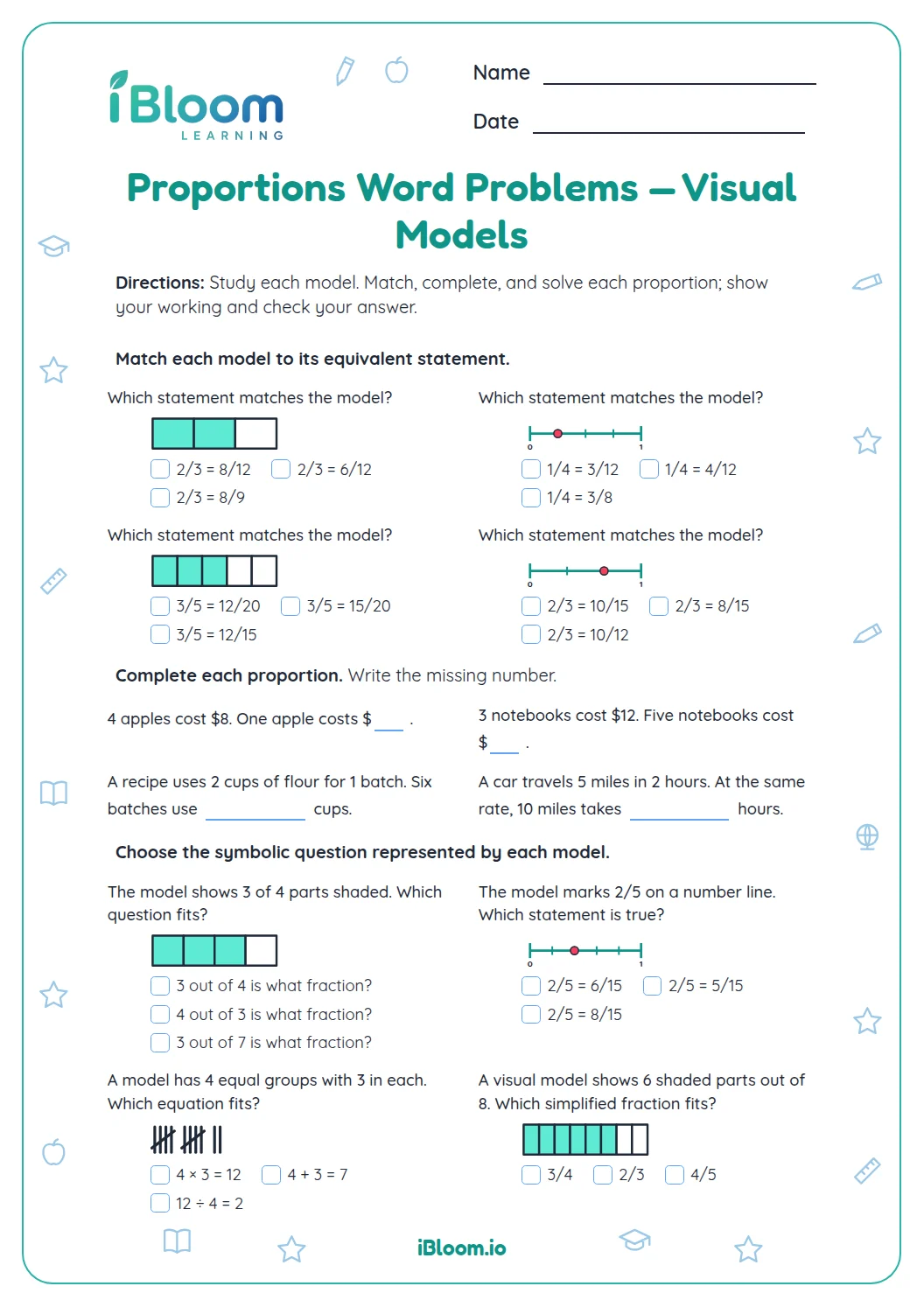
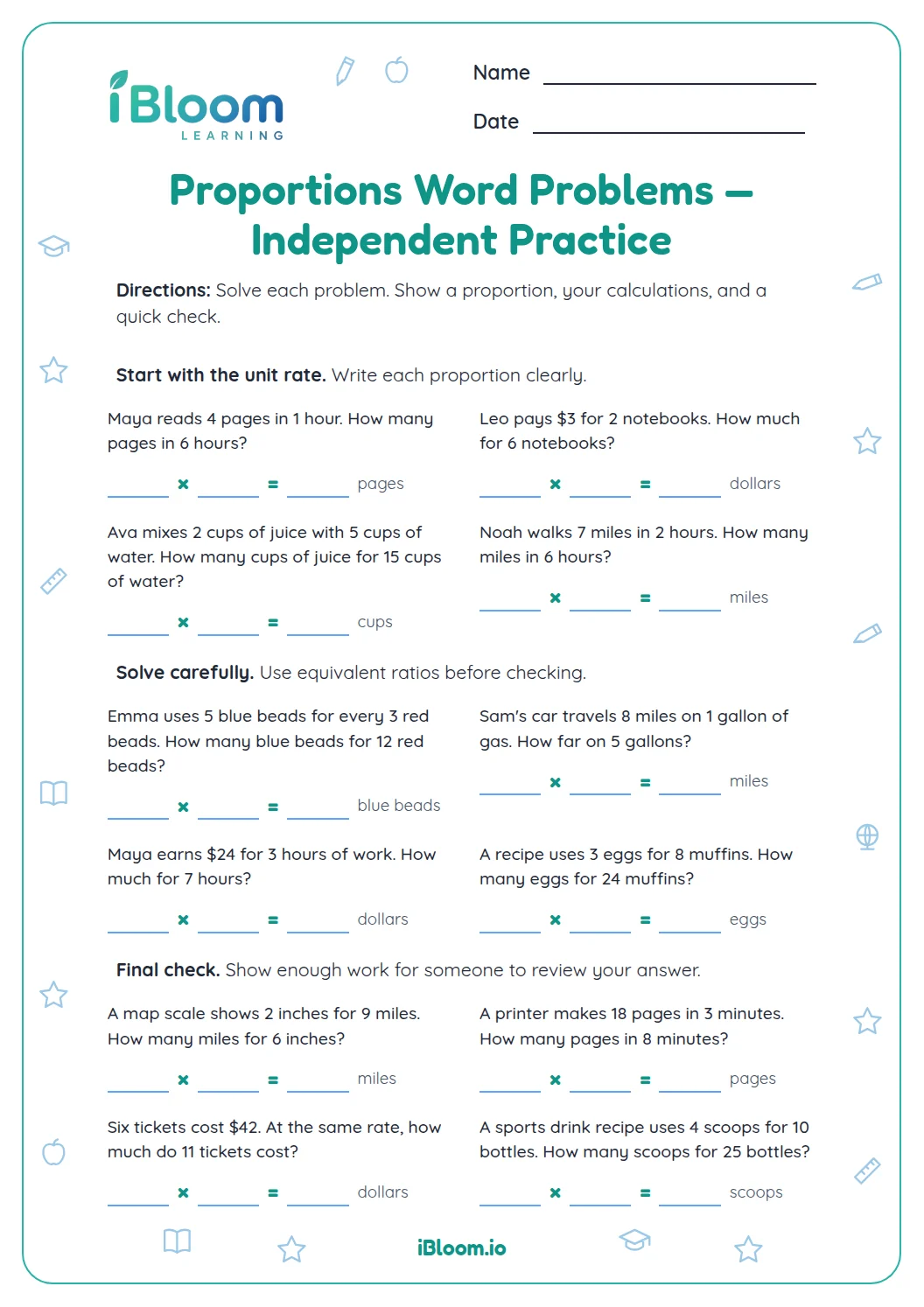
This free Grade 6 worksheet gives students 15 independent practice problems using proportions and decimal rates. The first part finds unit prices, speeds, or recipe amounts; the second scales those rates to new quantities; the final part mixes the two approaches. Students show work and include units, from a car’s miles per hour to the cost of a measured amount of fabric. The sheet practices Common Core 6.RP.A.3, using ratio and rate reasoning to solve real-world problems, and includes a separate answer key.
Aligned to 6.RP.A.3
How do you find a unit rate?
Divide the measured amount by the number of units. In question 2, $5.40 for 3 pounds gives $1.80 per pound. Keeping the unit in the answer helps show what the quotient means.
How do you use a unit rate for a new amount?
Multiply the unit rate by the new quantity. Question 7 uses $1.80 per pound for 5 pounds: 1.80 × 5 = 9, so the cost is $9. Question 8 uses 0.25 cup per muffin for 12 muffins and gives 3 cups.
How do you check a decimal proportion?
Compare both quantities using the same rate. In question 13, 1.2 inches represents 30 miles, so one inch represents 25 miles; 4 inches represents 100 miles. The key includes the final value and unit for every problem.
How to solve the problems
- 1Underline the two quantities that change together.
- 2Find the amount for one unit when the question asks for a unit rate.
- 3Write the unit beside the rate, such as dollars per pound.
- 4Multiply the unit rate by the requested amount to scale it.
- 5For a direct proportion, keep the same quantity order on both sides.
- 6Check that the answer’s size and unit fit the context.
Common slips and quick fixes
The mistake
Dividing in the wrong order for a unit price.
The fix
Divide total cost by pounds or items to get dollars per one.
The mistake
Multiplying by the original quantity instead of the new one.
The fix
Label the requested quantity first, then use that number to scale.
The mistake
Dropping the decimal point or unit in the final answer.
The fix
Estimate the size and write the measurement or rate unit beside it.
Common Core alignment
This sheet practices the following Common Core skill.
Use ratio and rate reasoning to solve real-world and mathematical problems.
On this sheet: Each context uses a constant rate or equivalent ratio to find a unit amount or a scaled amount.
Show the official wordingHide the official wording
Use ratio and rate reasoning to solve real-world and mathematical problems, e.g., by reasoning about tables of equivalent ratios, tape diagrams, double number line diagrams, or equations.
What to practice next
Make more practice
Further reading
Questions parents and teachers ask
How do unit rates help solve these problems?
A unit rate tells how much corresponds to one unit, such as dollars per pound or miles per hour. Once that value is known, multiply by the new number of units. Question 7, for example, uses $1.80 per pound to find the cost of 5 pounds.
How many problems are on the worksheet?
There are 15 questions in three parts: six unit-rate items, five rate-scaling items, and four mixed proportional problems. Short-answer items have a line for the value; the final four word problems include working space. A separate answer key lists the results with units.
Why do answers include units?
A number alone may not say what a result measures. Writing “4.8 miles per hour” identifies the rate, while “$1.80 per pound” tells the unit price. Include the unit named in the question when recording an answer. For example, a cost per pound keeps dollars and pounds as paired quantities in the same ratio.
How can a child check a decimal proportion?
Use the rate to predict the other quantity, then compare it with the answer. If 0.25 cup is used per muffin, 12 muffins need 12 × 0.25 = 3 cups. A reverse check divides 3 cups by 12 muffins. This helps connect the number to its measurement.
What if a proportion gives a repeating decimal?
Keep enough decimal places for the context and follow any rounding direction in the problem. These questions use rates that produce terminating decimal answers, so the answer key gives exact values and units. Question values produce exact decimal results, so students can focus on the proportion without rounding.