


About this worksheet
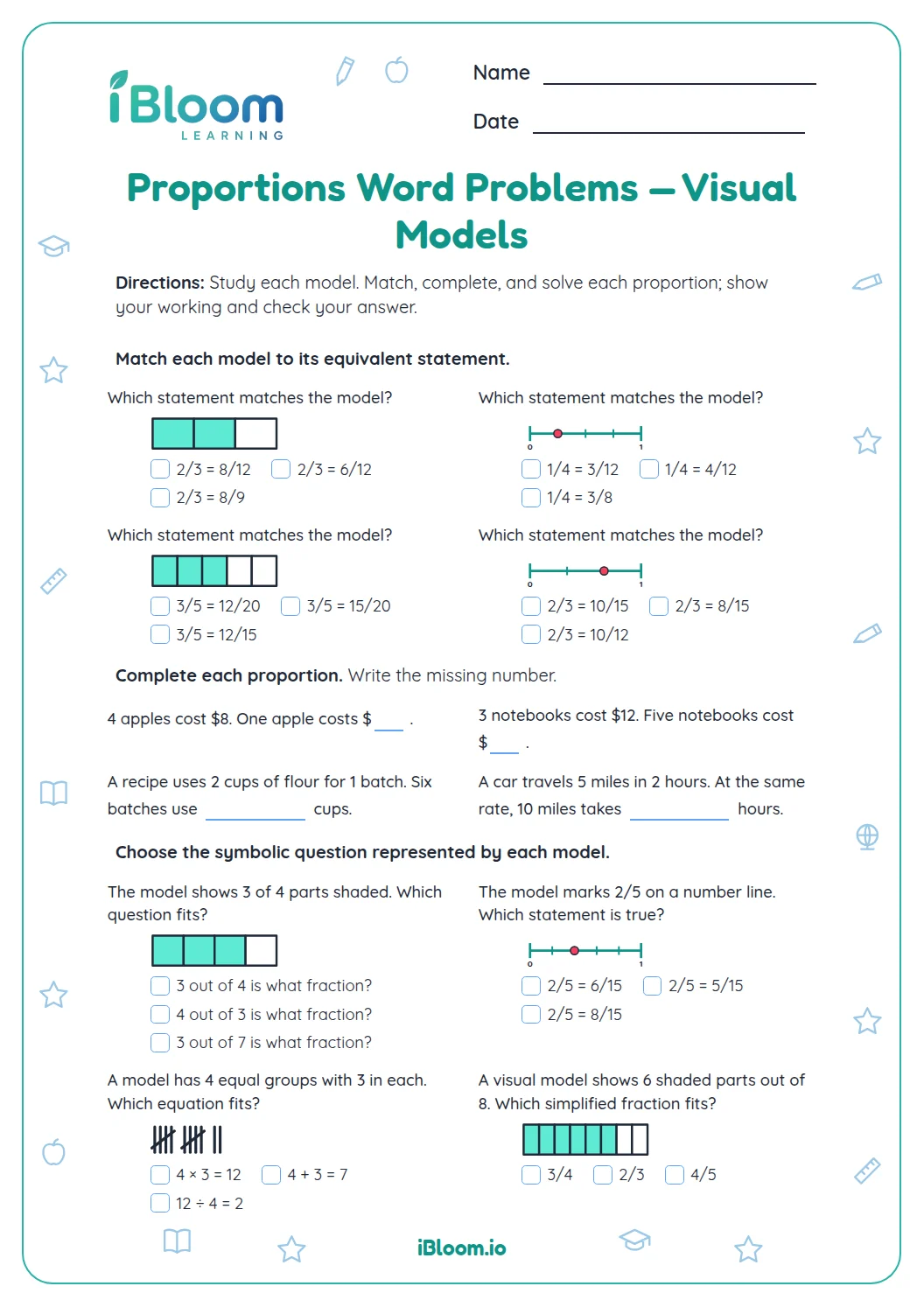
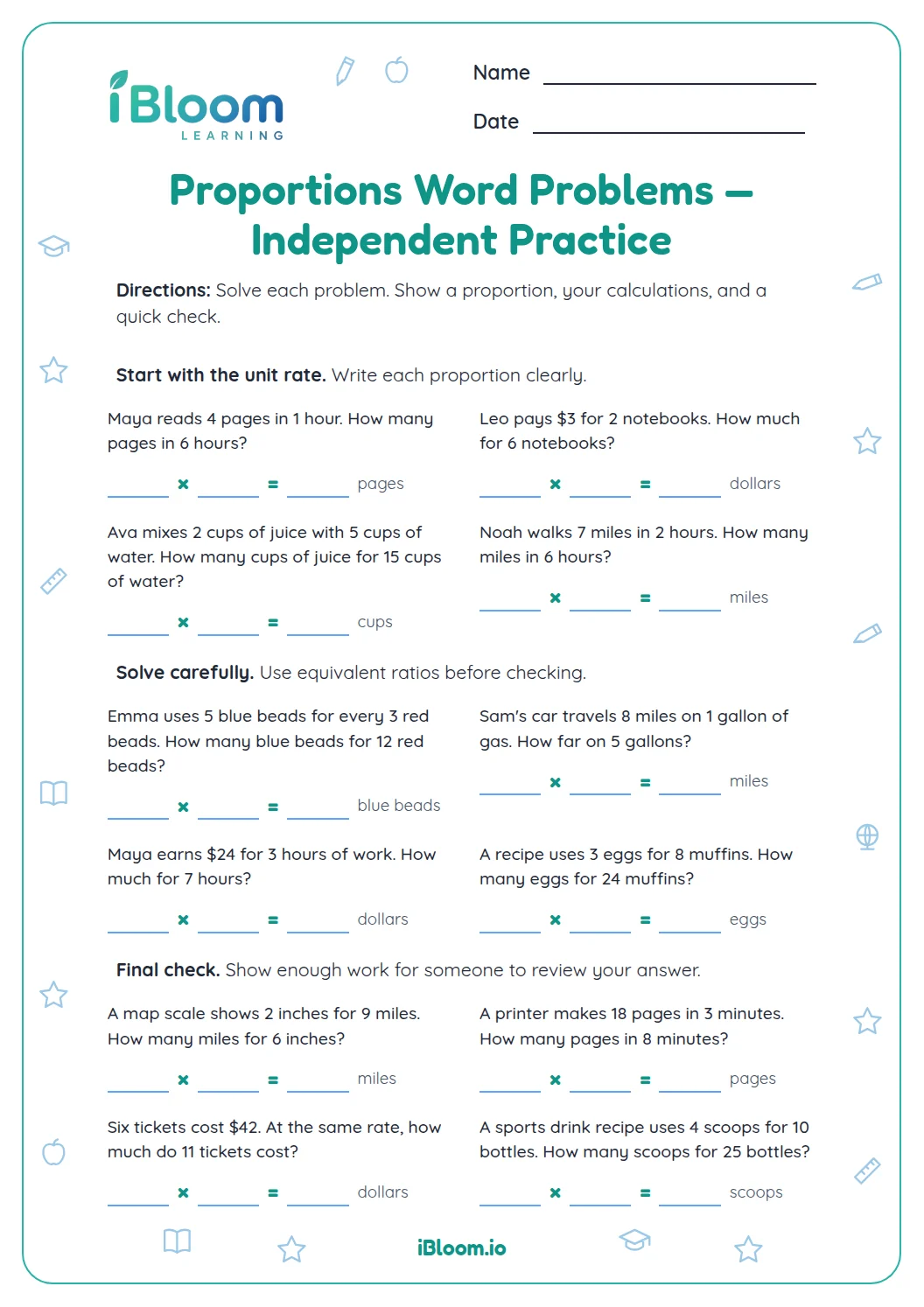
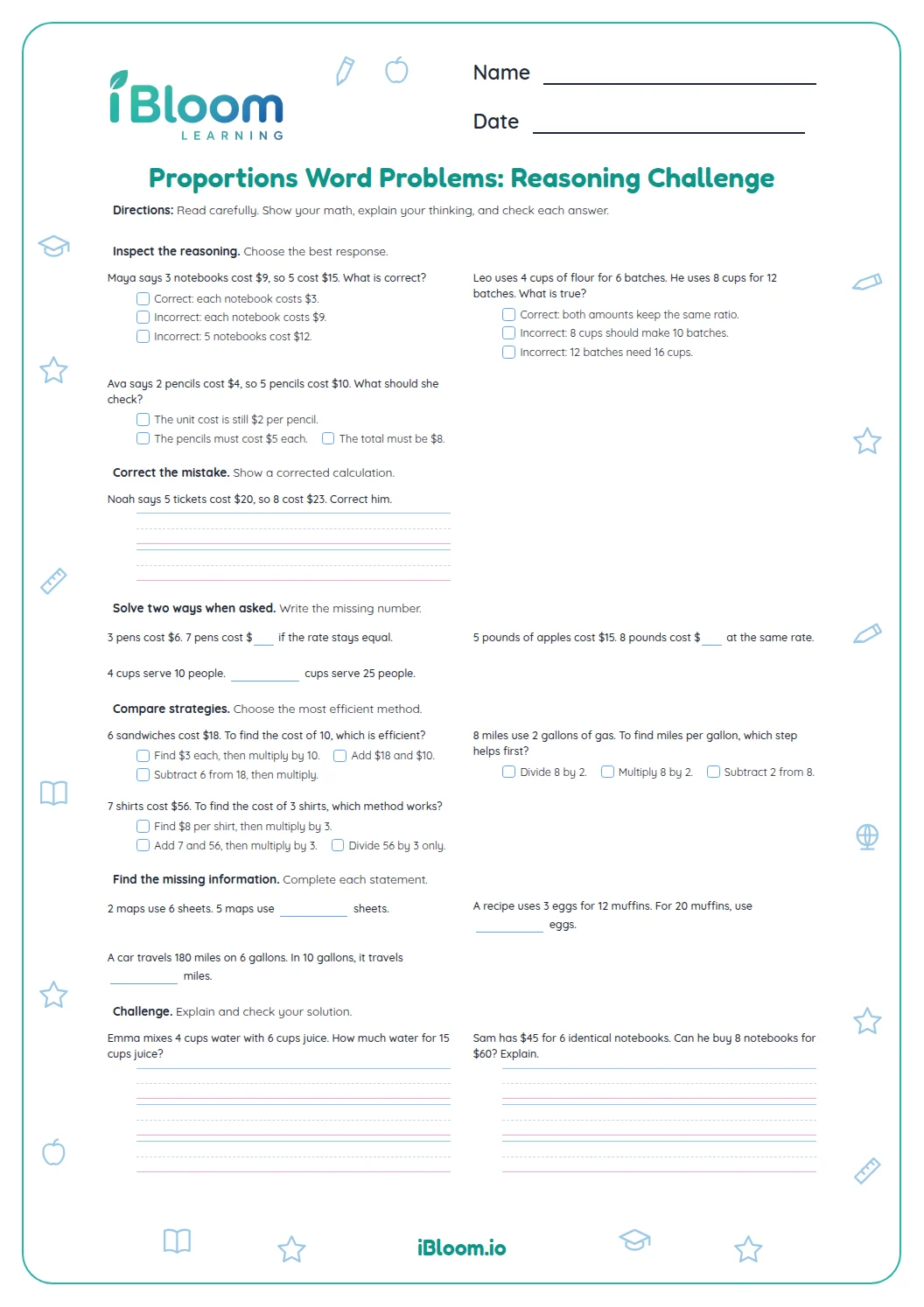
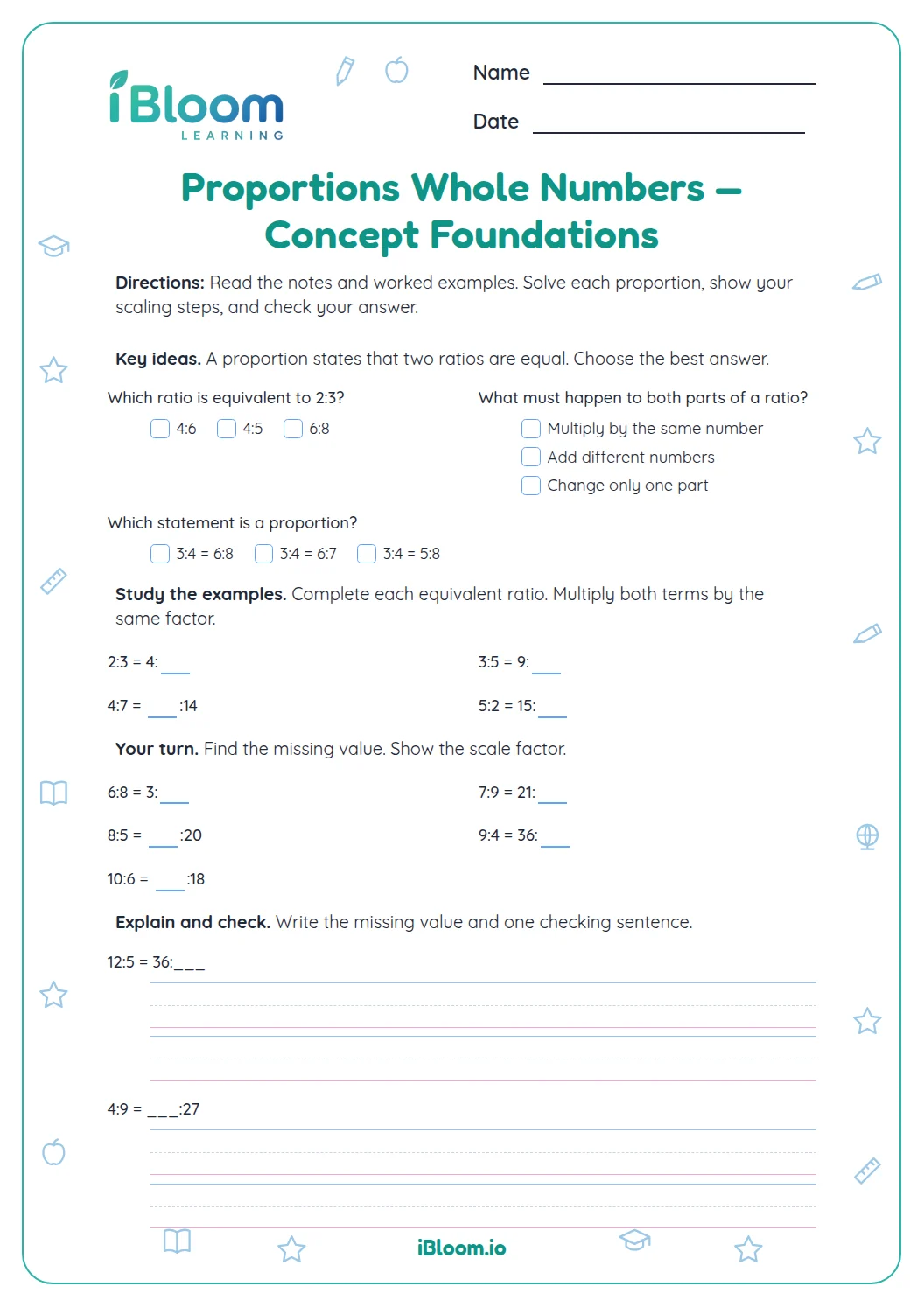
This Grade 6 worksheet uses proportions in everyday settings: notebooks, recipes, maps, travel, printing, paint and a faucet. Students solve 14 problems by finding a unit rate or scaling an equivalent ratio, then include the requested unit. The questions progress from whole-number contexts to decimal amounts and a proportional rate with a fractional time. A separate answer key gives the results.
Aligned to 6.RP.A.3
How does a unit rate help solve a problem?
A unit rate tells how much belongs to one item, one hour or one group. In question 1, three notebooks cost $6, so each costs $2. Five notebooks cost 5 × $2 = $10. The unit rate keeps the two quantities connected.
- 1$6 ÷ 3 notebooks = $2 per notebook
- 25 notebooks × $2 = $10
When can you scale an equivalent ratio?
When both quantities grow by the same factor, their ratio stays the same. Question 3 uses 1 cm for 4 km. Tripling the map distance from 1 cm to 3 cm also triples the real distance: 12 km.
How can you check the answer and its units?
Estimate first, then check the rate. A printer that makes 24 pages in 3 minutes makes 8 pages per minute, so 8 minutes gives 64 pages. A final answer should name the quantity asked for, such as pages, miles or liters.
How to use this worksheet
- 1Underline the two quantities that change together.
- 2Find a per-one rate or identify the scale factor.
- 3Multiply or divide both related quantities consistently.
- 4Write the target number with its unit.
- 5Estimate whether the result is reasonable.
- 6Check the original rate against your answer.
Common mistakes and quick fixes
The mistake
Scaling only one quantity in a ratio
The fix
Apply the same scale factor to both related quantities.
The mistake
Using the total as a per-one rate
The fix
Divide the known total by the known number of groups first.
The mistake
Forgetting the requested unit
The fix
Reread the question’s final phrase and label the answer.
Common Core alignment
This worksheet practices the listed Common Core skill through its questions.
Use ratio and rate reasoning to solve the worksheet’s real-world problems.
On this sheet: Each question asks students to scale an equivalent ratio or apply a unit rate in context.
Show the official wordingHide the official wording
Use ratio and rate reasoning to solve real-world and mathematical problems, e.g., by reasoning about tables of equivalent ratios, tape diagrams, double number line diagrams, or equations.
What to practice next
Make more practice
Further reading
Questions parents and teachers ask
What methods can students use?
Students can find a unit rate, scale both quantities by the same factor, or write equivalent ratios. For question 1, dividing $6 by 3 gives $2 per notebook; multiplying by 5 gives $10. Either method preserves the relationship between price and notebooks.
How do I know whether two quantities are proportional?
Check whether the ratio between them remains constant. If 3 notebooks cost $6, the unit price is $2 each; at that same rate, 5 cost $10. The worksheet states when a rate remains the same and asks students to calculate a matching amount.
Why should answers include units?
Units tell what the number measures and prevent mixing quantities. The map question asks for real distance, so its answer is 12 km. A bare 12 would not tell whether the result means centimeters or kilometers, so always label the result.
How is question 13 solved?
The cyclist travels 42 miles in 2 hours, or 21 miles per hour. In 3.5 hours, the cyclist travels 21 × 3.5 = 73.5 miles. The same speed is used throughout, so multiplying the unit rate gives the distance.
What mistake should students watch for?
Keep both quantities in a ratio connected by the same rate. In question 4, four tickets cost $18, so ten tickets cost $45 at that same price per ticket. Finding the amount for one ticket first is one way to keep the relationship clear.
Is there a separate answer key?
Yes. The answer key lists answers to all 14 proportion problems, with units where appropriate. Students can check calculations and verify that the rate or scale factor fits each situation before reviewing their work and correcting any step that changed only one quantity.