






About this worksheet
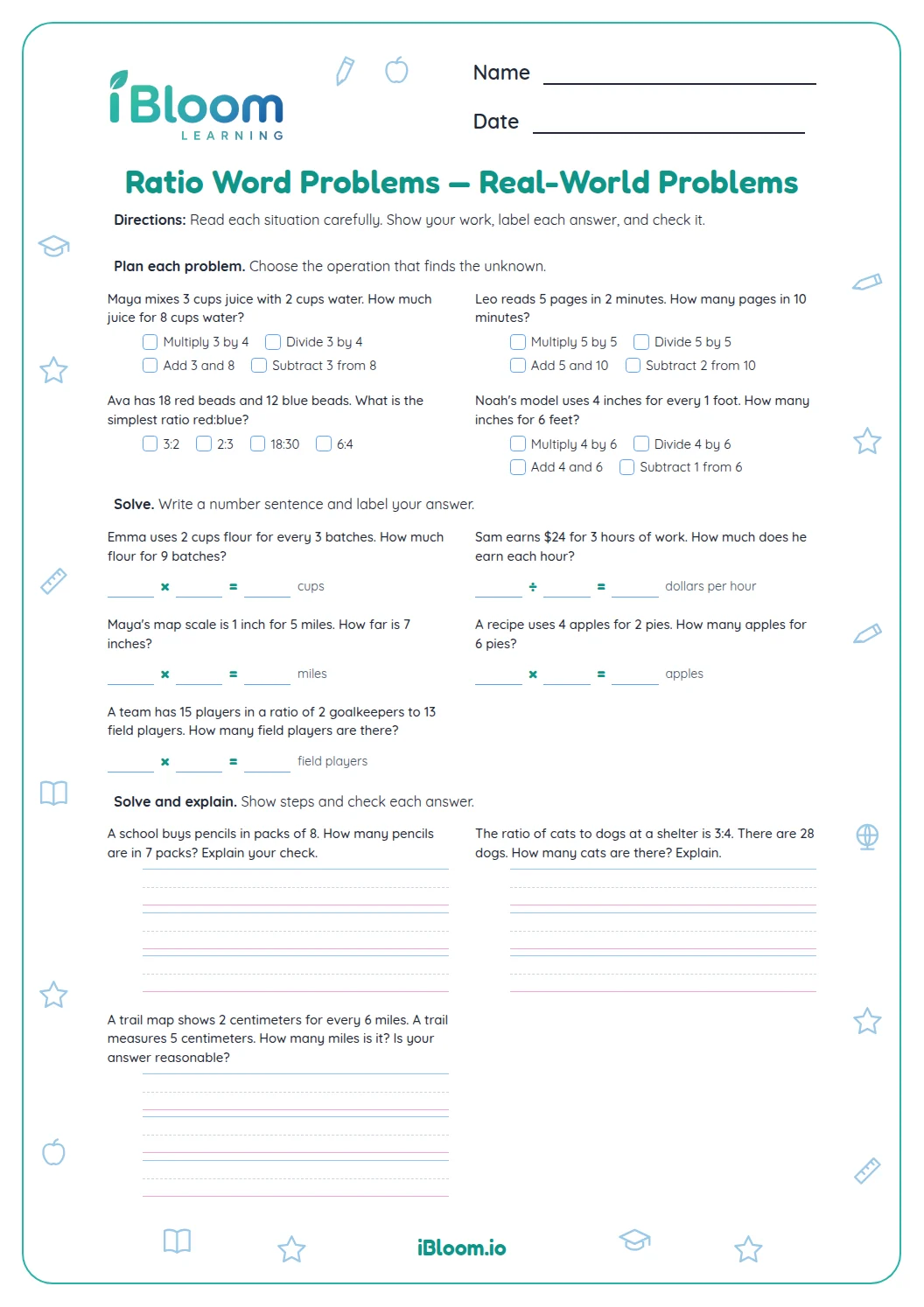
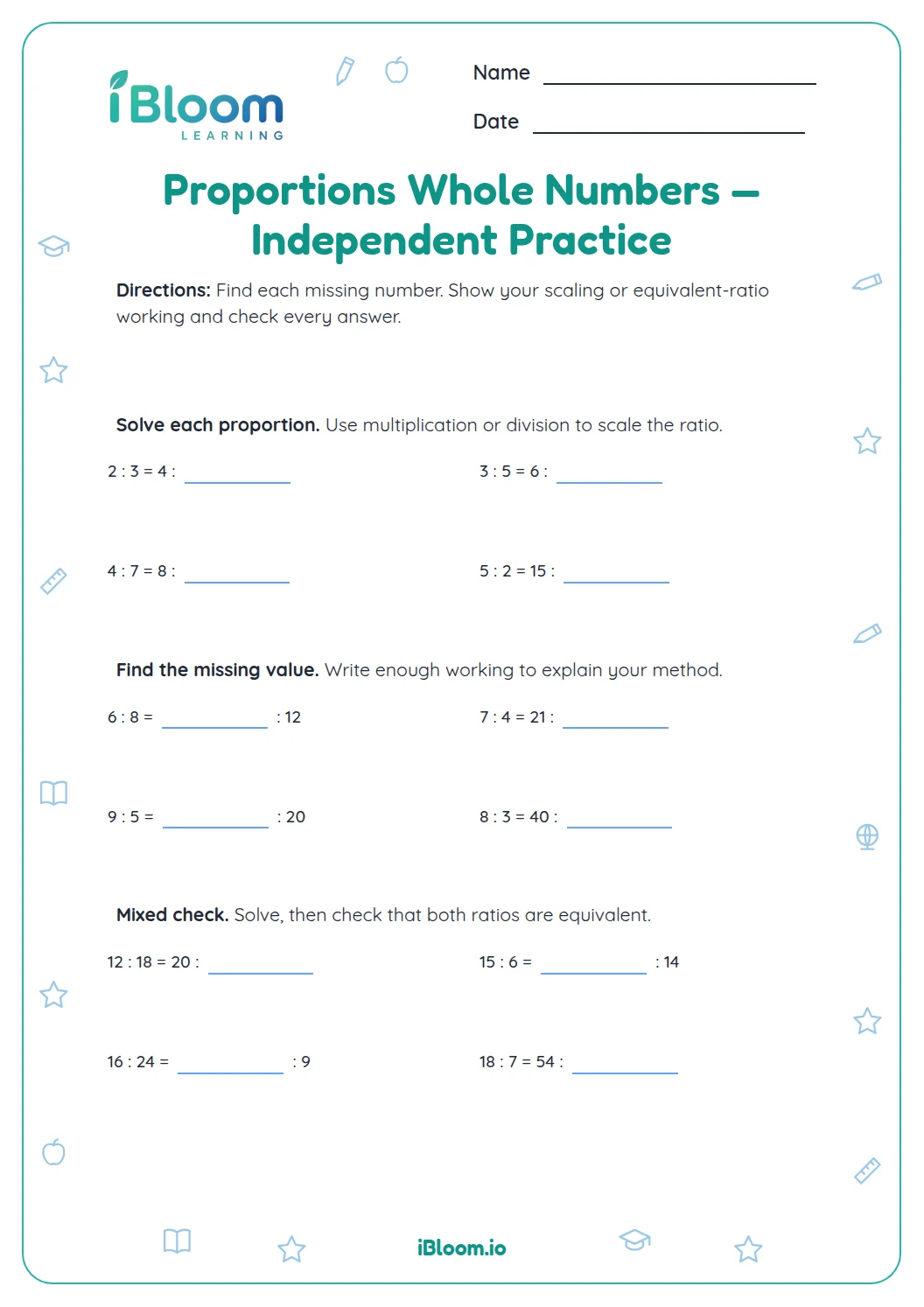
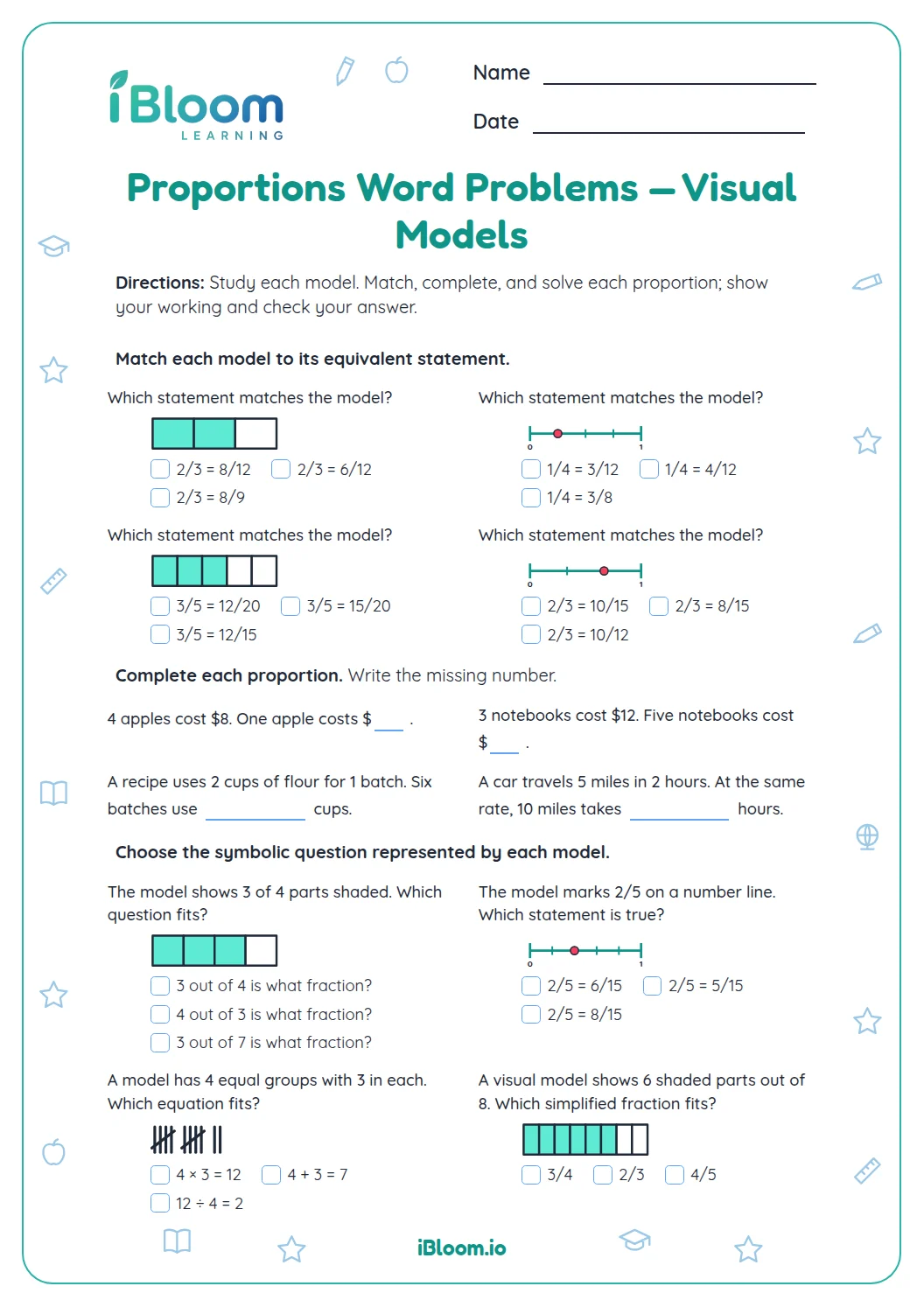
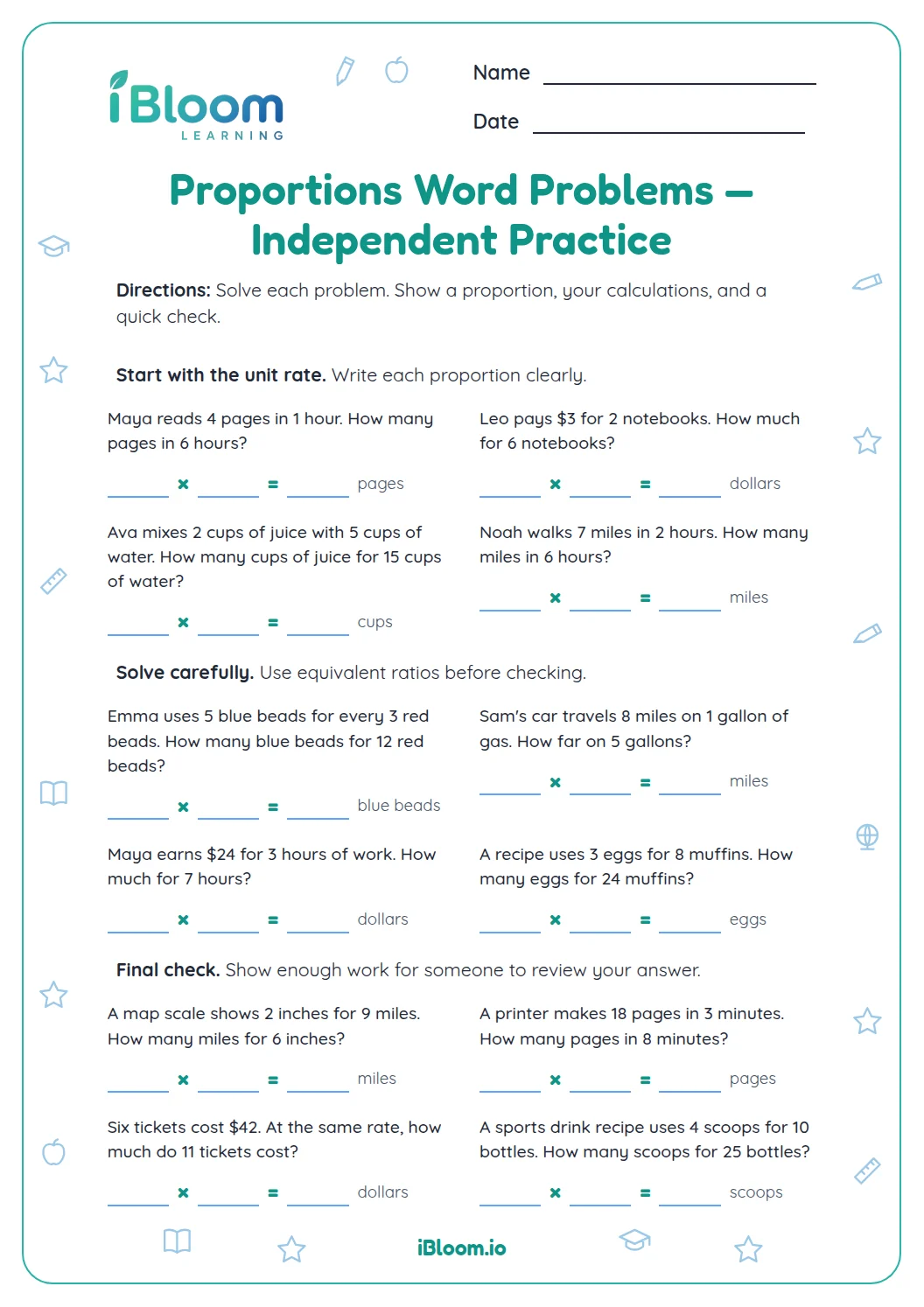
This Grade 6 guided practice sheet develops ratio reasoning through real-world situations. Students first scale equivalent ratios, then find unit rates, and finally solve part-to-part or total-part problems. Each of the 15 questions provides room for an equation and unit-labeled answer. The work aligns with CCSS 6.RP.A.3, which calls for ratio reasoning in real-world and mathematical problems. A separate key shows the matching calculations.
Aligned to 6.RP.A.3
How do you scale an equivalent ratio?
Keep the relationship between both quantities. If one quantity is multiplied by a factor, multiply the other by the same factor.
Question 1 compares oats and raisins in a 2:3 ratio. Since 9 raisins is 3 times 3, multiply 2 oats by 3 to get 6 cups.
- 1Oats : raisins = 2 : 3
- 23 to 9 is ×3
- 32 × 3 = 6 cups of oats
When should you find a unit rate?
A unit rate tells the amount for one unit, such as miles per gallon or dollars per notebook. Divide both quantities by the same number to reduce the comparison to one. For question 5, 150 miles ÷ 5 gallons = 30 miles per gallon.
How can you check a ratio answer?
Substitute the result into the original relationship. For a part-to-part ratio, compare the two parts; for a total, remember that the ratio parts add together. The final questions include totals and missing quantities to practice choosing the right setup.
How can students organize ratio problems?
- 1Underline the two quantities and keep their units attached.
- 2Write the given ratio in the order named by the story.
- 3Look for a scale factor or divide to find one unit.
- 4Apply the same factor to both parts of an equivalent ratio.
- 5For a total, add the ratio parts before finding each share.
- 6Check that the result makes sense in the original story.
Common ratio mistakes
The mistake
Multiplying only one part of a ratio.
The fix
Apply the same scale factor to both quantities to preserve the relationship.
The mistake
Reversing the requested order, such as writing boys-to-girls for girls-to-boys.
The fix
Write the labels above the ratio before simplifying it.
The mistake
Reporting a total when the question asks for a unit rate.
The fix
Divide to find the amount for one unit and include “per” in the answer.
Common Core alignment
This sheet uses ratio reasoning in rates, equivalent comparisons, and real-world problems.
Use equivalent ratios to solve real-world rate and ratio problems.
On this sheet: Each story uses equivalent ratios, unit rates, or a part-to-part relationship.
Show the official wordingHide the official wording
Use ratio and rate reasoning to solve real-world and mathematical problems, e.g., by reasoning about tables of equivalent ratios, tape diagrams, double number line diagrams, or equations.
What to practice next
Make more practice
Further reading
Questions parents and teachers ask
How many problems are included?
There are 15 ratio word problems across the two activity pages. Four ask students to scale equivalent ratios, four find unit rates, and seven apply ratios to part-to-part or total situations. The answer key provides the results and supporting calculations.
What is the answer to the trail-mix problem?
The mixture needs 6 cups of oats for 9 cups of raisins. The given ratio is 2 cups of oats to 3 cups of raisins; 3 is multiplied by 3 to make 9, so multiply 2 by 3 as well. That keeps the ratio equivalent.
What is a unit rate?
A unit rate gives the amount for one unit, such as miles per gallon or dollars per notebook. In question 5, divide 150 miles by 5 gallons to get 30 miles per gallon. Other questions practice cost, recipe amounts, and travel rates.
How do students simplify a part-to-part ratio?
Divide both quantities by the same common factor. For 18 girls to 12 boys, divide each part by 6 to get 3:2. Keep the order named in the question: girls first, then boys. This preserves what each side of the ratio represents.
How should students handle a ratio with a total?
Add the ratio parts to find the number of equal shares, then find the value of one share. For a 2:5 mixture totaling 21 cups, seven parts make 21 cups, so each part is 3 cups and the white portion is 15 cups.