



About this worksheet
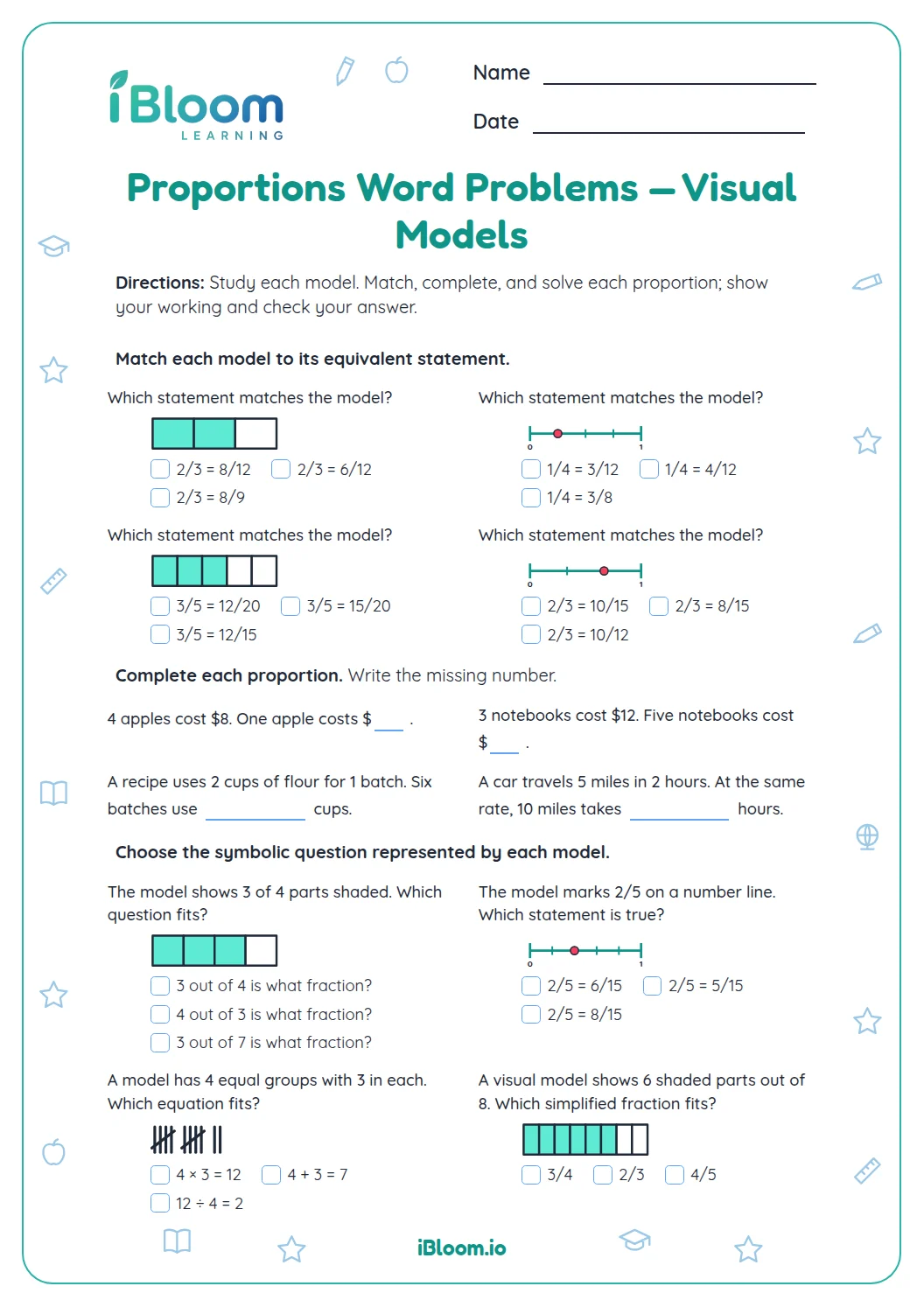
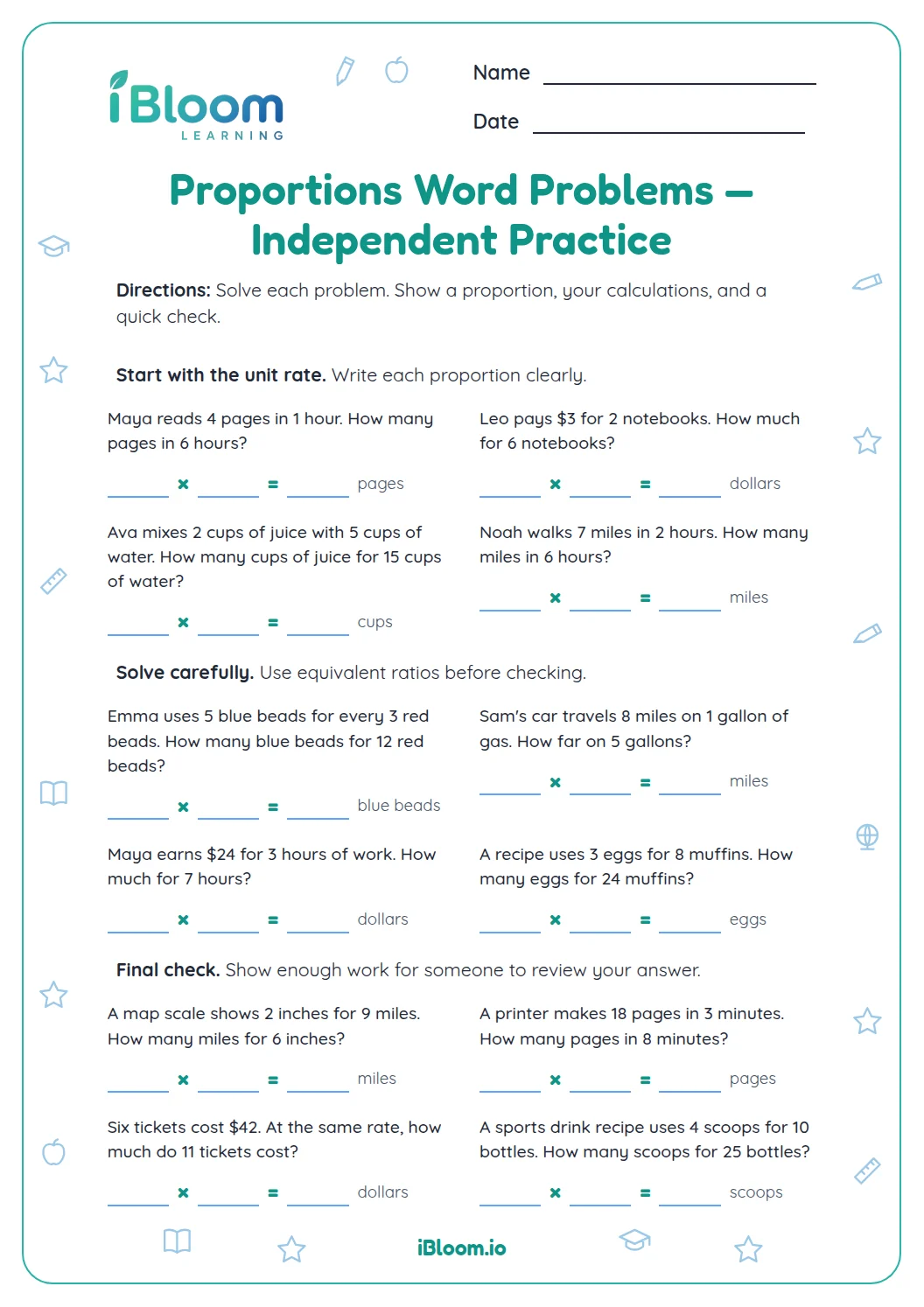
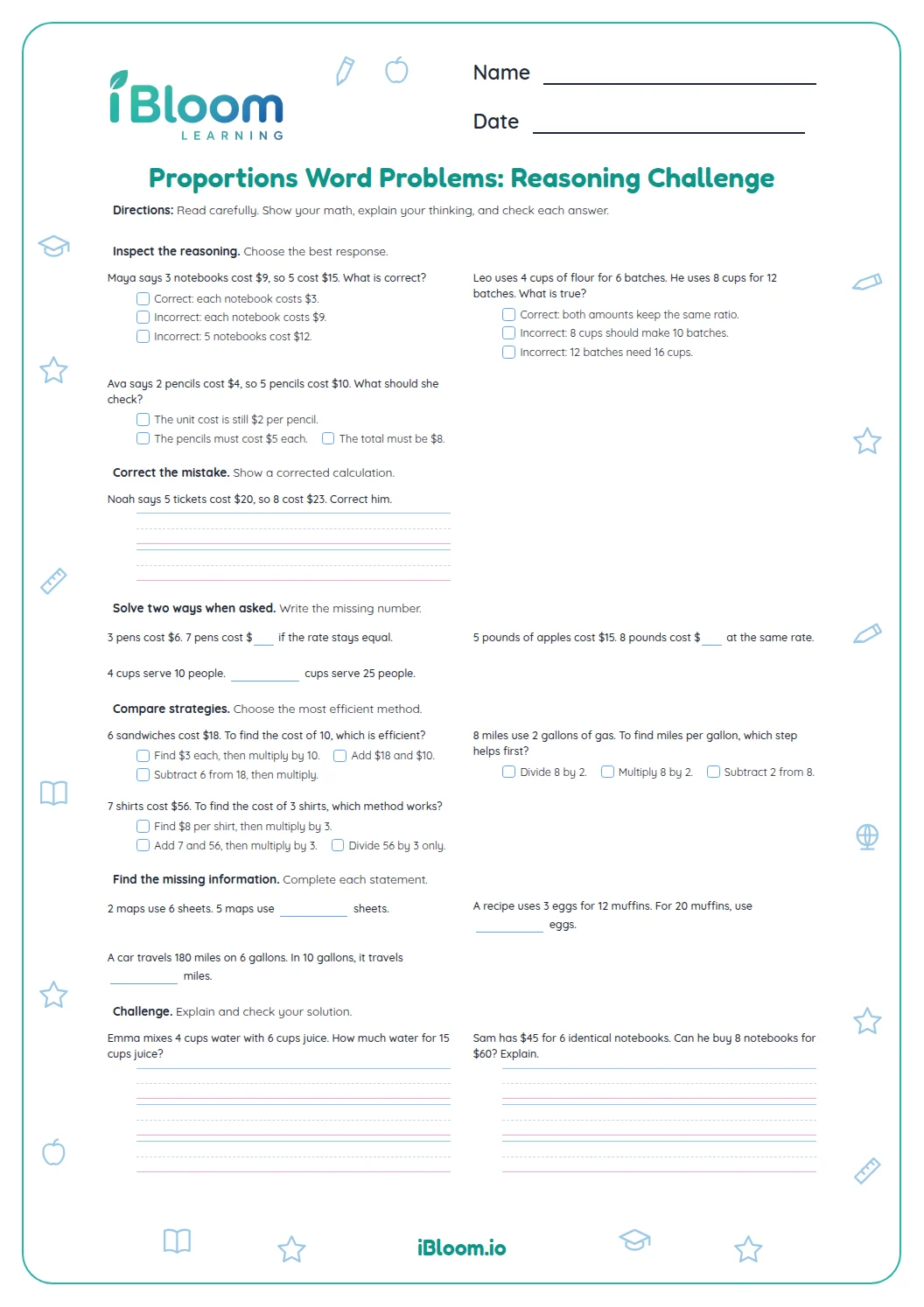
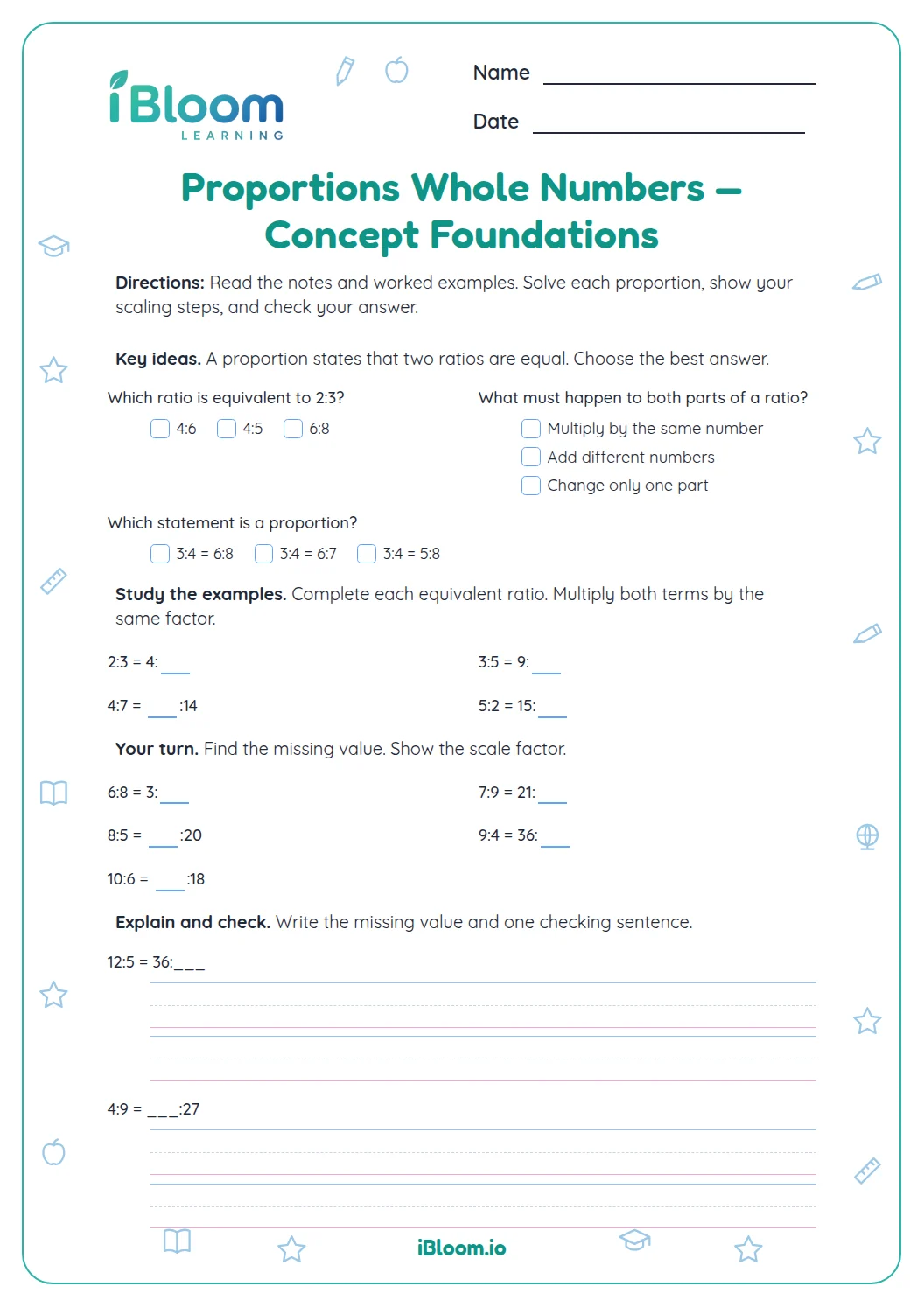
This free printable worksheet gives Grade 6 students guided practice with proportion word problems. Each part uses the one before it: find a unit rate, multiply it by a new amount, complete a proportion, then solve two word problems and compare two deals. The problems cover prices, speed, recipes and pay, and they practice Common Core 6.RP.A.2 and 6.RP.A.3.b. The sheet has 2 pages with 13 questions, and a separate answer key shows every answer.
Aligned to 6.RP.A.2 and 6.RP.A.3.b
What is on this worksheet?
Thirteen questions in five parts that move from guided to independent. The first two parts give children a sentence with a blank, so the structure is clear. The later parts ask for working and a choice between two deals.
The contexts are everyday ones: notebooks, grapes and apples, a car trip, a printer, flour and muffins, dog walking, rice, pens and pencils. The numbers are small enough to work without a calculator, which keeps the attention on setting up each problem.
- Part A: find the unit rate in 4 problems (questions 1 to 4)
- Part B: use the unit rate to scale up, 3 problems (questions 5 to 7)
- Part C: complete the proportion, 6/4 = 15/___ and 2/3 = ___/12 (questions 8 and 9)
- Part D: two word problems with working space (questions 10 and 11)
- Part E: pick the better buy and find a mistake (questions 12 and 13)
How do you find a unit rate?
A unit rate tells how much for one of something: one notebook, one hour, one pound. To find it, divide the total by the number of items. Four notebooks for $20 gives 20 ÷ 4 = $5 for one notebook.
Once children have the unit rate, the rest is multiplication. That is why Part B follows Part A: if apples cost $3 per pound, then 9 pounds cost 9 × $3 = $27.
- 1Question 2: 240 miles in 4 hours → 240 ÷ 4 = 60 miles per hour
- 2Question 6: 60 miles per hour for 6 hours → 6 × 60 = 360 miles
- 3The unit rate links the two questions.
How do you complete a proportion?
A proportion says two ratios are equal. In 6/4 = 15/___, the numerator went from 6 to 15, so it was multiplied by 2.5. The denominator must be multiplied by the same amount: 4 × 2.5 = 10.
The unit rate gives a second route. In 6/4 the top number is 1.5 times the bottom one, because 6 ÷ 4 = 1.5. The same must be true of 15/___, so the missing number is 15 ÷ 1.5 = 10. Both methods give 10, so children can check one against the other.
- 1Question 9: 2/3 = ___/12
- 23 × 4 = 12, so multiply 2 by 4 too
- 32 × 4 = 8, so 2/3 = 8/12
How do you decide which deal is the better buy?
Compare the price of one for each deal. In question 12, 4 pens for $6 is $6 ÷ 4 = $1.50 per pen, and 6 pens for $8 is about $1.33 per pen. The cheaper price for one means the better buy.
Comparing rates is a real-life use of unit rates. Children cannot judge by the total price alone, because the two deals have different numbers of pens.
How to use this worksheet at home or in class
- 1Read the Part A directions together. Remind your child that a unit rate is the amount for one.
- 2Have your child do Parts A and B, then check each unit rate by multiplying it back.
- 3For Part C, ask what the top number was multiplied by, then use the same amount on the bottom.
- 4In Part D, have your child write the unit rate first on the working space, then scale up.
- 5In Part E, ask your child to find the price of one pen for both deals before choosing.
- 6Use the key to find the first wrong answer, and ask your child to rework that problem.
Common mistakes and quick fixes
The mistake
Multiplying instead of dividing to find the unit rate, such as 5 × $15 = $75 for one pencil in question 13.
The fix
Ask whether one pencil should cost more or less than 5 pencils. One pencil costs less, so the total has to be divided by 5, which gives $3.
The mistake
Adding the same amount to both parts of a proportion, such as 6/4 becoming 15/13.
The fix
Show that a proportion keeps the ratio equal by multiplying, not adding. Doubling a recipe doubles both parts. Here both parts are multiplied by 2.5.
The mistake
Choosing the deal with the lower total price, such as 4 pens for $6 in question 12.
The fix
Remind your child that the deals have different amounts. Divide each price by the number of pens, then compare the price of one pen.
Common Core alignment
Most US states teach ratios with the Common Core standards or a close state version. These Grade 6 standards cover the unit rates and rate problems on this sheet.
Understand a unit rate as the amount for one and use rate language.
On this sheet: Part A finds unit rates such as $5 per notebook and 60 miles per hour.
Show the official wordingHide the official wording
Understand the concept of a unit rate a/b associated with a ratio a:b with b ≠ 0, and use rate language in the context of a ratio relationship.
Solve unit rate problems, including unit pricing and constant speed.
On this sheet: Parts B, D and E use unit prices and speed to scale up and to compare two deals.
Show the official wordingHide the official wording
Solve unit rate problems including those involving unit pricing and constant speed.
What to practice next
Make more practice
Further reading
Questions parents and teachers ask
What is a unit rate?
A unit rate compares a quantity to exactly one of something, such as dollars per notebook or miles per hour. On this sheet, 4 notebooks for $20 gives a unit rate of $5 per notebook. You find a unit rate by dividing the total amount by the number of items.
What is the difference between a ratio and a proportion?
A ratio compares two amounts, such as 3 cups of flour to 12 muffins. A proportion says two ratios are equal, such as 6/4 = 15/10. Part C asks children to complete proportions, and the unit rate method in Parts A and B gives another way to reach the same answer.
Do my child’s answers need the unit?
Yes, the directions ask children to write units with their answers, and the key shows them, such as $80 and 5 cups. Units help children check that an answer makes sense. A price should be in dollars, a speed in miles per hour, and a recipe amount in cups.
Is there more than one way to solve the word problems?
Yes. In question 10, a child can find the unit rate, $48 ÷ 6 = $8 per hour, and multiply by 10. Another child may notice that 10 hours is 6 hours plus 4 hours and work from there. Accept any method that gives $80 and shows clear working.
Why does question 13 give a wrong answer?
Question 13 shows a typical mistake, multiplying 5 by $15 to get $75, so children must find the error. They ask whether one pencil should cost more than five pencils together. Finding why an answer is unreasonable is a useful check for any unit rate problem.
What should my child do after this worksheet?
Ask your child to find a unit price at a grocery store, such as the price per ounce of two cereal boxes, and decide which is the better buy. Then try the ratio word problems or the proportions with whole numbers worksheet for more practice.