


About this worksheet
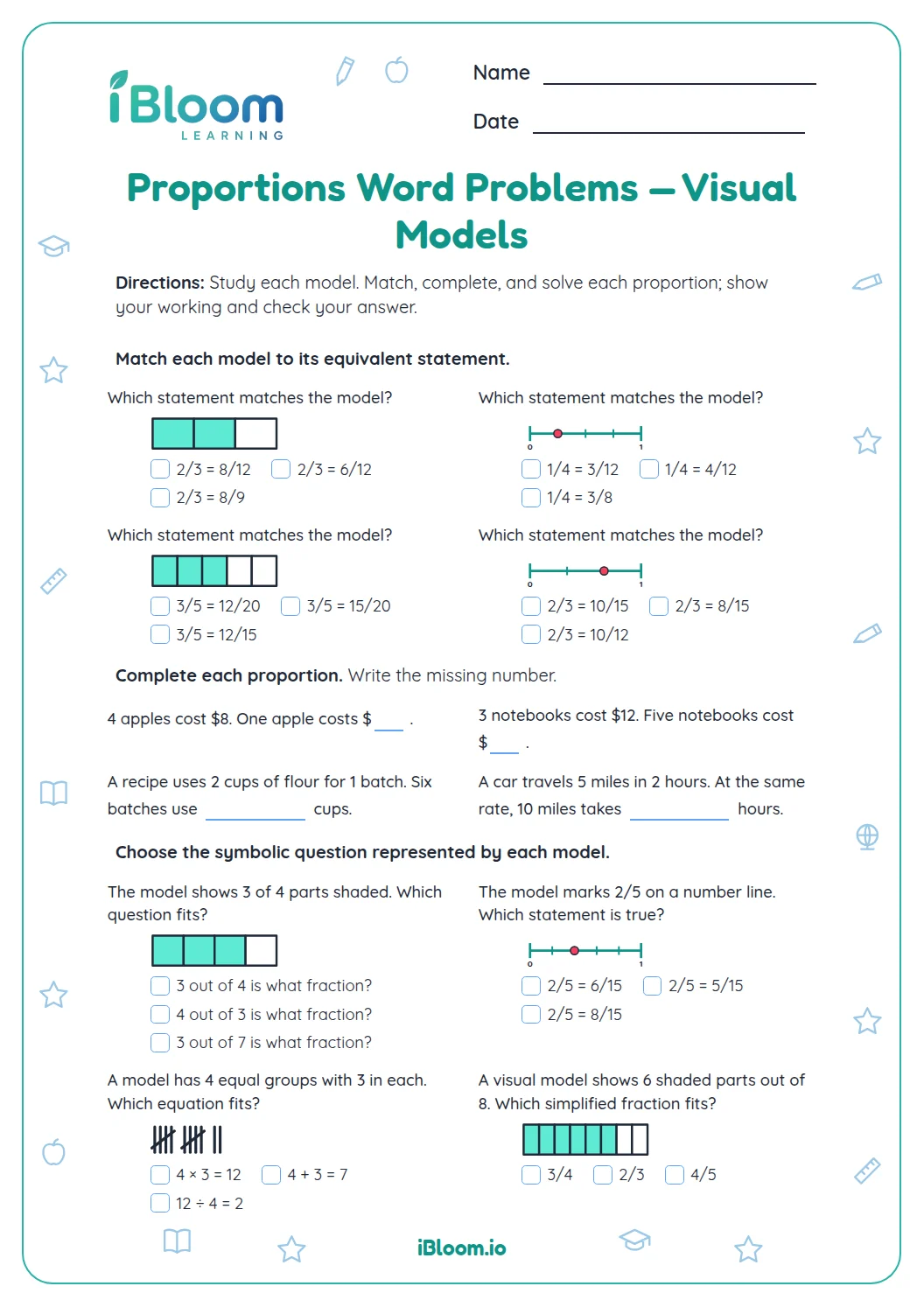
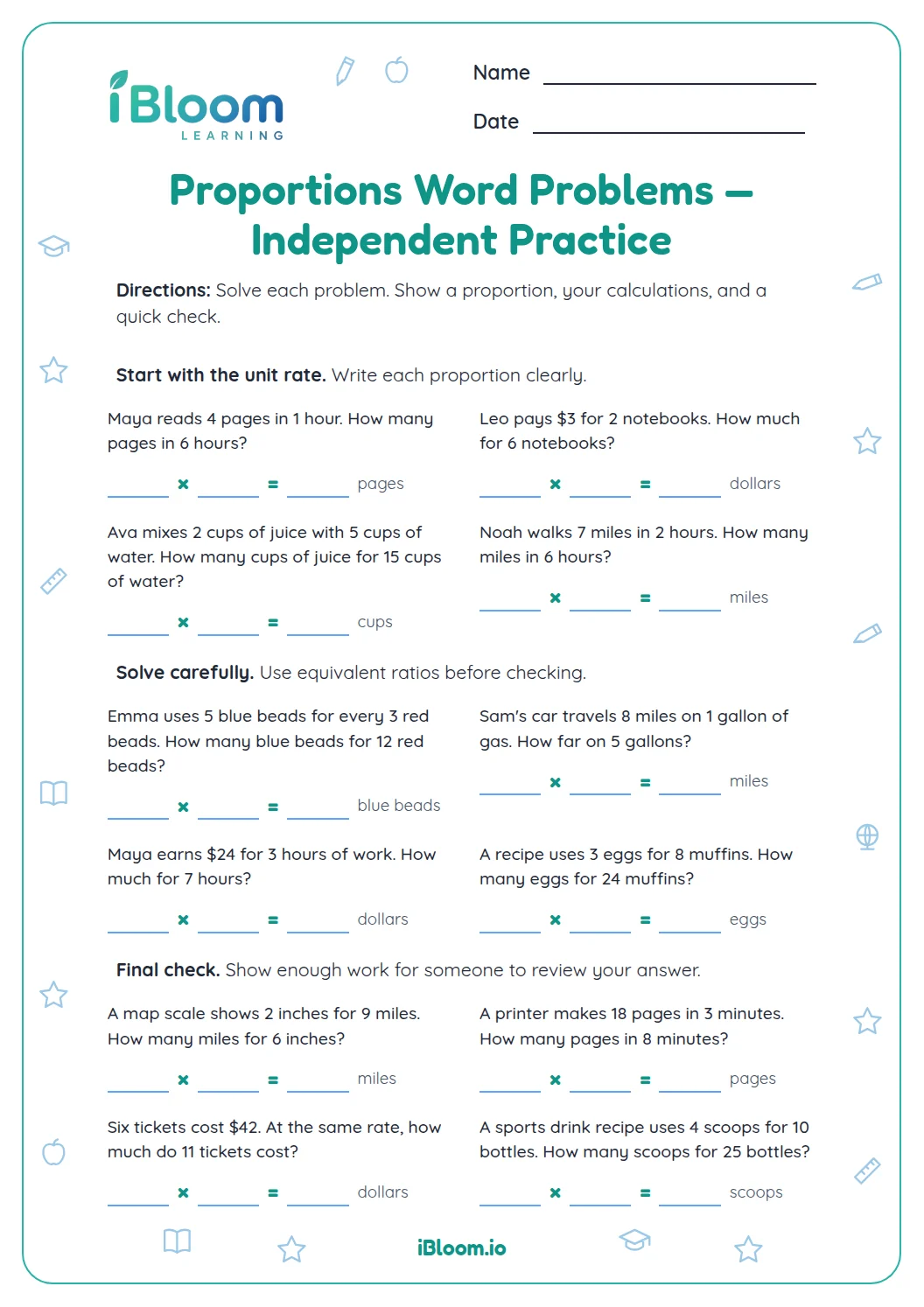
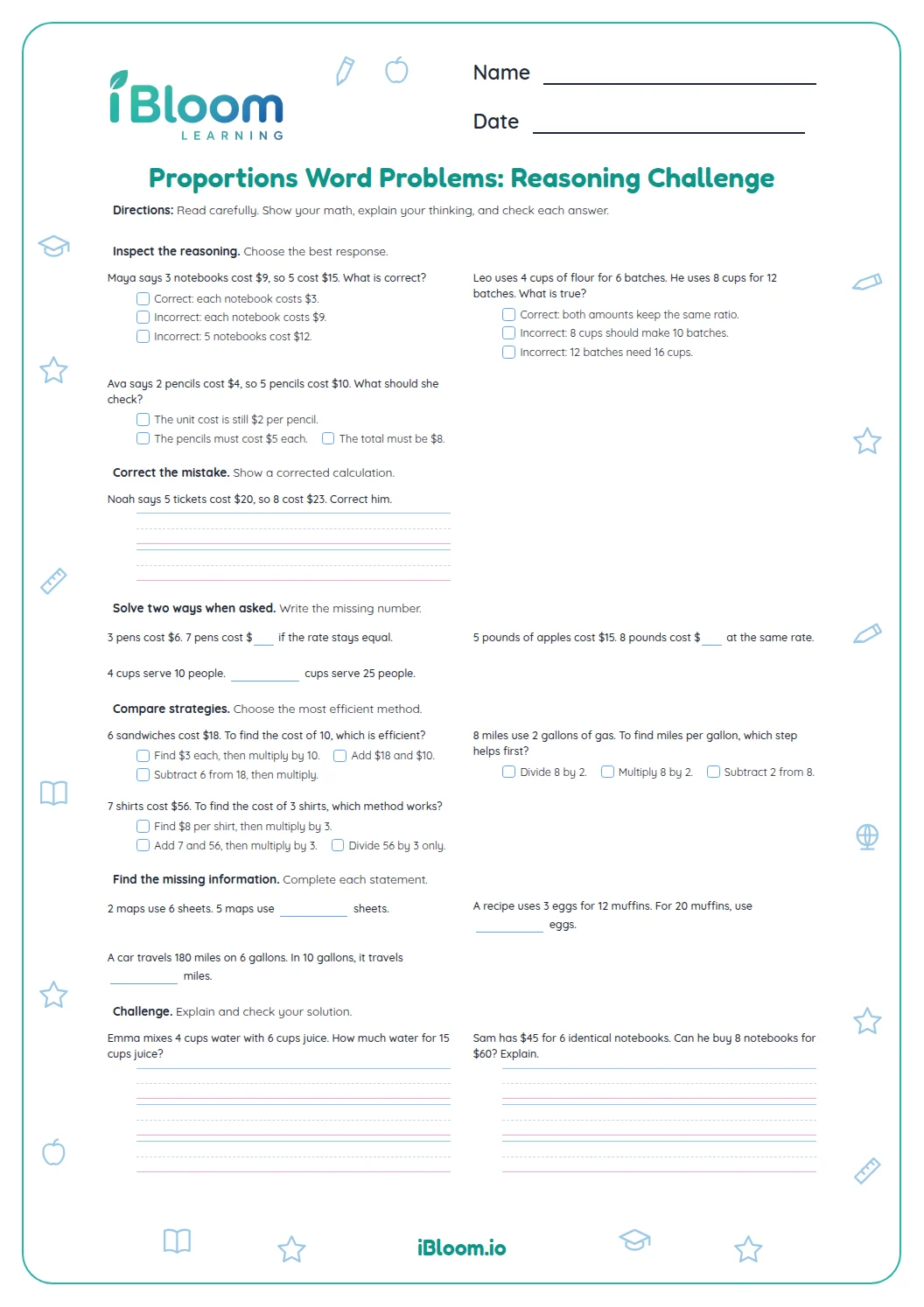
This free Grade 6 worksheet gives students 16 real-world proportion problems involving map scales, unit prices, recipes, work rates, and travel. Students can build equivalent ratios or find a unit rate, then scale it to the requested amount. The problems progress from direct scaling to fractional quantities and a reasoning check. It aligns with Common Core 6.RP.A.3 and includes a separate answer key.
Aligned to 6.RP.A.3
How do you scale a ratio?
A proportion keeps two ratios equivalent. In question 3, the cups of water triple from 8 to 24, so the scoops triple from 3 to 9.
- 18 cups × 3 = 24 cups
- 23 scoops × 3 = 9 scoops
When is a unit rate useful?
A unit rate tells how much for one unit. In question 7, 84 pages ÷ 7 minutes = 12 pages per minute.
What kinds of situations are included?
The contexts include shopping, recipes, maps, travel, gardening, and production. Later questions use decimals and ask students to evaluate an incorrect claim.
How to use this worksheet
- 1Underline the two quantities and their units.
- 2Check whether the quantities increase together at a constant rate.
- 3Scale both values by the same factor, or divide to find a unit rate.
- 4Keep units attached to intermediate and final values.
- 5Estimate whether the result is reasonable.
Common mistakes and quick fixes
The mistake
Scaling only one quantity, such as tripling cups but not scoops.
The fix
Apply the same multiplier to both quantities in the ratio.
The mistake
Adding the same amount instead of scaling, such as adding 2 to both ratio terms.
The fix
Use multiplication or division by one common factor.
The mistake
Giving a number without a unit.
The fix
Write the requested unit after the value.
Common Core alignment
This worksheet practices ratio reasoning in familiar real-world settings.
Use ratio and rate reasoning to solve real-world problems.
On this sheet: Every item scales equivalent ratios or uses a unit rate in a real context.
Show the official wordingHide the official wording
Use ratio and rate reasoning to solve real-world and mathematical problems, e.g., by reasoning about tables of equivalent ratios, tape diagrams, double number line diagrams, or equations.
What to practice next
Make more practice
Questions parents and teachers ask
How do I choose between equivalent ratios and a unit rate?
Both methods work when the quantities change at a constant rate. An equivalent ratio scales both quantities by the same factor; a unit rate finds the amount for one unit first. In question 1, 2 cm becomes 6 cm by multiplying by 3, so 5 km also becomes 15 km.
What is the answer to the map problem?
Question 1 gives a map scale of 2 cm for 5 km. Since 6 cm is three times 2 cm, the matching real distance is 15 km. Students can show 2:5 = 6:15 or multiply 5 by 3.
Can students use decimals in the problems?
Yes. Questions 8, 11, 13, and 16 use fractional or decimal quantities, including 1.5-foot pieces, 3.5 inches on a map, 2.5 cups, and 4.5 hours. Students can scale both quantities or use a unit rate, then check that the units match the story.
What does the answer key include?
The separate key gives a result for all 16 questions. It includes units for real-world measurements and rates, such as miles, dollars, and pages per minute, so students can check both the number and what it measures in each situation.