




About this worksheet
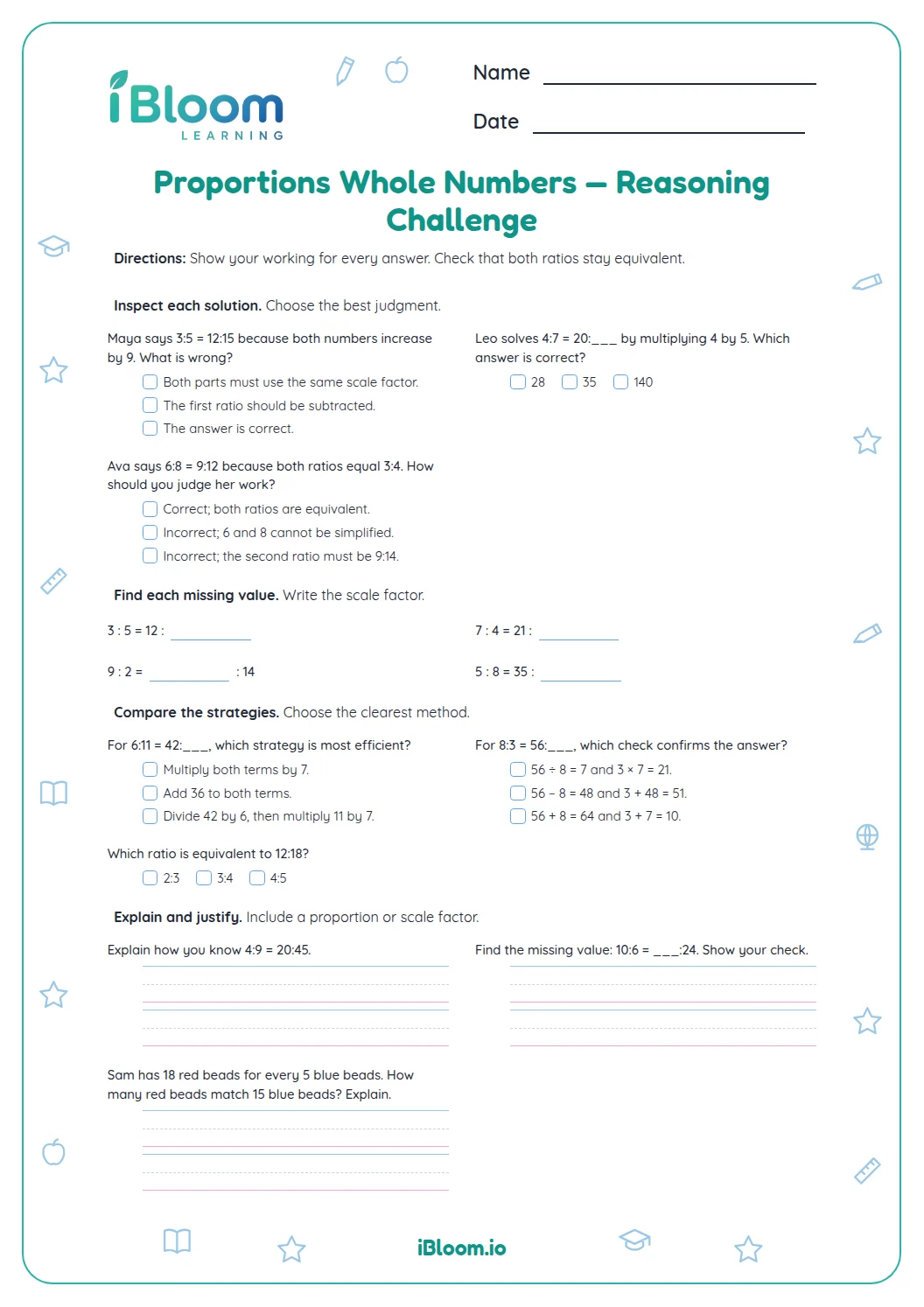
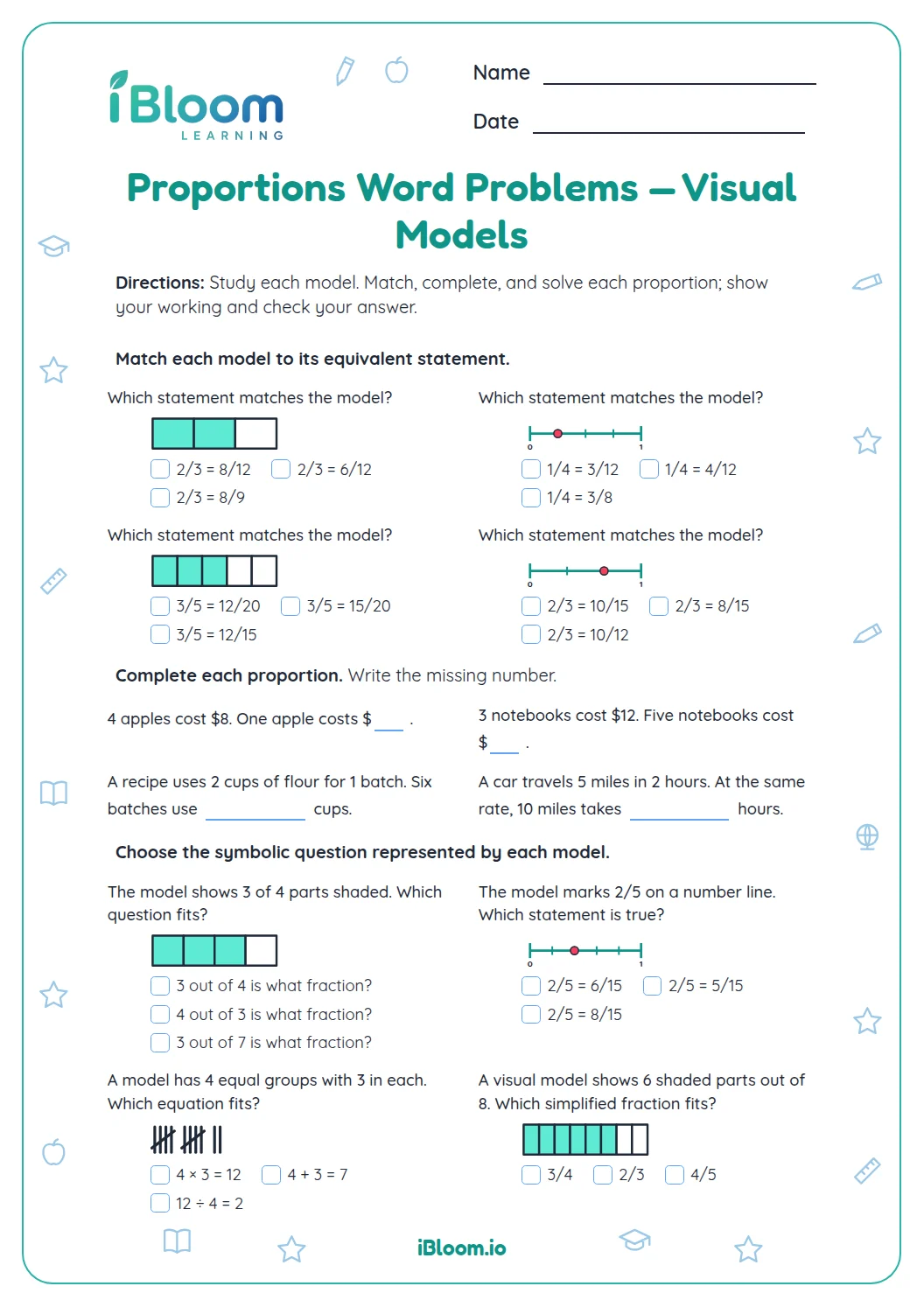
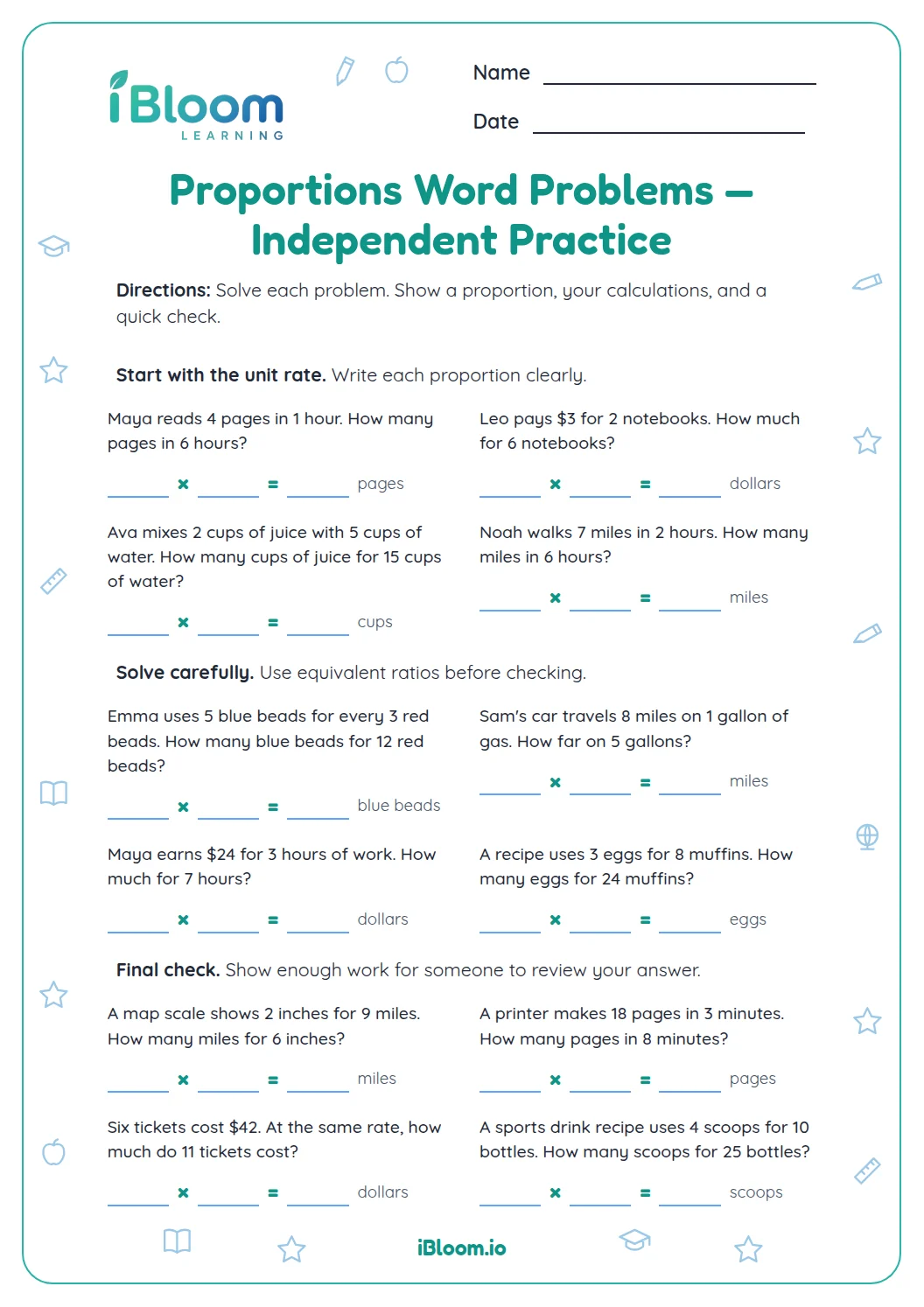
This free Grade 6 worksheet guides students through proportions with whole-number terms and answers. Part A names the multiplication or division to use on both terms of a ratio. Part B removes those hints and changes the location of the missing number. Part C applies the same reasoning to ticket prices, recipe servings, notebooks and ribbon. The twelve questions practice Common Core 6.RP.A.3 through equivalent-ratio equations and real-world problems. A separate answer key gives every missing number and each story answer with its unit.
Aligned to 6.RP.A.3
Why must both ratio terms use the same factor?
A proportion says two ratios are equal. Multiplying both terms by the same positive factor makes more copies of the original relationship. Dividing both terms by the same factor makes fewer copies while keeping the relationship unchanged.
Adding the same amount to both terms does something different. Starting with 2/5, adding 10 to both terms gives 12/15, which is not equivalent to 2/5.
- 12/5 = ___/15
- 25 × 3 = 15, so use a factor of 3.
- 32 × 3 = 6.
- 4The completed proportion is 2/5 = 6/15.
How does the worksheet gradually remove help?
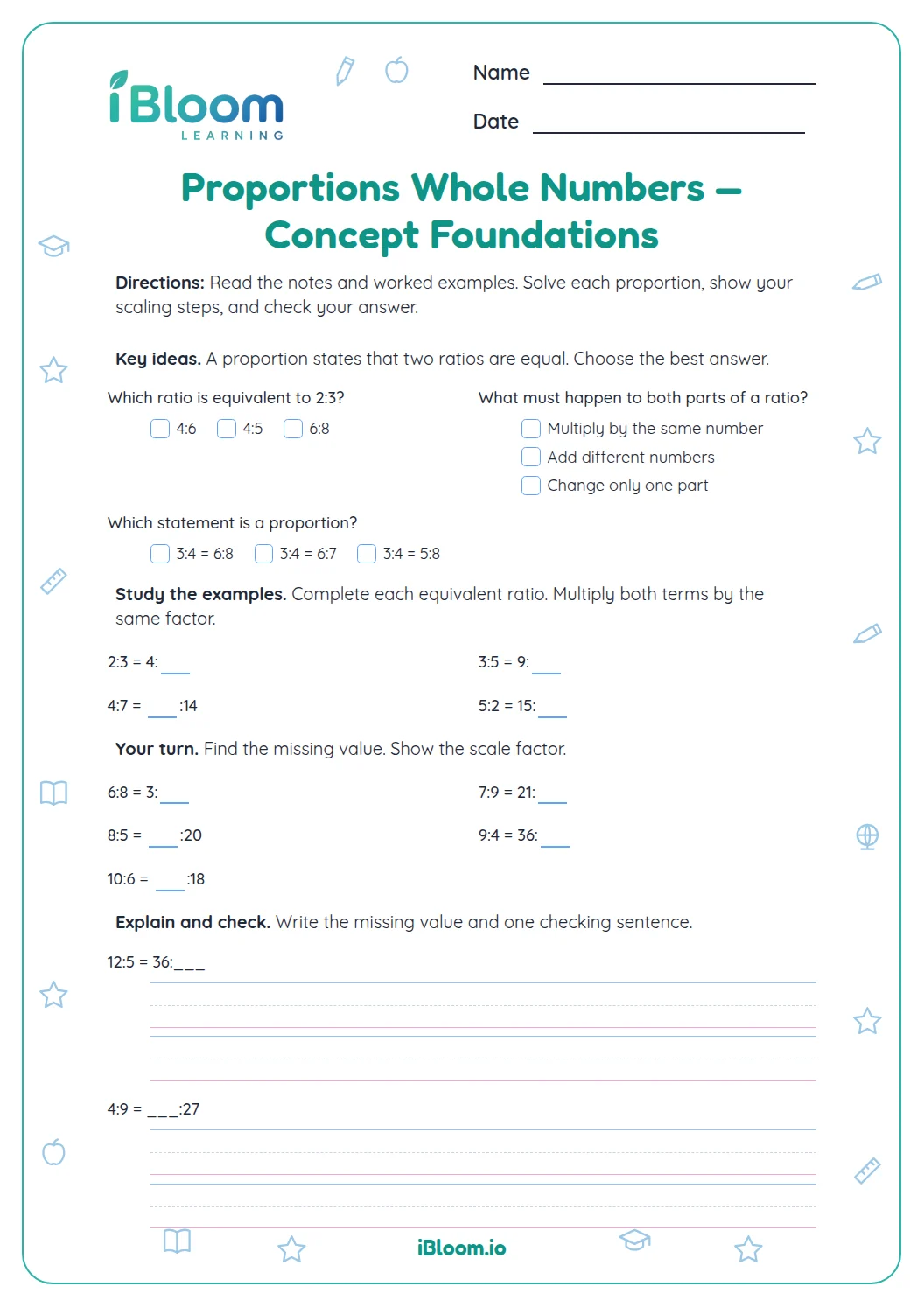
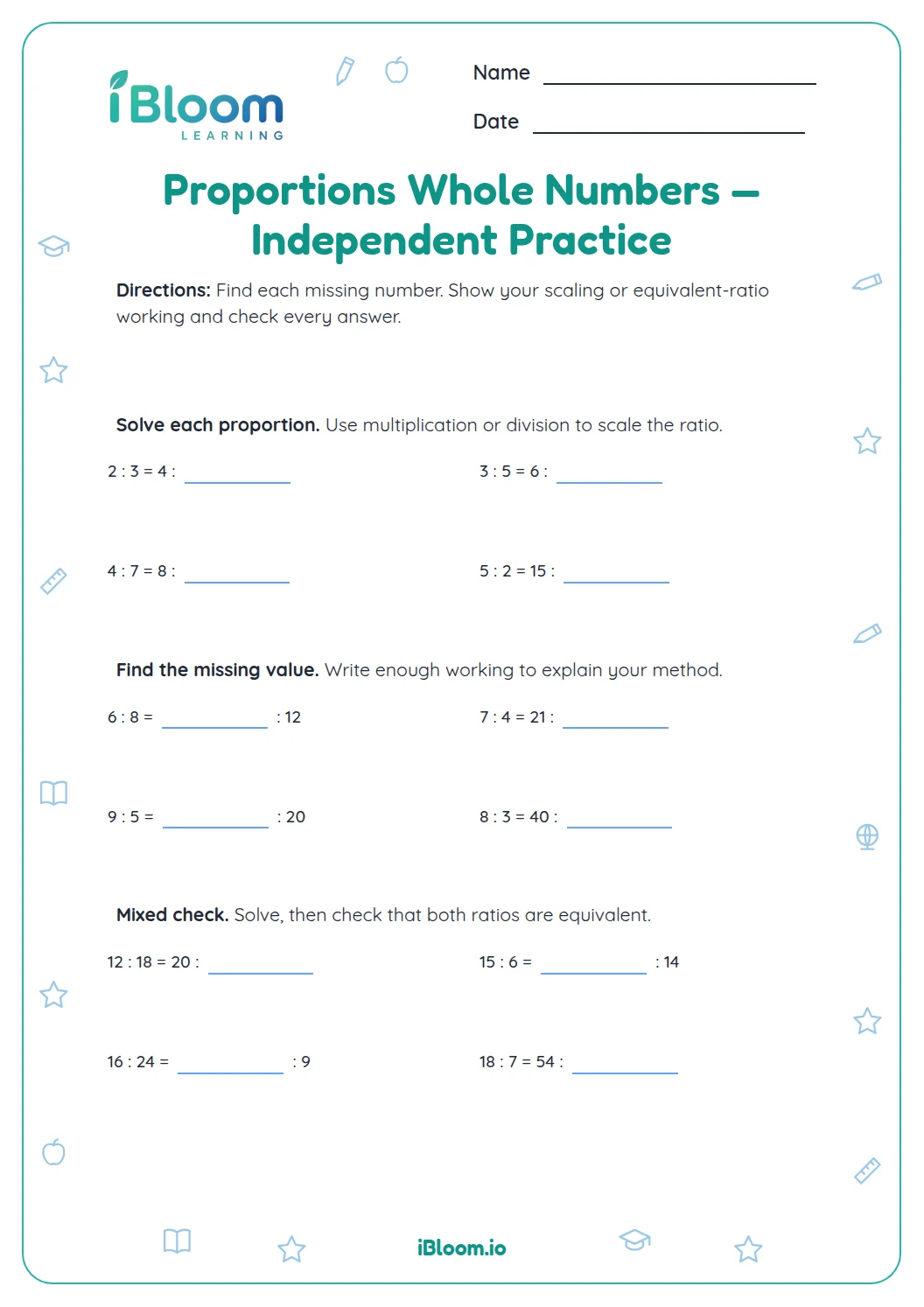
Part A gives four directions: multiply by 3, multiply by 5, divide by 6 and divide by 8. Students still work out the missing term. Part B gives four bare proportion equations, with blanks in different positions.
Ask students to mark the known matching pair first. In question 7, the numerators change from 9 to 27, so the scale factor is 3. The missing denominator must triple to 36, giving 12.
How should students set up the word problems?
Keep the quantities in the same order on both sides. For the ticket question, tickets over dollars gives 3/12 = 5/20. A cost per ticket of $4 is another useful way to reach the answer.
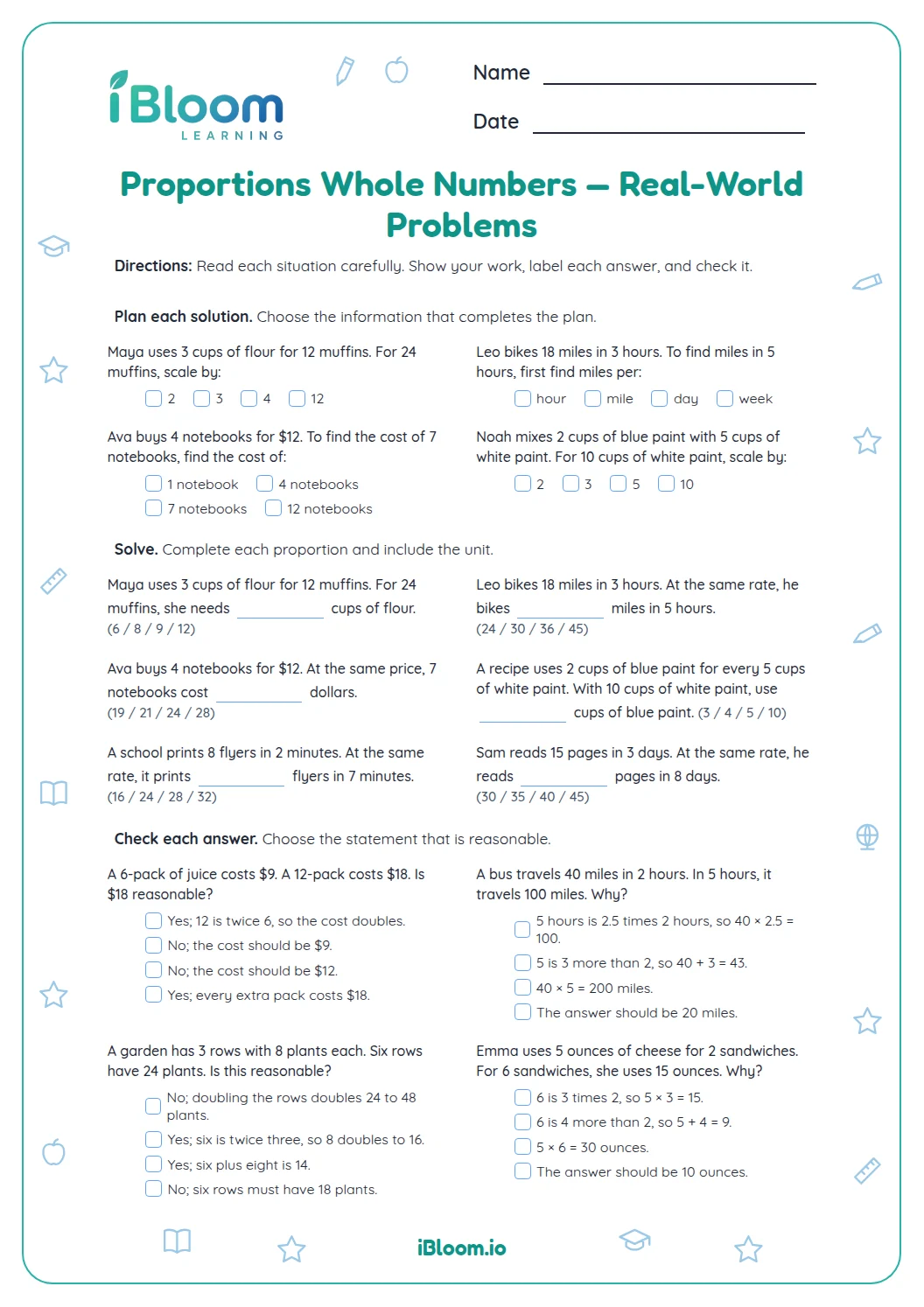
Every story specifies an unchanged price, recipe ratio or amount of ribbon per flag. Students can scale directly or find the amount for one item. In either method, label the final answer so the quantity is clear.
How to use this worksheet
- 1Read the scaling instruction in the first Part A question.
- 2Apply that multiplication or division to both terms.
- 3In Part B, find a known matching pair and work out its factor.
- 4Substitute each answer and check that both ratios are equivalent.
- 5For Part C, label the two quantities and keep their order consistent.
- 6Write a calculation in the working space and include the answer unit.
Mistakes to notice and how to help
The mistake
Adding 10 to both terms of 2/5 to get 12/15.
The fix
The denominator triples from 5 to 15, so triple the numerator: 2 × 3 = 6.
The mistake
Multiplying 36 by 3 in 9/___ = 27/36.
The fix
The missing left denominator becomes 36 after tripling. Undo that step: 36 ÷ 3 = 12.
The mistake
Comparing tickets per dollar on one side with dollars per ticket on the other.
The fix
Write the quantity names beside each ratio and keep the top and bottom labels in the same order.
Common Core alignment
Use equivalent ratios to find missing whole numbers and solve everyday problems.
On this sheet: Children multiply or divide both terms of a ratio by the same factor and use equivalent ratios in four word problems.
Show the official wordingHide the official wording
Use ratio and rate reasoning to solve real-world and mathematical problems, e.g., by reasoning about tables of equivalent ratios, tape diagrams, double number line diagrams, or equations.
What to practice next
Make more practice
Further reading
Questions parents and teachers ask
What makes these proportion questions guided practice?
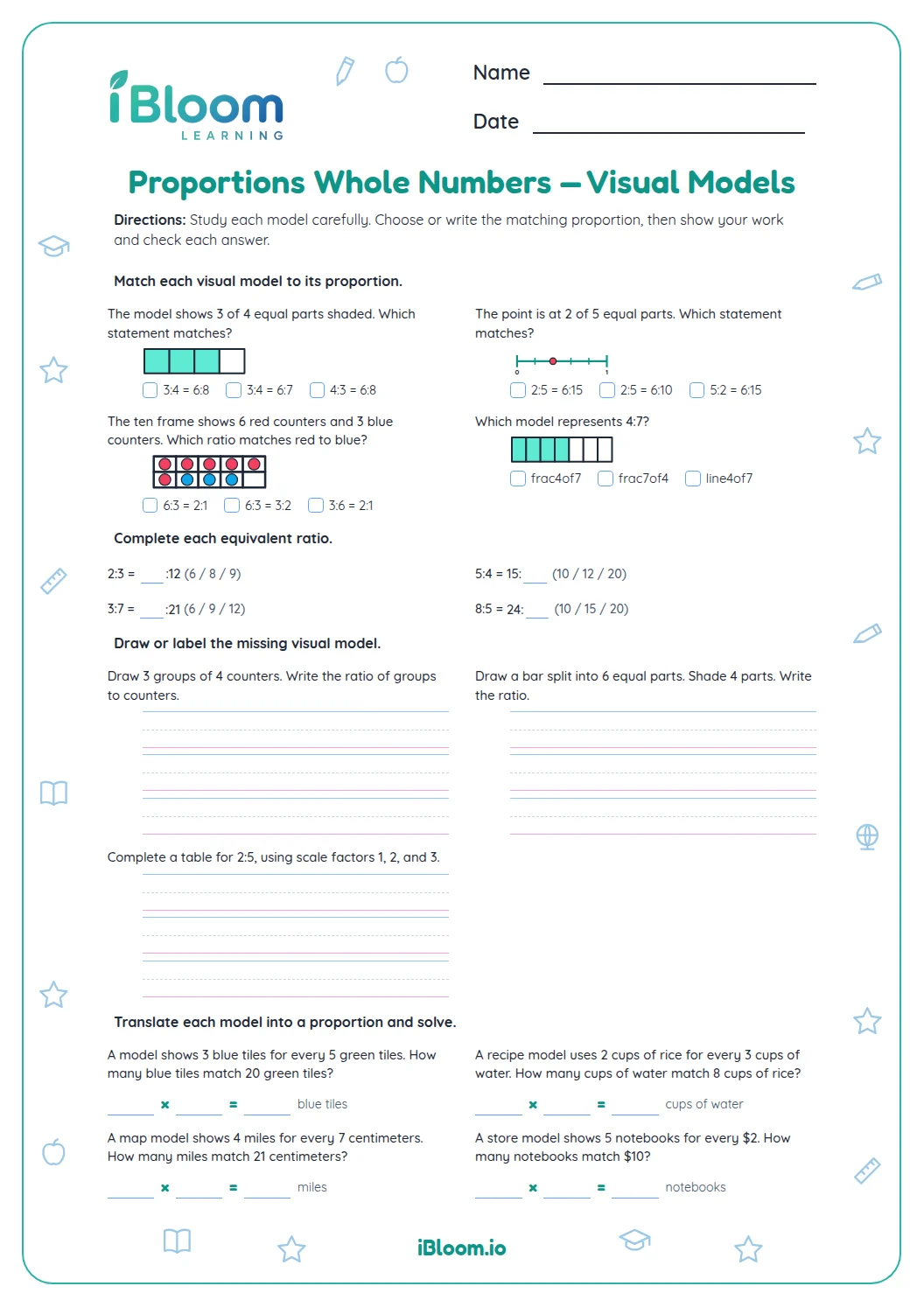
The first four questions tell students exactly how to scale a ratio, including two multiplication steps and two division steps. The next four remove those directions. Four word problems then ask students to choose a strategy and use the working space to show how the quantities stay proportional.
Do students need cross multiplication for this sheet?
Students can solve every question with equivalent ratios or a unit rate. The early hints emphasize applying the same factor to both terms. For ticket prices, finding the cost of one ticket is especially useful. Ask students to explain the relationship before using a different checking method.
Are all the missing values whole numbers?
Yes, all missing ratio terms and all four word-problem answers are whole numbers. The ratios are printed in fraction form so students can compare corresponding terms. Some questions scale up and others scale down, giving practice with multiplication and division while keeping the arithmetic manageable.
How do I check the answer to the ribbon problem?
The answer is 3 meters of ribbon for two flags. Eight flags use 12 meters, and two flags are one fourth as many. Divide 12 by 4 to get 3, then check that four groups of two flags would use four groups of three meters.
What should students write in the word-problem spaces?
Students should record a calculation or equivalent-ratio equation and give the answer with its unit. For three tickets costing $12, they might write 12 ÷ 3 = 4, then 5 × 4 = 20. The key lists $20, but either clear proportional method is acceptable.