




About this worksheet
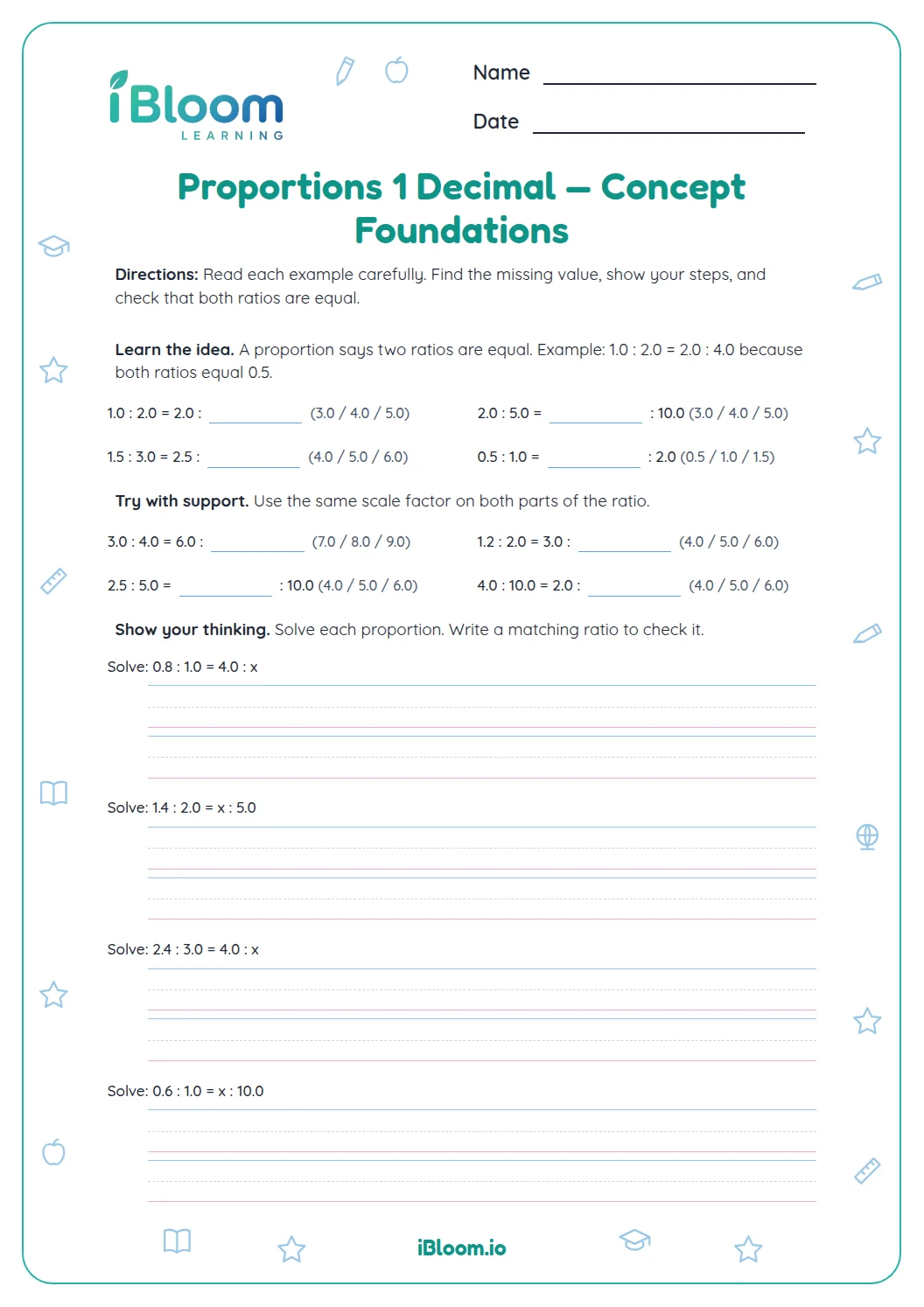
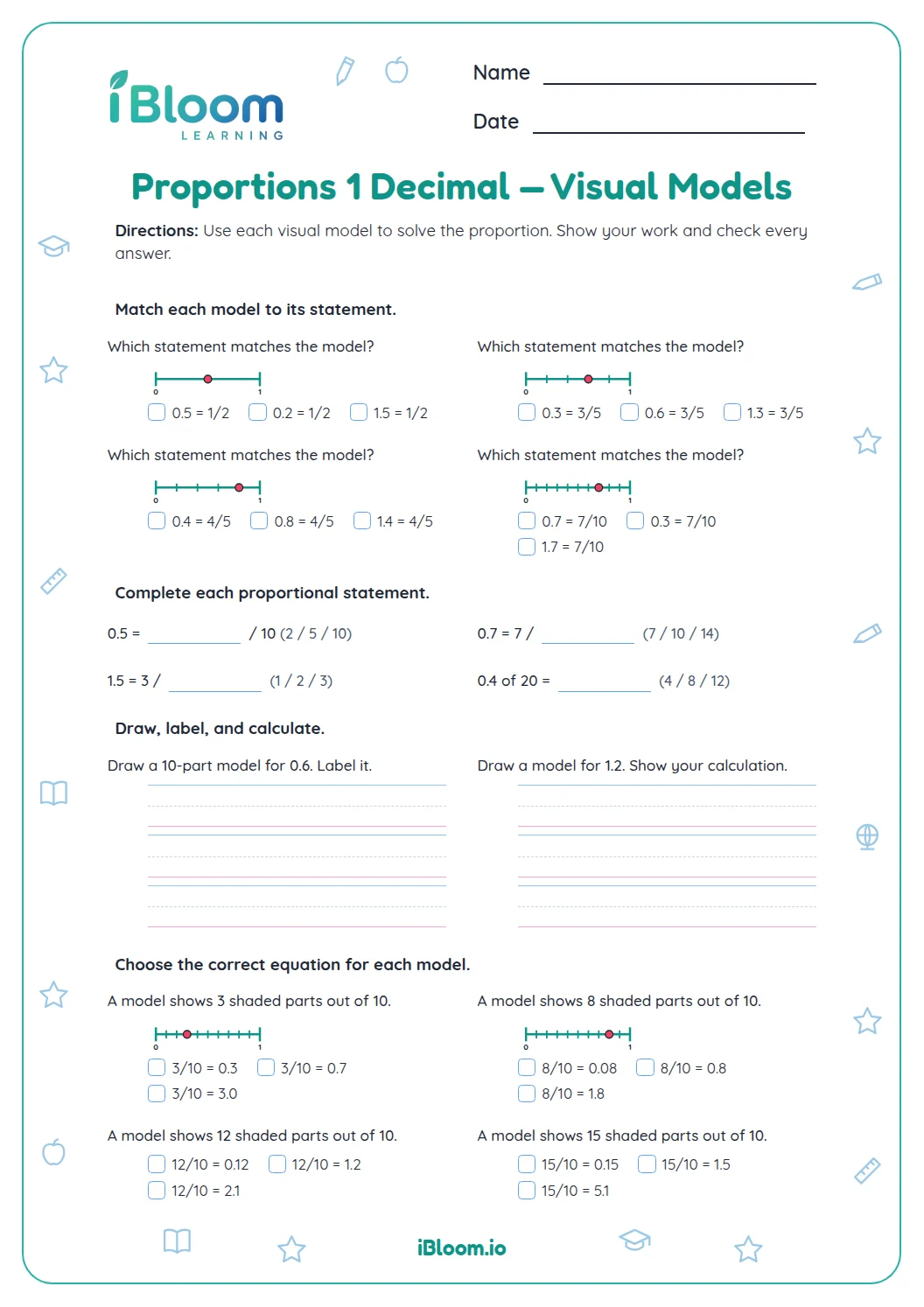
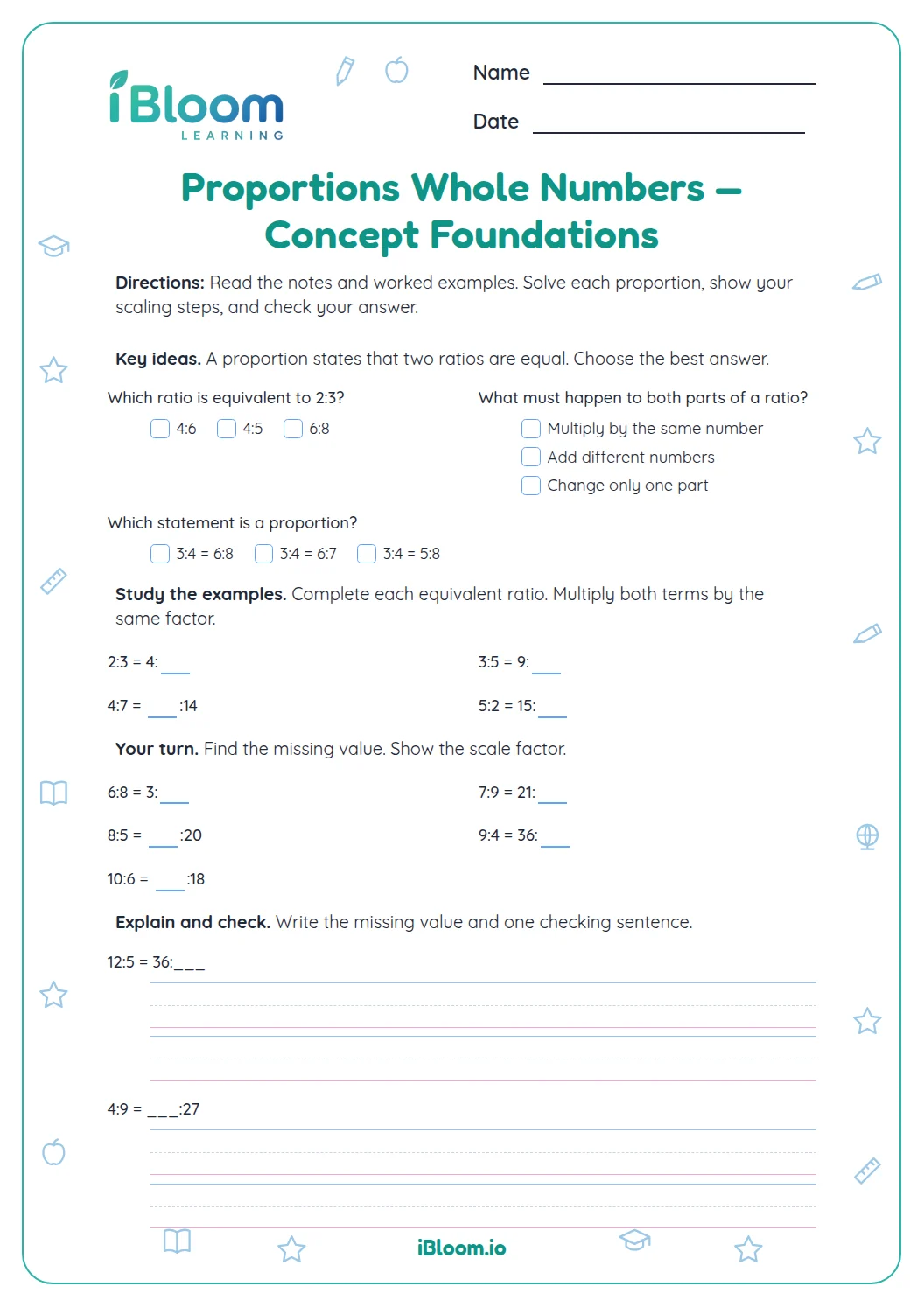
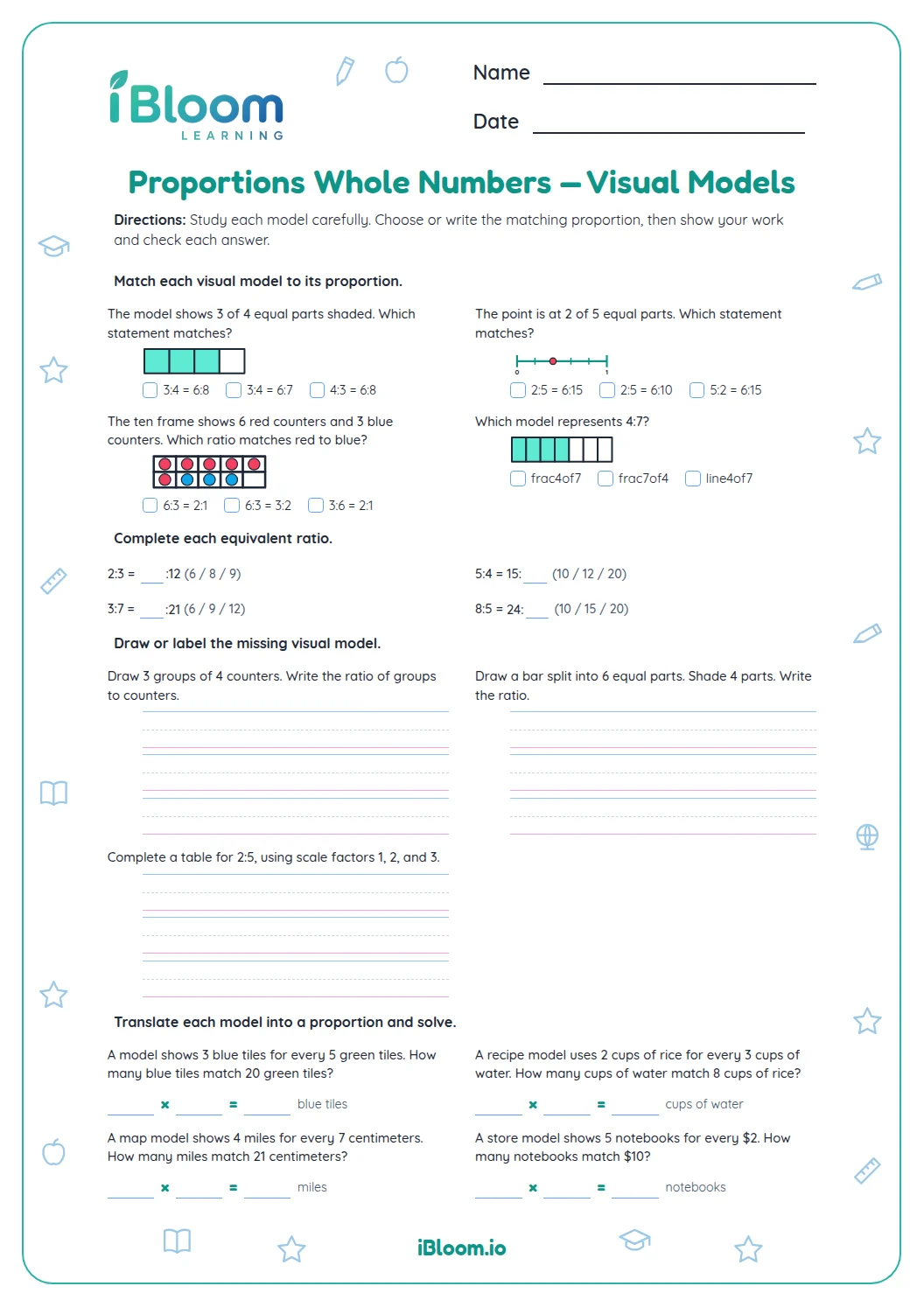
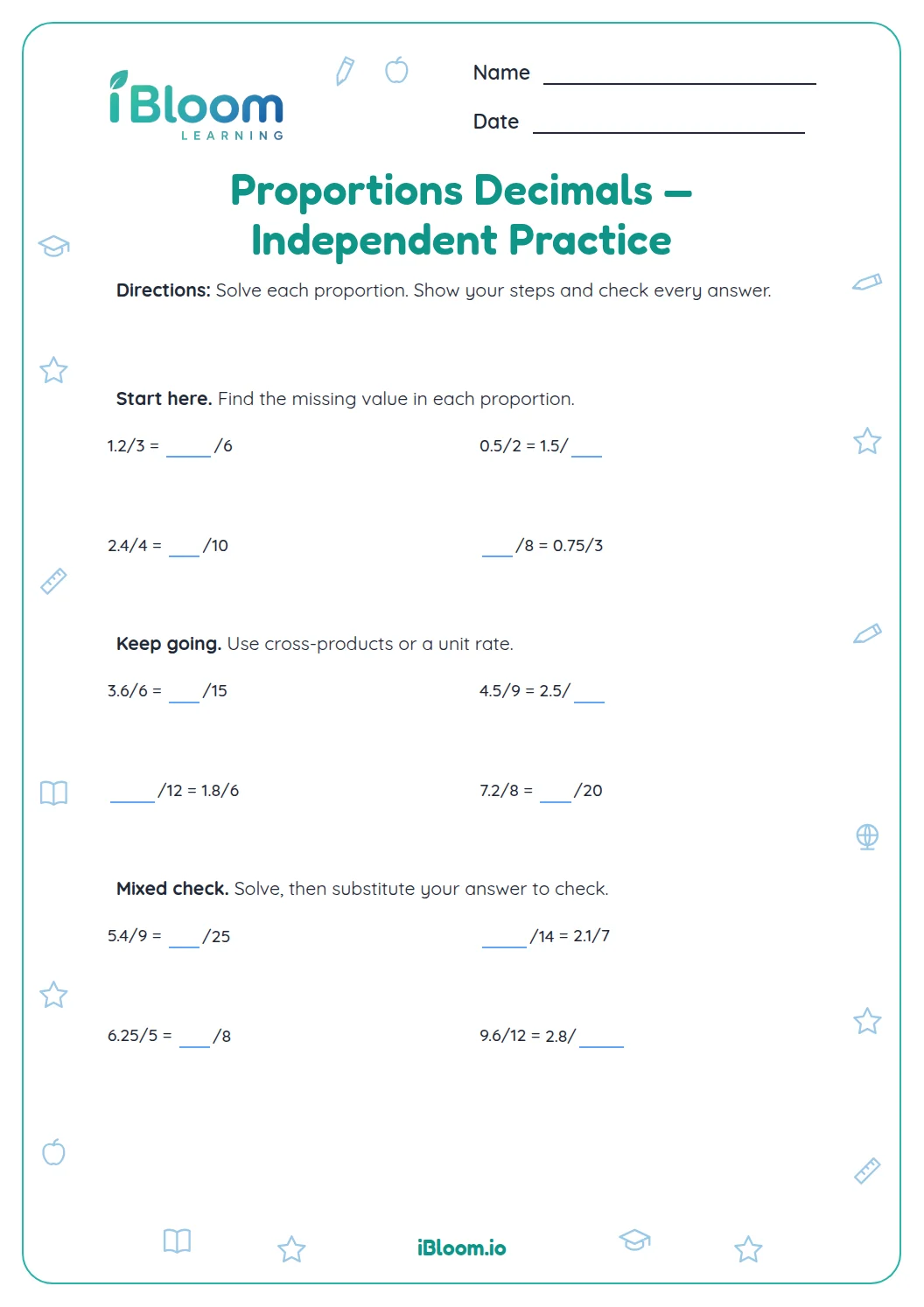
This free Grade 6 worksheet develops ratio reasoning with decimals in tenths. Students first follow four multiplication or division hints, then solve six missing-value proportions with less help. Two final problems apply the same reasoning to ribbon and juice. The questions practice Common Core 6.RP.A.3 through equivalent ratios and constant rates. Each proportion uses a colon to keep the order of its two quantities visible. Students get working grids for recording their scale factors, and a separate answer key gives all 12 results.
Aligned to 6.RP.A.3
How does scaling keep a ratio equivalent?
A proportion says that two ratios are equal. The ratio 1.2 : 3 means 1.2 to 3, with the first quantity compared to the second. Changing both quantities by the same factor preserves that comparison.
In question 1, the second quantity grows from 3 to 9. That is multiplication by 3, so 1.2 must also be multiplied by 3. Adding 6 to both quantities would change the ratio.
- 11.2 : 3 = x : 9
- 23 × 3 = 9
- 31.2 × 3 = 3.6
- 4Check: 1.2 ÷ 3 = 0.4 and 3.6 ÷ 9 = 0.4.
What help is printed on the worksheet?
Part A states the factor for four proportions, including one that scales down. Students still carry out the decimal calculation and record their work. Part B removes those individual hints and places x in different positions so students must match corresponding quantities.
Part C asks about ribbon sold at a constant price per meter and juice used in a repeated recipe. The contexts make the relationship explicit: doubling the length doubles its cost, and halving the number of servings halves the juice.
How can students check a missing value?
Substitute the answer into the original ratio and compare the two quotients. For question 6, 2.4 : 6 = 6.0 : 15 works because both quotients are 0.4. A scale-factor check is also useful: 2.4 becomes 6.0 when multiplied by 2.5, and 6 becomes 15 with the same factor.
Keep the quantities in their original order. In question 11 the price is $2.50 for 1 meter, so 4 meters cost four times as much. The key gives $10; $10.00 is the usual way to write this amount in dollars and cents.
A routine for each proportion
- 1Read each ratio from left to right and match the first quantities and second quantities.
- 2Use the printed factor in Part A; write the operation on the working grid.
- 3In Part B, find a factor using the two known corresponding quantities.
- 4Apply that factor to the remaining quantity and enter the missing value.
- 5Substitute the result and check that both ratios have the same value.
Mistakes to watch for
The mistake
Adding the same amount to each quantity, such as making 1.2 : 3 into 7.2 : 9.
The fix
Use multiplication: 3 × 3 = 9, so the first quantity must be 1.2 × 3 = 3.6.
The mistake
Multiplying only the decimal and leaving its partner unchanged.
The fix
Mark the same scale factor beside both corresponding pairs before calculating.
The mistake
Reversing a ratio when x comes second, as in 2.4 : 6 = 6.0 : x.
The fix
Keep first quantities together: 2.4 to 6.0. Then apply that change to 6 to find 15.
Common Core alignment
Use equivalent ratios to find missing decimal values and solve constant-rate problems.
On this sheet: Students scale decimal ratios and apply the same reasoning to ribbon prices and juice quantities.
Show the official wordingHide the official wording
Use ratio and rate reasoning to solve real-world and mathematical problems, e.g., by reasoning about tables of equivalent ratios, tape diagrams, double number line diagrams, or equations.
What to practice next
Make more practice
Further reading
Questions parents and teachers ask
What does the colon mean in these questions?
The colon means “to” and separates the two quantities in a ratio. For example, 1.2 : 3 reads “1.2 to 3.” The equal sign says that the ratio on one side has the same value as the ratio on the other side.
Are all the missing values decimals?
The missing values include whole numbers and numbers with a tenths digit. Both belong in this practice because the given ratios use numbers written to one decimal place. Accept 5 and 5.0 as equivalent, while keeping a nonzero tenths digit when it is needed.
Does my child have to cross-multiply?
No. The worksheet guides students to multiply or divide corresponding quantities by the same factor. Question 1 supplies multiplication by 3, and question 4 supplies division by 3. Students may use another valid method, but should explain why their completed ratios are equivalent.
What makes the last two questions proportions?
Both questions describe a constant relationship between two quantities. Ribbon costs the same amount per meter, and each serving of the juice mixture uses the same amount of juice. Students scale the known pair together to find the cost or volume for the new amount.
How should I use the answer key?
Use the key to check the missing values and the units in the two final answers. Also review the working grids: a correct answer should follow from a factor applied to both quantities. If a result is incorrect, ask the student to substitute it and compare quotients.