

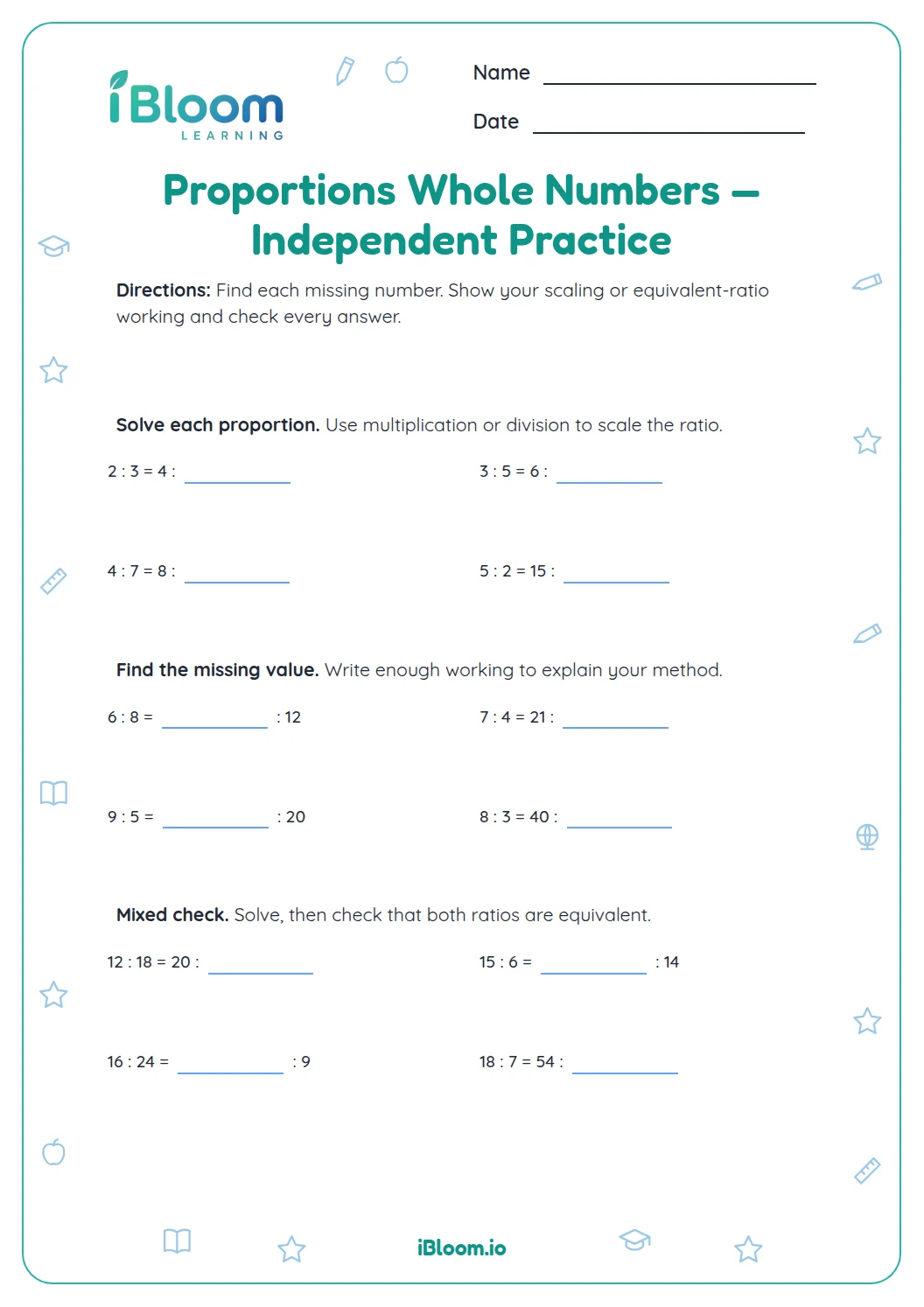
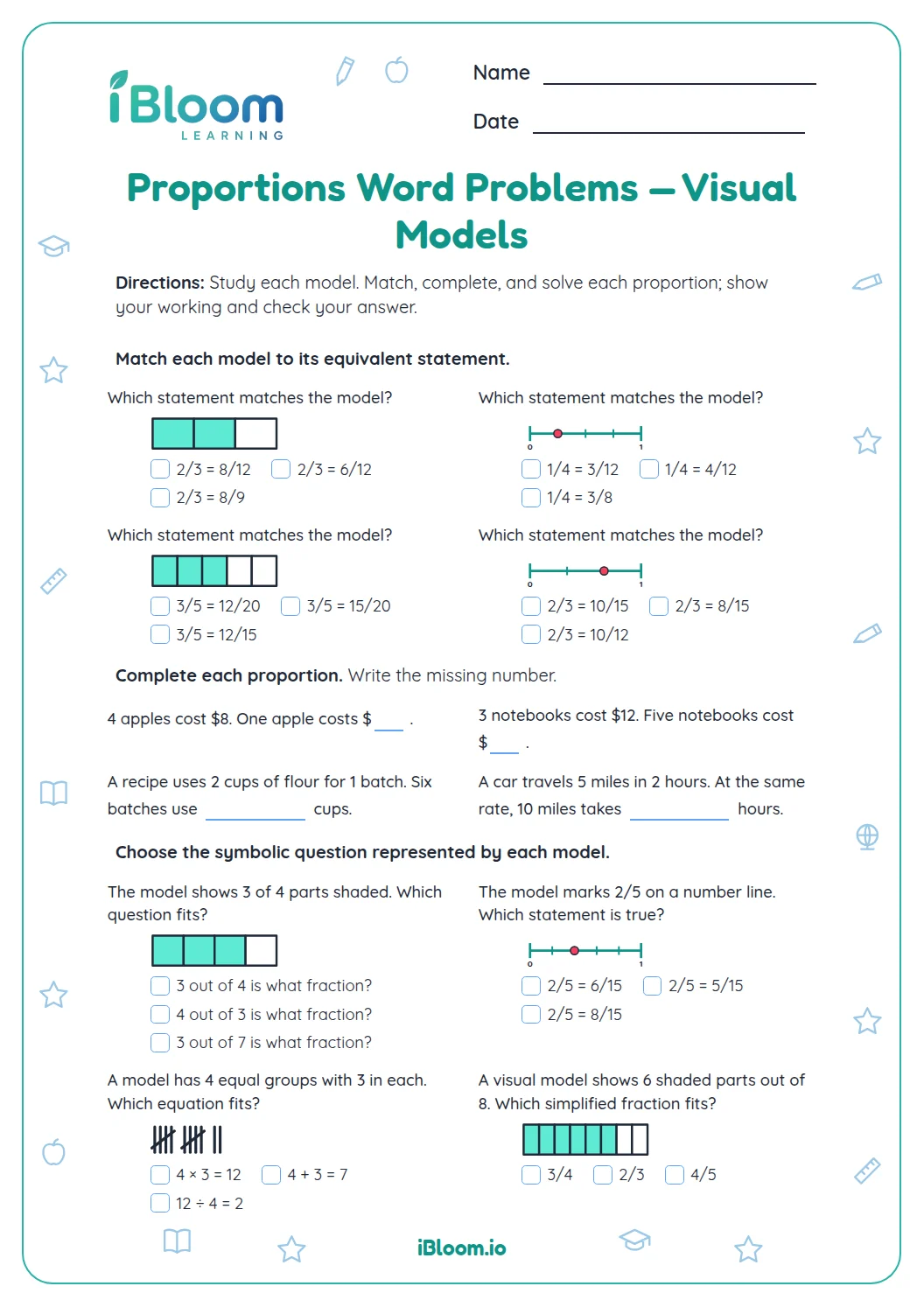
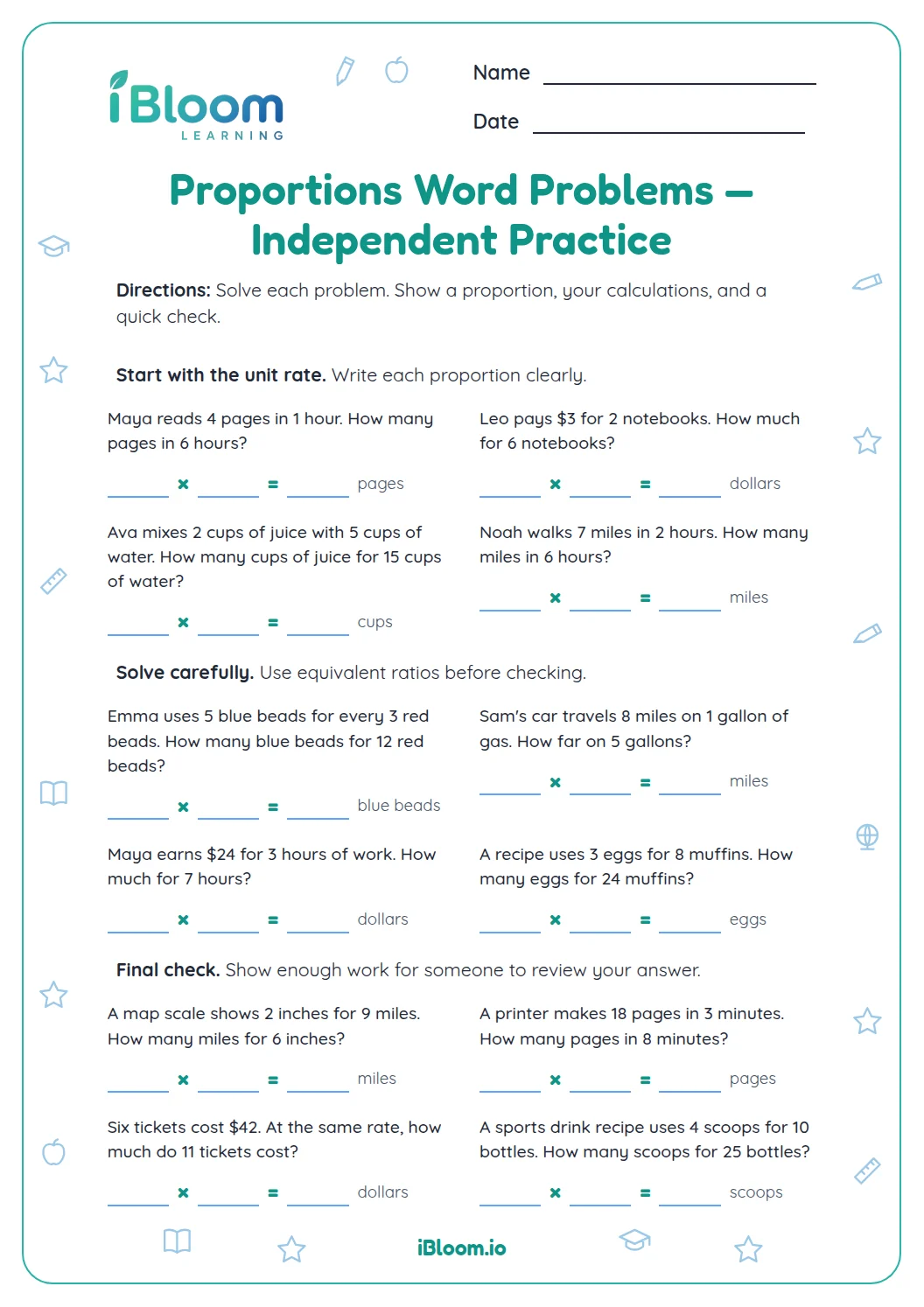


About this worksheet
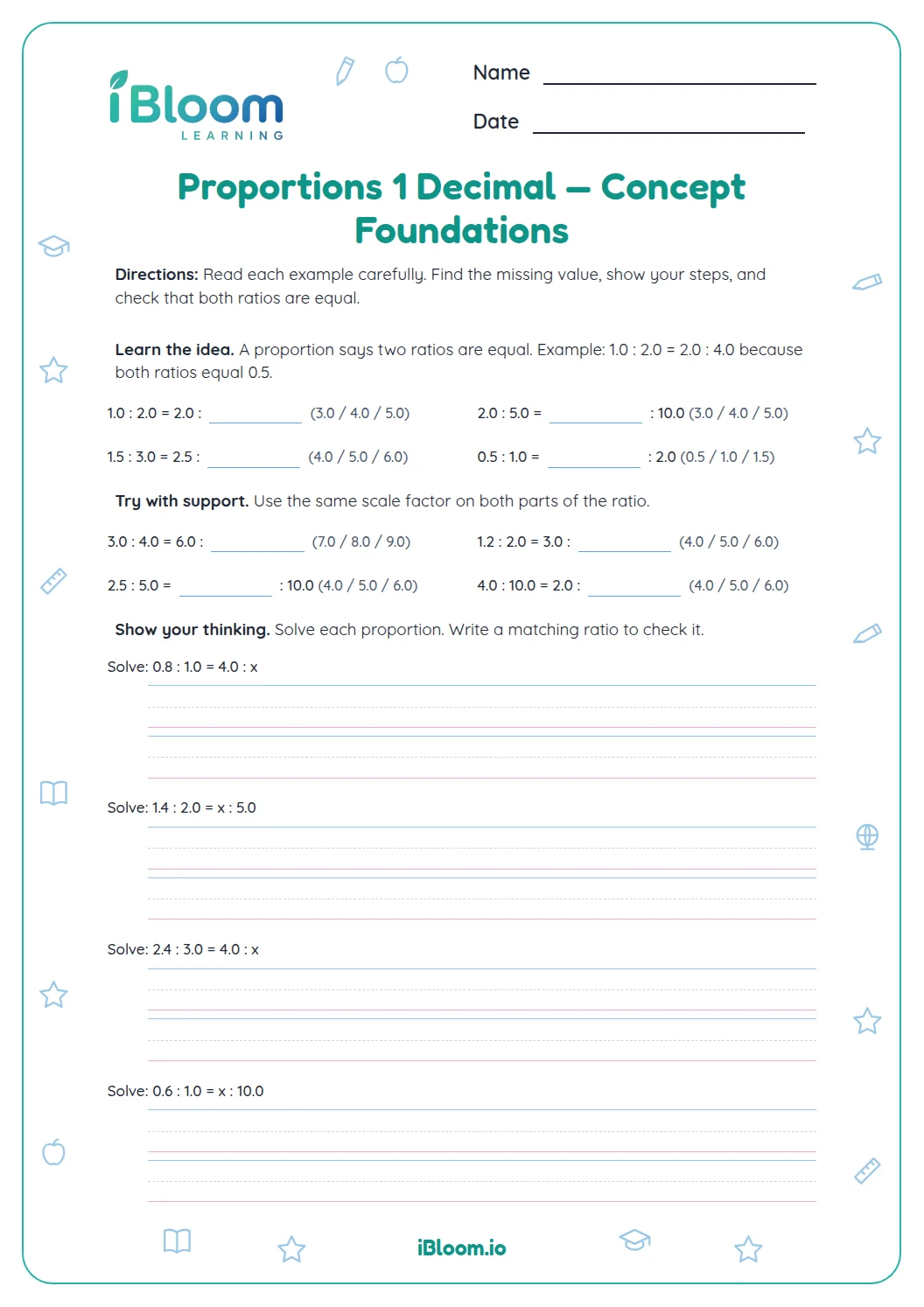
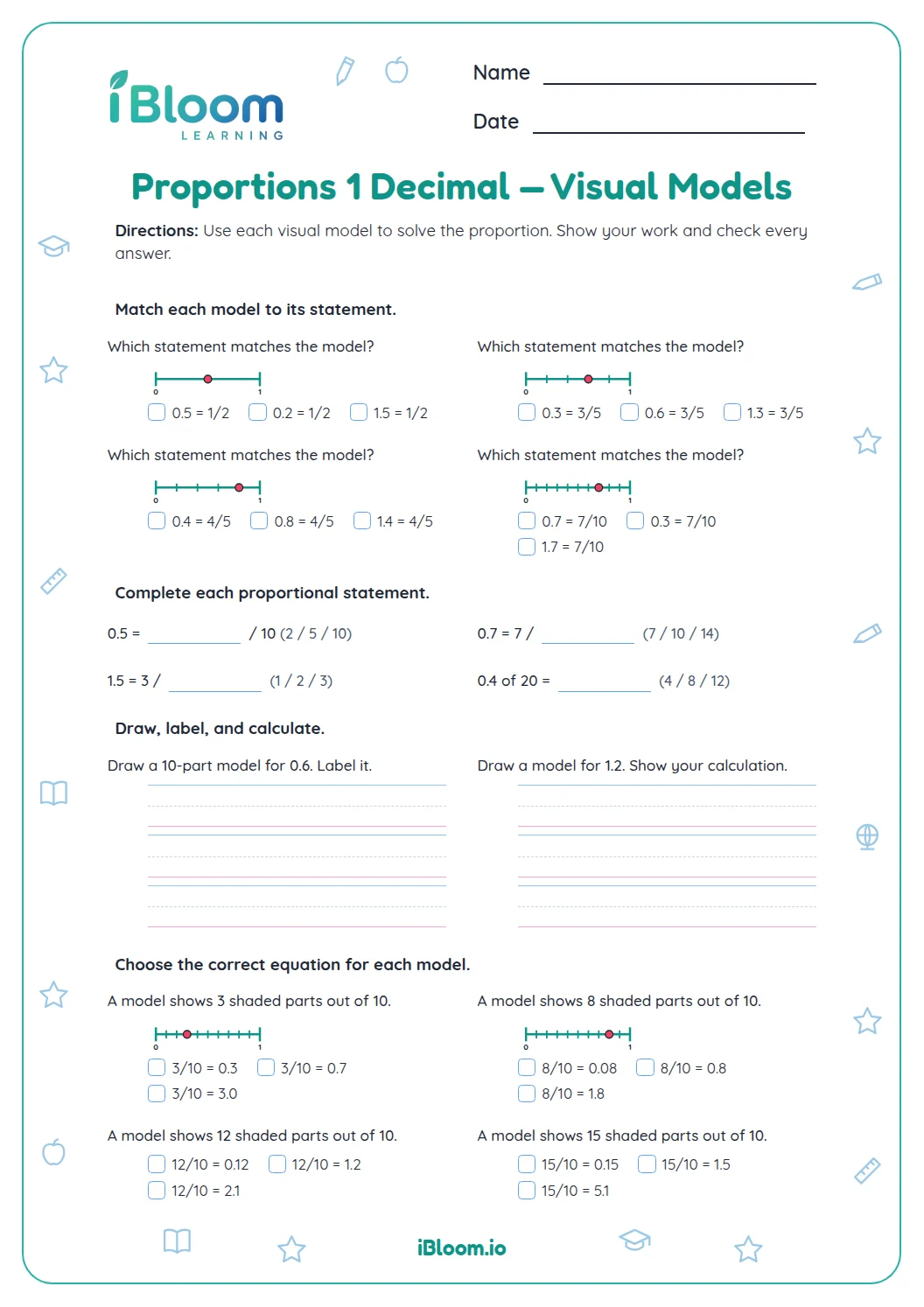
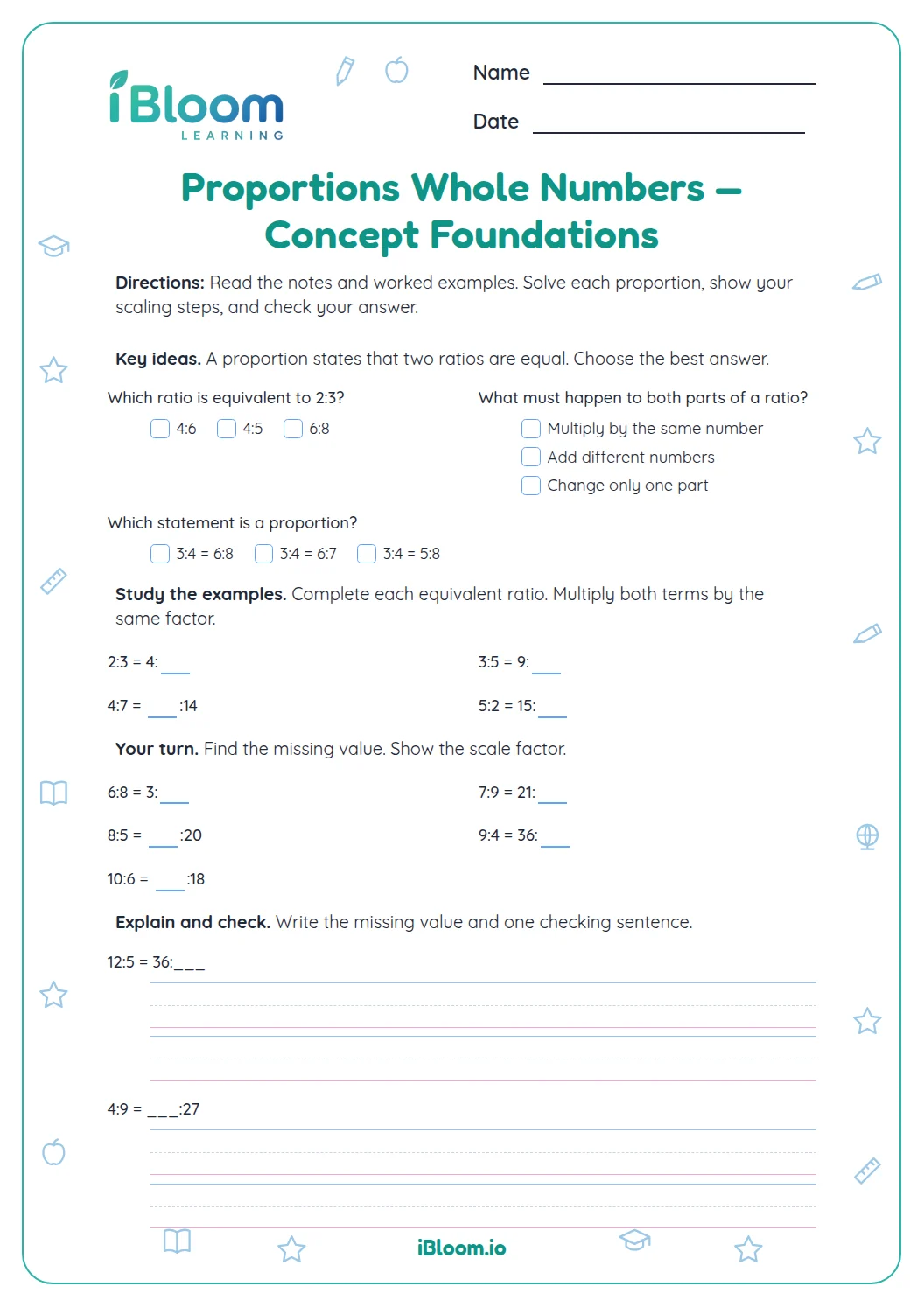
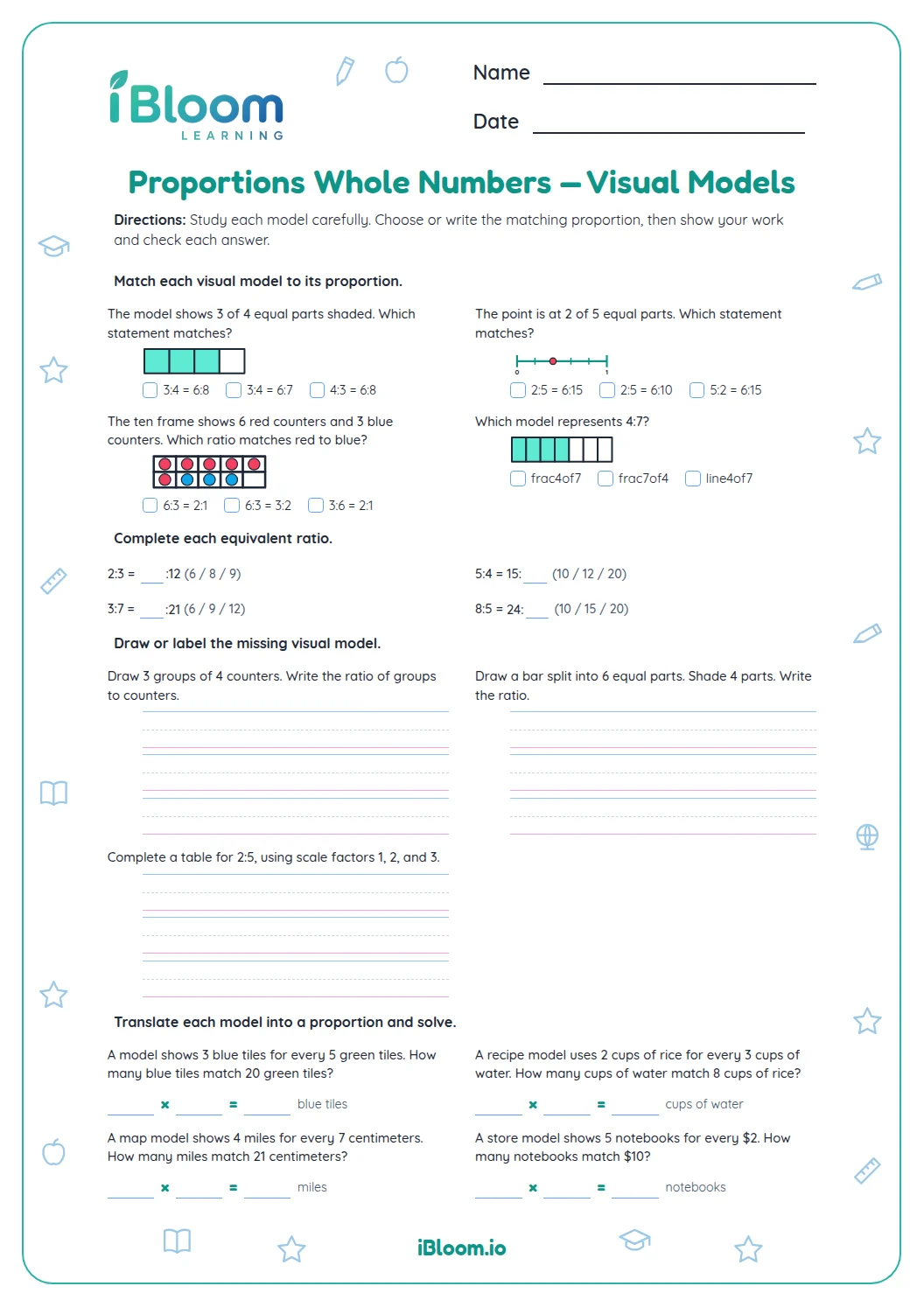
This Grade 6 printable focuses on equivalent ratios with decimal values, the skill named by Proportions 1 Decimal. Students find the missing term by scaling both parts of a ratio by the same factor. Part A builds the idea with direct scale factors; Part B uses less familiar values and decimal terms. The sheet has 18 questions and a separate answer key. It practices CCSS 6.RP.A.3 through ratio tables written as number sentences.
Aligned to 6.RP.A.3
How do you solve a decimal proportion?
Equivalent ratios describe the same multiplicative relationship. Find the factor that changes one known term into its partner, then use that factor on the other side. Keep the order of the quantities consistent.
For example, 1 : 2 = 1.5 : ___. Since 1 becomes 1.5 by multiplying by 1.5, multiply 2 by 1.5 too. The missing value is 3.
What does each part practice?
Part A has nine missing-value proportions with decimal terms such as 1.5, 2.4, and 7.5. Part B has nine more, including ratios scaled up or down by whole-number and decimal factors. Each problem has one blank.
How can you check a missing value?
Substitute the answer and compare the two ratios by simplifying or finding a shared scale factor. In 1 : 2 = 1.5 : 3, both ratios express the same relationship because each term on the left is multiplied by 1.5.
How to use this worksheet
- 1Read the two ratios in order.
- 2Find the factor between a pair of known matching terms.
- 3Apply that factor to the other term.
- 4Write the missing number clearly.
- 5Check that both ratios have the same value.
Check the work
The mistake
Scaling only one term.
The fix
Multiply or divide both terms by the same factor.
The mistake
Reversing the ratio order.
The fix
Compare first terms with first terms and second terms with second terms.
The mistake
Moving a decimal point without checking the factor.
The fix
Write the scale factor, then multiply the matching term.
Common Core alignment
This sheet gives focused practice with the listed skill.
Use equivalent ratios and rate reasoning to solve problems.
On this sheet: Every item asks students to use equivalent ratios and a scale factor to find an unknown value.
Show the official wordingHide the official wording
Use ratio and rate reasoning to solve real-world and mathematical problems, e.g., by reasoning about tables of equivalent ratios, tape diagrams, double number line diagrams, or equations.
What to practice next
Make more practice
Further reading
Questions parents and teachers ask
What does this worksheet mean by a decimal proportion?
Each question shows two equivalent ratios, and at least one value may be a decimal. Find the missing term by multiplying or dividing both parts by the same factor. For example, 1 : 2 = 1.5 : 3 because both terms in the first ratio are multiplied by 1.5.
How do I find the missing value in 1 : 2 = 1.5 : ___?
Compare the first terms: 1 becomes 1.5 when multiplied by 1.5. Apply that same factor to the second term, so 2 × 1.5 = 3. The completed proportion is 1 : 2 = 1.5 : 3, and the two ratios describe the same relationship.
What should stay the same when scaling a ratio?
Use the same factor for both terms of a ratio. If one quantity is multiplied by 3, its partner must also be multiplied by 3. Scaling only one term changes the relationship, so the resulting pair would not be an equivalent ratio.
Are the questions word problems?
No. All 18 items are number sentences with one missing value. Part A introduces decimal ratios, and Part B varies the scale factor and position of the blank while keeping the task focused on equivalent ratios. Try finding a common scale factor for each pair of terms before writing the result.
How can I check the answer key?
Replace the blank with your value and see whether the two ratios scale by the same factor. You can also simplify both ratios or divide corresponding terms. For 2 : 5 = 4 : 10, both terms on the left double to make the terms on the right.