




About this worksheet
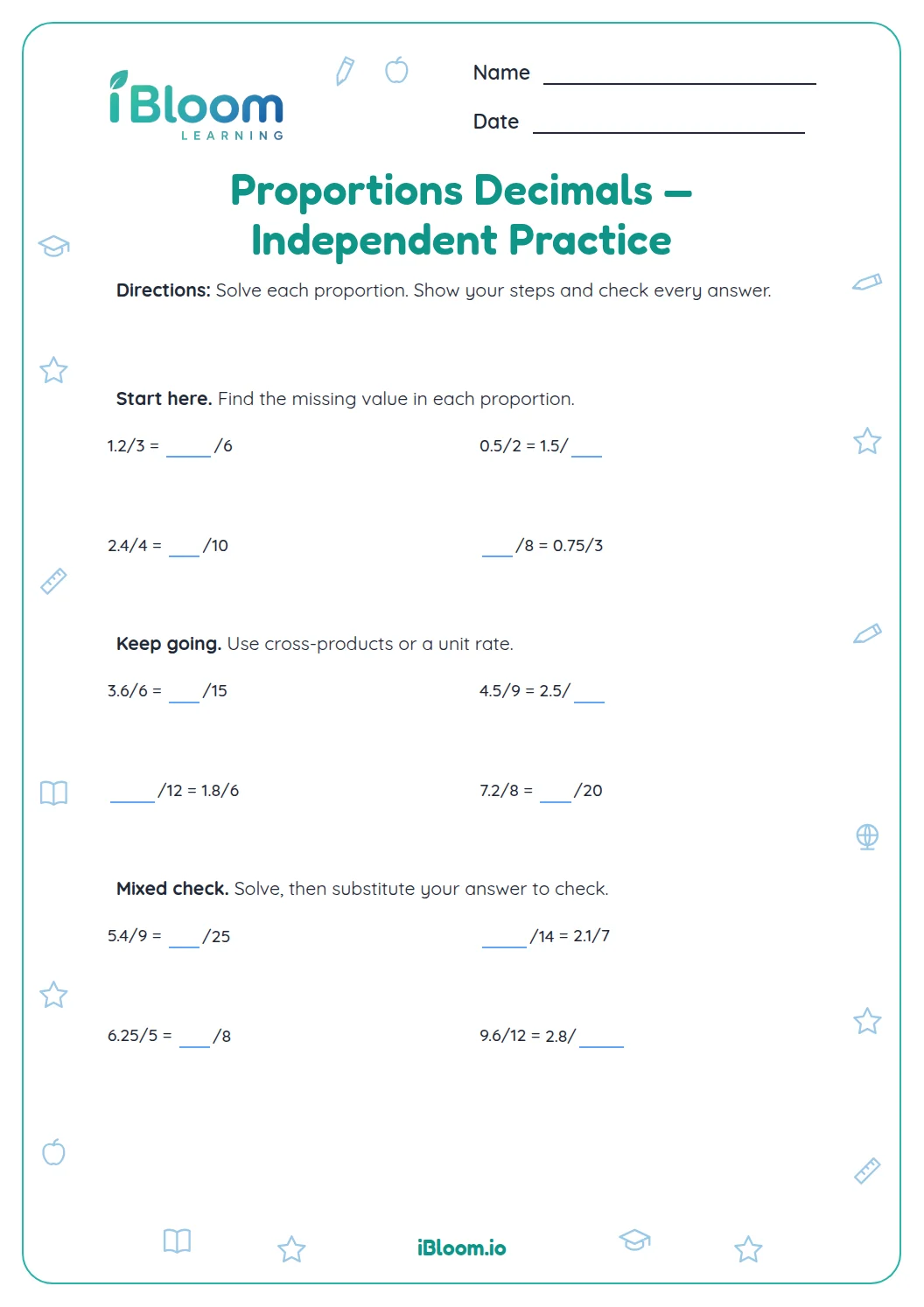
Sixteen decimal-ratio problems progress from equivalent ratios to unit rates, comparisons, and written reasoning. The printable includes a separate answer key and focused practice that moves from direct work to reasoning.
Aligned to 6.RP.A.3 and 6.RP.A.3.b
Keep ratios equivalent
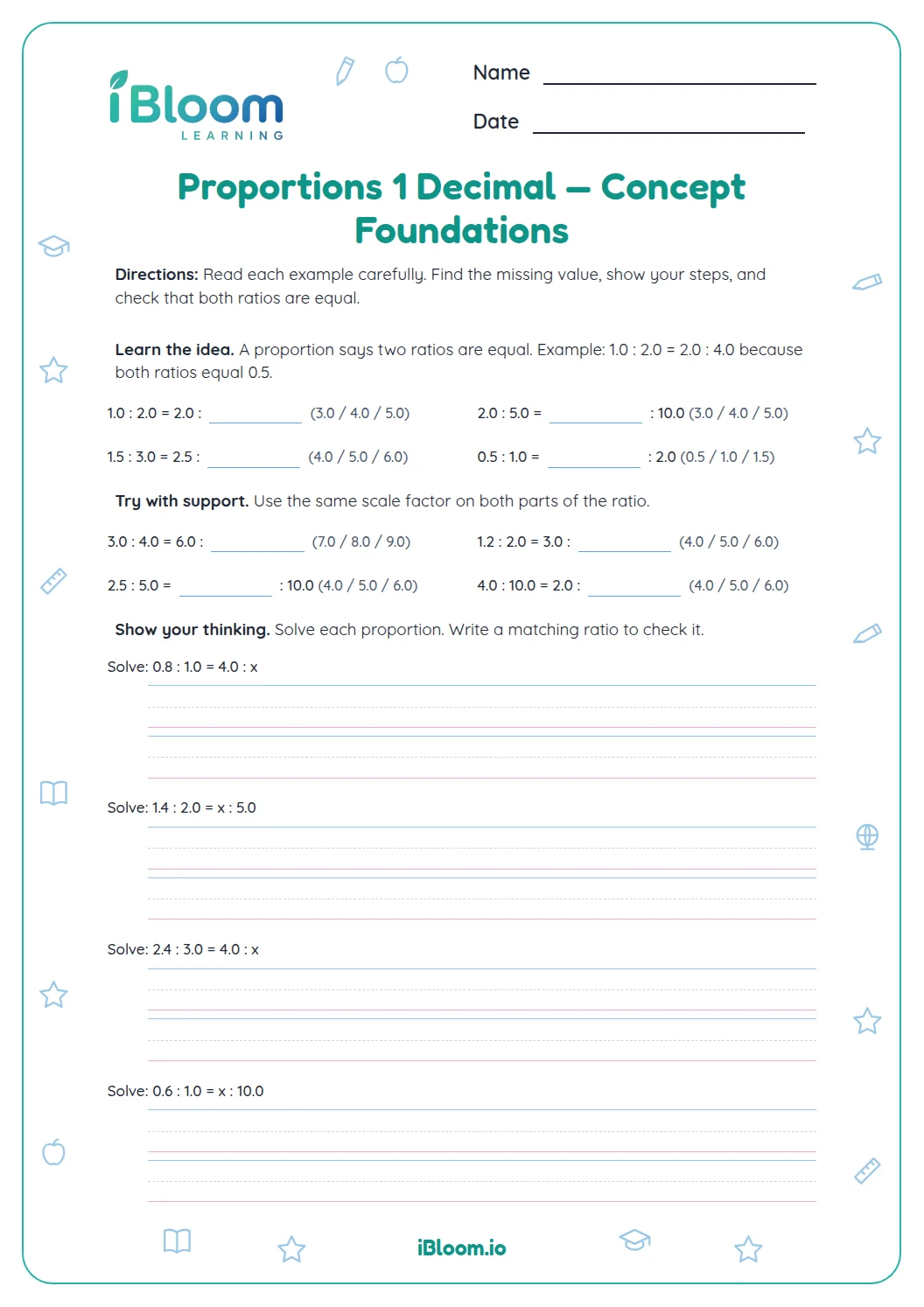
A proportion states that two ratios describe the same relationship. To make an equivalent ratio, multiply or divide both terms by the same number. Decimal values work the same way as whole numbers.
- 11.5/2 = 4.5/6
- 2Both terms were multiplied by 3.
Use a unit rate to compare
A unit rate tells how much belongs to one unit. For a cost comparison, divide the total price by the number of items; then compare the per-item prices.
What the three parts practice
Part A builds equivalent ratios and scaling. Part B compares rates and catches a one-sided scaling error. Part C applies ratios to travel, maps, mixing, and pricing.
- Part A: missing values and scaled quantities
- Part B: proportional pairs, unit rates, and error analysis
- Part C: multi-step applications and one explanation
How to use this worksheet
- 1Read each part direction and keep paired quantities in the same order.
- 2For a missing value, find the scale factor between one pair of terms.
- 3For a rate, divide to find the amount for one unit before comparing.
- 4Use the separate two-page key to check answers and revisit any missed item.
Common mistakes and quick fixes
The mistake
Scaling only one term of a ratio.
The fix
Multiply or divide both terms by the same factor.
The mistake
Treating a decimal ratio as if its terms use different units.
The fix
Keep the paired quantities in the same order and label units.
The mistake
Comparing total prices when pack sizes differ.
The fix
Divide each price by its item count, then compare cost per pen.
Curriculum alignment
This worksheet practices the following Common Core skills.
Use ratio and rate reasoning to solve real-world and mathematical problems.
On this sheet: Learners scale ratios and use unit rates, including decimal quantities.
Show the official wordingHide the official wording
Use ratio and rate reasoning to solve real-world and mathematical problems, e.g., by reasoning about tables of equivalent ratios, tape diagrams, double number line diagrams, or equations.
Solve unit-rate problems involving unit pricing and constant speed.
On this sheet: Several questions find and apply a unit rate.
Show the official wordingHide the official wording
Solve unit rate problems including those involving unit pricing and constant speed.
What to practice next
Make more practice
Further reading
Questions parents and teachers ask
How do I solve a decimal proportion?
Write the paired quantities in the same order, then scale both terms by the same factor. For example, multiplying 1.5 and 2 by 3 gives 4.5 and 6. Check that the two ratios still describe the same relationship.
How does a unit rate help compare prices?
Divide each price by its number of items to find a price for one item. The worksheet compares three pens for $2.40 with five pens for $3.50: $0.80 per pen versus $0.70 per pen, so the five-pen pack costs less per pen.
Why must both parts of a ratio be scaled?
The terms describe a pair of quantities. Changing only one term changes the relationship. Multiplying both terms by 3 keeps 1.5 to 2 equivalent to 4.5 to 6, which is the same scaling idea used in the first part.
What kinds of problems are on the sheet?
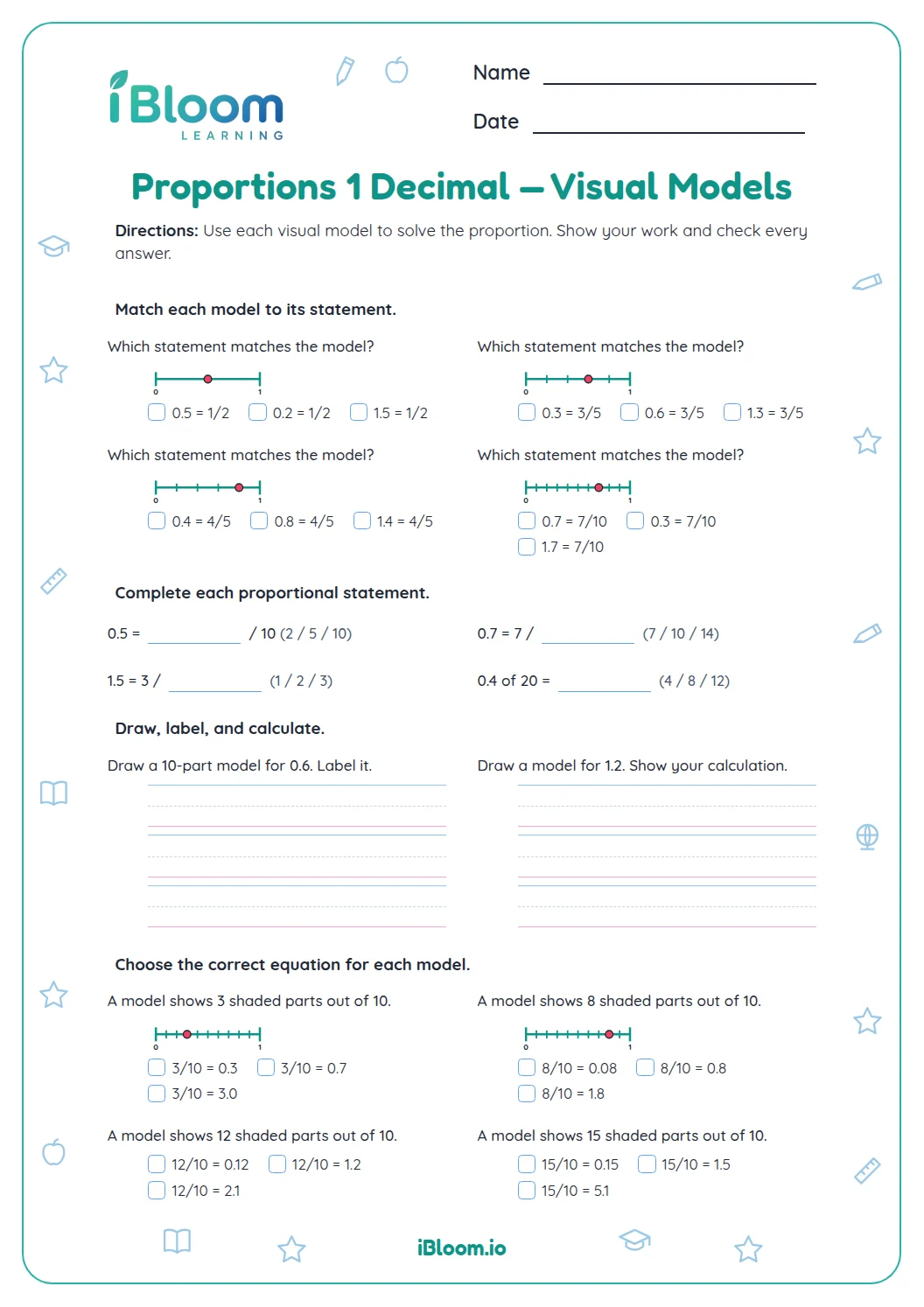
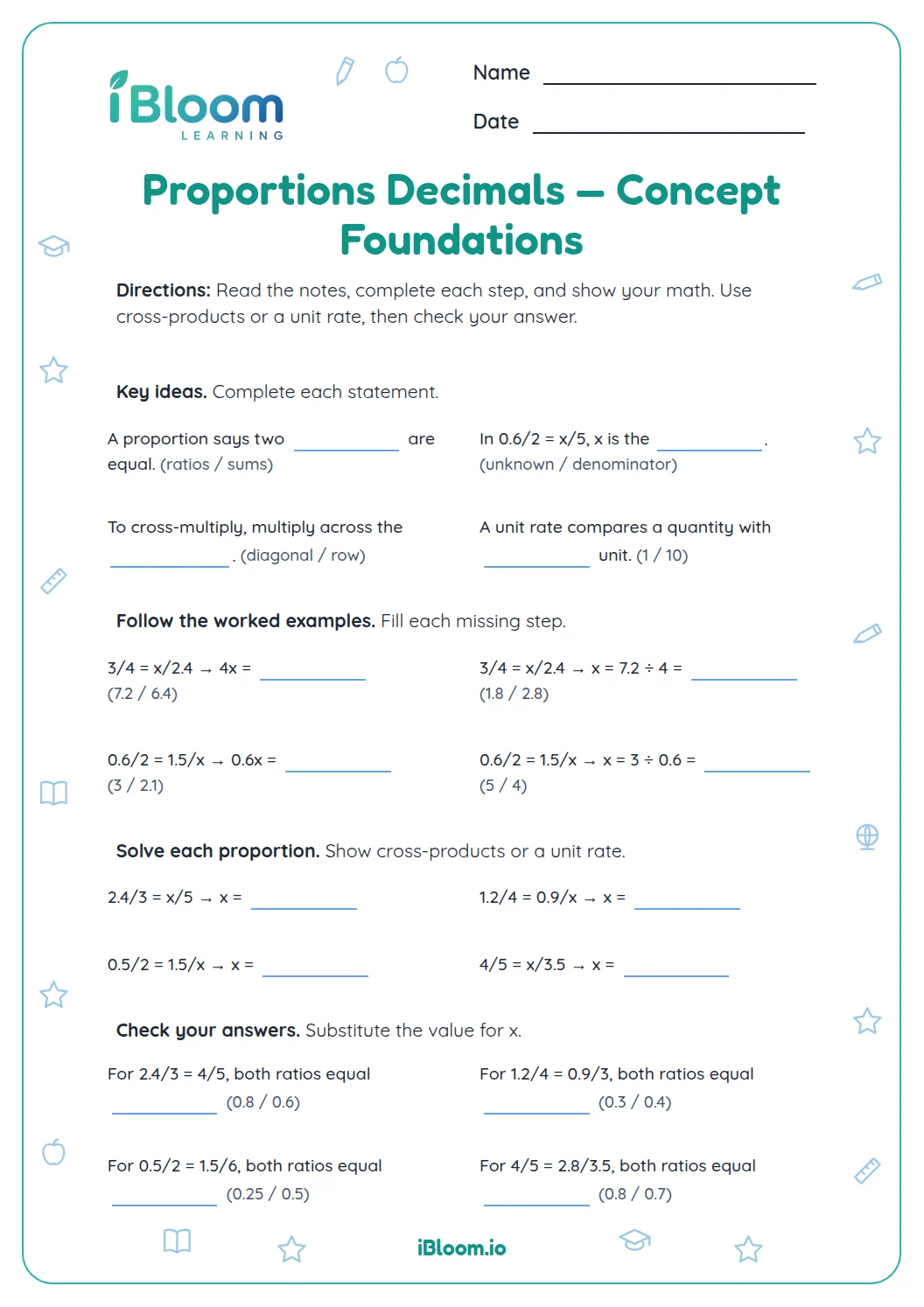
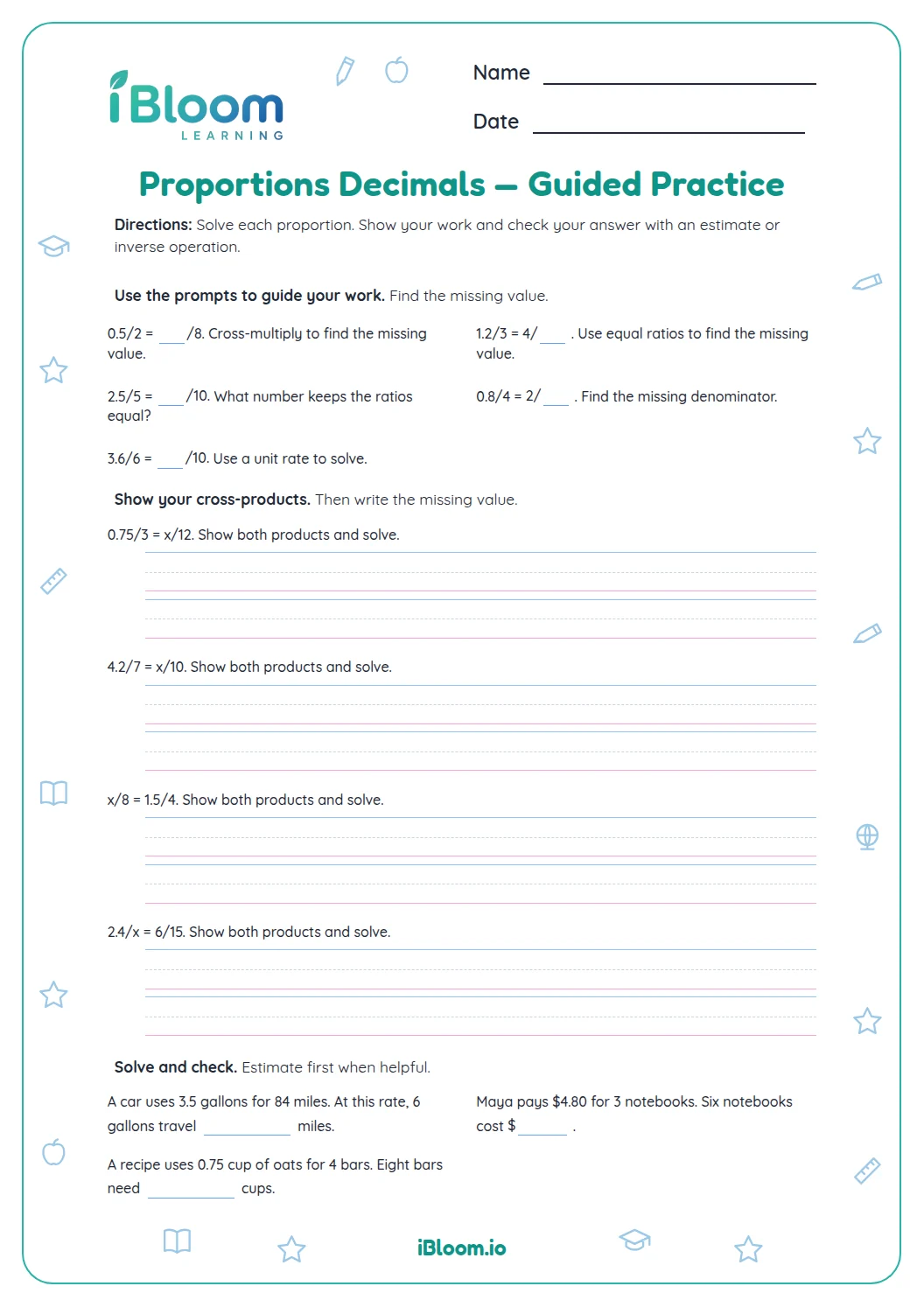
The 16 problems include equivalent ratios, unit rates, map and scale relationships, travel, a recipe, a paint mixture, and unit pricing. Part C also includes a short explanation. A separate answer key has two pages.
What should learners do when comparing two rates?
Convert each rate to the same unit basis, often one item or one hour. For a price comparison, divide total cost by item count. For travel, divide distance by time; then use that unit rate to calculate a new amount.
How can a learner check a missing ratio value?
Compare the known pair of terms to find the scale factor, then apply that same factor to the other term. A reverse check should recover the original ratio. For example, 1.5/2 = 4.5/6 because each term on the left is multiplied by 3.