



About this worksheet
This printable for Grades 1–2 practices adding doubles minus 2 and using those sums in fact families. Children start with eight number bonds, such as 4 and 2, then use the totals to complete related subtraction facts. The problems stay within 20 and connect a near-double strategy to addition and subtraction fluency. It aligns with CCSS 2.OA.B.2, with a separate answer key for checking.
Aligned to 2.OA.B.2
How does the doubles-minus-2 strategy work?
A doubles-minus-2 fact adds two numbers that differ by 2. For 4 + 2, the related double is 3 + 3 = 6.
Question 1 uses a number bond to show 4 and 2 make 6. The total also answers 3 + 3, the nearby double.
- 14 + 2 = 6
- 23 + 3 = 6
How does a fact family help check a sum?
The subtraction problems use the same totals and parts. For example, 6 − 4 = 2 and 6 − 2 = 4 belong with 4 + 2 = 6.
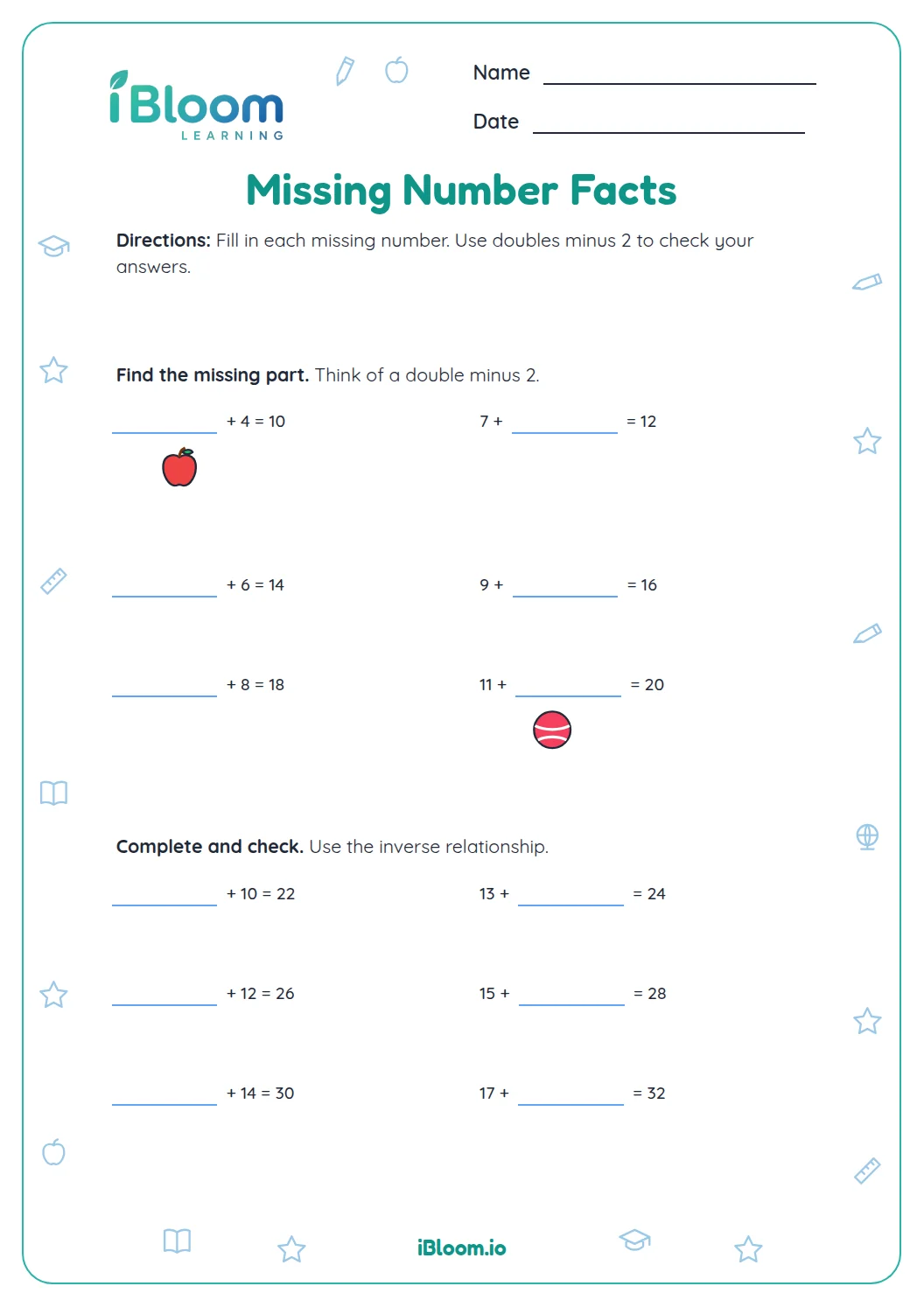
The second half of this sheet starts with the totals and asks children to find a missing part.
How to use this worksheet
- 1Look at the two parts in the number bond.
- 2Raise the smaller addend by 1 to make a double.
- 3Subtract 2 from the double to find the sum.
- 4Use the sum and both parts to write a related subtraction fact.
- 5Check that addition and subtraction undo each other.
Common mistakes and quick fixes
The mistake
Adding the two addends as though they were equal.
The fix
Make a true double first, then subtract 2.
The mistake
Subtracting 1 instead of 2 from the double.
The fix
Both changes matter: add 1 to one addend and subtract 2 from the resulting double.
The mistake
Using a part instead of the total in subtraction.
The fix
The total comes first in a subtraction fact: total minus a part equals the other part.
Common Core alignment
This worksheet practices the standard below through focused printable practice.
Fluently add and subtract within 20 using mental strategies.
On this sheet: Students use near-double addition facts and connected subtraction facts within 20.
Show the official wordingHide the official wording
Fluently add and subtract within 20 using mental strategies. By end of Grade 2, know from memory all sums of two one-digit numbers.
What to practice next
Make more practice
Further reading
Questions parents and teachers ask
What does doubles minus 2 mean?
When two addends differ by 2, increase the smaller addend by 1 to make a double, then subtract 2 from that double. For example, 8 + 6 is two less than 7 + 7, so the sum is 12. This mental strategy connects near doubles to familiar facts.
How does a number bond help with these facts?
The number bond shows the two addends and their total. Children can use the two parts to find a sum, then use the total and one part to solve a related subtraction fact. The visual model makes the connection between addition and subtraction explicit.
How many fact-family questions are included?
There are 16 questions: eight near-double addition facts and eight connected subtraction facts. The number bonds in the first section show how the addends combine. The later items ask children to use the related total and parts. They can use the total and parts to check each relationship.
Is there an answer key for the drill?
Yes. A separate answer key lists the sum or missing number for every item. Use it to check that each addition fact and its related subtraction fact agree. For example, the total minus one part should leave the other part.