






About this worksheet
This printable mastery check helps Grade 1 and Grade 2 learners solve addition facts whose addends differ by two. They complete eight facts, match four sums to a double-minus-two expression, and solve four short stories. The work uses sums within 20 and connects a near double to an easier known double, a strategy named in Common Core 1.OA.C.6.
Aligned to 1.OA.C.6
What does “near double” mean?
The two addends differ by two, such as 7 and 5. Move one unit from the larger addend to the smaller and the total stays the same: 7 + 5 becomes 6 + 6.
- 17 + 5
- 26 + 6
- 312
How is the practice organized?
Part A builds quick recall with eight different facts. Part B asks learners to recognize an equal double-minus-two expression. Part C applies the same addition idea to four short situations.
- Part A: solve each near-double fact
- Part B: choose an equivalent double expression
- Part C: write and solve an addition sentence
How can an answer be checked?
A learner can add the numbers in the original order or use the nearby double. The two methods should give the same total. For a story, the written addition sentence should name both groups before the total is found.
How can I use this worksheet?
- 1Read the two addends and notice their difference is two.
- 2For a fact, move one from the larger addend to the smaller to make a double.
- 3In Part B, evaluate the choices and look for an equal expression.
- 4In Part C, name the two groups in an addition sentence.
- 5Check each total with the original addends.
What should learners check?
The mistake
Changing only one addend changes the total.
The fix
Move one from one addend to the other, keeping the total fixed.
The mistake
Doubling the larger addend overcounts.
The fix
Use the number halfway between the addends as the double.
The mistake
Writing a total without an equation can hide a missed group.
The fix
Record both addends before writing the total.
Common Core alignment
This sheet practices an equivalent-sum strategy for addition within 20.
Use addition strategies to solve facts within 20.
On this sheet: Use addition strategies to solve facts within 20.
Show the official wordingHide the official wording
Add and subtract within 20, demonstrating fluency for addition and subtraction within 10. Use strategies such as counting on; making ten (e.g., 8 + 6 = 8 + 2 + 4 = 10 + 4 = 14); decomposing a number leading to a ten (e.g., 13 - 4 = 13 - 3 - 1 = 10 - 1 = 9); using the relationship between addition and subtraction (e.g., knowing that 8 + 4 = 12, one knows 12 - 8 = 4); and creating equivalent but easier or known sums (e.g., adding 6 + 7 by creating the known equivalent 6 + 6 + 1 = 12 + 1 = 13).
What to practice next
Make more practice
Questions parents and teachers ask
What does “adding doubles minus 2” mean?
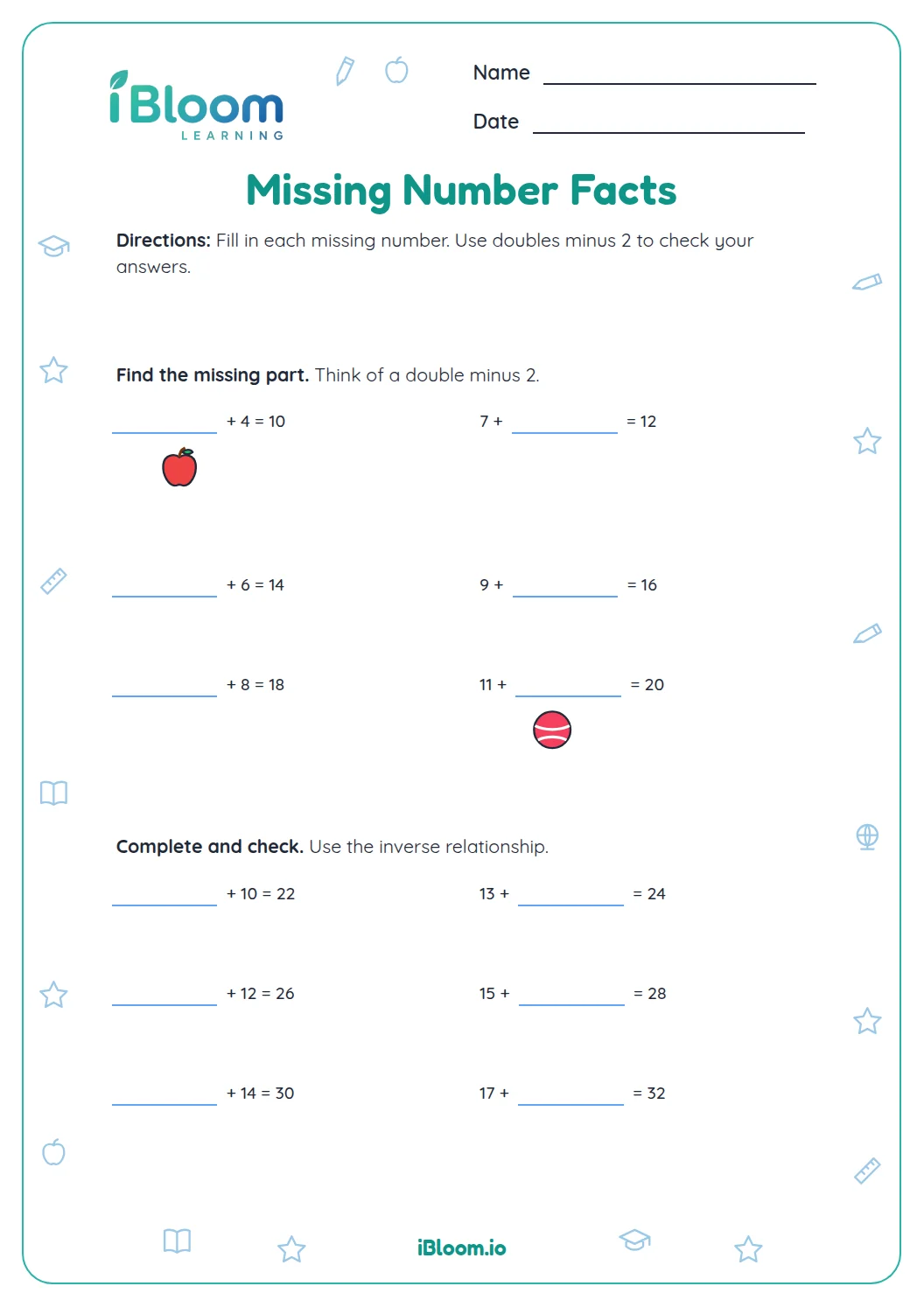
It means adding two numbers that are two apart, such as 7 + 5. A learner can use the double in between, 6 + 6, because moving one from 7 to 5 keeps the total unchanged. This worksheet practices that idea in facts, choices, and short stories.
How many questions are on the worksheet?
There are 16 questions in three parts. Part A has eight addition facts, Part B has four equivalent-expression choices, and Part C has four short story problems. A separate answer key accompanies the worksheet so an adult or learner can check the work.
What grades can use this practice?
The page is labeled for Grades 1–2 and keeps every sum within 20. A learner should already be comfortable adding small numbers and can use the nearby-double strategy to make some facts easier. The written stories give a chance to connect the number facts with groups.
How can I explain the strategy?
Ask which number is halfway between the addends. For 7 and 5, the halfway number is 6. Then show that 7 + 5 and 6 + 6 have the same total because one was taken from the first addend and added to the second.
Does the worksheet include word problems?
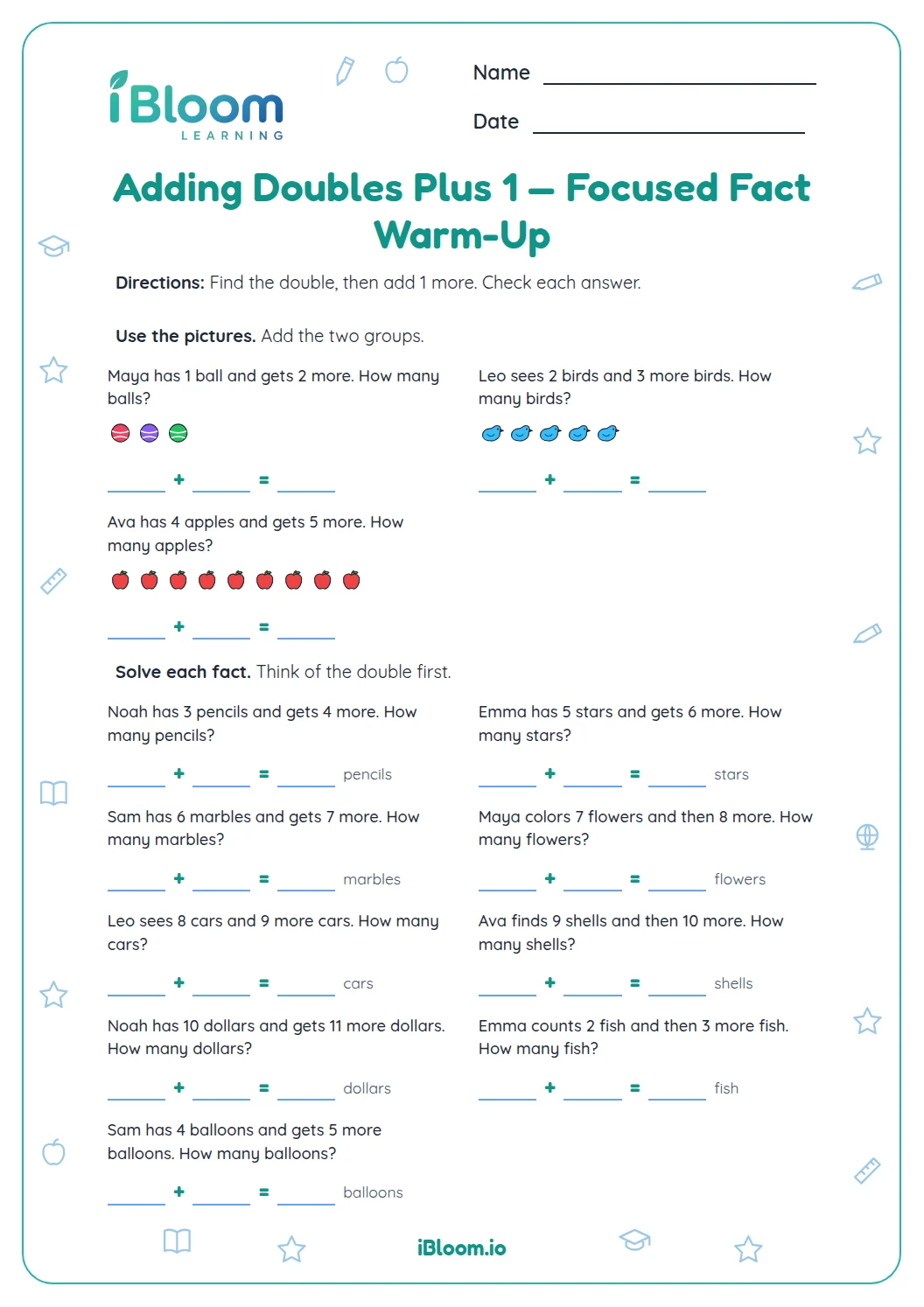
Yes. Part C has two short situations with pairs of groups whose sizes differ by two. Each gives space for an addition sentence and the total, so learners can connect a near-double fact to objects in a story.
How should a learner check a near-double answer?
They can add the original pair or rewrite it as a double. Both methods should produce the same total. If the result differs, check that one was moved from the larger addend to the smaller rather than added to both.