





About this worksheet
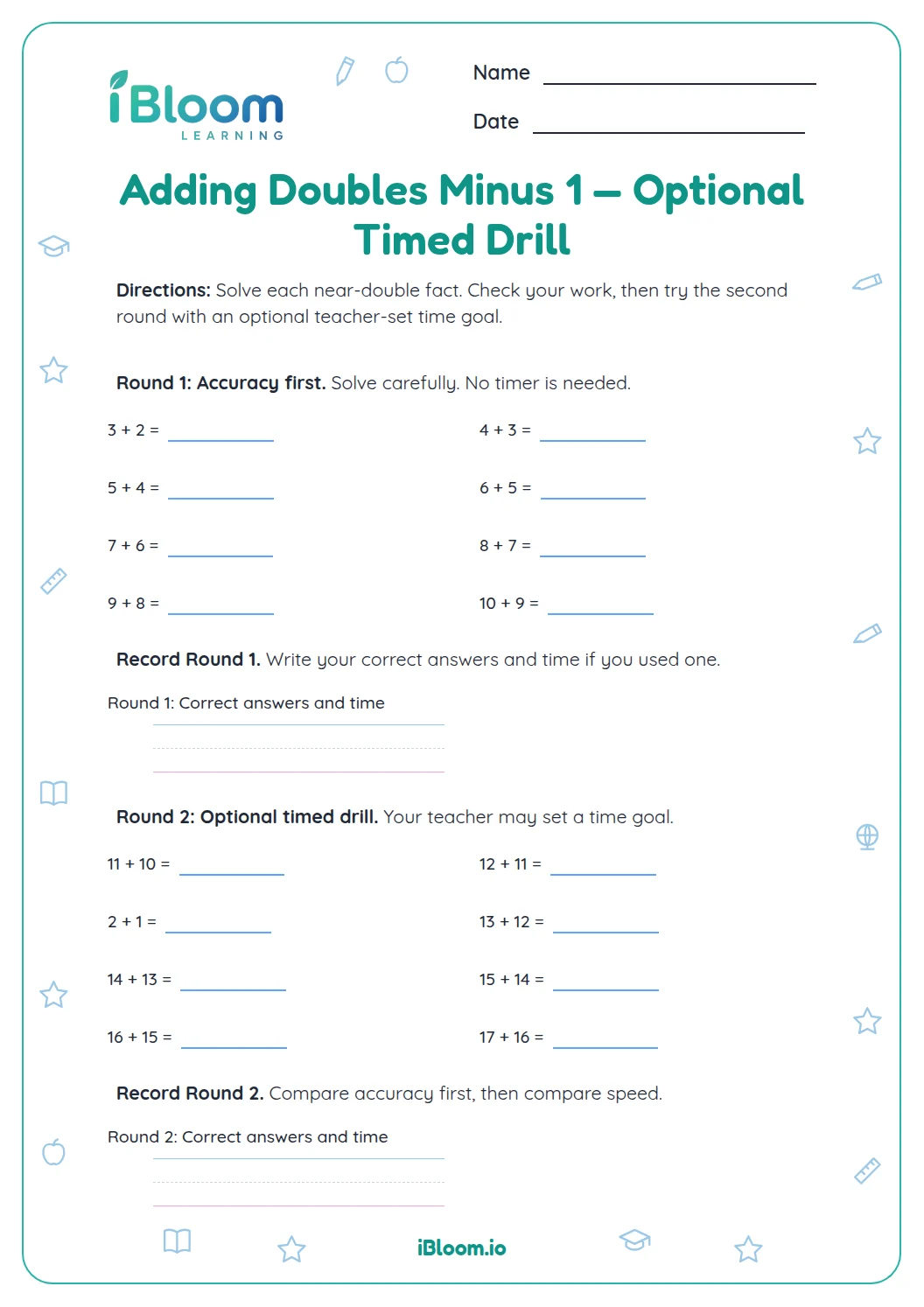
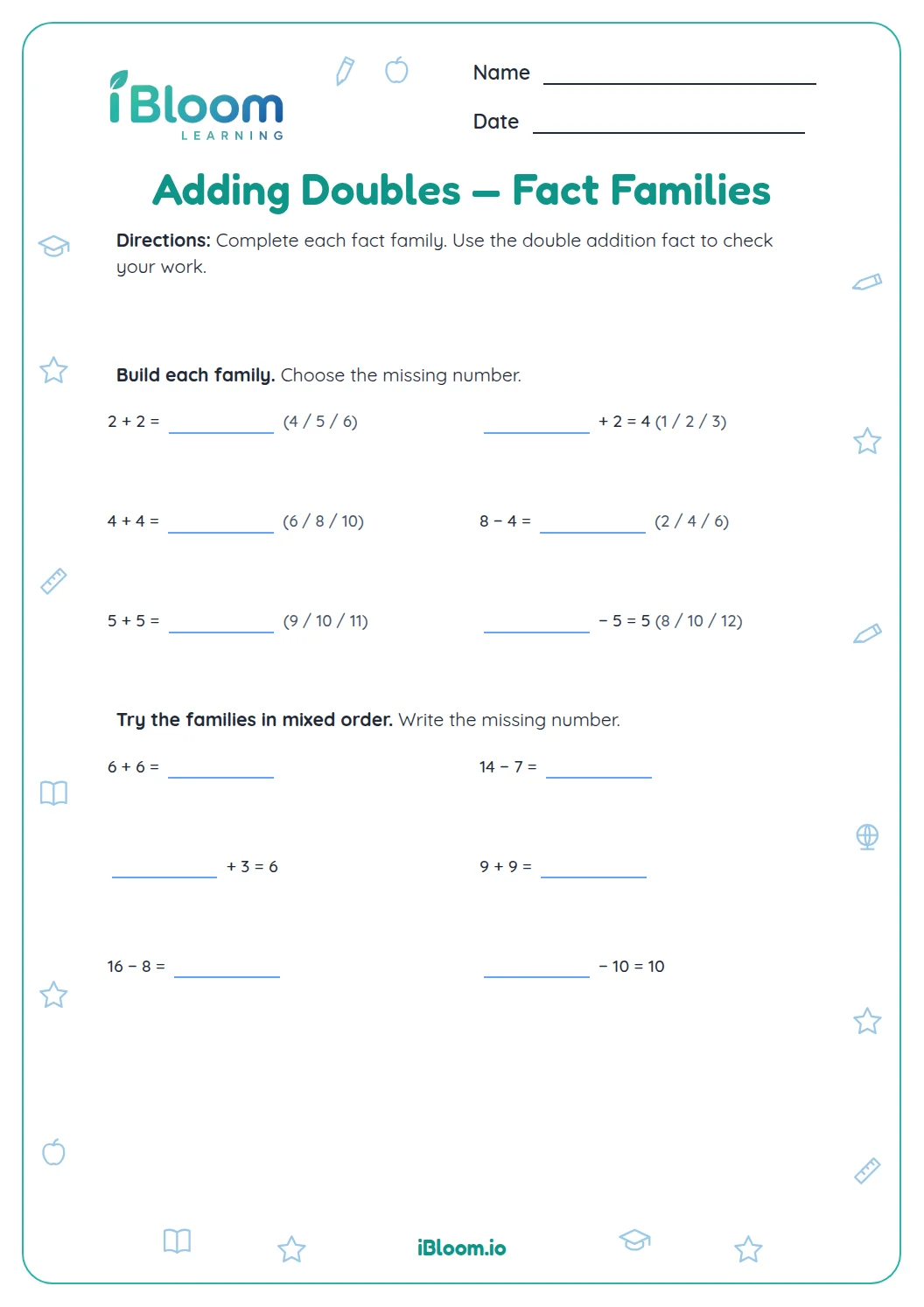
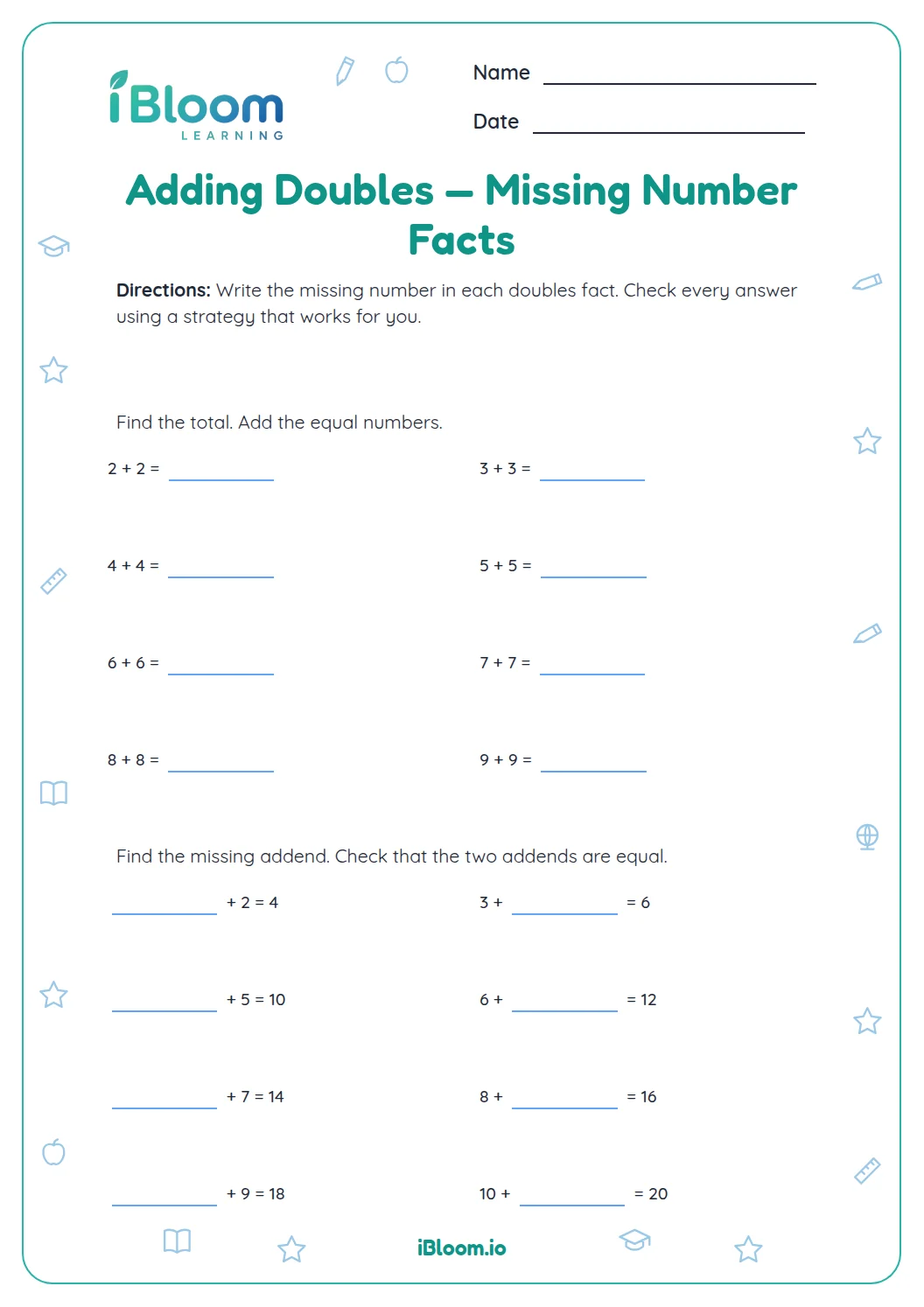
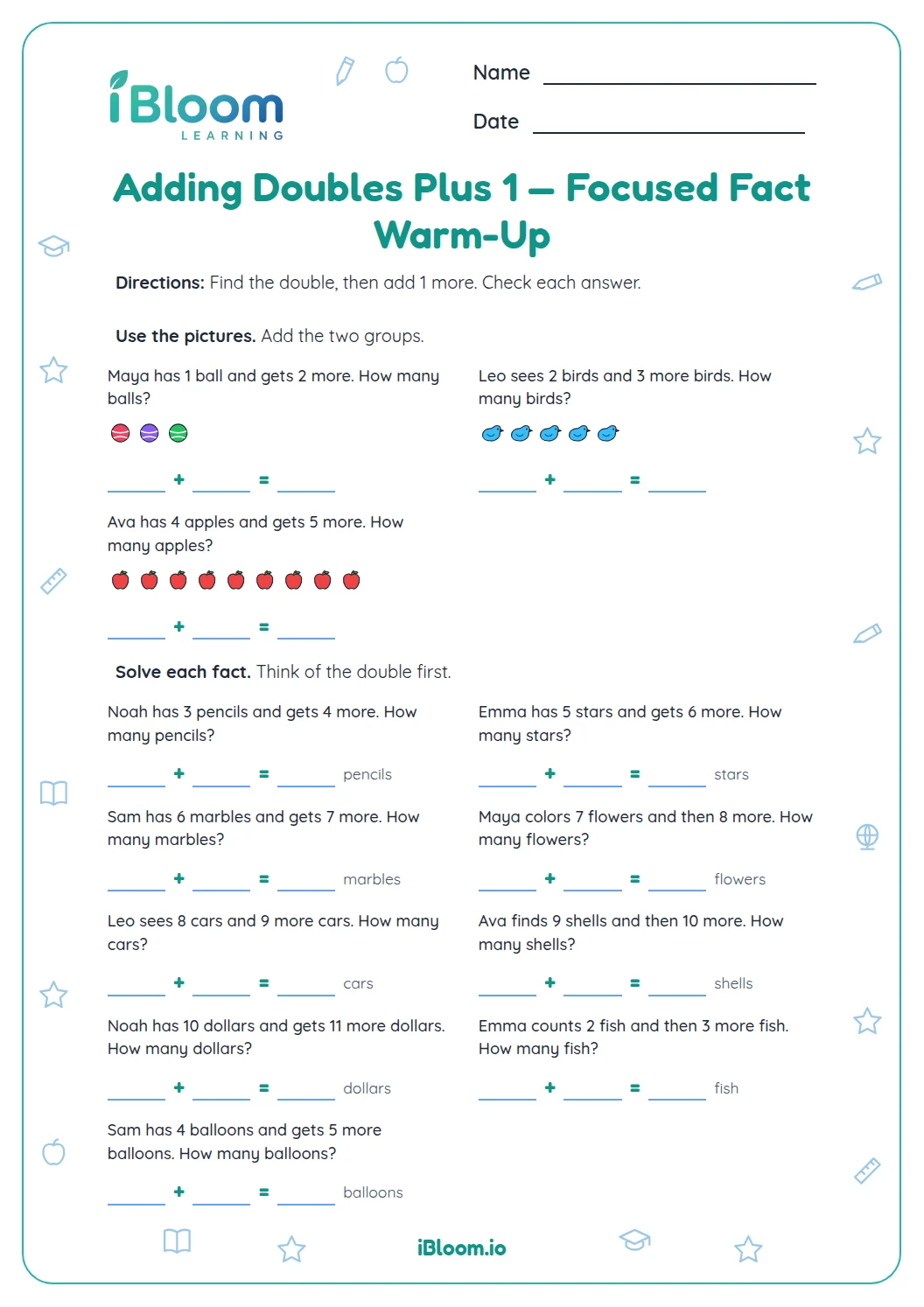
This printable doubles-minus-one worksheet is for Grades 1–2. It has 17 questions: six near-double sums, four missing addends, four related subtraction facts, and three fact-family questions. The practice centers on neighboring addends and uses related facts to check each answer.
Aligned to 1.OA.C.6
How does a doubles-minus-one fact work?
A near double with one less is one less than an equal-addend sum. For example, 7 + 6 is one less than 7 + 7, so the sum is 13.
- 17 + 6 = 7 + 7 − 1
- 214 − 1 = 13
How can a near double help find a blank?
Compare the known addend with its neighboring number, then use the matching double to find the missing addend. Check by putting the number back in the equation.
How do fact families connect the sums?
The final parts use subtraction facts that share numbers with the near-double sums. Start with the whole, then subtract one part to find the other.
How to use this worksheet
- 1Find the known double near the two addends.
- 2Adjust the double by one.
- 3For a blank, substitute your answer to check it.
- 4Use the whole number first in a subtraction fact.
- 5Check that each family uses the same three numbers.
Common mistakes and quick fixes
The mistake
Using the double without adjusting by one.
The fix
A doubles-minus-one sum is one less than the equal-addend sum.
The mistake
Putting the total in a missing-addend blank.
The fix
Test the addend by adding it to the number already shown.
The mistake
Subtracting the whole from one part.
The fix
Begin with the total and take away the known part.
Common Core alignment
This page practices addition and related fact strategies.
Use addition strategies and related facts to solve within 20.
On this sheet: Use near doubles, adding-two facts, or complements and related subtraction within 20.
Show the official wordingHide the official wording
Add and subtract within 20, demonstrating fluency for addition and subtraction within 10. Use strategies such as counting on; making ten (e.g., 8 + 6 = 8 + 2 + 4 = 10 + 4 = 14); decomposing a number leading to a ten (e.g., 13 - 4 = 13 - 3 - 1 = 10 - 1 = 9); using the relationship between addition and subtraction (e.g., knowing that 8 + 4 = 12, one knows 12 - 8 = 4); and creating equivalent but easier or known sums (e.g., adding 6 + 7 by creating the known equivalent 6 + 6 + 1 = 12 + 1 = 13).
What to practice next
Make more practice
Further reading
Questions parents and teachers ask
What is a doubles-minus-one fact?
A doubles-minus-one fact adds two neighboring numbers, such as 7 and 6. Since 7 + 7 is 14, 7 + 6 is one less, or 13. The worksheet practices these sums, missing addends, and related family facts. Have the learner explain the strategy, then verify the completed equation with the answer key.
How many questions are on the sheet?
The worksheet has 17 questions in four parts: six near-double sums, four missing addends, three related subtraction facts, and four family questions. The answer key gives one response for each item, so an adult can review the full set after the learner finishes.
What is a fact family?
A fact family uses the same three numbers in related addition and subtraction equations. For example, 8 + 7 = 15 connects to 15 − 8 = 7. This sheet uses those links to help check near-double facts. Have the learner explain the strategy, then verify the completed equation with the answer key.
How can a double help solve 8 + 7?
Think of the equal-addend fact 8 + 8 = 16. Because 7 is one less than 8, subtract one from 16 to get 15. The first part uses this reasoning with different neighboring addends, then later parts connect the related facts.
When should a child check the key?
Complete one part first, then compare the responses with the key. For any missed item, rebuild the related double or fact family and substitute the answer into the original equation. This keeps checking focused on the strategy as well as the result.