







About this worksheet
This free printable worksheet helps Grade 1 and Grade 2 students learn the doubles minus 1 facts, such as 6 + 5 and 9 + 8. Each of these is a double with one taken away, so a child who knows 7 + 7 = 14 can find 7 + 6 = 13. Part A starts from the double, Part B mixes the order so the bigger number comes first or second, Part C asks children to spot a near double, and Part D has two word problems. The practice supports Common Core 1.OA.C.6 and 2.OA.B.2. An answer key is included.
Aligned to 1.OA.C.6 and 2.OA.B.2
What is on this worksheet?
Nineteen questions in four parts, all built on the same idea. Every addition fact on the page has two numbers that are one apart, and every sum can be found from a double.
Part A gives the double first and asks for the fact beside it. Part B removes that support, and the bigger number moves from the first to the second position. Part C asks children to name a doubles minus 1 fact, including one from a ten frame. Part D has two short word problems with working space.
- Part A: use the double to solve the next fact (questions 1 to 6)
- Part B: mixed order, large first or second (questions 7 to 14)
- Part C: spot the near double, one with a ten frame (questions 15 to 17)
- Part D: two word problems (questions 18 and 19)
- Answer key on its own pages
How does the doubles minus 1 strategy work?
Find the bigger number, double it, then take one away. For 6 + 5, the bigger number is 6, and 6 + 6 = 12. Taking one away gives 11, because 5 is one less than 6.
The strategy works because the two numbers are always one apart. Children who know their doubles to 10 + 10 can then answer all of the facts on this sheet, from 3 + 2 up to 10 + 9, without counting.
- 15) 7 + 7 = 14, so 7 + 6 = ___
- 27 + 6 is one less than 7 + 7.
- 314 − 1 = 13
Why does the order of the numbers change in Part B?
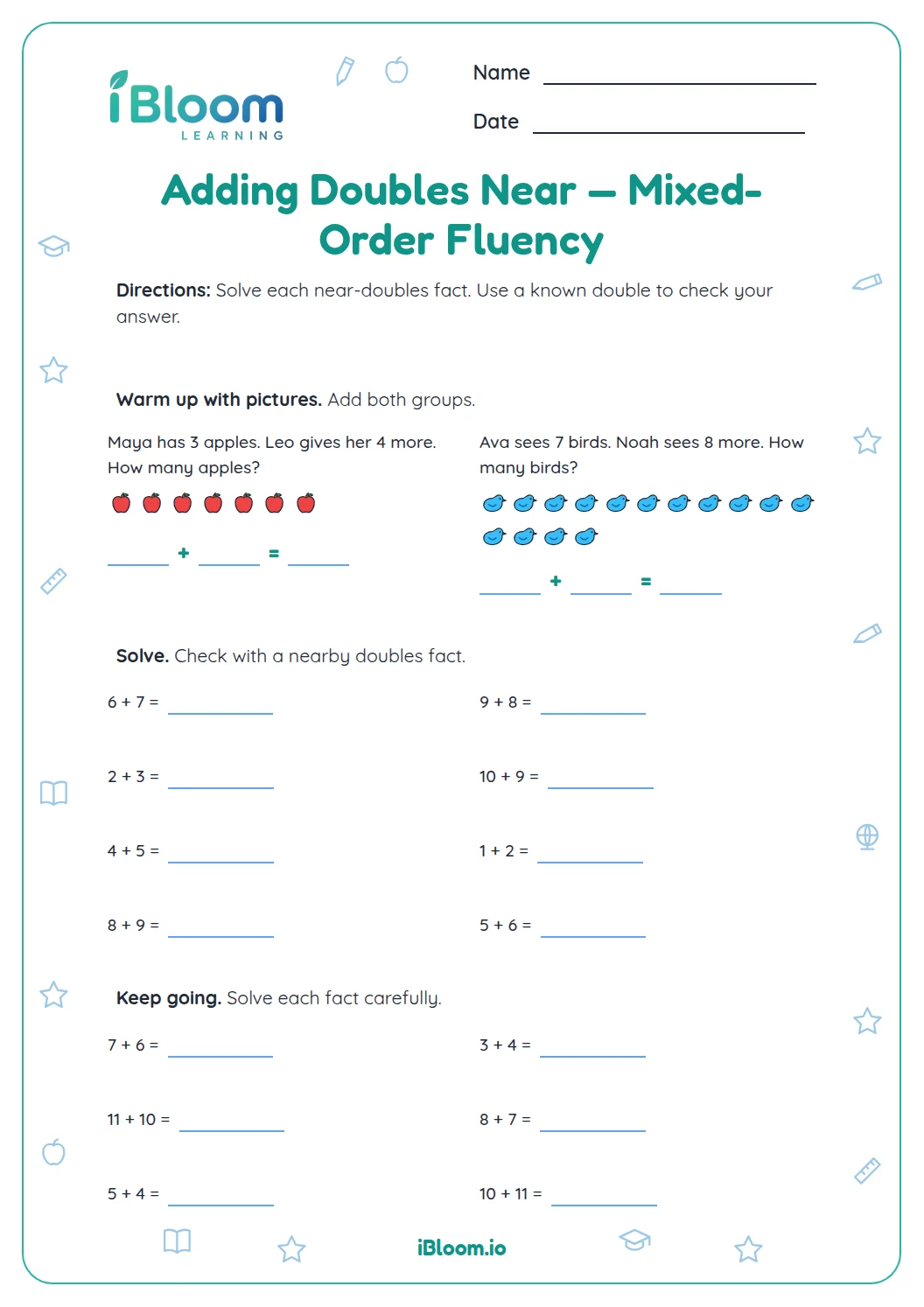
Children meet near doubles in both orders: 9 + 8 and 8 + 9, or 4 + 5 and 5 + 4. Addition gives the same sum either way, so the same strategy works. The trick is to look for the bigger number wherever it sits.
Part B has four facts with the bigger number first and four with it second. That keeps children from relying on a pattern such as “the answer is always the first number doubled.”
- 18) 9 + 8 → the bigger number is 9, 9 + 9 = 18, 18 − 1 = 17
- 211) 8 + 9 → same numbers in the other order, so the answer is 17 too
- 314) 10 + 9 → 10 + 10 = 20, 20 − 1 = 19
How do the ten frame and word problems fit in?
Question 17 shows 13 counters in two ten frames and asks which doubles minus 1 fact makes 13. Children can check each choice: 7 + 6 is 13, while 7 + 7 is 14 and 6 + 6 is 12.
In the word problems, Maya has 8 red and 7 green apples, and Leo has 6 stickers while Sam has 5. Children decide to add, then use a near double: 8 + 8 = 16, so 8 + 7 = 15.
How to use this worksheet at home or in class
- 1Warm up by saying doubles aloud from 1 + 1 to 10 + 10 so your child can answer without thinking.
- 2Show question 1 and ask: “How is 3 + 2 different from 3 + 3?” Let your child say that it is one less.
- 3Let your child finish Part A on their own, then move to Part B and ask them to find the bigger number first each time.
- 4For Part C, say each fact aloud and ask, “Is it a double? Is it one less than a double?”
- 5Check the answers with the key, and ask your child to explain one fact by saying its double first.
- 6Move on to the near doubles worksheets when most answers come without drawing or counting.
Common mistakes and quick fixes
The mistake
Stopping at the double and writing 7 + 6 = 14 (question 5).
The fix
Ask whether 6 is the same as 7. It is one less, so the answer has to be one less than 14, which is 13.
The mistake
Doubling the smaller number and then taking one away, so 6 + 7 becomes 6 + 6 − 1 = 11 (question 9).
The fix
Doubling the smaller number leaves you one short, so add 1 instead. Or double the bigger number and take 1 away. Check by counting up from 6: 7, 8, 9, 10, 11, 12, 13.
The mistake
Adding one instead of subtracting, so 9 + 8 becomes 9 + 9 + 1 = 19 (question 8).
The fix
Draw 9 and 8 side by side. The second number is smaller than 9, so the sum is smaller than 18. The answer is 17.
Common Core alignment
Most US states teach addition facts with the Common Core standards or a close state version. These two standards name the skills the page practices.
Add within 20 using strategies such as creating an easier or known sum.
On this sheet: Each question finds a sum within 20 from a known double, the easier-known-sum strategy the standard names.
Show the official wordingHide the official wording
Add and subtract within 20, demonstrating fluency for addition and subtraction within 10. Use strategies such as counting on; making ten (e.g., 8 + 6 = 8 + 2 + 4 = 10 + 4 = 14); decomposing a number leading to a ten (e.g., 13 - 4 = 13 - 3 - 1 = 10 - 1 = 9); using the relationship between addition and subtraction (e.g., knowing that 8 + 4 = 12, one knows 12 - 8 = 4); and creating equivalent but easier or known sums (e.g., adding 6 + 7 by creating the known equivalent 6 + 6 + 1 = 12 + 1 = 13).
Add within 20 fluently using mental strategies.
On this sheet: Part B mixes the order so children use the near-double strategy mentally, building toward sums known from memory.
Show the official wordingHide the official wording
Fluently add and subtract within 20 using mental strategies. By end of Grade 2, know from memory all sums of two one-digit numbers.
What to practice next
Make more practice
Further reading
Questions parents and teachers ask
What is the difference between doubles and doubles minus 1?
A double adds a number to itself, such as 7 + 7 = 14. A doubles minus 1 fact adds a number to one less than itself, such as 7 + 6, which equals 14 − 1 = 13. Part A on this worksheet gives the double first so children can see the link.
Why does the sheet show facts in mixed order?
Children need to recognize near doubles however they appear. In Part B, 4 + 5 puts the bigger number second, while 9 + 8 puts it first. Because addition gives the same sum in either order, the strategy works both ways, and mixed order shows whether a child really understands it.
Is this worksheet for Grade 1 or Grade 2?
It suits both. Grade 1 children can use Part A as a guided step and do the smaller facts, such as 3 + 4 and 5 + 4. Grade 2 children can work through all of it, including 10 + 9, and aim to answer without drawing or counting.
Does my child need to memorize the doubles first?
Knowing doubles to 10 + 10 makes the sheet much easier, so it helps to warm up with them. Children who are unsure can use the ten frame in question 17 or draw dots. Over time, the near doubles become another set of facts they know from memory.
Should my child time this drill?
A timer is not needed. The strategy comes first, and speed follows once the facts feel familiar. If your child likes a challenge, ask them to say the double aloud before writing each answer. Accuracy and explaining the reasoning matter more than finishing quickly.
What should my child do after this worksheet?
Try the Adding Doubles worksheet to secure the doubles, then Adding Doubles Plus 1 for the same idea with one more. Adding Doubles Near mixes both directions. If a fact still feels slow, the Making Ten worksheet offers a different route to sums within 20.