






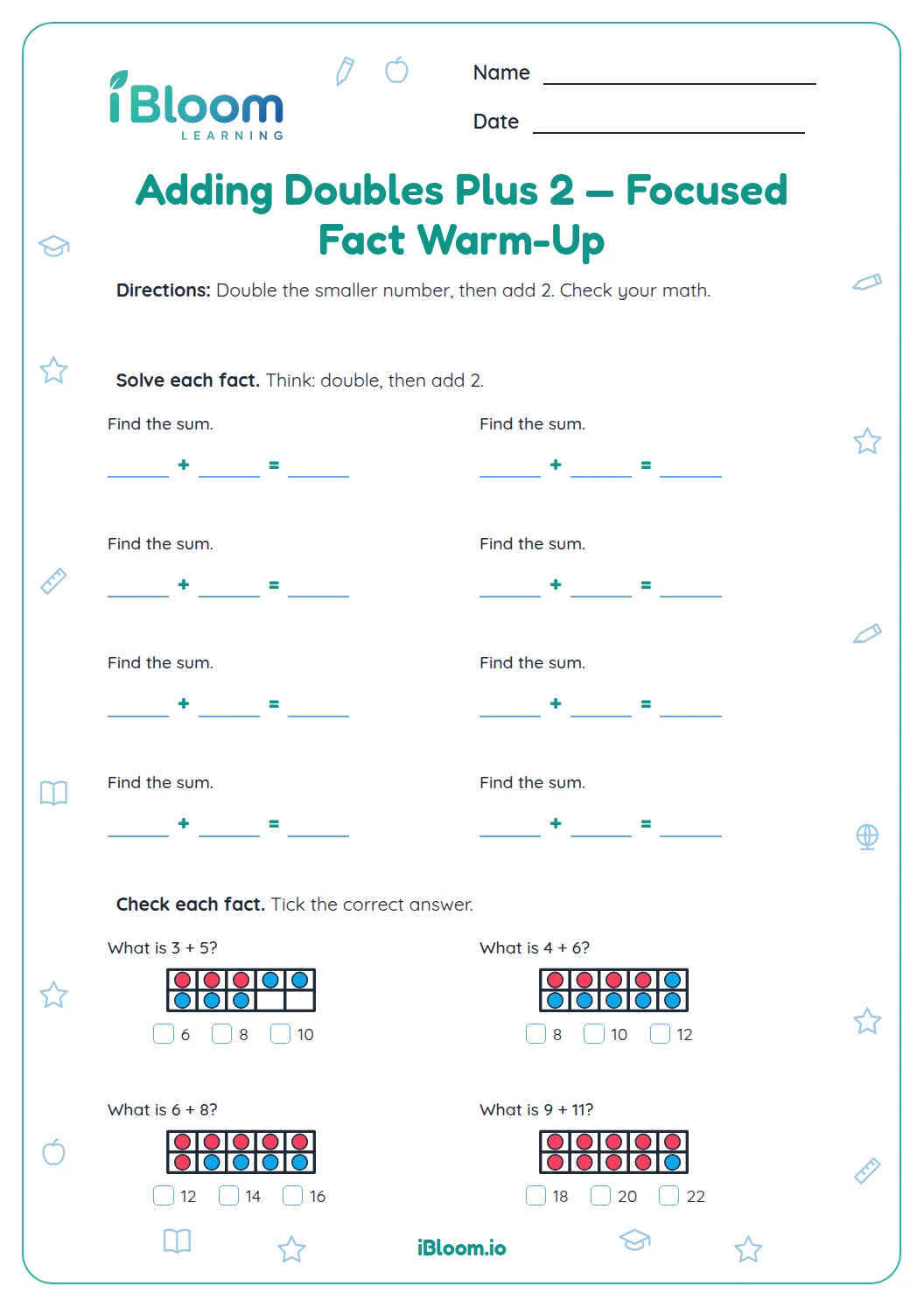
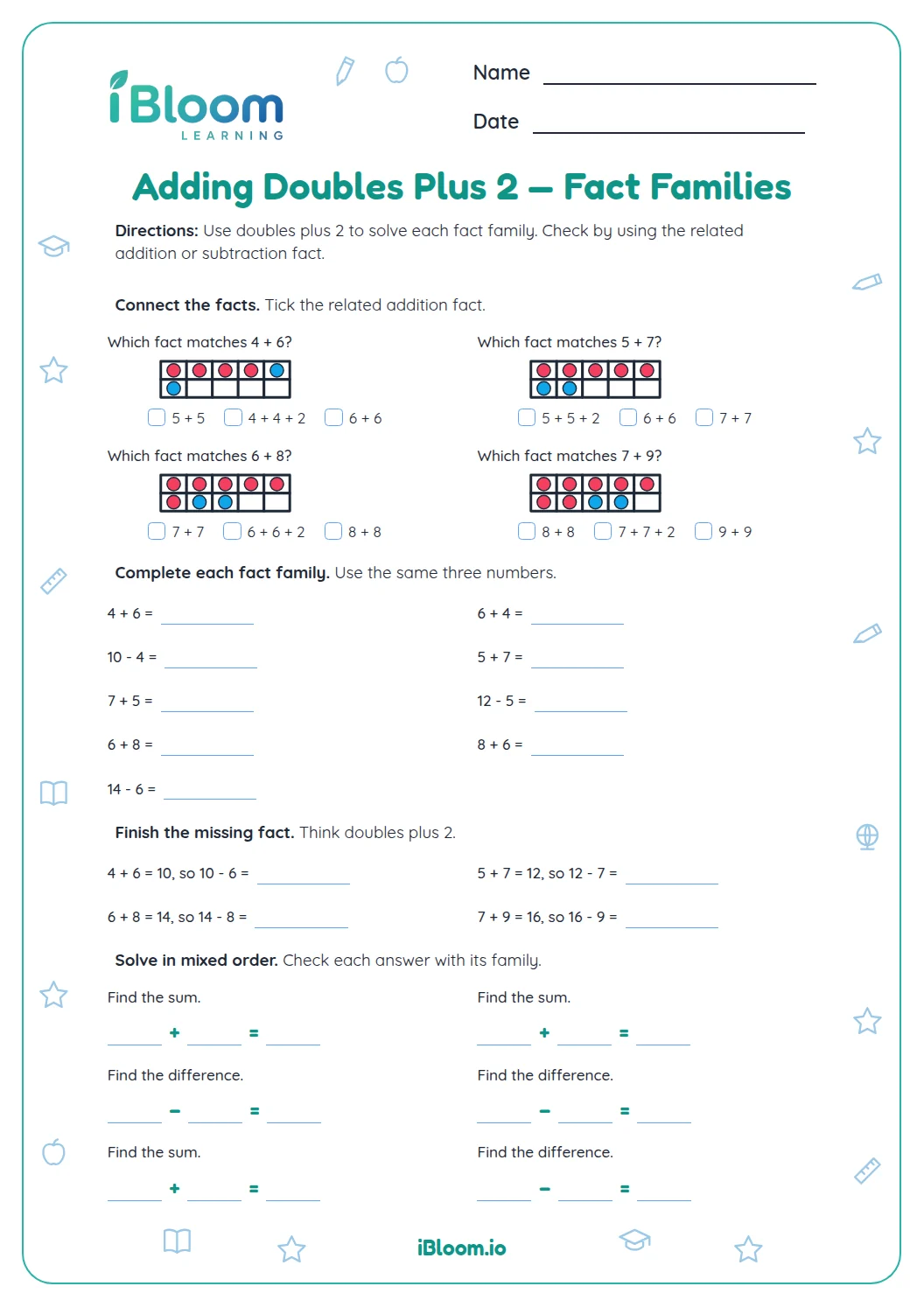
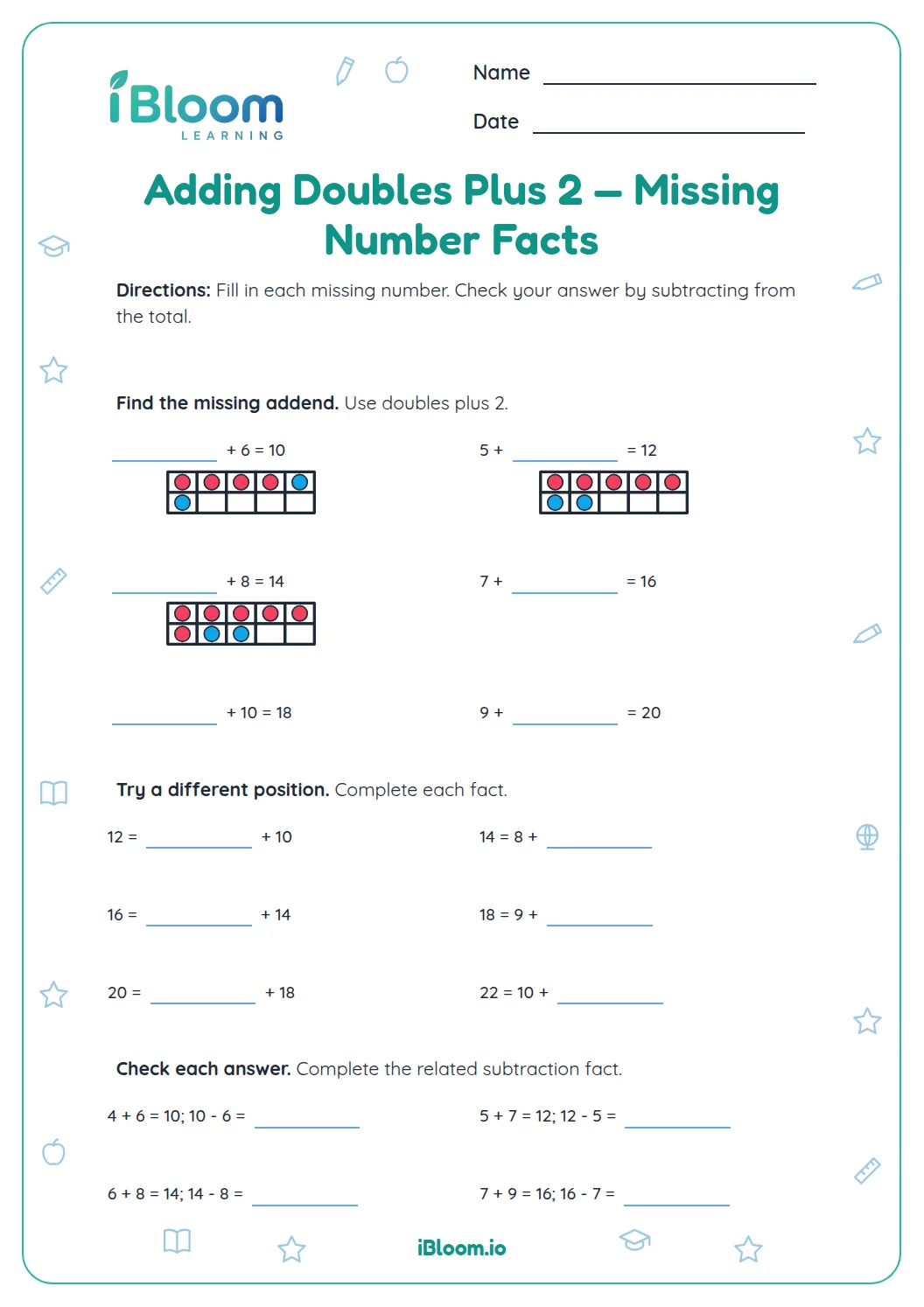
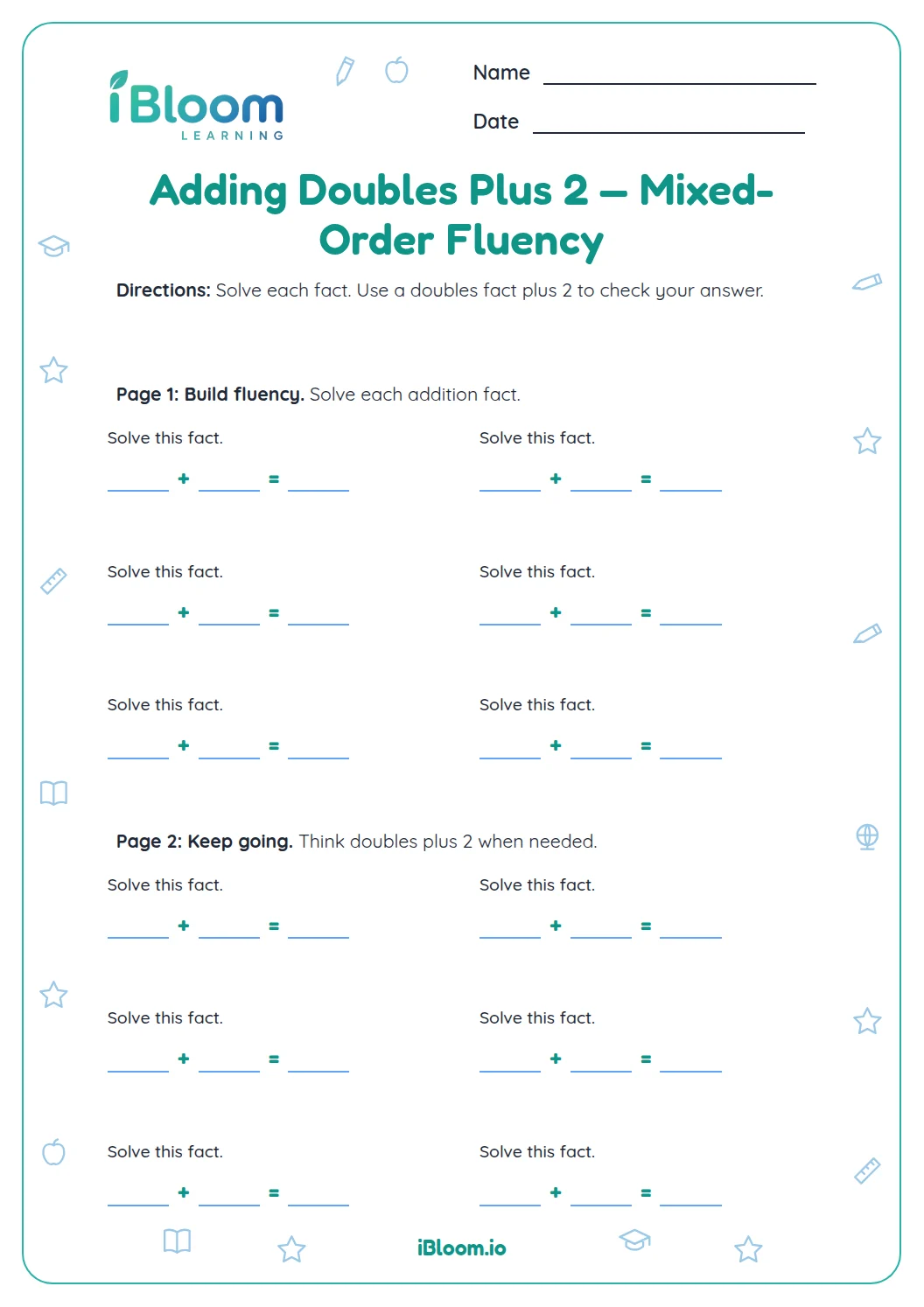

About this worksheet
This free printable worksheet is a short warm-up for the doubles minus 2 strategy: when one number is 2 less than the other, as in 8 + 6, double the bigger number and take away 2, so 8 + 8 = 16 and 16 − 2 = 14. Children review four doubles, two of them drawn as apple arrays, practice taking 2 from a double, solve four doubles-minus-2 facts, match facts to the right double, and finish with two story problems. It practices Common Core 1.OA.C.6 and 2.OA.B.2, with 18 questions on two pages, all sums within 20, and an answer key.
Aligned to 1.OA.C.6 and 2.OA.B.2
How does the doubles minus 2 strategy work?
Doubles minus 2 works when the two numbers are 2 apart. Pretend the smaller number is as big as the larger one, which makes a double, then take back the 2 extra. For 8 + 6, the double 8 + 8 is 16, and 16 − 2 = 14.
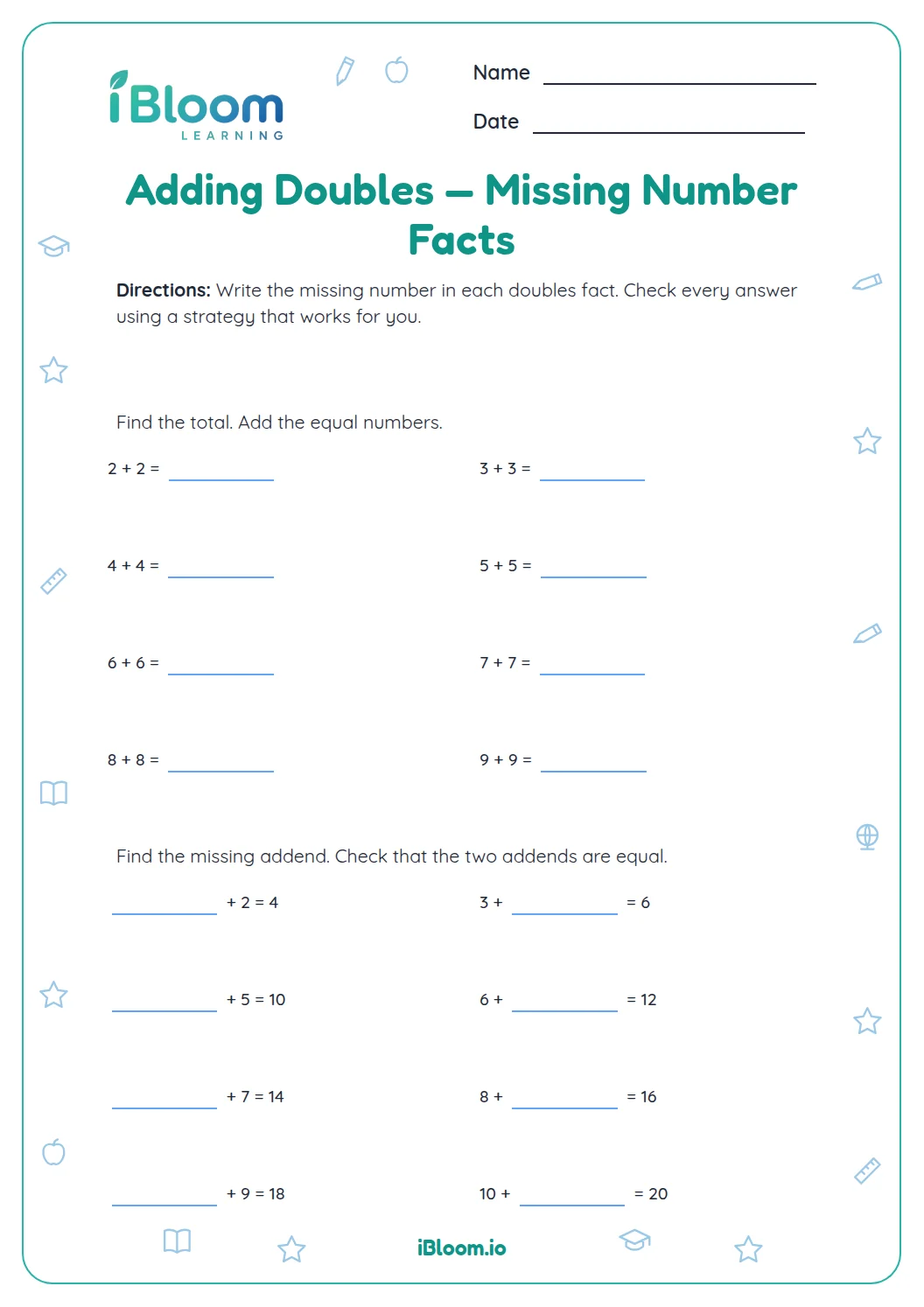
The strategy only helps a child who knows the doubles, so the sheet starts there. Part A reviews 6 + 6, 7 + 7, 8 + 8 and 9 + 9, the four doubles that come back in Parts B and C.
- 18 + 6 = ___
- 2The bigger number is 8. Double it: 8 + 8 = 16
- 36 is 2 less than 8, so take away 2: 16 − 2 = 14
- 48 + 6 = 14
Why does the sheet take the strategy one step at a time?
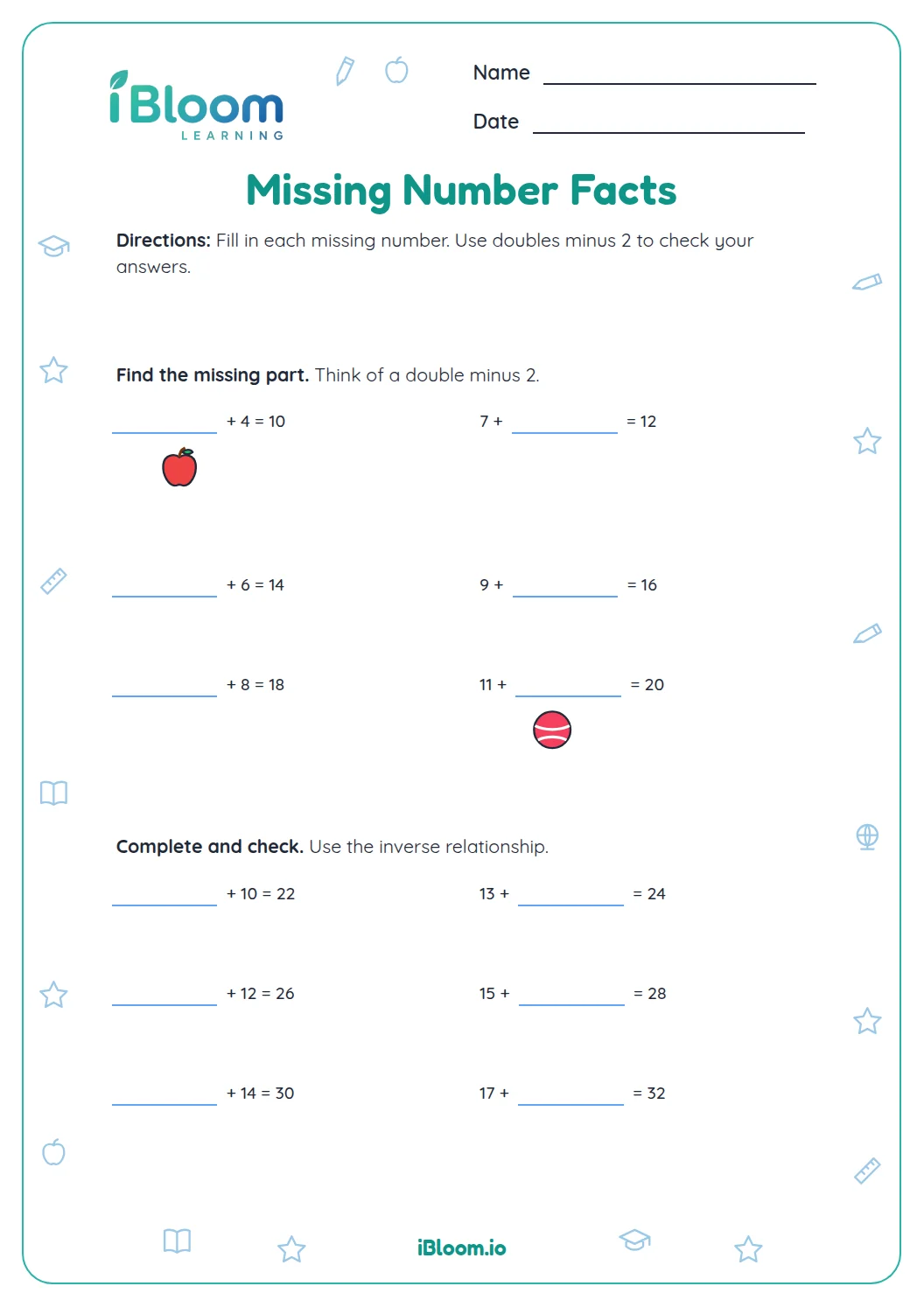
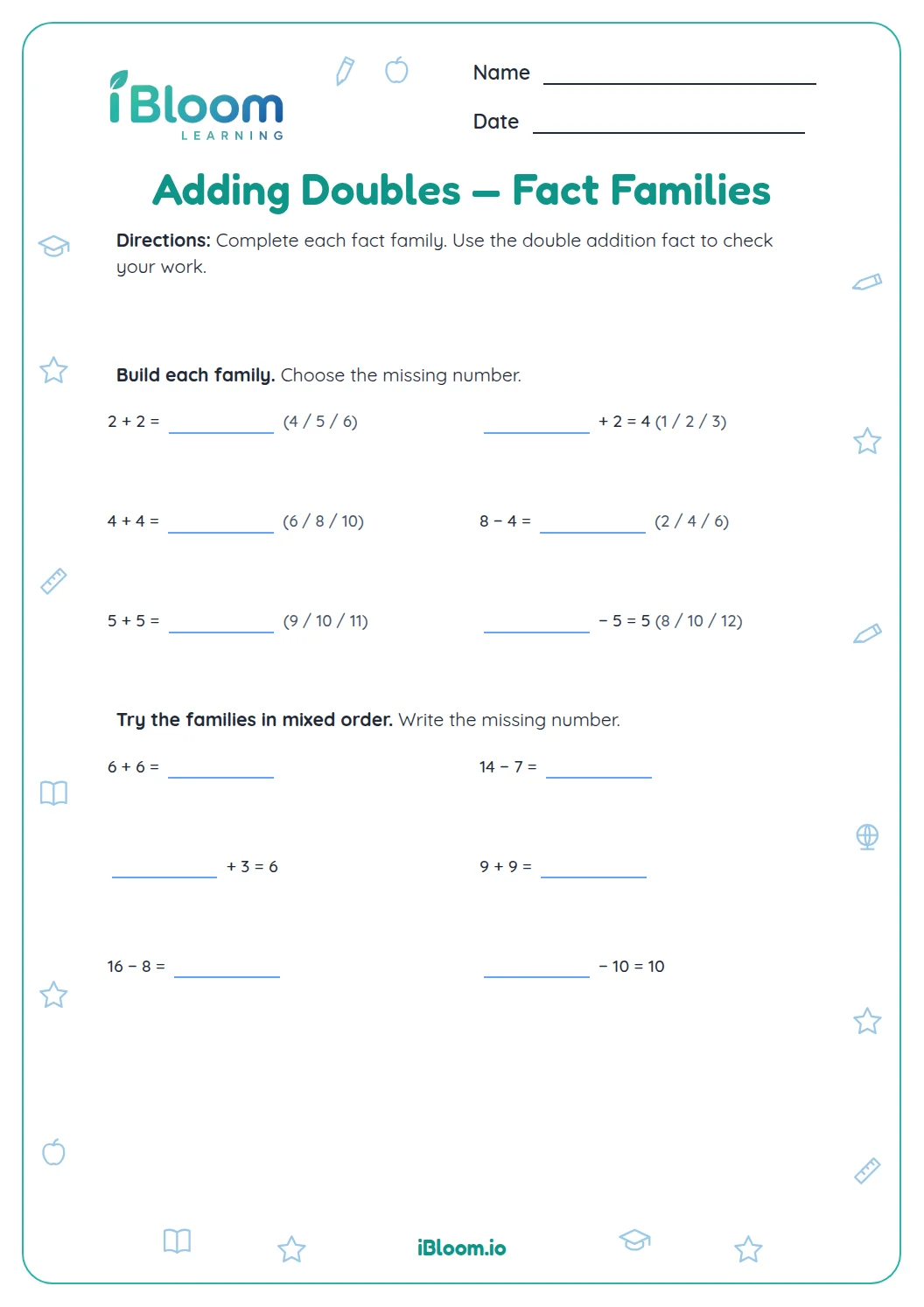
Each part adds one step. Part A gives the double, with the first two drawn as two equal rows of apples. Part B writes the whole strategy out, as in 7 + 7 − 2, so children only do the arithmetic. Part C hides it: children see 10 + 8 and have to think of 10 + 10 − 2 themselves.
Part D checks the thinking without any adding. For 9 + 7, children choose 9 + 9 − 2 over 9 + 9 + 2 and 7 + 7 − 2, which shows whether they double the bigger number and take away rather than add.
What is on this worksheet?
Eighteen questions in five parts on two pages, all with sums within 20.
- Part A, Know the doubles: 6 + 6, 7 + 7, 8 + 8 and 9 + 9, the first two with apple arrays
- Part B, Double, then take away 2: four number sentences such as 8 + 8 − 2
- Part C, Doubles minus 2 facts: 5 + 3, 8 + 6, 10 + 8 and 11 + 9
- Part D, Pick the match: choose the double minus 2 that equals each fact
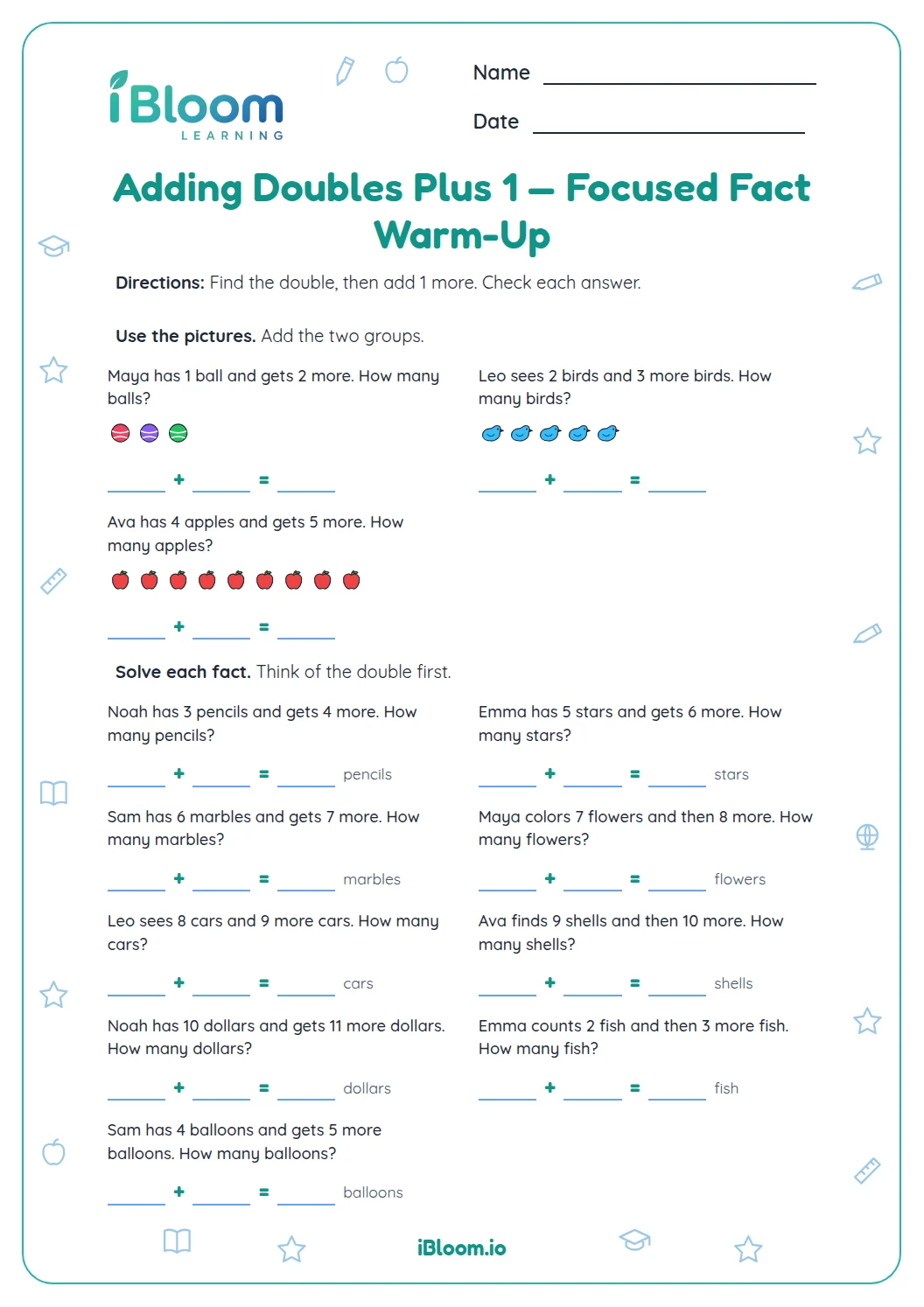
- Part E, Story problems: pencils and marbles, with room for a number sentence
- Answer key on two separate pages
What should come after this warm-up?
Once doubles minus 2 feels easy, practice its neighbors: doubles minus 1 for facts like 7 + 6, and doubles plus 1 and plus 2, which start from the smaller number instead. Mixed practice then teaches children to look at the two numbers first and pick the double that fits.
How to use this worksheet at home or in class
- 1Warm up with counters. Make two rows of 7, then take 2 away from one row, and count the 12 that are left: that is 7 + 5.
- 2Say the doubles in Part A out loud together: “6 and 6 is 12.” Count the apples if a double is not known yet.
- 3Let your child do Part B alone. Every answer is the double from Part A with 2 taken away.
- 4Do question 10 together, asking which number is bigger, what its double is, and what is left after taking away 2.
- 5In Part D, ask your child why the wrong choices do not work, for example why 9 + 9 + 2 is too big.
- 6For the story problems, ask for a number sentence first. Check with the answer key and replay any fact that was missed.
Common mistakes and quick fixes
The mistake
Doubling the smaller number and taking away 2, so 8 + 6 becomes 6 + 6 − 2 = 10.
The fix
Taking away only works from the bigger double. Circle the bigger number first, double it, then take away 2.
The mistake
Adding 2 instead of taking it away, so 9 + 7 becomes 9 + 9 + 2 = 20.
The fix
The double is too big, because 7 was turned into 9. Ask: “Did we add extra?” Yes, 2 extra, so take 2 away.
The mistake
Taking away 1 instead of 2, so 7 + 5 becomes 13.
The fix
Count up from the smaller number to the bigger one: 5, 6, 7 is 2 steps, so take away 2. Doubles minus 1 is for numbers 1 apart.
Common Core alignment
Most US states use the Common Core math standards or a close state version. This sheet practices the two addition standards below.
Add within 20 by turning a fact into a known double and adjusting it.
On this sheet: Parts B to E turn facts like 8 + 6 into the known double 8 + 8, then take away 2, all within 20.
Show the official wordingHide the official wording
Add and subtract within 20, demonstrating fluency for addition and subtraction within 10. Use strategies such as counting on; making ten (e.g., 8 + 6 = 8 + 2 + 4 = 10 + 4 = 14); decomposing a number leading to a ten (e.g., 13 - 4 = 13 - 3 - 1 = 10 - 1 = 9); using the relationship between addition and subtraction (e.g., knowing that 8 + 4 = 12, one knows 12 - 8 = 4); and creating equivalent but easier or known sums (e.g., adding 6 + 7 by creating the known equivalent 6 + 6 + 1 = 12 + 1 = 13).
Add within 20 quickly in your head, using doubles as a mental strategy.
On this sheet: Doubles and doubles-minus-2 facts within 20 are solved mentally, for quick recall in Grade 2.
Show the official wordingHide the official wording
Fluently add and subtract within 20 using mental strategies.
What to practice next
Make more practice
Further reading
Questions parents and teachers ask
What does doubles minus 2 mean?
Doubles minus 2 means adding two numbers that are 2 apart, such as 8 + 6, by doubling the bigger number and taking away 2. So 8 + 8 = 16, and 16 − 2 = 14. On this sheet, 5 + 3, 8 + 6, 10 + 8 and 11 + 9 all work this way.
Why do you double the bigger number and not the smaller one?
When you double the bigger number, you count 2 extra, so you take 2 away. Doubling the smaller number gives a total that is 2 too small, which needs adding, not taking away; that is the doubles plus 2 strategy. Question 13 asks children to choose between these, so the difference matters.
Why are there apple arrays at the start?
The arrays show a double as two equal rows, so children can see why 6 + 6 and 8 + 8 are doubles and count them if they need to. With counters, taking 2 apples away from one row of a double shows exactly what doubles minus 2 means, which makes the later number sentences easier to trust.
How does Part D help my child?
Part D asks children to pick the double minus 2 that equals a fact, such as 9 + 9 − 2 for 9 + 7, without working out any totals. The wrong choices add 2 instead of taking it away, or double the wrong number, so a child's choice shows whether they understand each step of the strategy.
What should my child know before trying this sheet?
Your child should be able to take 2 away from a number up to 22 and know the doubles up to 10 + 10, at least with a little thinking time. Part A reviews four of those doubles, so you can see right away whether your child is ready for the facts in Parts B and C.
Is there an answer key for this worksheet?
Yes. Two answer key pages show the totals for every double and fact, the matching choice in each Part D question and each story answer with its unit, 12 pencils and 14 marbles. Print the worksheet alone, keep the key for checking, or download everything as a free PDF.