







About this worksheet
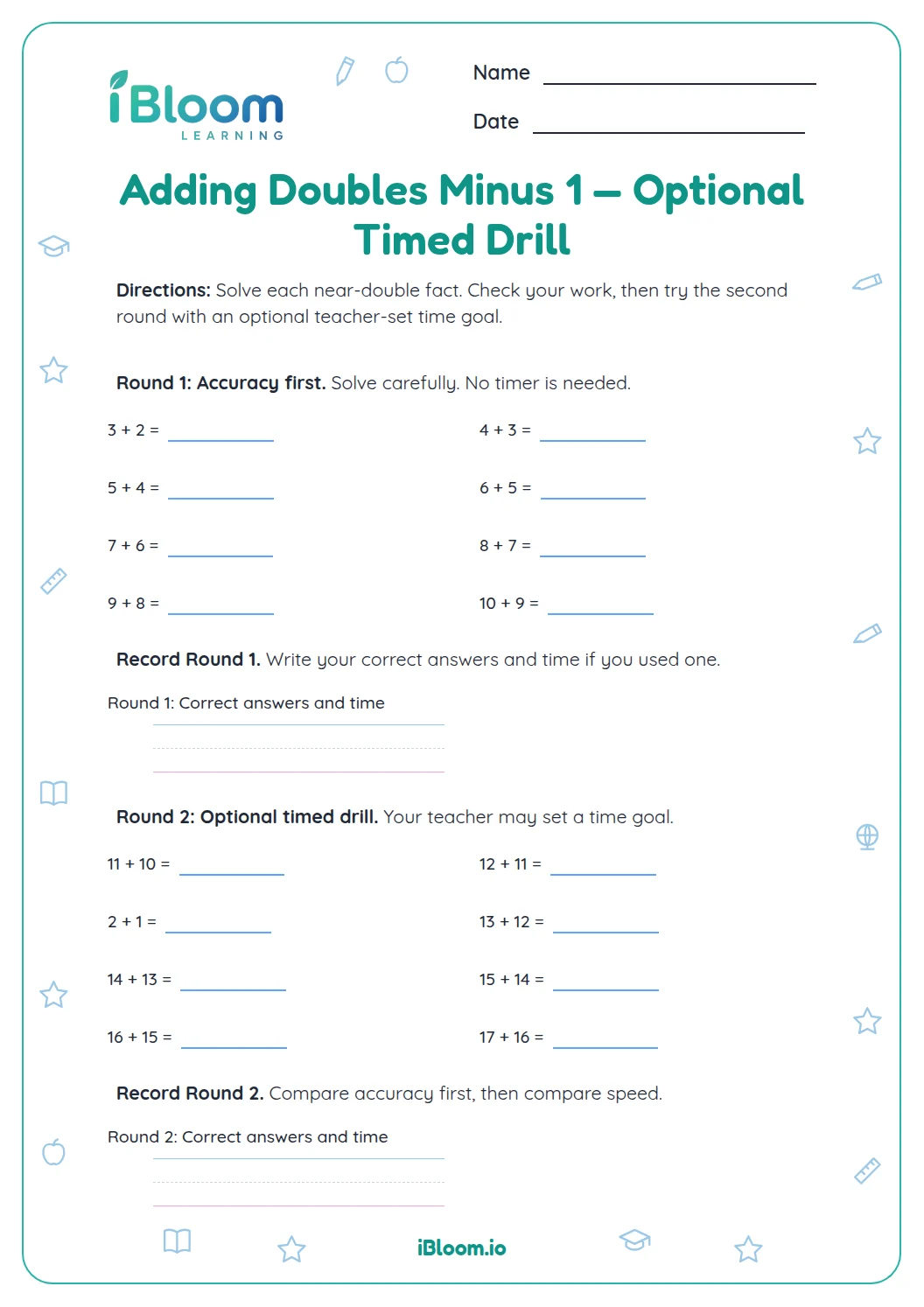
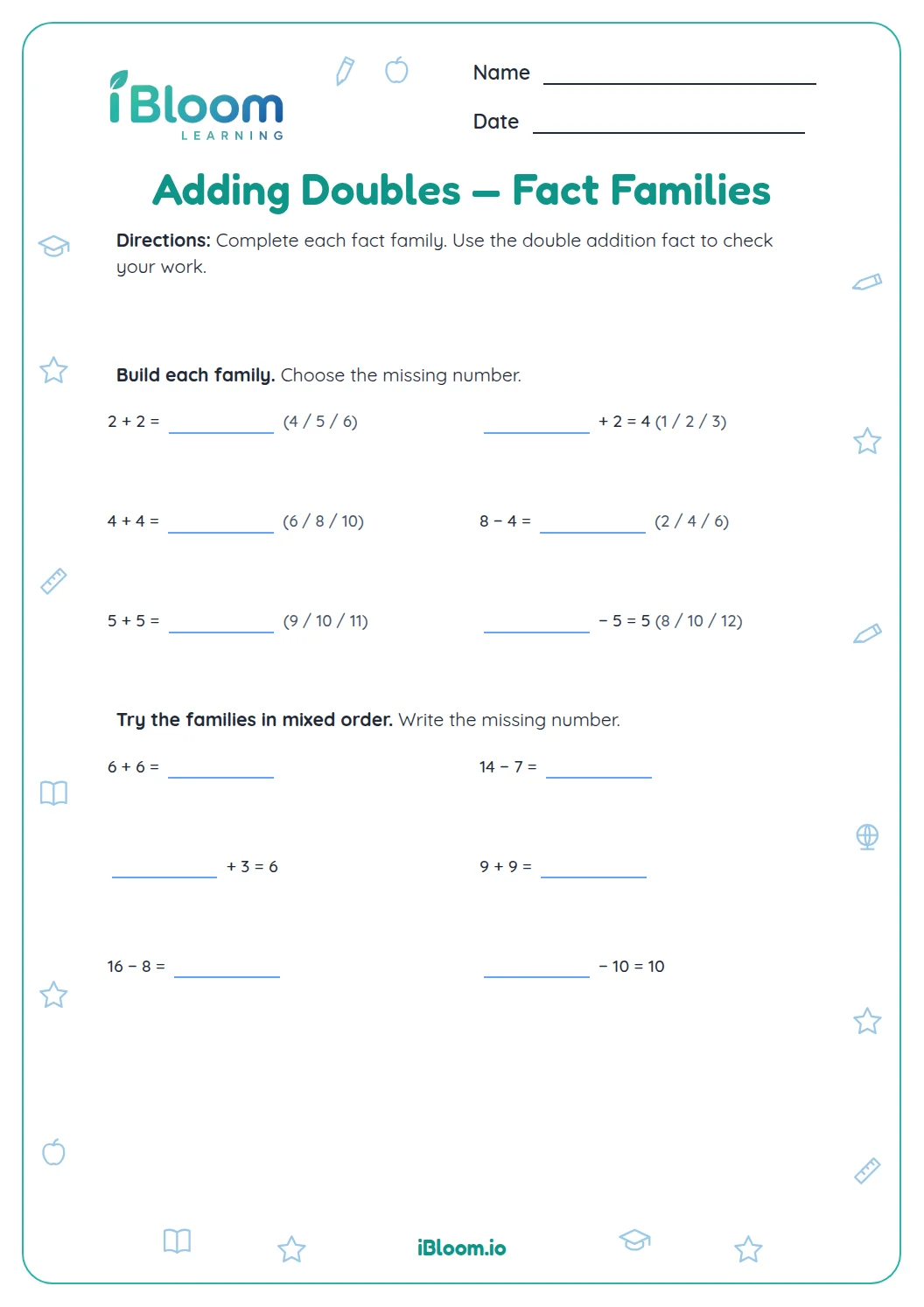
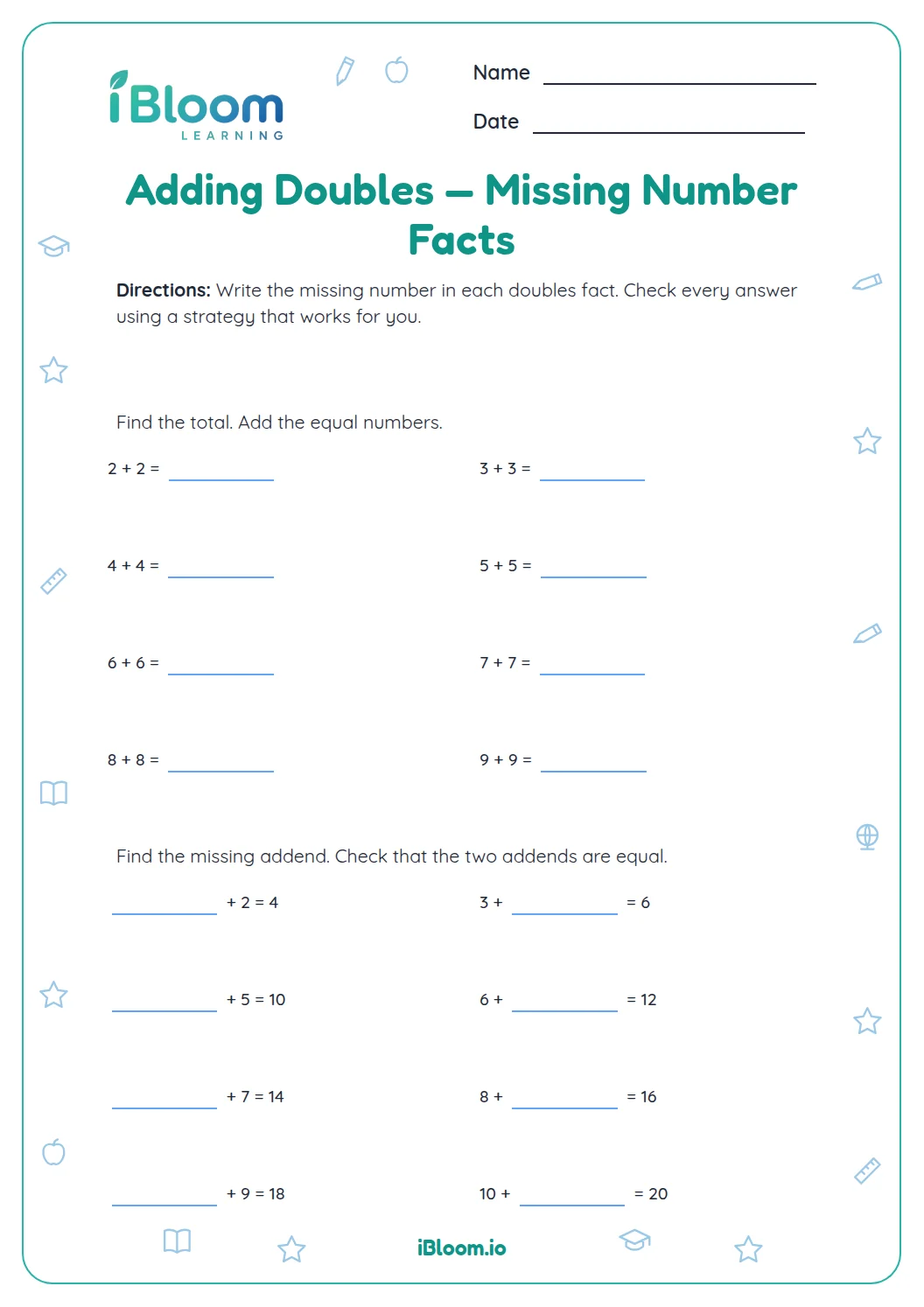
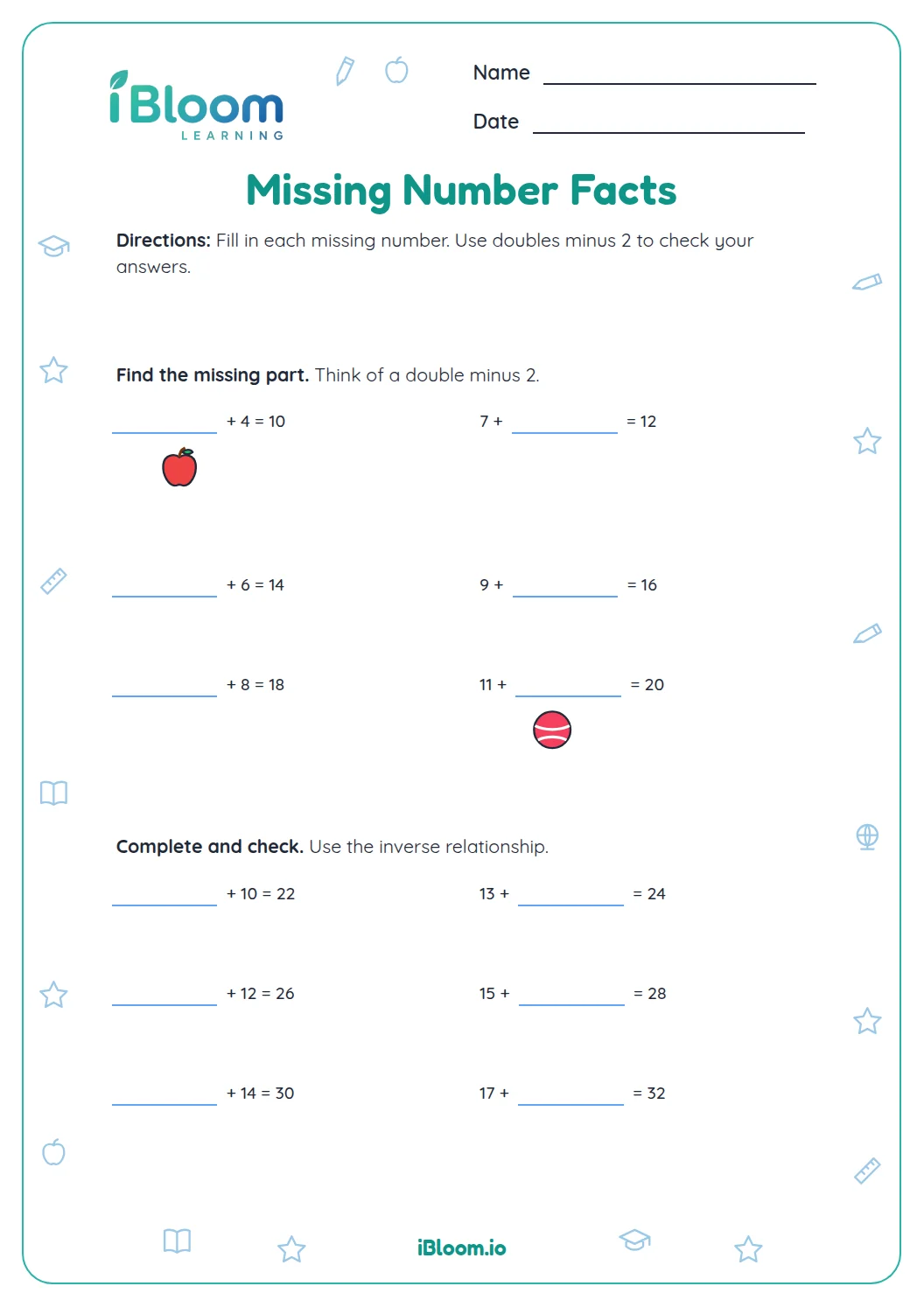
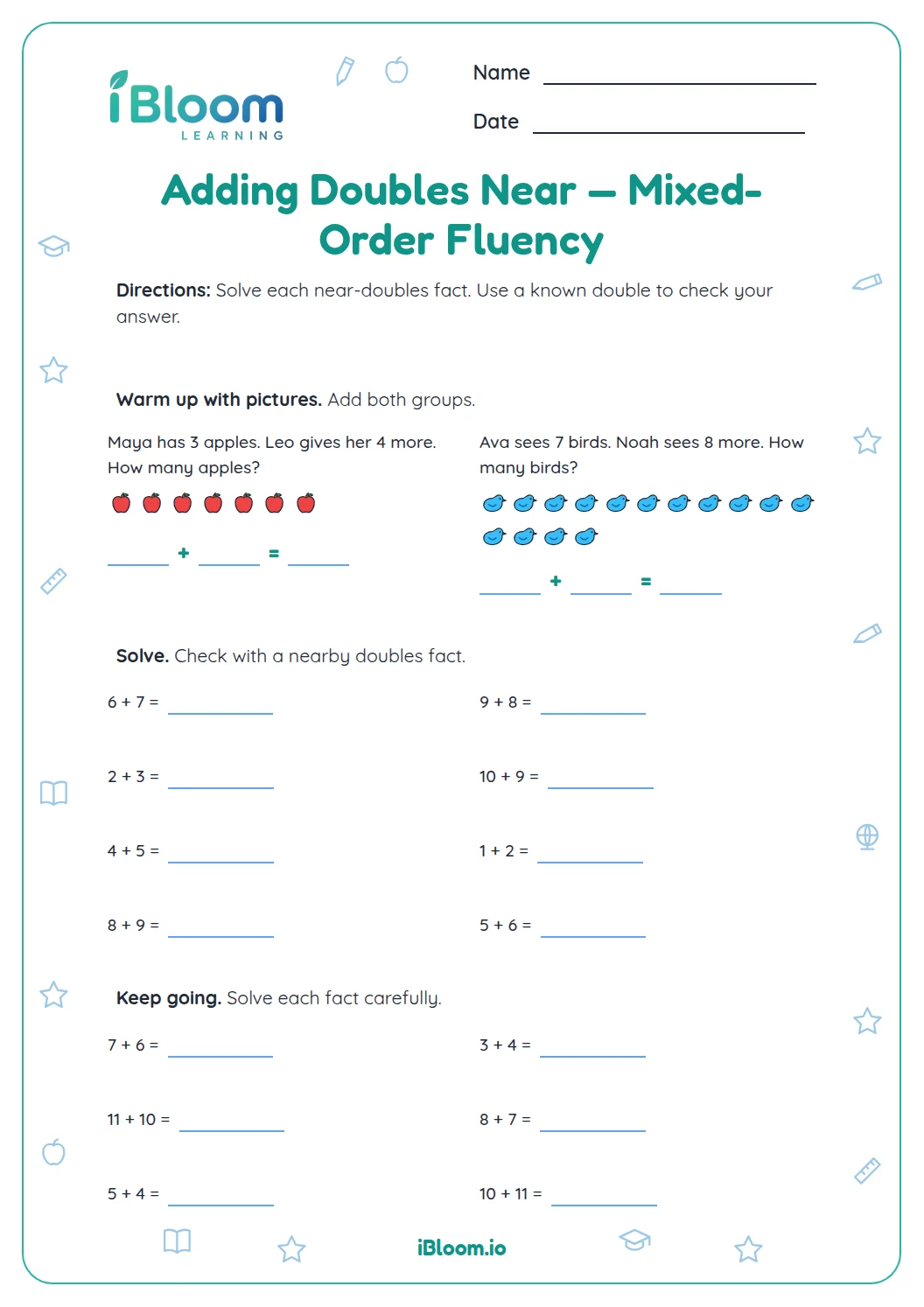
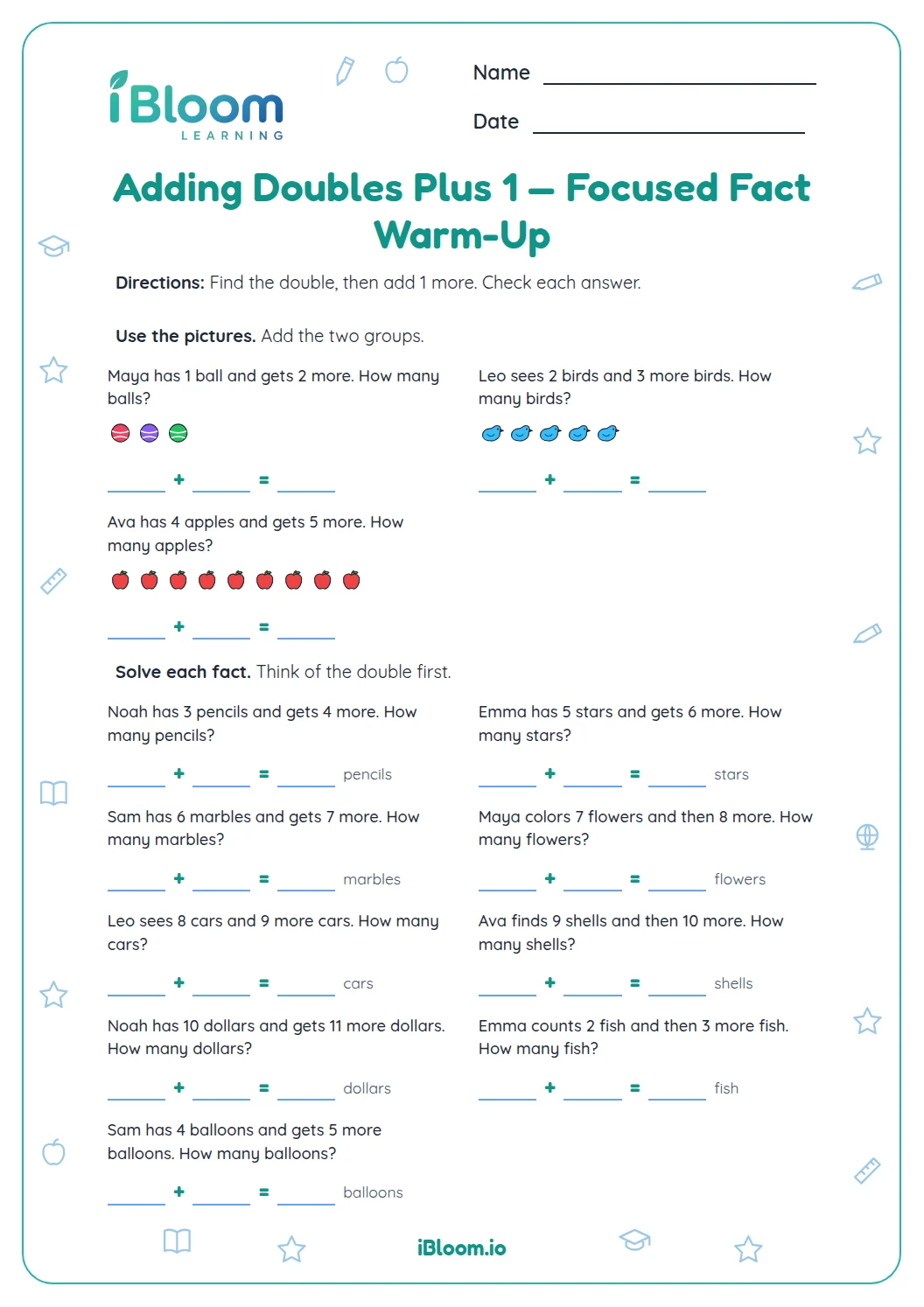
This Grade 1 addition worksheet focuses on doubles-minus-one facts and a few reversed pairs. Students solve short number sentences, notice that switching addends keeps the sum, and apply the same idea to four familiar addition stories. The questions stay within 20 and build from quick facts to short contexts. The answer key lists each sum. This practice aligns with the known-sum strategies in Common Core 1.OA.C.6.
Aligned to 1.OA.C.6
How can a known double help?
Part A asks for sums where one addend is one less than the other. Think of 7 + 7, then adjust to solve 7 + 6.
Why are some addends reversed?
Part B changes the order of the addends. The total stays the same, so 8 + 9 has the same sum as 9 + 8.
How does the strategy work in a story?
Part C turns the same idea into everyday groups. Six red kites and five blue kites make 11 kites altogether.
How to use this worksheet
- 1Say the larger addend twice to make a double.
- 2Adjust the double by one: subtract one for a doubles-minus-one fact.
- 3For reversed addends, remember the total does not change.
- 4In a story, identify both groups and write an addition sentence.
- 5Check the sum by adding one back to the smaller addend.
Helpful reminders
The mistake
Adding the larger addend twice without adjusting.
The fix
For 8 + 7, find 8 + 8 and subtract one from that total.
The mistake
Changing the sum when the addends switch places.
The fix
Build both groups with counters and notice that the total objects stay together.
The mistake
Counting only one group in a story.
The fix
Underline both group amounts, then combine them with addition.
Common Core alignment
Near doubles are a useful known-sum strategy for addition facts.
Use a known double to find a nearby sum within 20.
On this sheet: Each near-double pair can be solved by adding the equal pair and one more or one less.
Show the official wordingHide the official wording
Add and subtract within 20, demonstrating fluency for addition and subtraction within 10. Use strategies such as counting on; making ten (e.g., 8 + 6 = 8 + 2 + 4 = 10 + 4 = 14); decomposing a number leading to a ten (e.g., 13 − 4 = 13 − 3 − 1 = 10 − 1 = 9); using the relationship between addition and subtraction (e.g., knowing that 8 + 4 = 12, one knows 12 − 8 = 4); and creating equivalent but easier or known sums (e.g., adding 6 + 7 by creating the known equivalent 6 + 6 + 1 = 12 + 1 = 13).
What to practice next
Make more practice
Further reading
Questions parents and teachers ask
How do you solve a doubles-minus-one fact?
Use the nearby double you know. For 8 + 7, think 8 + 8 = 16, then take away one to get 15. The worksheet uses this adjustment strategy for several near-double facts and then applies it to short addition stories with familiar objects.
What grade is this worksheet for?
The page is written for Grade 1 addition practice. It uses sums within 20 and builds fluency with known sums, including the strategy of turning a new fact into an easier nearby double. The story problems use small groups and familiar settings.
Why are there reversed addends?
A few problems show the smaller addend first. Reversing the order helps children see that the same two groups have the same total either way, while still practicing the near-double pair. Children can check by drawing or counting both groups together.
Are the story problems doubles-minus-one facts too?
Yes. Each story combines two groups where one amount is one less than the other, such as 6 and 5 kites. Students can write an addition equation and use the same adjustment strategy they used for the number sentences earlier on the sheet.
Is an answer key included?
Yes. A separate key lists the correct sum for every number sentence and story problem. For the stories, children may write the addition equation as well as the sum to show how they reasoned, even though the key focuses on the final total.