


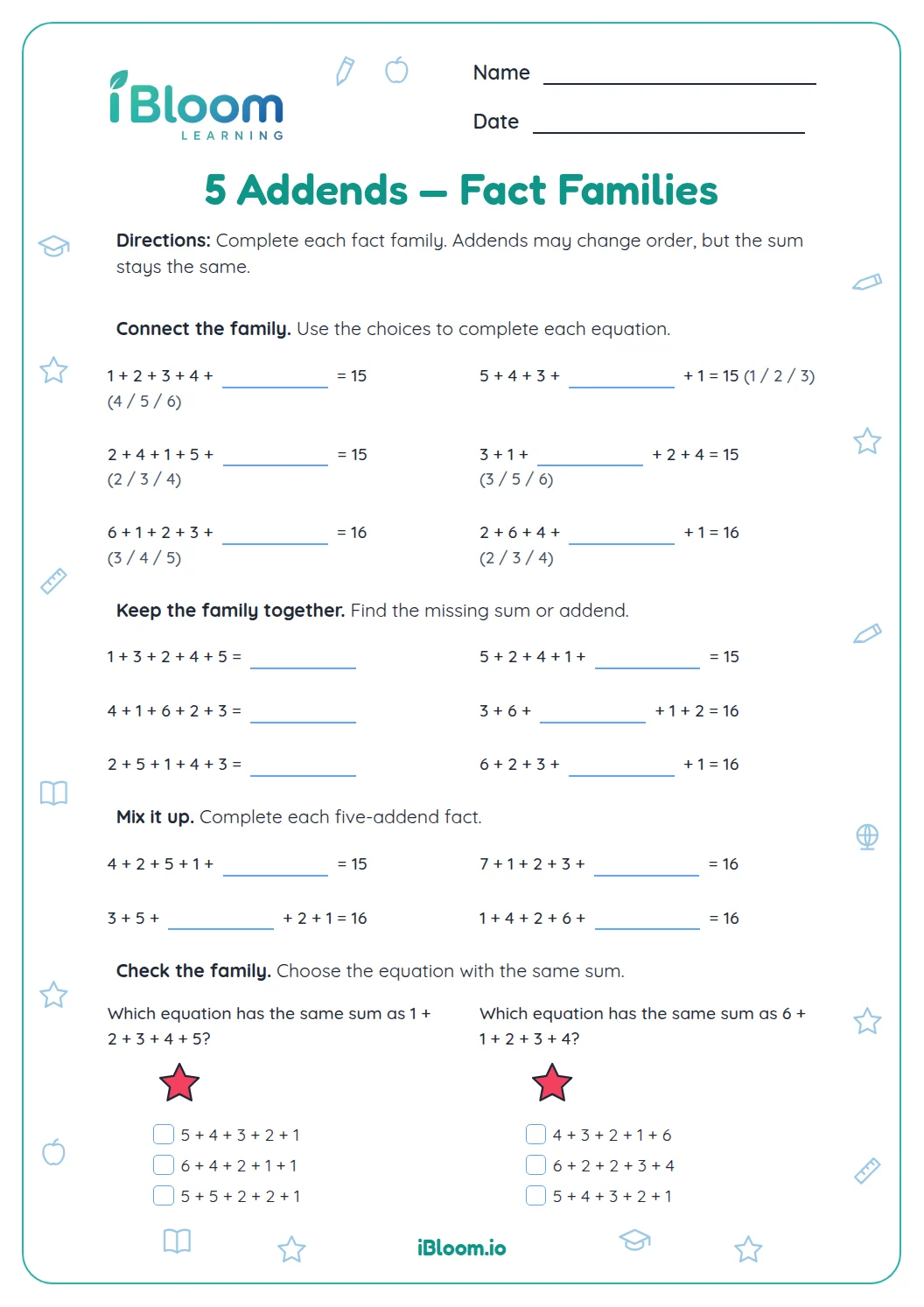

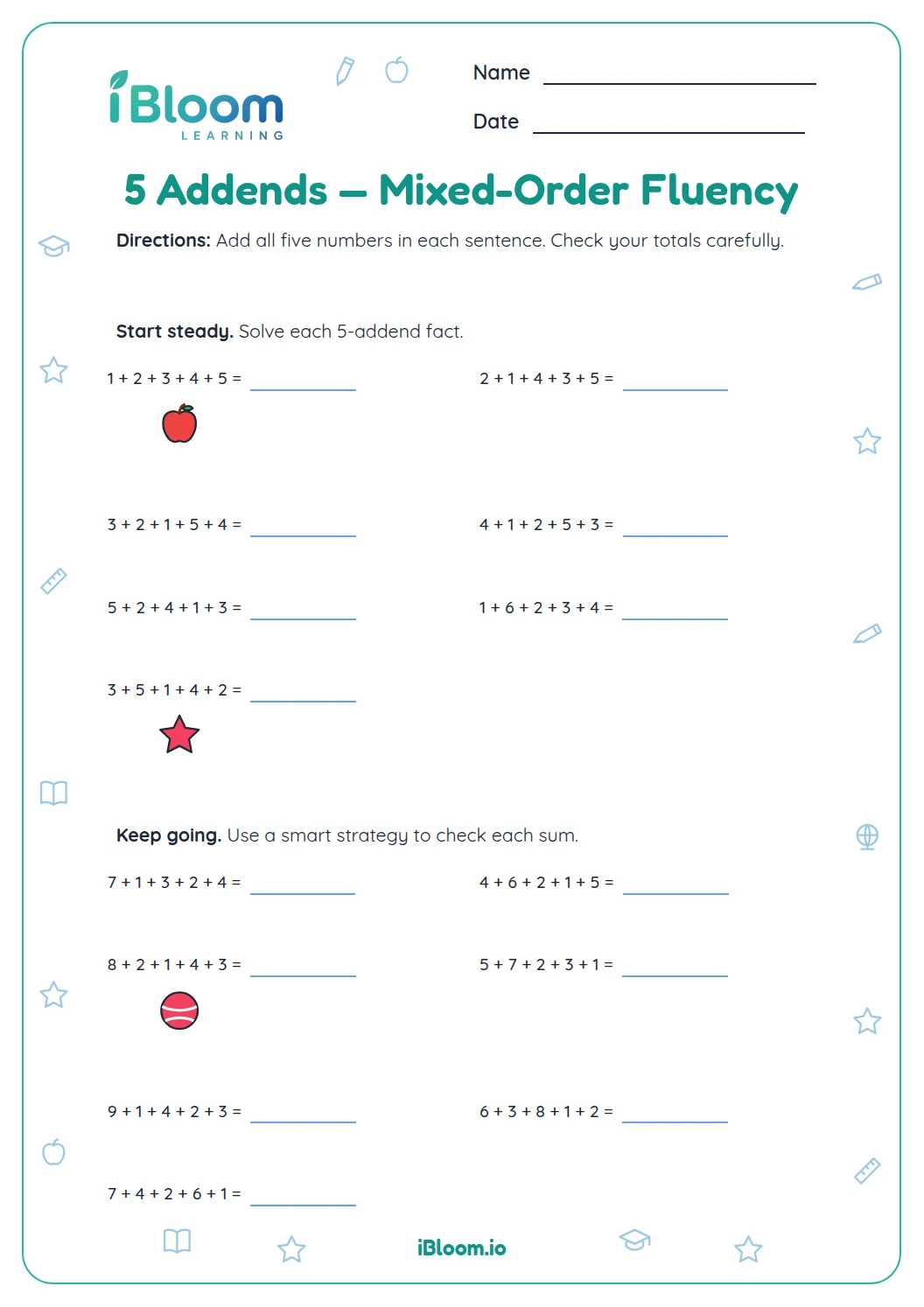
About this worksheet
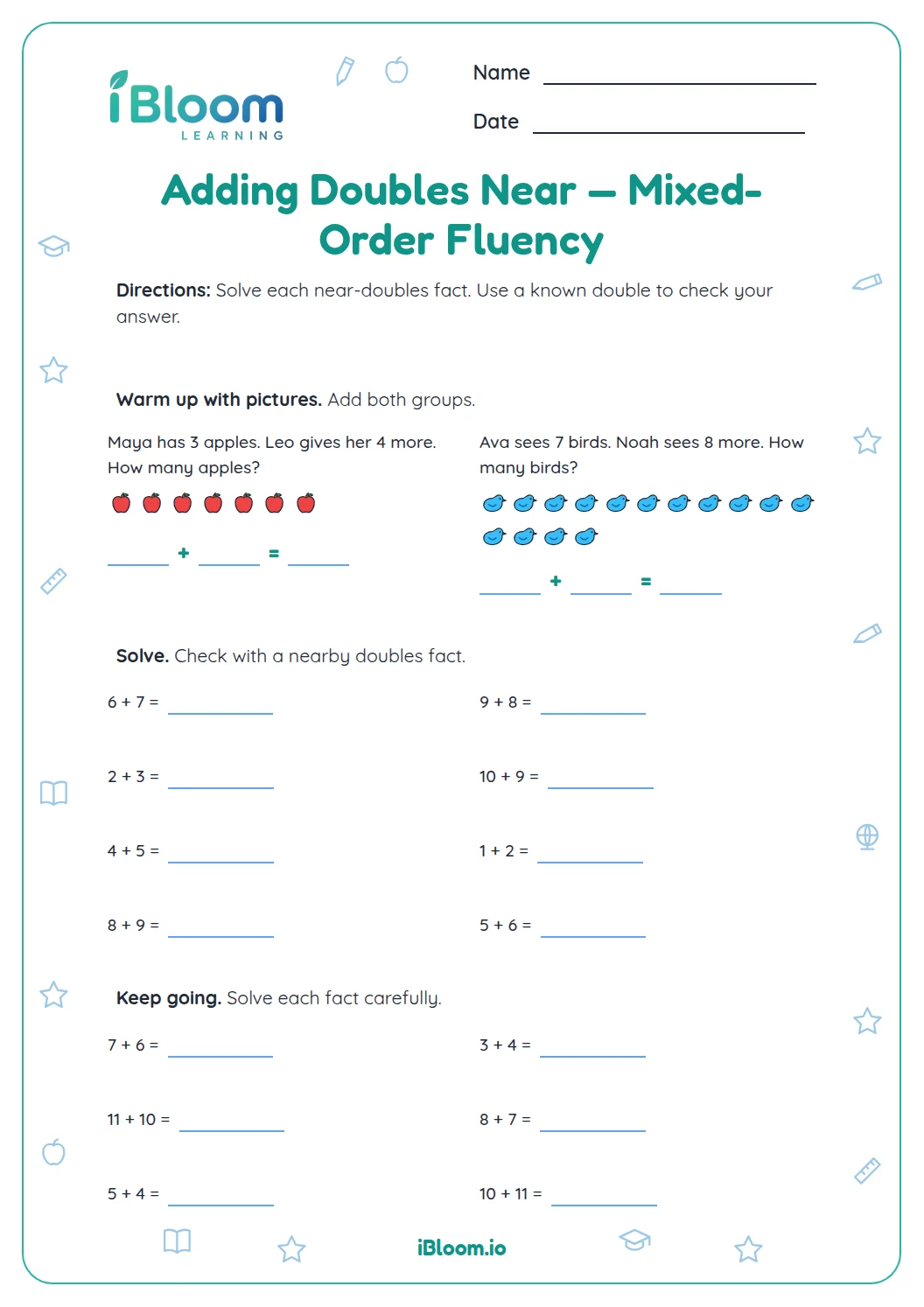
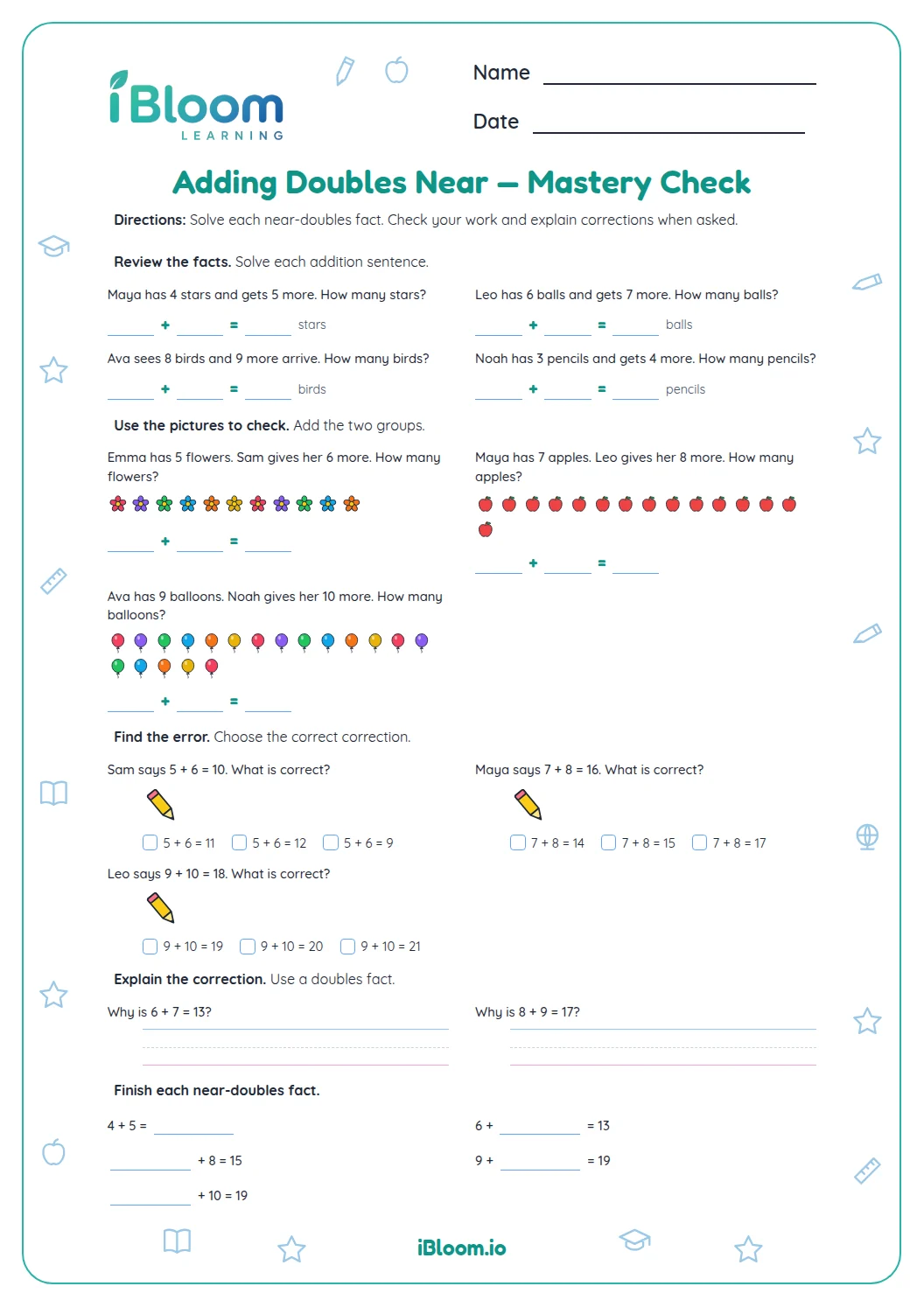
This printable doubles near worksheet is for Grades 1–2. It has 16 questions: 7 near-double sums and 7 related missing-addend facts. The questions focus on the skill named in the title, with a separate answer key for checking completed work.
Aligned to 1.OA.C.6
How can a double help with a nearby sum?
For neighboring addends, double the smaller addend and add one. For example, 6 + 7 is 6 + 6 + 1, which equals 13.
- 16 + 7 = 6 + 6 + 1
- 212 + 1 = 13
What changes in the optional timed round?
Both rounds use near doubles. The second round is still about correct answers; recording a time is optional and can be skipped.
How can a missing addend be checked?
Put the proposed addend into the blank and use the nearby double to check the resulting sum.
How to use this worksheet
- 1Solve Round 1 without watching the clock.
- 2Double the smaller addend.
- 3Add one for the neighboring addend.
- 4Check each blank by completing its equation.
- 5Try Round 2 with an optional timer only if useful.
Common mistakes and quick fixes
The mistake
Doubling the larger addend.
The fix
Double the smaller addend, then add one.
The mistake
Adding two after doubling.
The fix
Neighboring addends differ by one, so add one.
The mistake
Rushing during timed practice.
The fix
Accuracy comes first; the second round does not need a timer.
Common Core alignment
This page practices addition and related fact strategies.
Use addition strategies and related facts to solve within 20.
On this sheet: Use near doubles, adding-two facts, or complements and related subtraction within 20.
Show the official wordingHide the official wording
Add and subtract within 20, demonstrating fluency for addition and subtraction within 10. Use strategies such as counting on; making ten (e.g., 8 + 6 = 8 + 2 + 4 = 10 + 4 = 14); decomposing a number leading to a ten (e.g., 13 - 4 = 13 - 3 - 1 = 10 - 1 = 9); using the relationship between addition and subtraction (e.g., knowing that 8 + 4 = 12, one knows 12 - 8 = 4); and creating equivalent but easier or known sums (e.g., adding 6 + 7 by creating the known equivalent 6 + 6 + 1 = 12 + 1 = 13).
What to practice next
Make more practice
Further reading
Questions parents and teachers ask
Is the timed round required?
No. Timing Round 2 is optional. Students can solve the facts at a comfortable pace and record a time only if a teacher or family member chooses to use one. The goal of the page is accurate near-double reasoning. Have the learner explain the strategy, then verify the completed equation with the answer key.
How many facts are included?
There are 16 questions in two rounds. Round 1 has nine near-double sums, and Round 2 has seven related missing-addend facts. Each item has an answer in the separate key. Have the learner explain the strategy, then verify the completed equation with the answer key.
What is a near double?
A near double uses two numbers that differ by one, such as 8 and 9. Double the smaller number and add one to find the sum. This strategy is used throughout both rounds. Have the learner explain the strategy, then verify the completed equation with the answer key.
How do you solve 8 + 9?
Double 8 to get 16, then add one more for 9. The sum is 17. Students can use the same method for each neighboring pair, or check by counting on one from the double. Have the learner explain the strategy, then verify the completed equation with the answer key.
Can children use the answer key between rounds?
Yes. The key can help an adult review Round 1 before the learner starts Round 2. For practice, have the student explain the double they used and verify each missing addend in its equation. Have the learner explain the strategy, then verify the completed equation with the answer key.