



About this worksheet
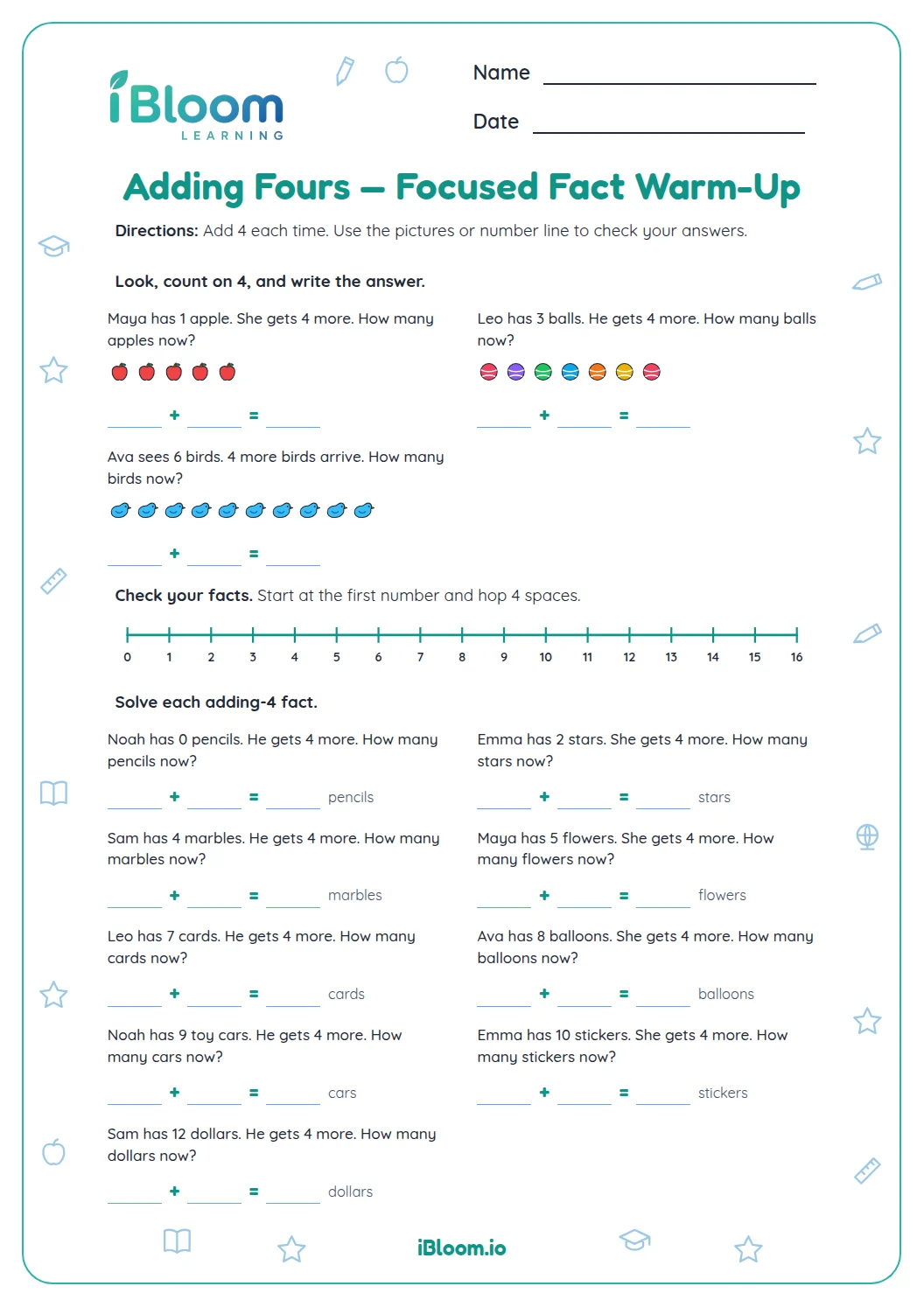
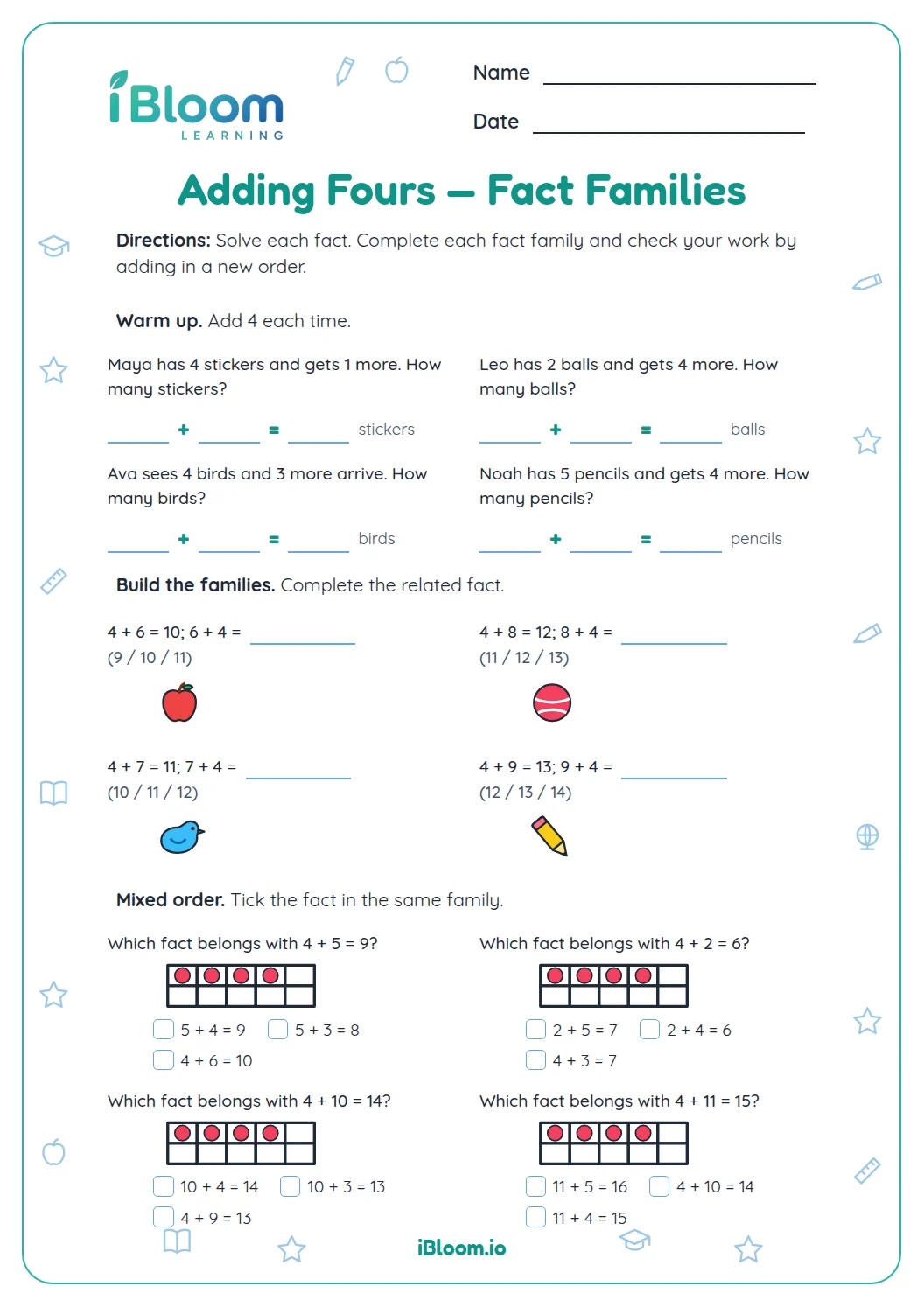
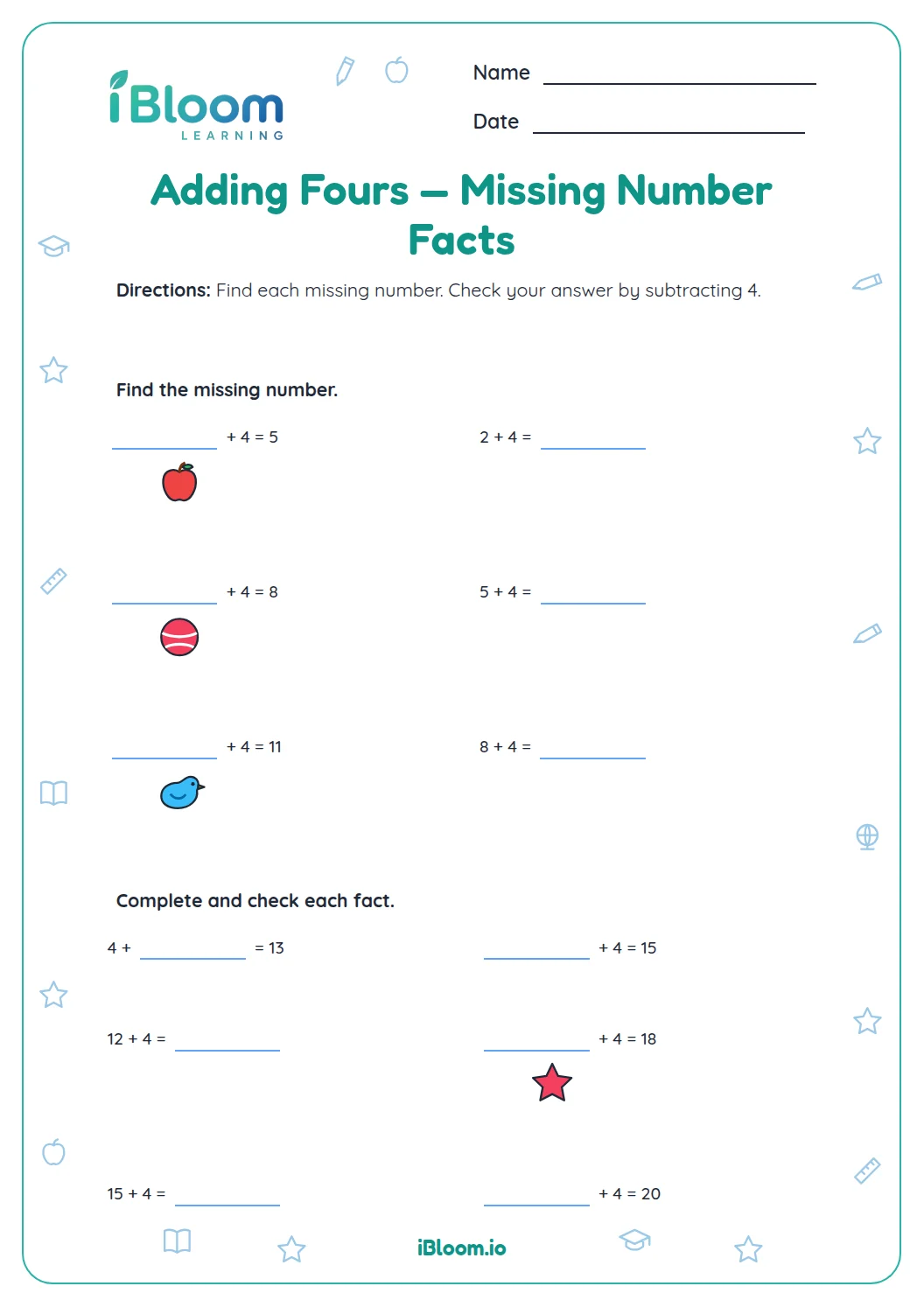
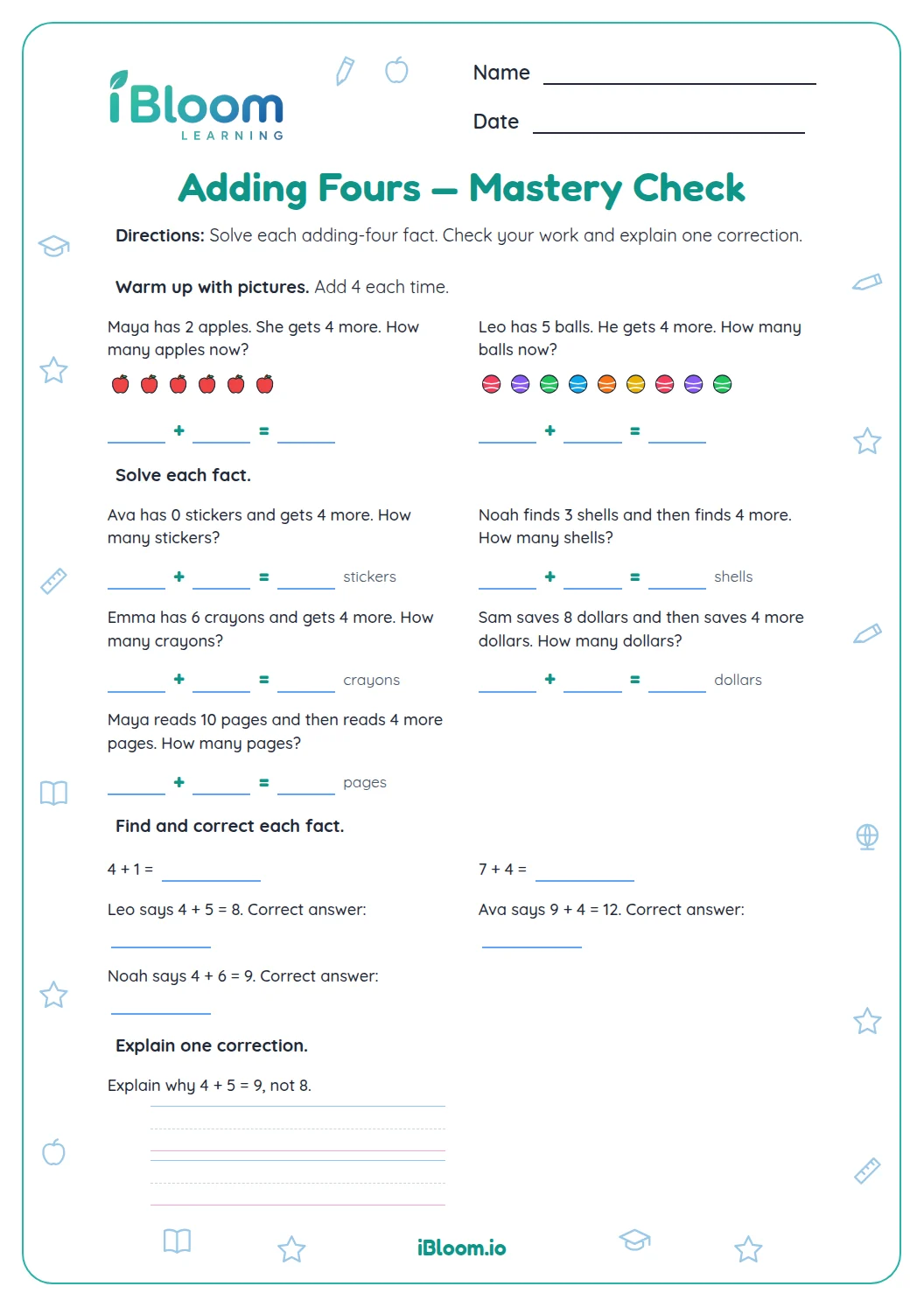
This free addition worksheet gives Grade 1 and Grade 2 learners 20 facts with 4 as one addend. Part A mixes eight facts with sums within 10. Part B adds eight facts with sums from 9 to 13, encouraging children to use familiar facts and make ten when helpful. The 4 appears first or second, so children read each equation rather than follow a counting pattern. The work supports Common Core 1.OA.C.6 and 2.OA.B.2 through addition strategies and fact fluency. A separate answer key shows every sum; timing is optional.
Aligned to 1.OA.C.6 and 2.OA.B.2
Why are these adding-four facts mixed up?
The other addend does not rise in order, and 4 changes position. Children must attend to each pair of numbers instead of writing a run of consecutive answers. Every fact still includes 4, keeping the practice focused.
Part A contains eight sums within 10. Part B includes larger totals, and the final four questions use adding 4 in short stories.
How can children solve 7 + 4 mentally?
Question 9 is a useful place to make ten. Split 4 into 3 and 1: three more takes 7 to 10, and one more makes 11. Students can use this reasoning until the fact is familiar.
- 17 + 4 = ___
- 2Split 4 into 3 + 1.
- 37 + 3 = 10
- 410 + 1 = 11
- 5Answer: 11
What should you look for when checking the sums?
Notice whether the child recognizes that switching the addends leaves the sum unchanged. Questions 10 and 15 are 4 + 9 and 9 + 4; both equal 13. The final story sums ask the child to add 4 to a starting amount.
If a fact is incorrect, ask for a strategy and try that fact again after a few different ones. A correct explanation is useful evidence of understanding even when the child is still working toward quick recall.
How to use this worksheet
- 1Say one known fact with 4, such as 4 + 4 = 8.
- 2Let the child work through Part A in its printed order.
- 3For a harder Part B fact, invite making ten or adding two twice.
- 4Check all 16 answers against the key.
- 5Ask the child to correct each error using a strategy, then revisit it later.
Mistakes to notice and how to help
The mistake
Writing 4 + 0 = 0.
The fix
Adding zero leaves the other addend unchanged, so the sum is 4.
The mistake
Counting 7 as the first of four steps for 7 + 4.
The fix
Start after 7: 8, 9, 10, 11. There are four new counts.
The mistake
Giving different totals for 4 + 9 and 9 + 4.
The fix
The same two amounts are combined in either order, so both totals are 13.
Common Core alignment
Add within 20 using strategies, with focused practice on sums within 10.
On this sheet: The two parts practice adding 4 within 20, with eight introductory sums within 10.
Show the official wordingHide the official wording
Add and subtract within 20, demonstrating fluency for addition and subtraction within 10. Use strategies such as counting on; making ten (e.g., 8 + 6 = 8 + 2 + 4 = 10 + 4 = 14); decomposing a number leading to a ten (e.g., 13 - 4 = 13 - 3 - 1 = 10 - 1 = 9); using the relationship between addition and subtraction (e.g., knowing that 8 + 4 = 12, one knows 12 - 8 = 4); and creating equivalent but easier or known sums (e.g., adding 6 + 7 by creating the known equivalent 6 + 6 + 1 = 12 + 1 = 13).
Build mental fluency with sums of two one-digit numbers that include 4.
On this sheet: Students solve mixed-order one-digit addition facts with 4 as either addend.
Show the official wordingHide the official wording
Fluently add and subtract within 20 using mental strategies. By end of Grade 2, know from memory all sums of two one-digit numbers.
What to practice next
Make more practice
Further reading
Questions parents and teachers ask
How many facts are on this worksheet?
There are 16 addition facts, divided into two parts of eight. Every fact includes 4 as one addend, and the other addends range from 0 through 9. Some pairs appear in both orders, giving children a chance to recognize that reversing addends keeps the same total.
Should I time my child on this sheet?
Timing is optional. Start by letting the child solve the facts accurately and explain any strategy needed. If you later record a completion time, compare it with that child’s own earlier work and check accuracy too. The worksheet gives no required time limit or speed target.
What strategy helps when 7 + 4 is difficult?
Making ten works well for 7 + 4. Break 4 into 3 and 1, add 3 to 7 to reach 10, then add the remaining 1 to get 11. Ask the child to say those steps aloud before trying another fact that crosses ten.
Why does 4 sometimes come after the other number?
Changing the order helps children recognize the same addition relationship in different forms. For example, 8 + 4 and 4 + 8 both equal 12. The mixed placement also encourages children to read the full equation instead of assuming every line begins with the same number.
How can I use the key to plan another practice session?
Mark the facts that need another look, then ask the child to correct them with a mental strategy. Choose two or three of those facts for a short later session and mix in familiar ones. The key provides all 16 totals, making it easy to check accuracy consistently.