

About this worksheet
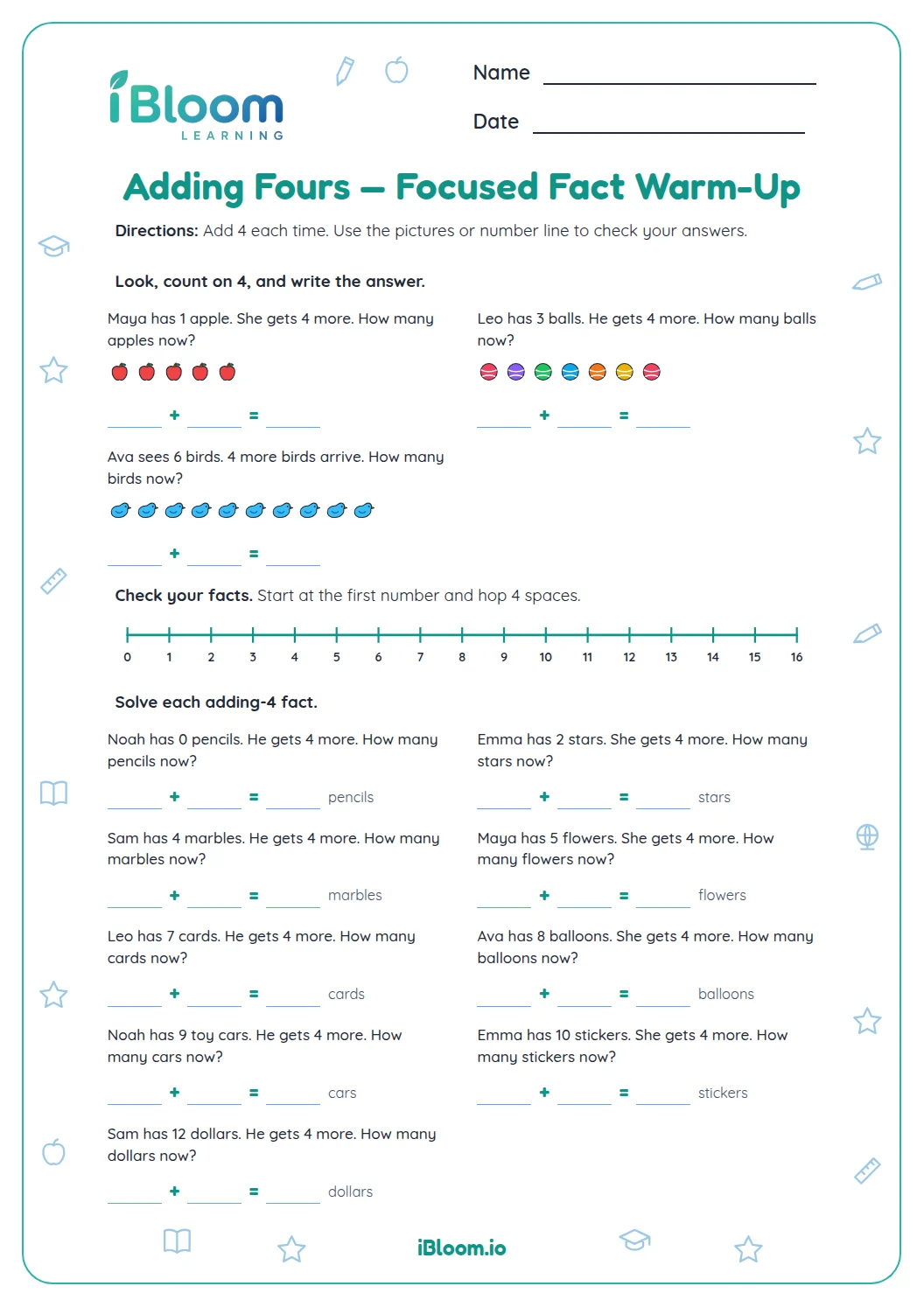
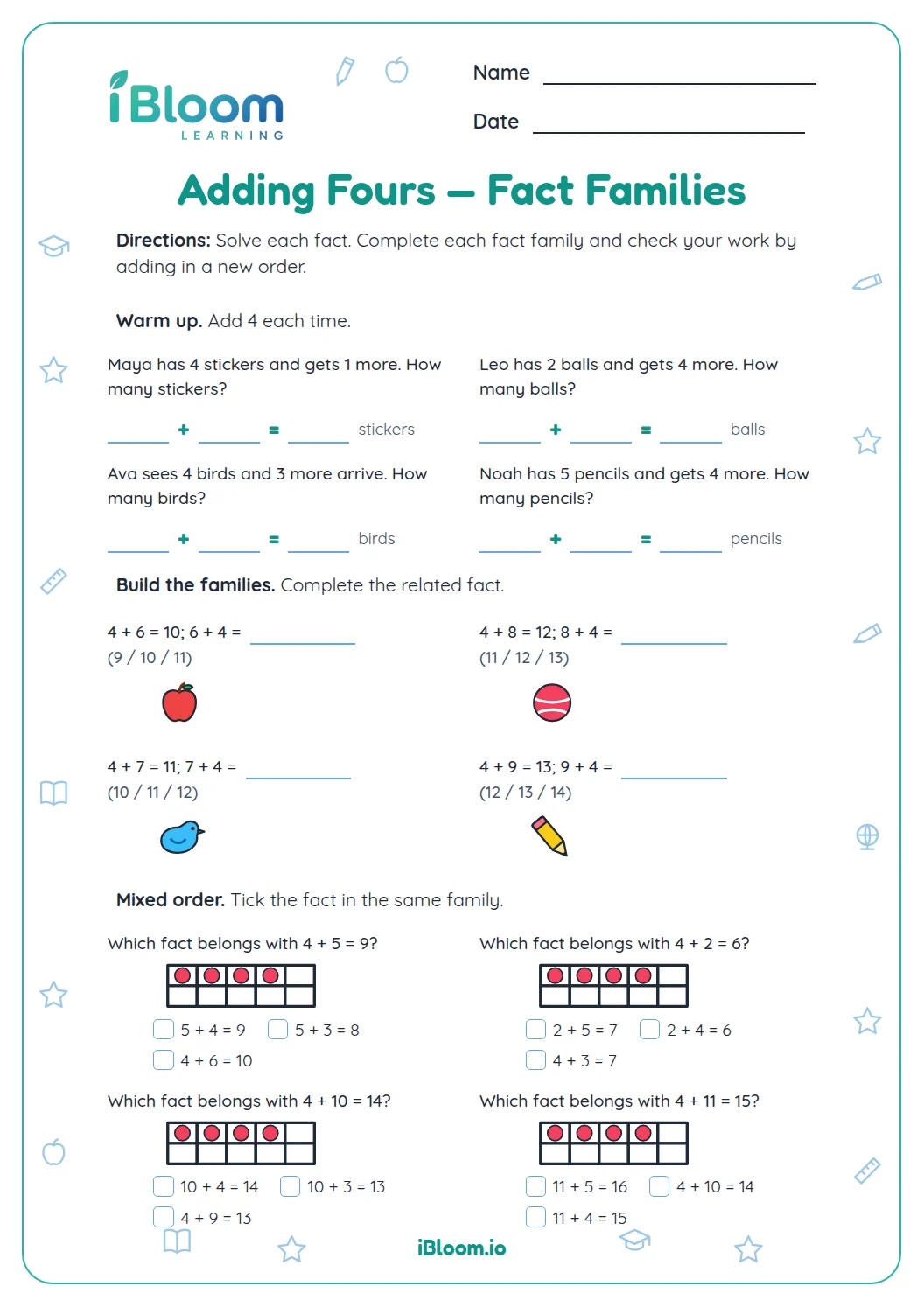
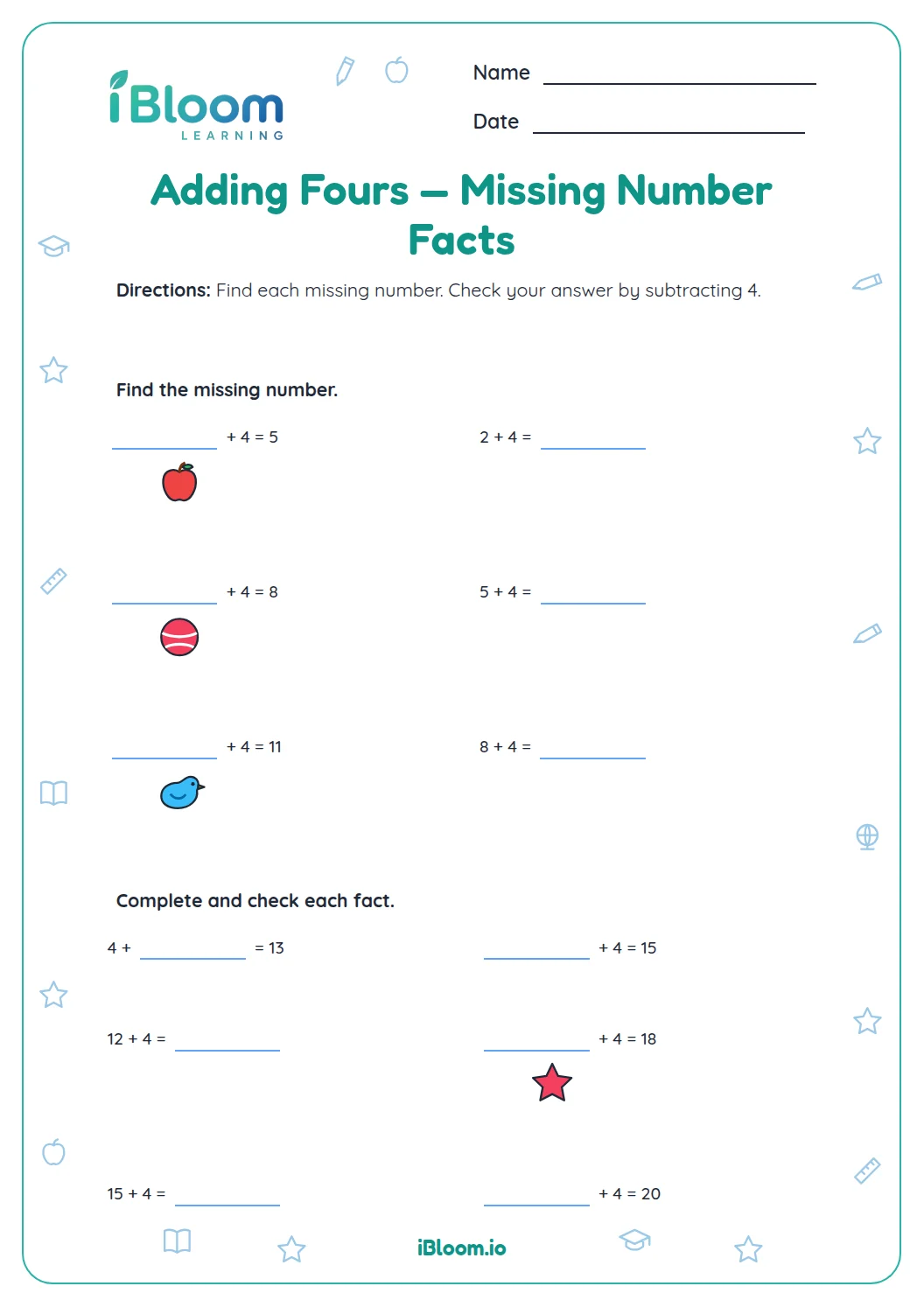
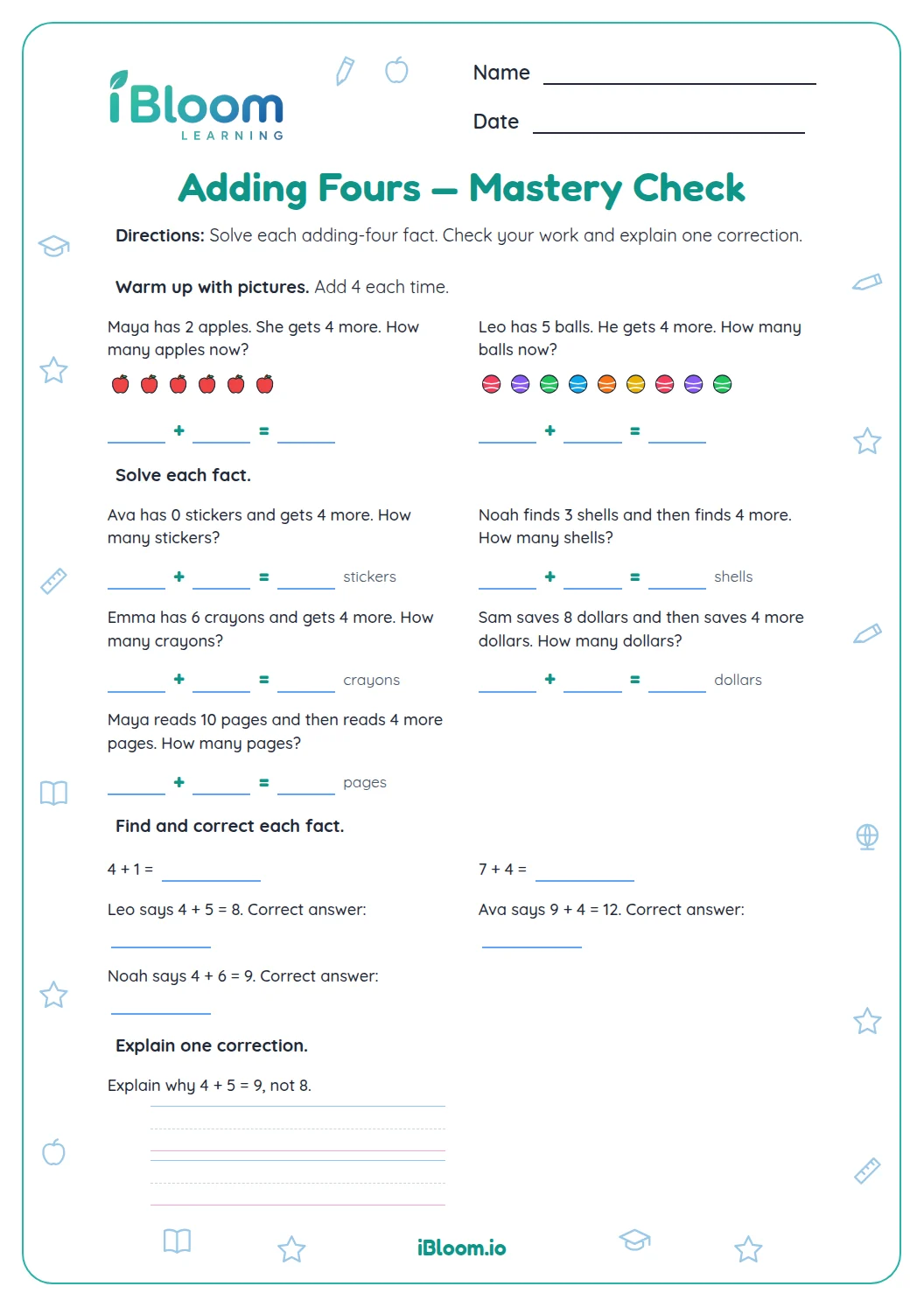
This free Grade 1–2 printable gives students 20 ways to practice adding 4. Part A is a short warm-up of single-digit addends. Part B extends the sums through 20, and a final set asks for a missing addend. A timer is optional; the separate key makes accuracy easy to check. The sums stay within 20, matching CCSS 2.OA.B.2.
Aligned to 2.OA.B.2
What skill does this sheet practice?
This worksheet gives Grade 1 and Grade 2 learners focused practice with addition facts that add 4. Each item asks children to use the same idea in a slightly different way, so they can check both the answer and the reasoning behind it.
How can students add four?
Think of 4 as two more and two more, count on four steps, or use a known sum. For 8 + 4, start at 8 and count 9, 10, 11, 12. The total is 12.
- 18 + 4 = ___
- 2Count on four: 9, 10, 11, 12
- 3Answer: 12
What is different in each round?
Part A warms up with 0 through 9 plus 4. Part B continues with 10 through 16 plus 4. Part C asks students to find a missing addend in three equations. Timing is optional and can be done with an adult’s timer.
How should timing be used?
Accuracy comes first. A child can complete both parts without a clock, or an adult can time one round and record the result separately. Compare a later attempt with the child’s own earlier work rather than racing someone else.
How to use this adding-fours drill
- 1Solve Part A without timing first.
- 2For each sum, count on four or use a known addition fact.
- 3Take a brief pause before Part B.
- 4Solve the sums through 20, then fill each missing addend.
- 5Check every response with the answer key.
- 6If useful, repeat a round with an optional timer and note accuracy too.
Addition mistakes to watch for
The mistake
Adding 4 but stopping after three counts.
The fix
Touch four count-on steps: for 8, say 9, 10, 11, 12.
The mistake
Reading a missing addend as the sum.
The fix
Ask what number plus 4 makes the total printed at the end.
The mistake
Focusing on speed before the sums are correct.
The fix
Finish untimed first and check accuracy before trying an optional timer.
Common Core alignment
Use mental strategies to add and subtract within 20.
On this sheet: The sums practice adding 4 within 20, and the final equations ask students to find a missing part in totals within 20.
Show the official wordingHide the official wording
Fluently add and subtract within 20 using mental strategies. By end of Grade 2, know from memory all sums of two one-digit numbers.
What to practice next
Make more practice
Further reading
Questions parents and teachers ask
Is the timed part required?
No. A child can solve every problem without a timer. If timing is motivating, use it after an untimed round and record accuracy as well as time. The goal is comfortable recall of adding 4, not pressure to finish before someone else.
What does this adding-fours sheet include?
There are 20 questions: 17 sums that add 4, followed by three equations with a missing addend. The first part starts with smaller numbers, and the next part builds to totals of 20. A separate answer key is included.
What can a child do if adding 4 is hard?
Count on four numbers from the first addend, or break 4 into 2 and 2. For 8 + 4, add 2 to make 10, then add 2 more to reach 12. The child can use that strategy before trying to recall the sum.
Why are there missing-addend equations?
A missing addend asks the child to think about the same fact from the total back to one part. For 4 + ___ = 17, ask what joins 4 to make 17. This adds a small reasoning step while keeping the adding-fours relationship visible.
How should I use the answer key?
Let the child complete a group before checking the answers. For a missed sum, solve it again using a count-on or make-ten strategy. For a missing addend, put the proposed number back into the equation and check that both sides match.