


About this worksheet
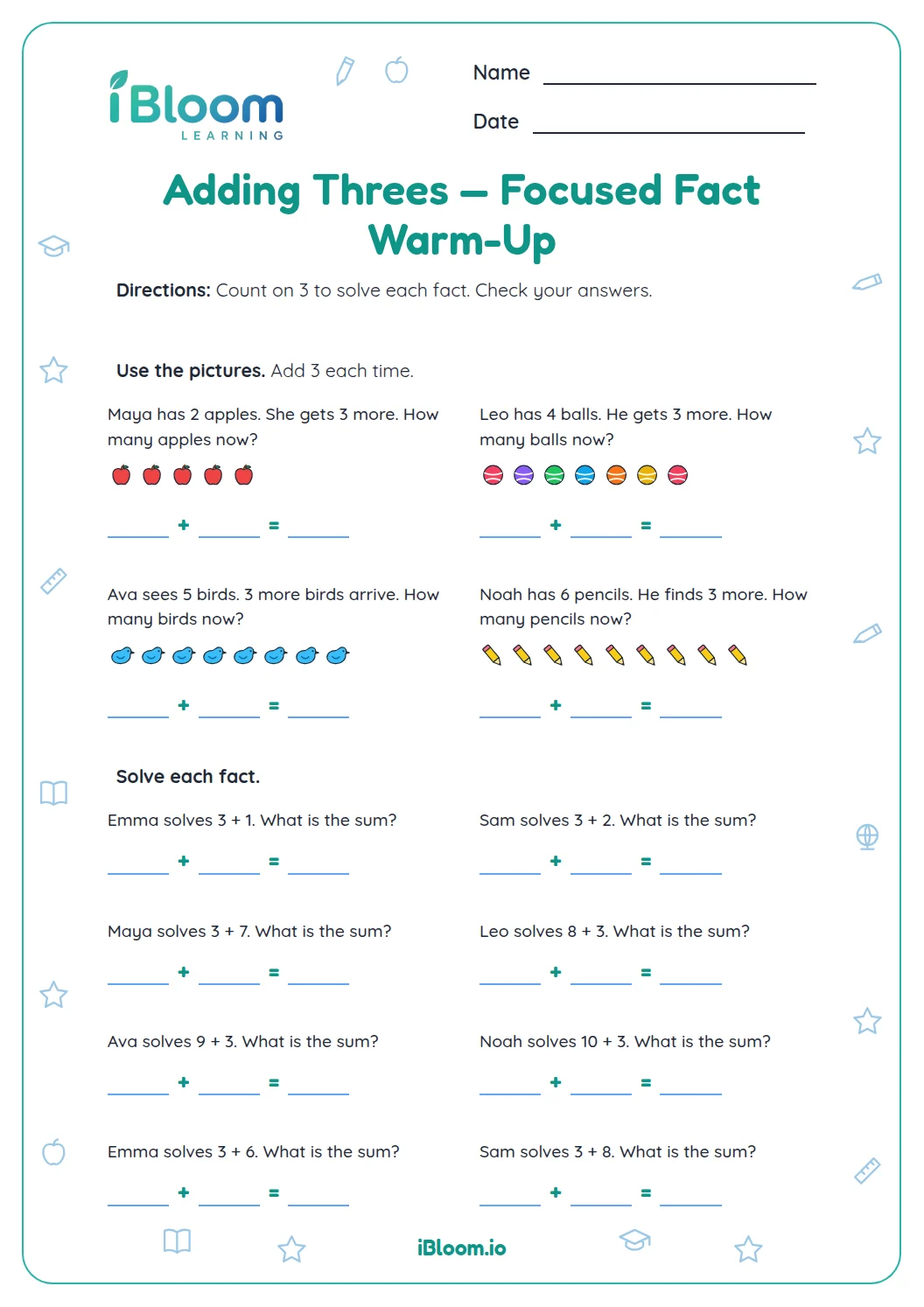
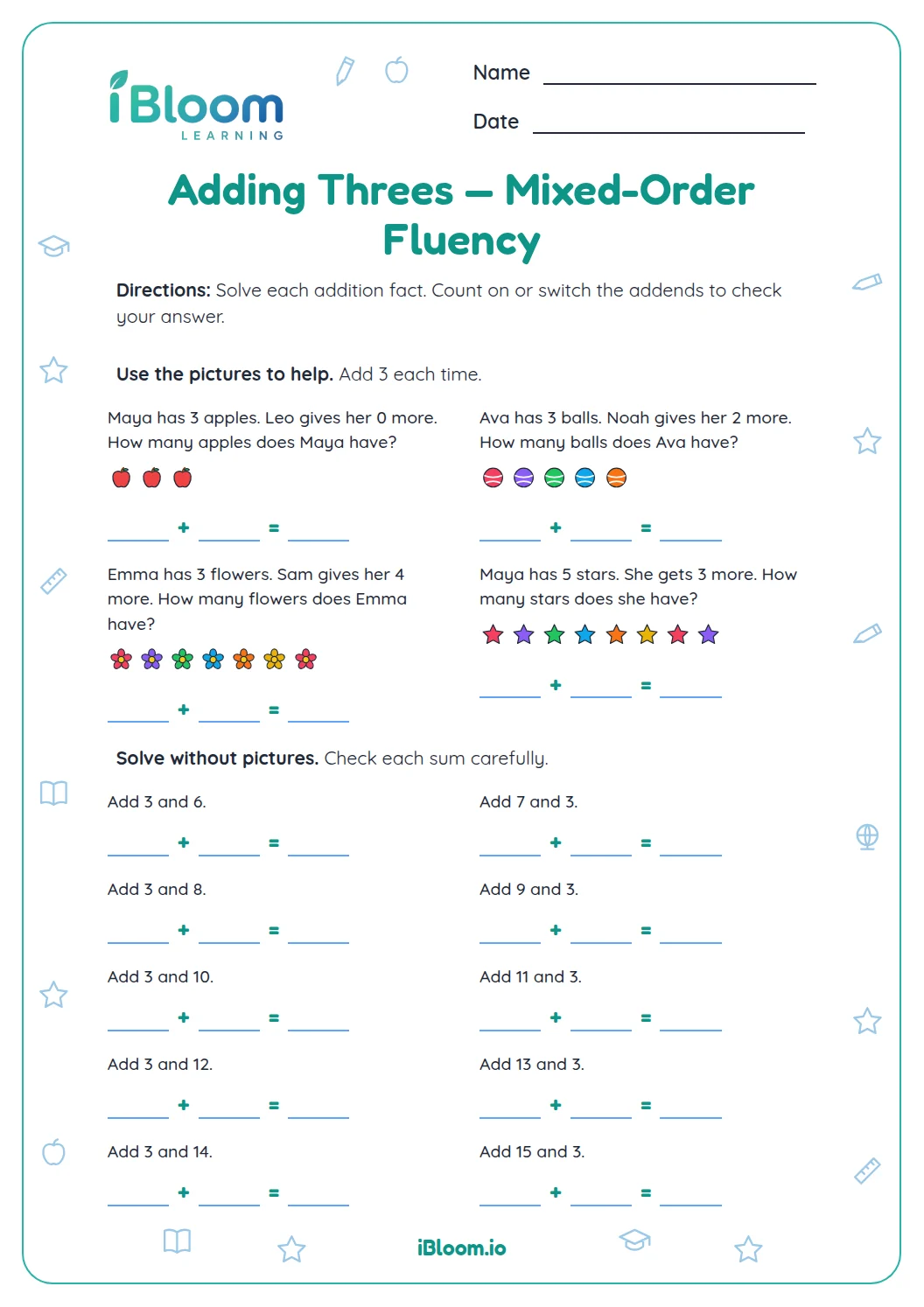
This Grade 1 math drill gives children 20 addition questions with 3 as one addend. The first two parts check facts in mixed order; the final part applies the same facts to short stories with room for an equation. A separate key supports checking.
Aligned to 1.OA.C.6
How can children add 3?
Start at the other addend and count forward three numbers. For 3 + 6, say 7, 8, 9; the sum is 9.
- 1For 3 + 4, count on from 4: 5, 6, 7. The sum is 7.
Why does the 3 move?
The same addends have the same sum in either order. Part A puts 3 first, while Part B puts it second in some facts.
How should I use the drill?
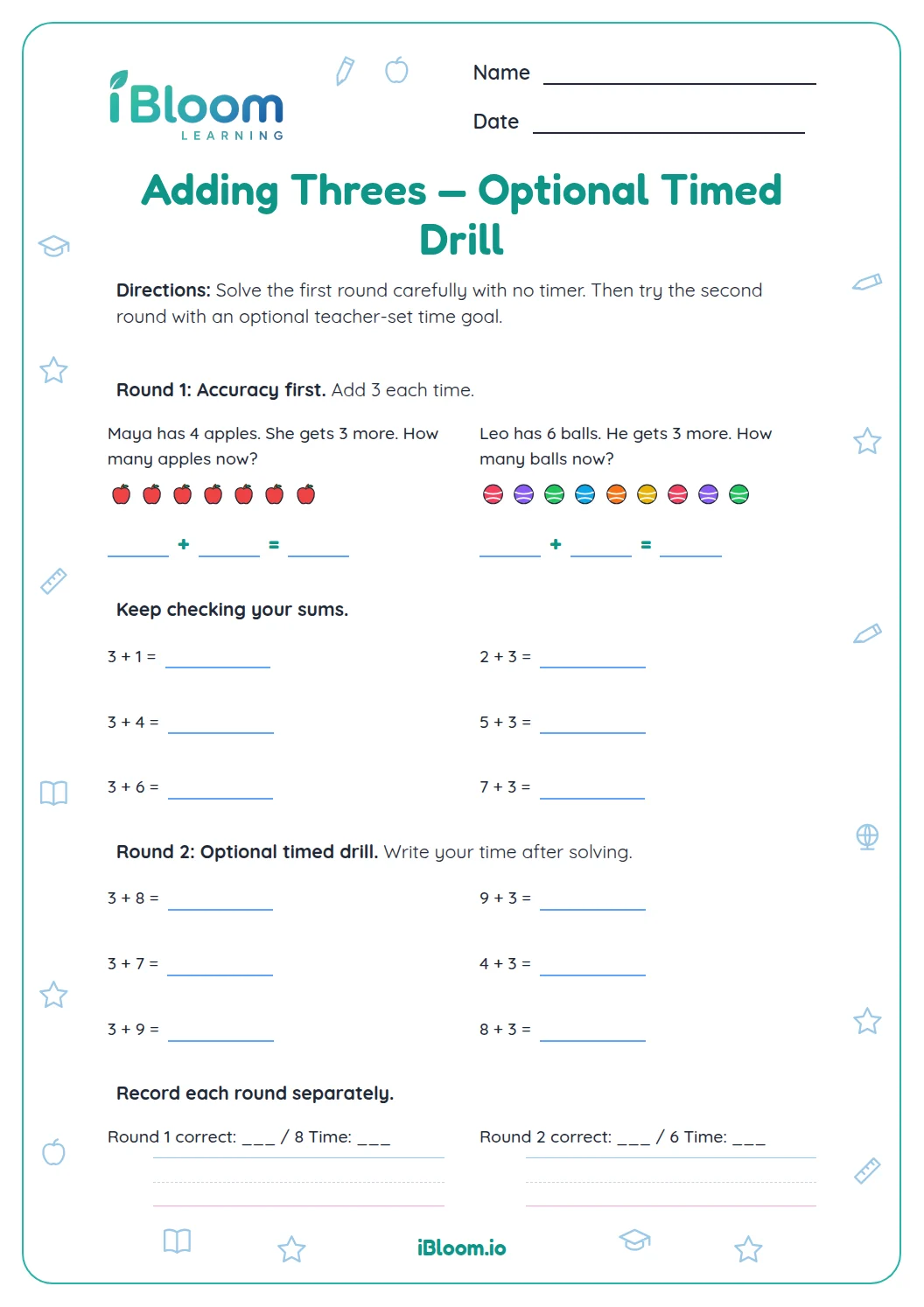
Work accurately before adding a timer. Use fingers, counters, or counting on if a fact is not automatic yet.
How can I use this worksheet?
- 1Read each number sentence and say the addends.
- 2Count on three when a fact is not yet automatic.
- 3Finish both parts before checking the key.
- 4If using a timer, treat it as optional and record accuracy too.
Common mistakes and quick fixes
The mistake
Adding only 2 after starting at the other addend.
The fix
Say three counting numbers aloud, including the last number as the sum.
The mistake
Reading the plus sign as a minus sign.
The fix
Point to + and say “add” before finding the total.
The mistake
Changing the sum when the addends switch places.
The fix
Check with counters: the total objects stay the same when the groups switch places.
Curriculum alignment
This worksheet gives learners focused practice with the skill named in the standard.
Build accurate recall for addition facts that add 3, including sums through 15.
On this sheet: The questions directly practice the stated skill.
Show the official wordingHide the official wording
Add and subtract within 20, demonstrating fluency for addition and subtraction within 10.
What to practice next
Make more practice
Further reading
Questions parents and teachers ask
Which facts are on the page?
The worksheet has 20 questions using 3 as one addend. Sixteen are direct addition facts, and four place an adding-threes fact in a short story. The sums range from 3 through 15, within Grade 1 addition practice. All answers appear in the key.
Is a timer required?
No. A child can use the page as an untimed accuracy check. If you choose to add timing, try it after the child understands the facts and feels comfortable solving them. The story problems also leave room to write an equation and work.
How can a child solve an unfamiliar fact?
Start with the other addend and count forward three numbers. For 3 + 6, start at 6 and say 7, 8, 9. Fingers or counters can make the three added objects visible before the child records the sum. Counters can make the added group visible.
Why is 3 sometimes second?
Addition can be written with the addends in either order and still have the same sum. Part A puts 3 first; Part B puts it in either position. Reading both arrangements helps children attend to the complete number sentence. The same idea appears in story form too.
What should we review after checking?
Use the answer key to spot facts that need another try. Practice a missed fact by counting on three from the other addend, then revisit it later without counting support. For a story item, ask the child to match the equation to the situation.