

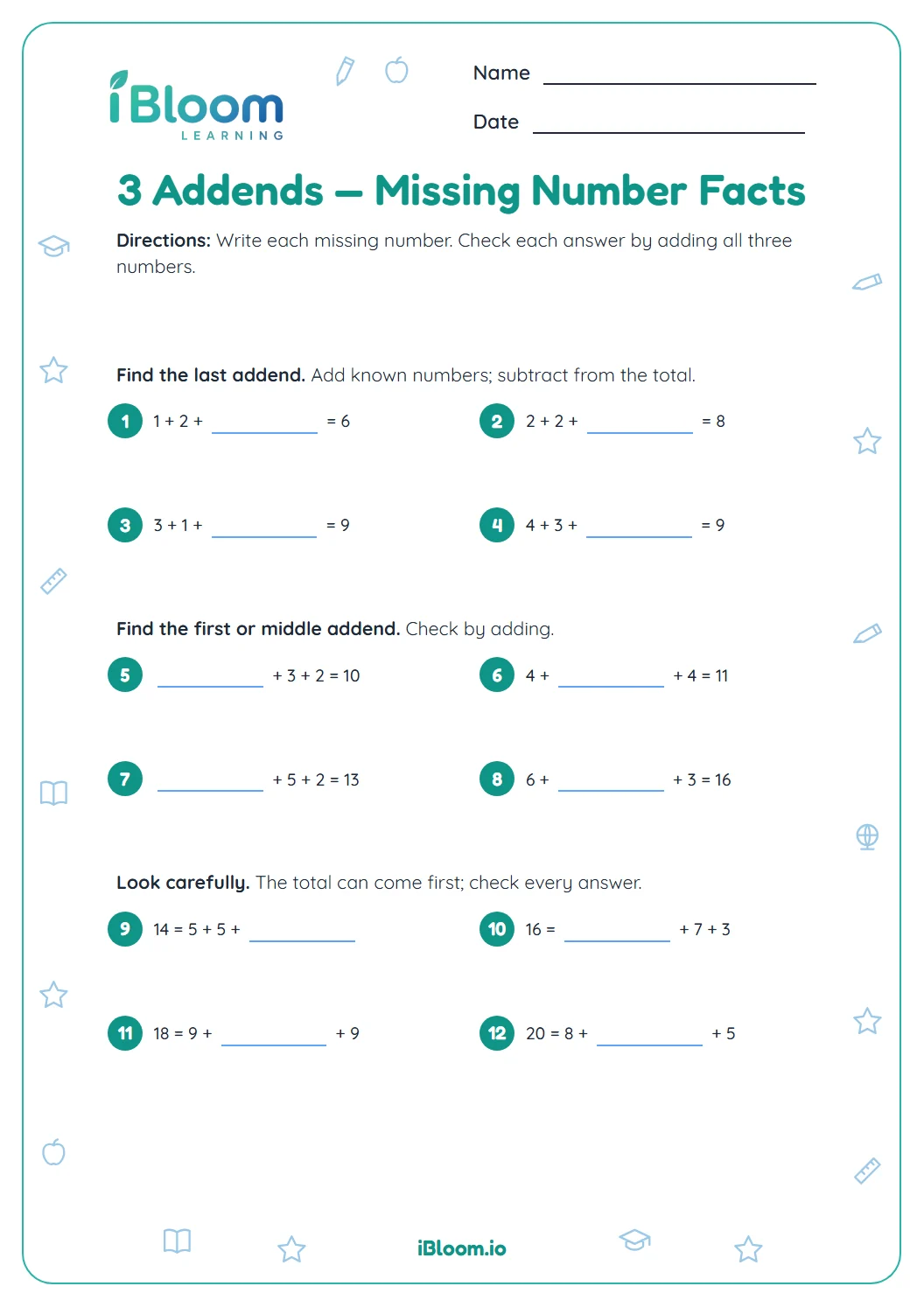
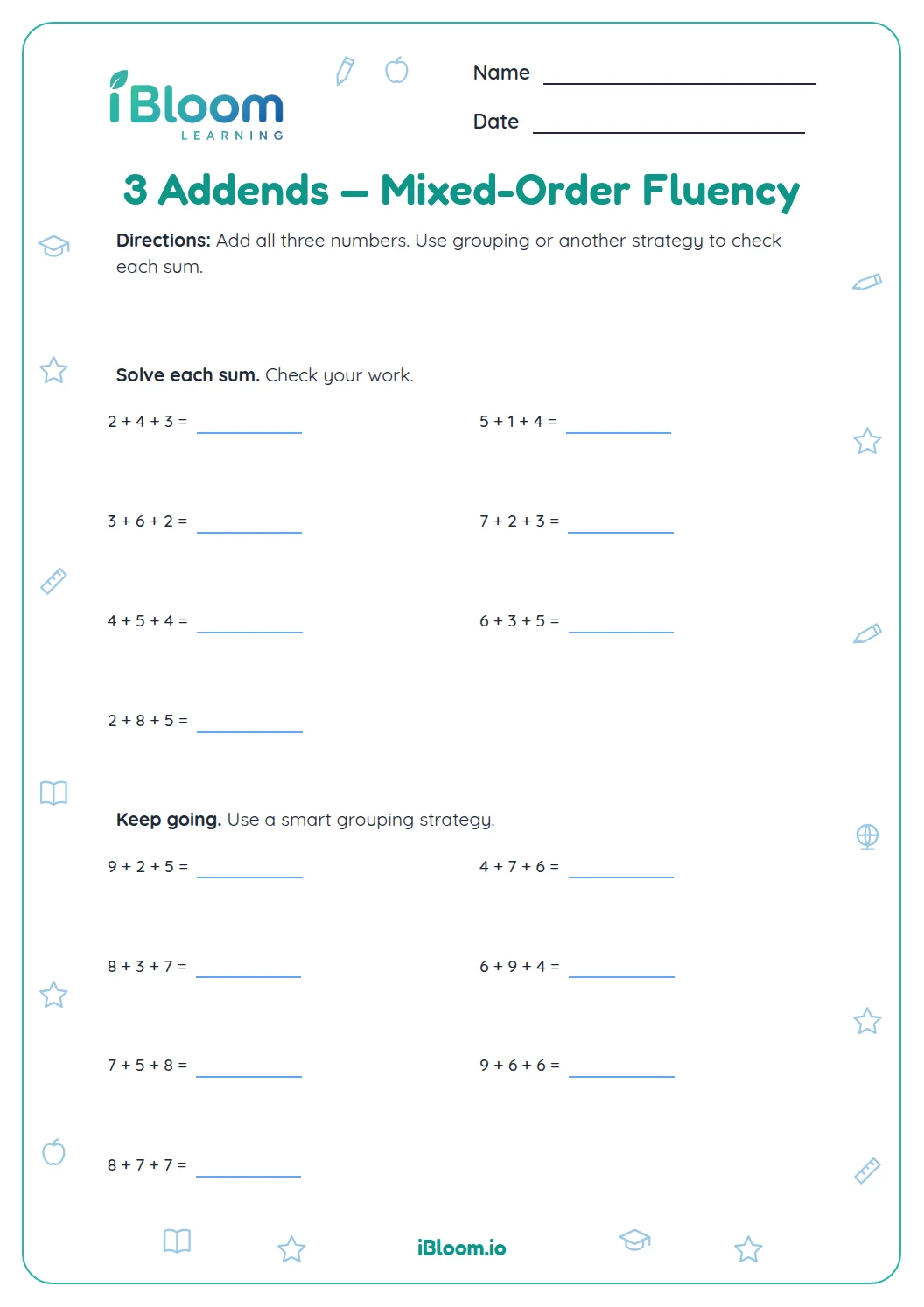
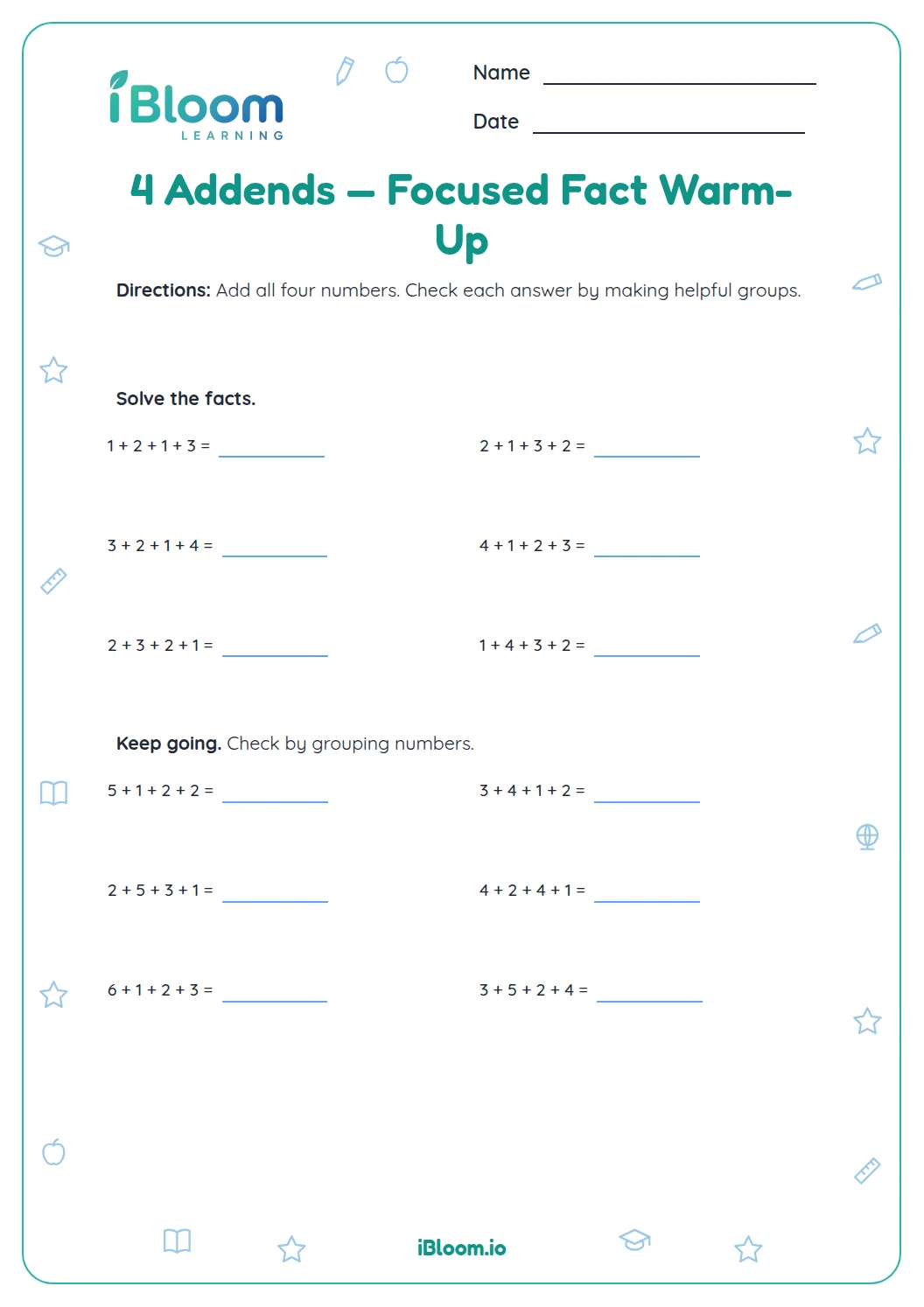
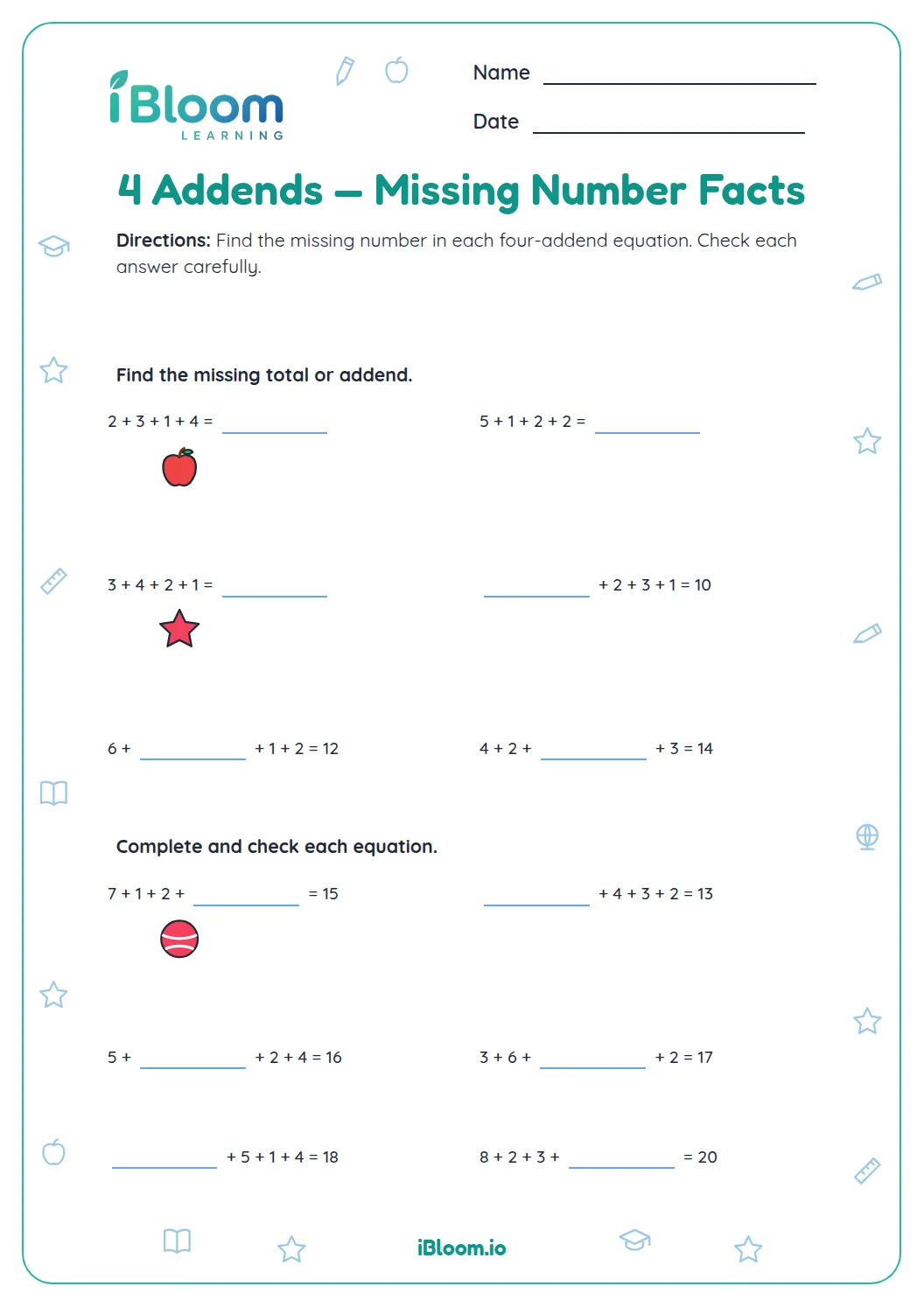

About this worksheet
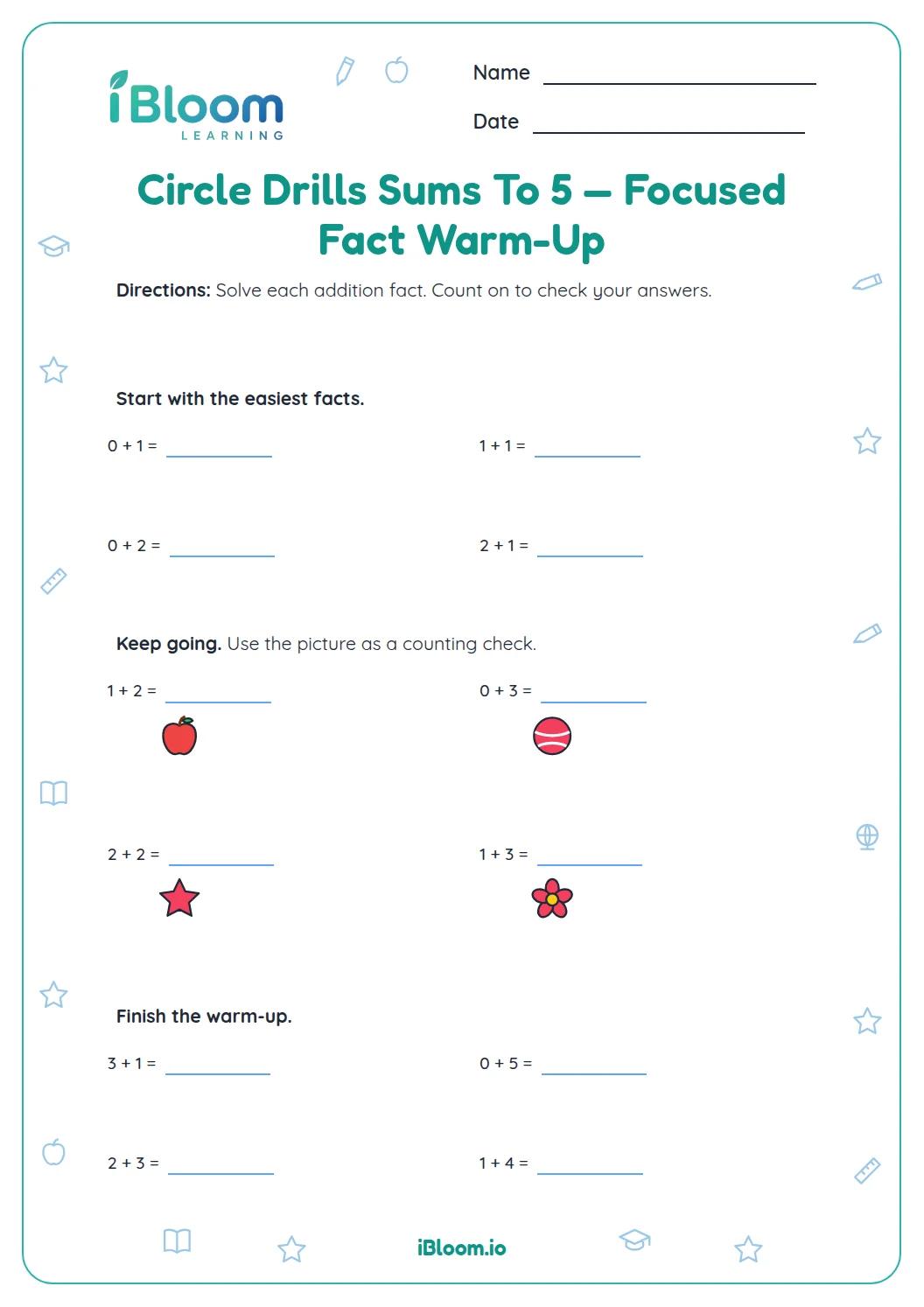
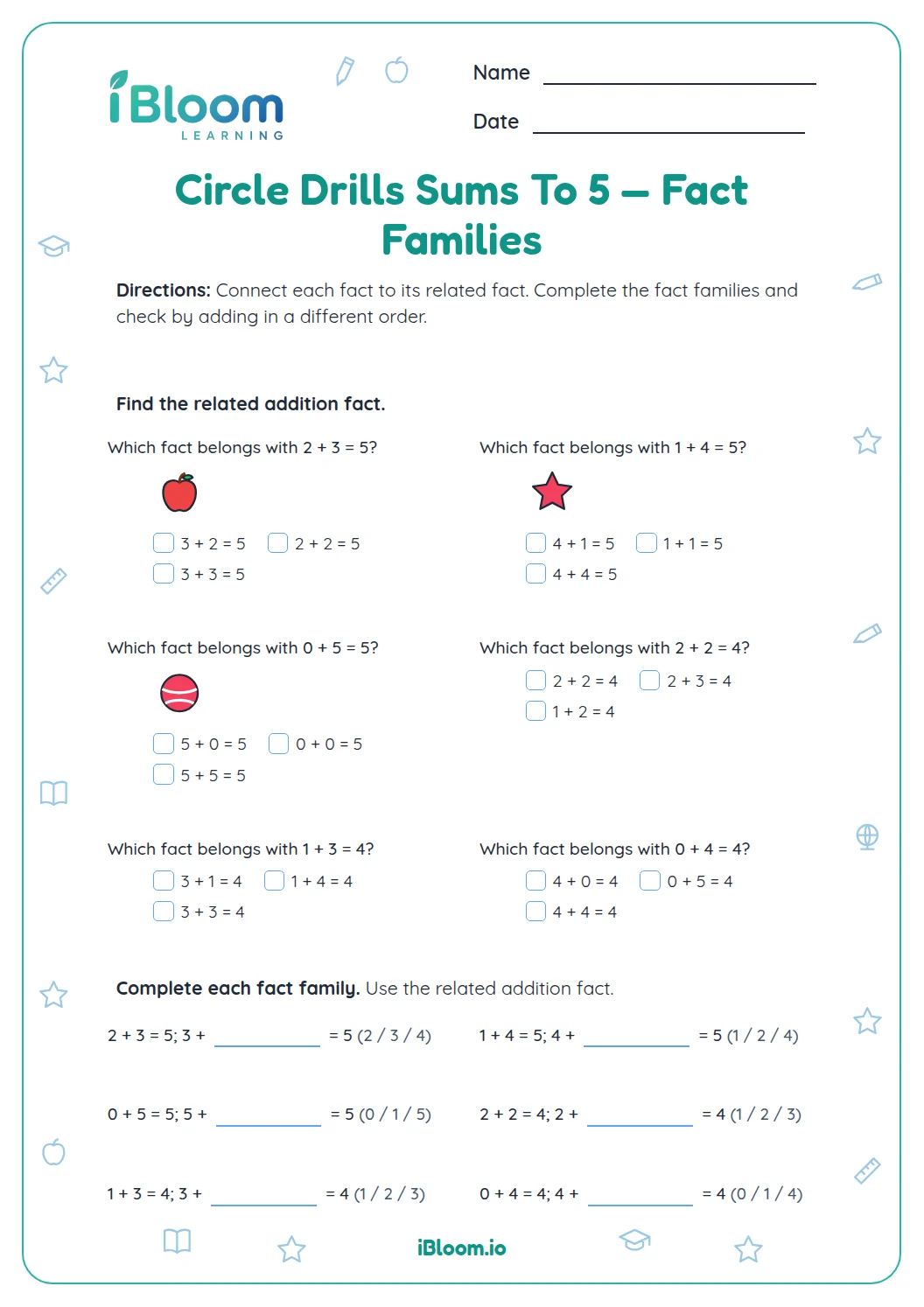
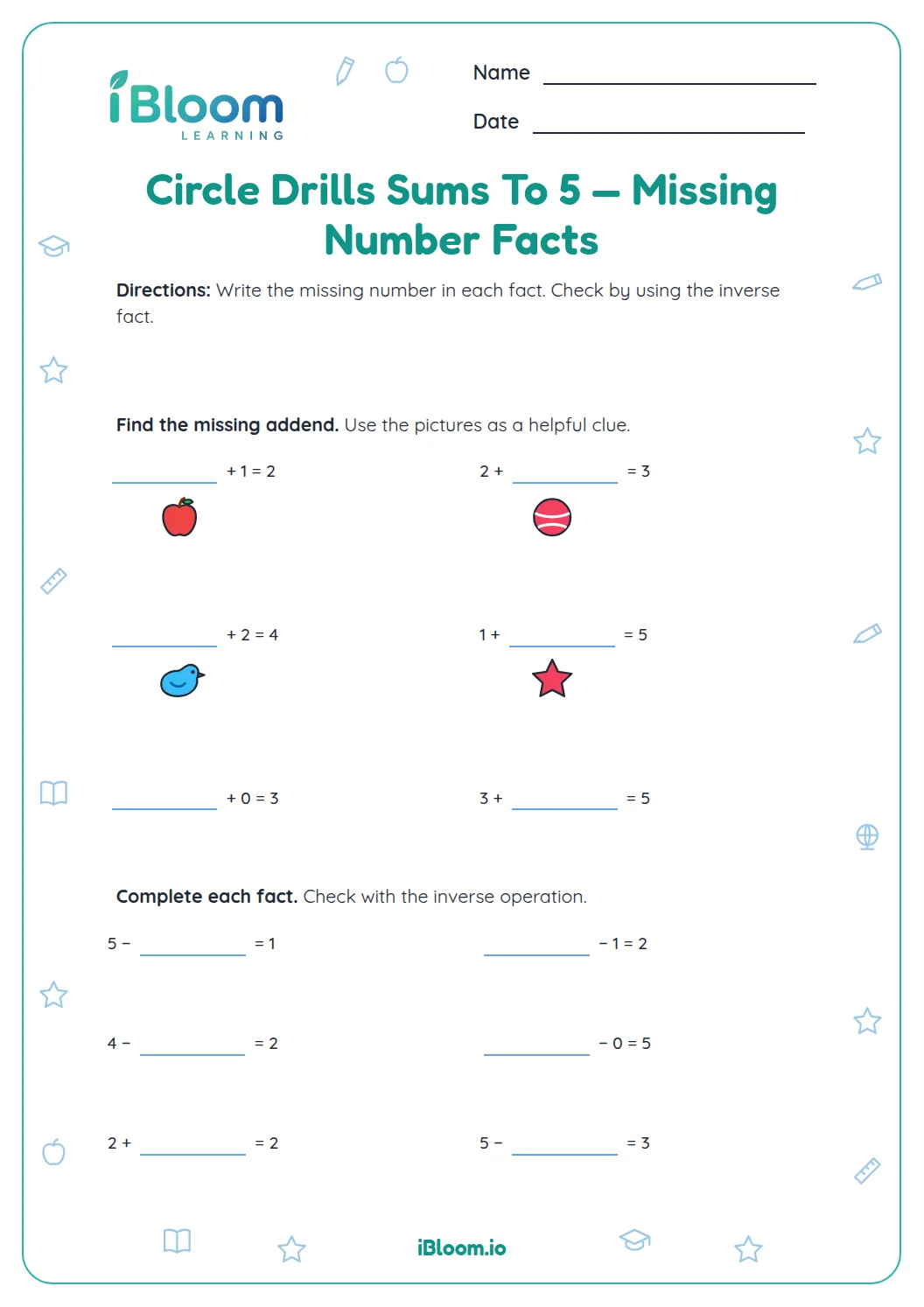
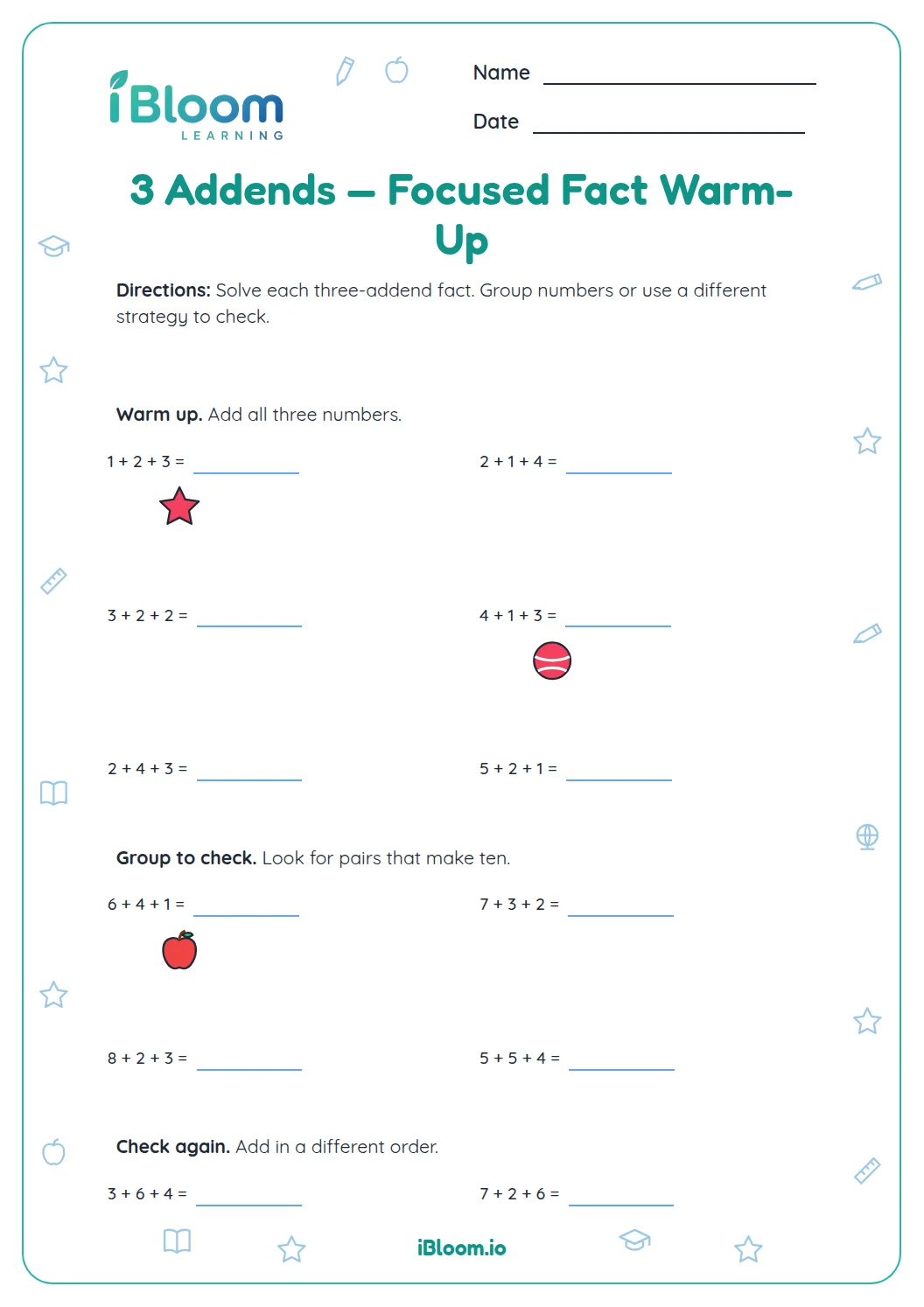
This Grade 1 printable gives 20 addition facts with sums no greater than five. Learners fill in each missing sum and may time a round only if useful. A separate answer key lists every result. The facts support Common Core 1.OA.C.6.
Aligned to 1.OA.C.6
How does the addition practice work?
Each equation has two addends and one missing sum. For example, 2 + 3 = 5. All 20 facts total five or less.
Some later questions leave room to show a count-on strategy. Timing is optional; accuracy comes first.
- 12 + 3 = 5
How can a learner check a sum?
Count on from one addend by the amount of the other, or use counters to represent both groups. Check that the total does not exceed five. If using a timer, record accuracy separately from time.
What is included on the printable?
The two-page worksheet has 20 missing-sum equations and a separate two-page answer key. Learners can complete the facts without timing and use the key to check each result.
How to use this worksheet
- 1Read both addends.
- 2Count on or use a known fact to find the sum.
- 3Write the missing number.
- 4Check that the total is five or less.
- 5Use the answer key; time practice only if helpful.
Common mistakes and quick fixes
The mistake
Adding the addends in the wrong direction.
The fix
Start with one addend and count on by the other.
The mistake
Writing an addend instead of the total.
The fix
Check by counting all the objects or numbers in both groups.
The mistake
Rushing because a timer is available.
The fix
Practice untimed until the sums are accurate.
Common Core alignment
This worksheet practices the standard below.
Build fluency with doubles facts within 20.
On this sheet: Build fluency with doubles facts within 20.
Show the official wordingHide the official wording
Add and subtract within 20, demonstrating fluency for addition and subtraction within 10. Use strategies such as counting on; making ten (e.g., 8 + 6 = 8 + 2 + 4 = 10 + 4 = 14); decomposing a number leading to a ten (e.g., 13 - 4 = 13 - 3 - 1 = 10 - 1 = 9); using the relationship between addition and subtraction (e.g., knowing that 8 + 4 = 12, one knows 12 - 8 = 4); and creating equivalent but easier or known sums (e.g., adding 6 + 7 by creating the known equivalent 6 + 6 + 1 = 12 + 1 = 13).
What to practice next
Make more practice
Further reading
Questions parents and teachers ask
What does “sums to five” mean?
Every addition fact on this worksheet has a total of five or less. For example, 2 + 3 = 5. The 20 equations include different addends and totals, and the answer key lists each missing sum. Learners can solve them without a timer.
Is a timer needed?
No. Timing is optional, and the facts can be completed without a timer. If a learner chooses to time a round, record the time separately and check every sum for accuracy afterward. Untimed practice is useful while learning the facts.
How can counters help?
Make one group for the first addend and another group for the second addend. Count all the counters to find the sum, or start at one addend and count on. The worksheet totals stay within five, so a small set of counters is enough.
How many addition facts are on the sheet?
There are 20 missing-sum equations across two worksheet pages. The separate answer key gives the result for each question. Learners can solve them in order and check the answers after completing a page. The equations use totals from zero through five.
What should a learner do after making a mistake?
Read both addends again and count on from one of them by the amount of the other. Compare the result with the equation, then check the answer key. Focus on getting accurate sums before choosing optional timed practice.