
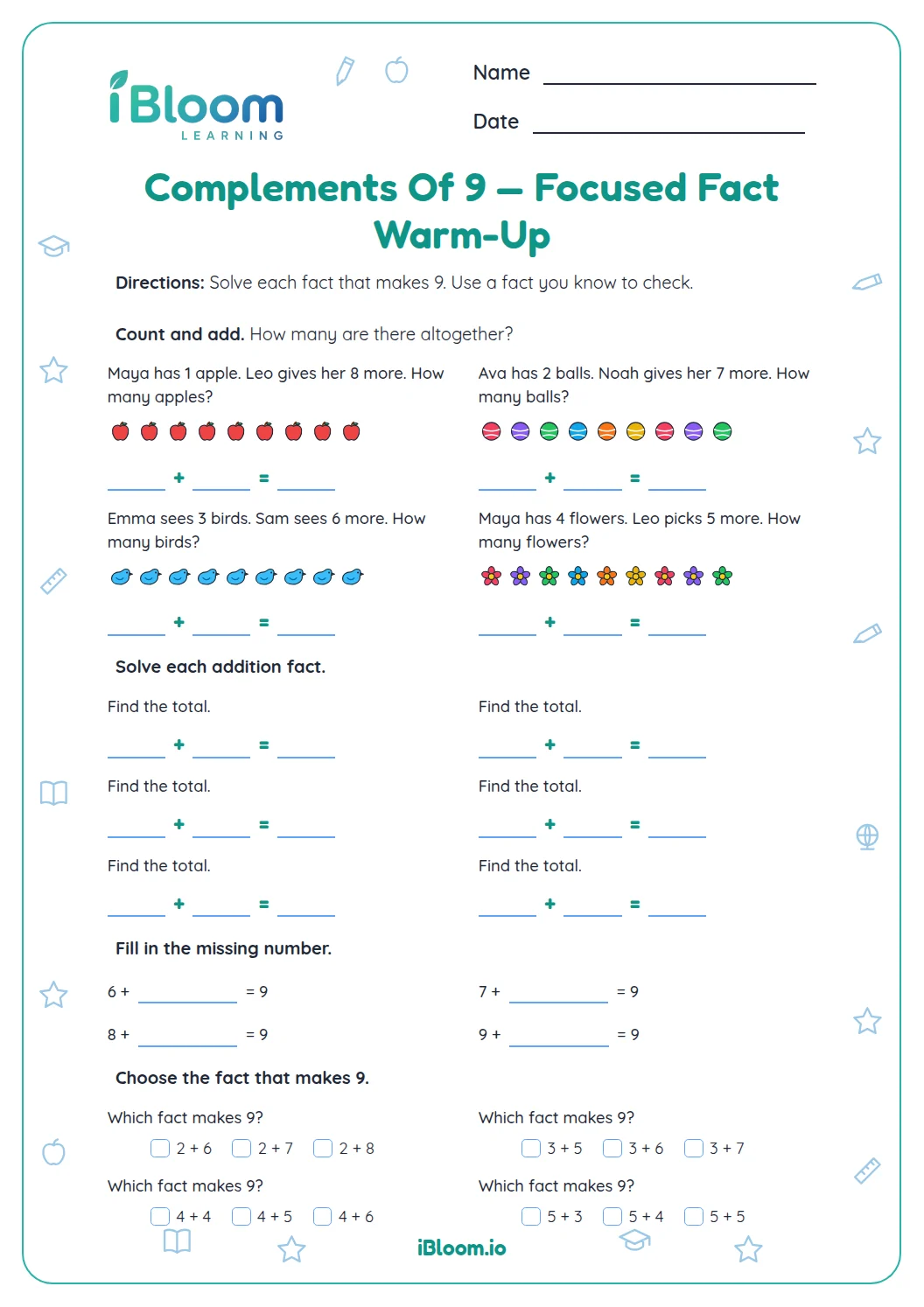
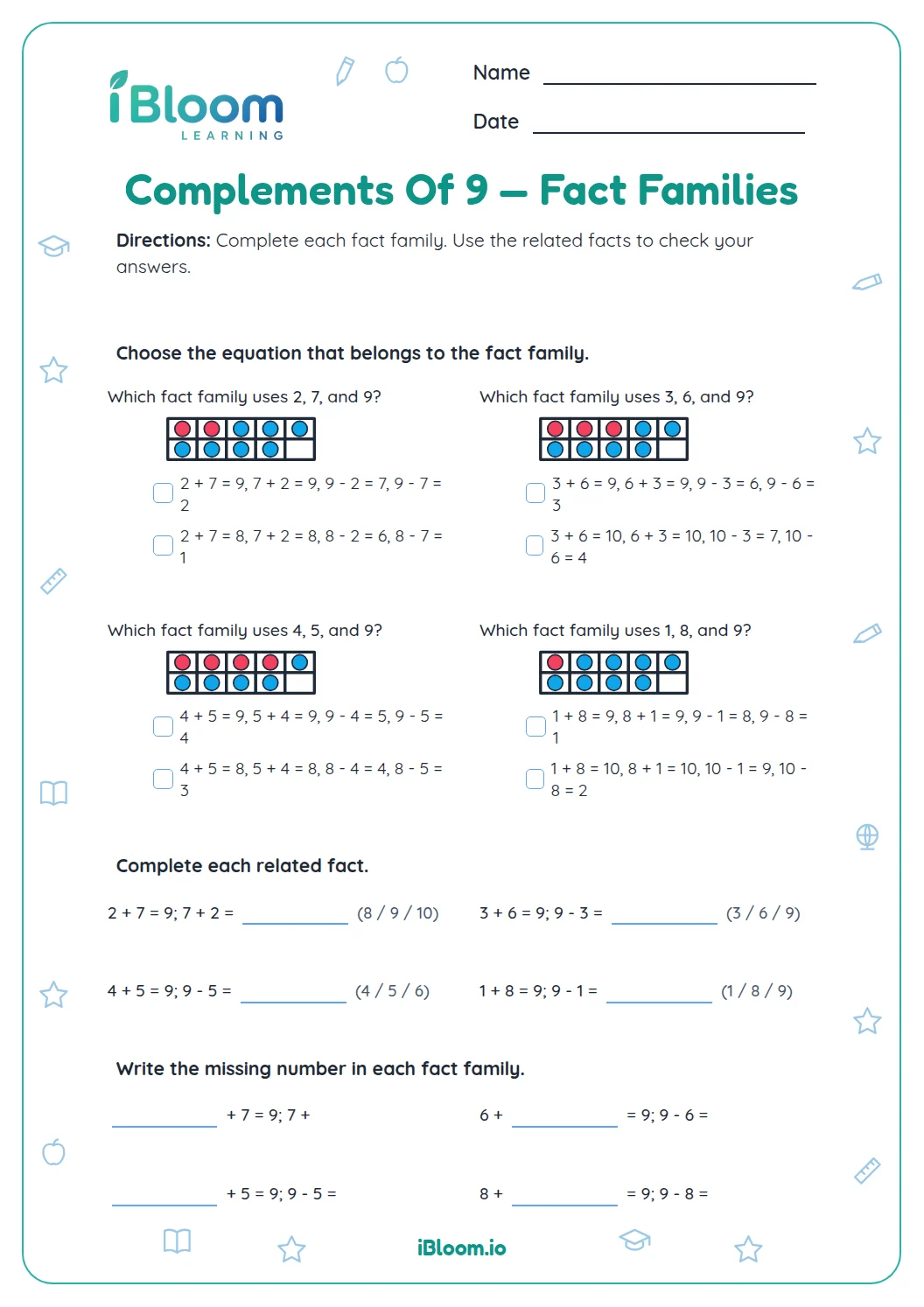
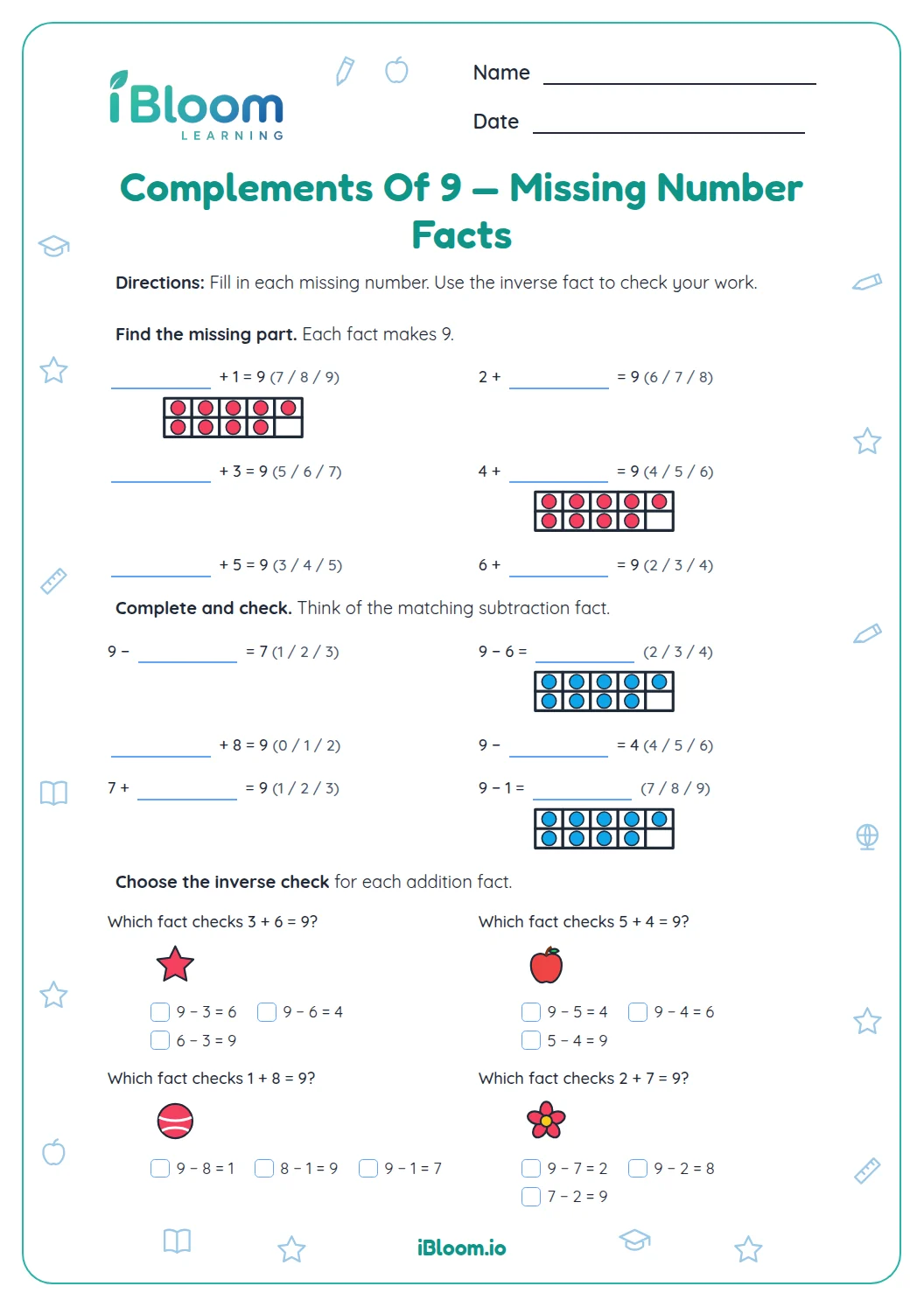

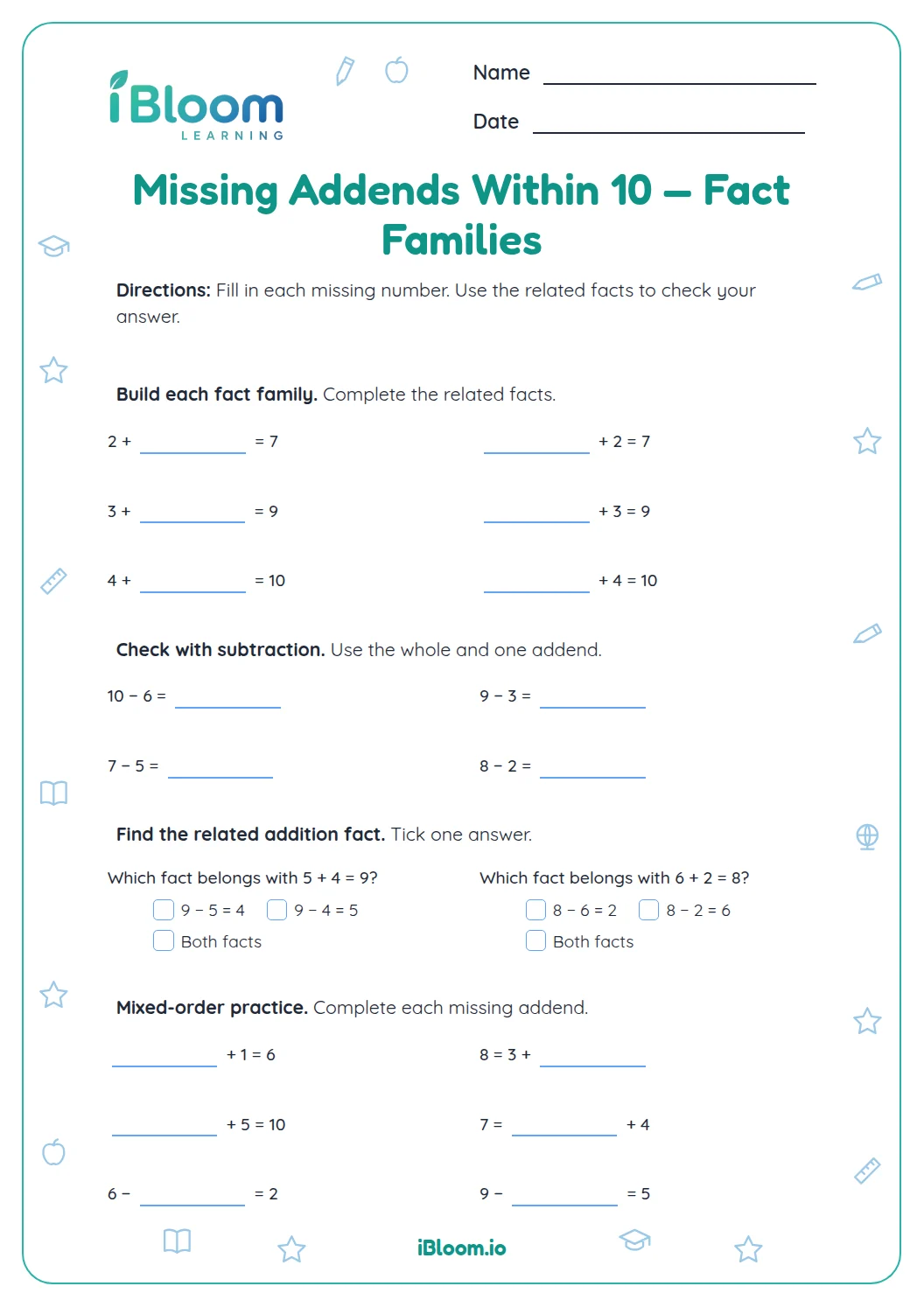



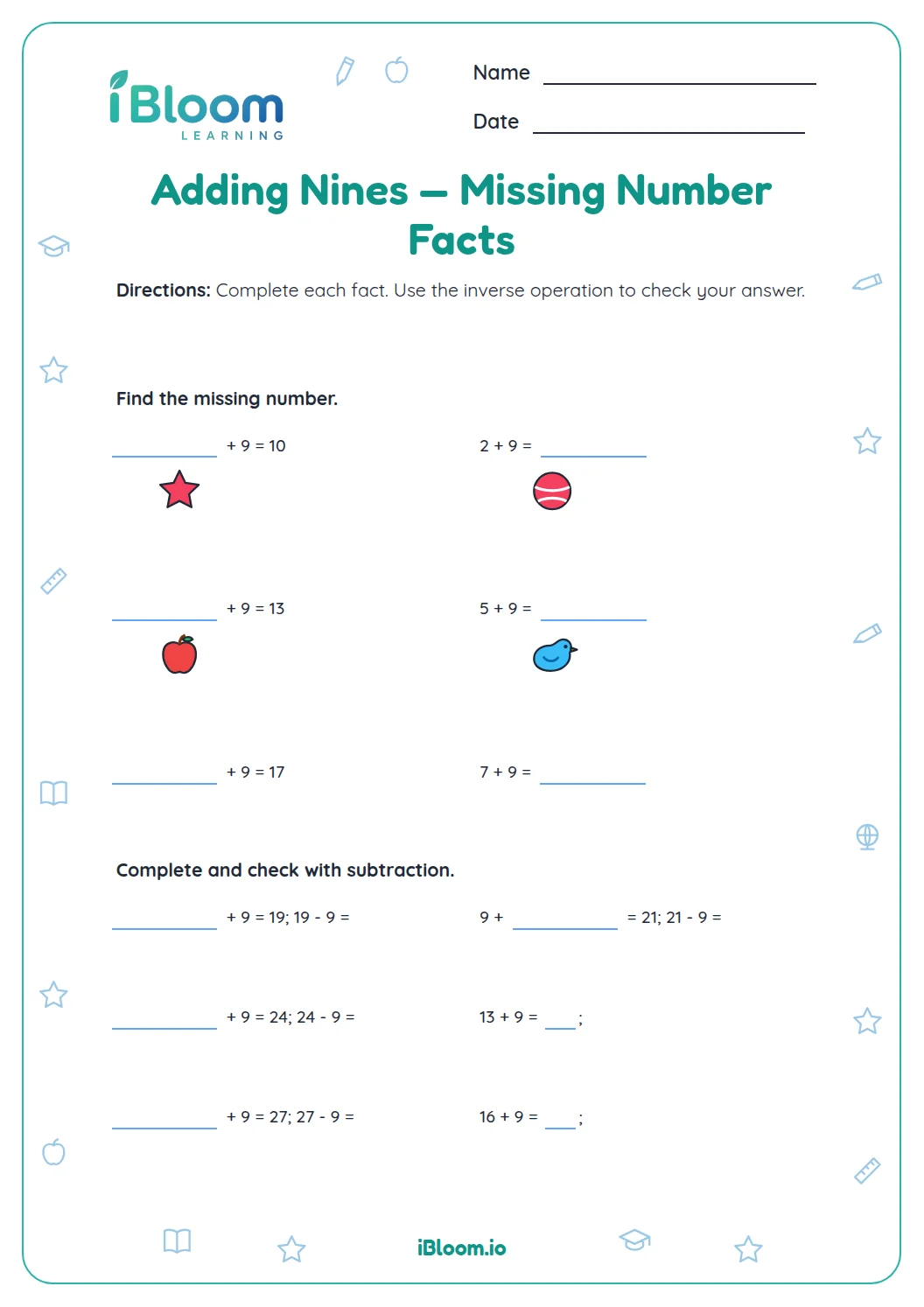
About this worksheet
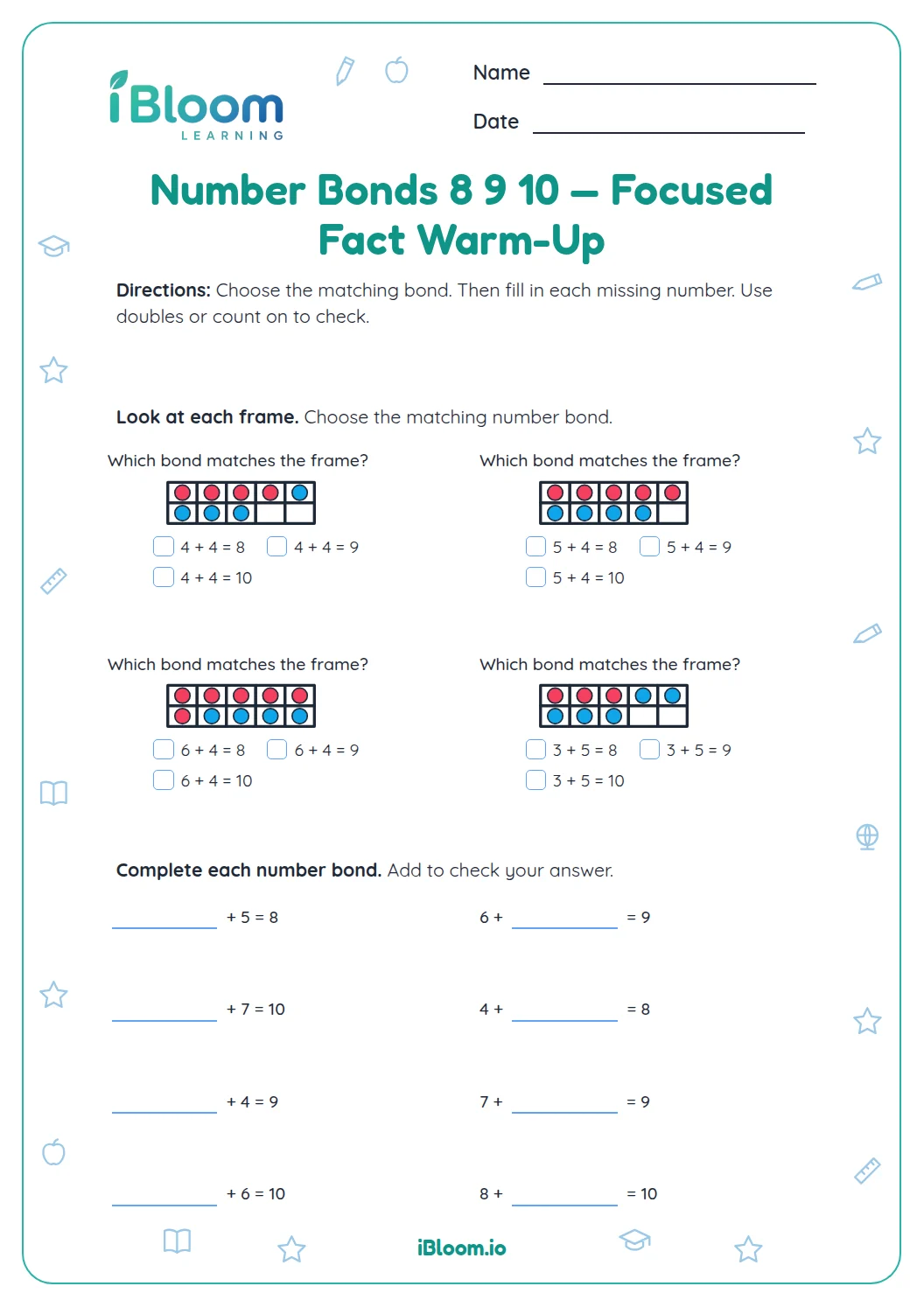
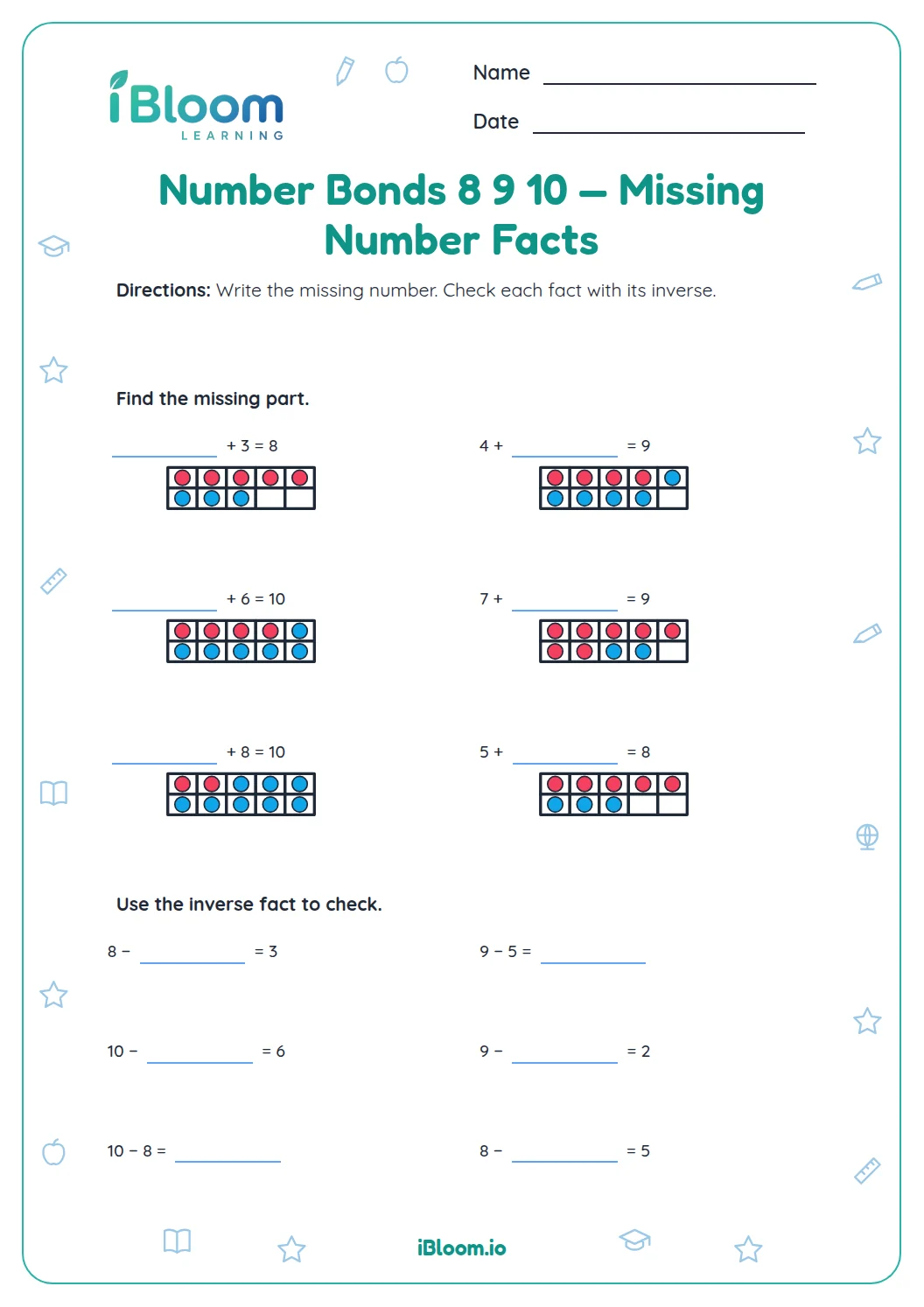
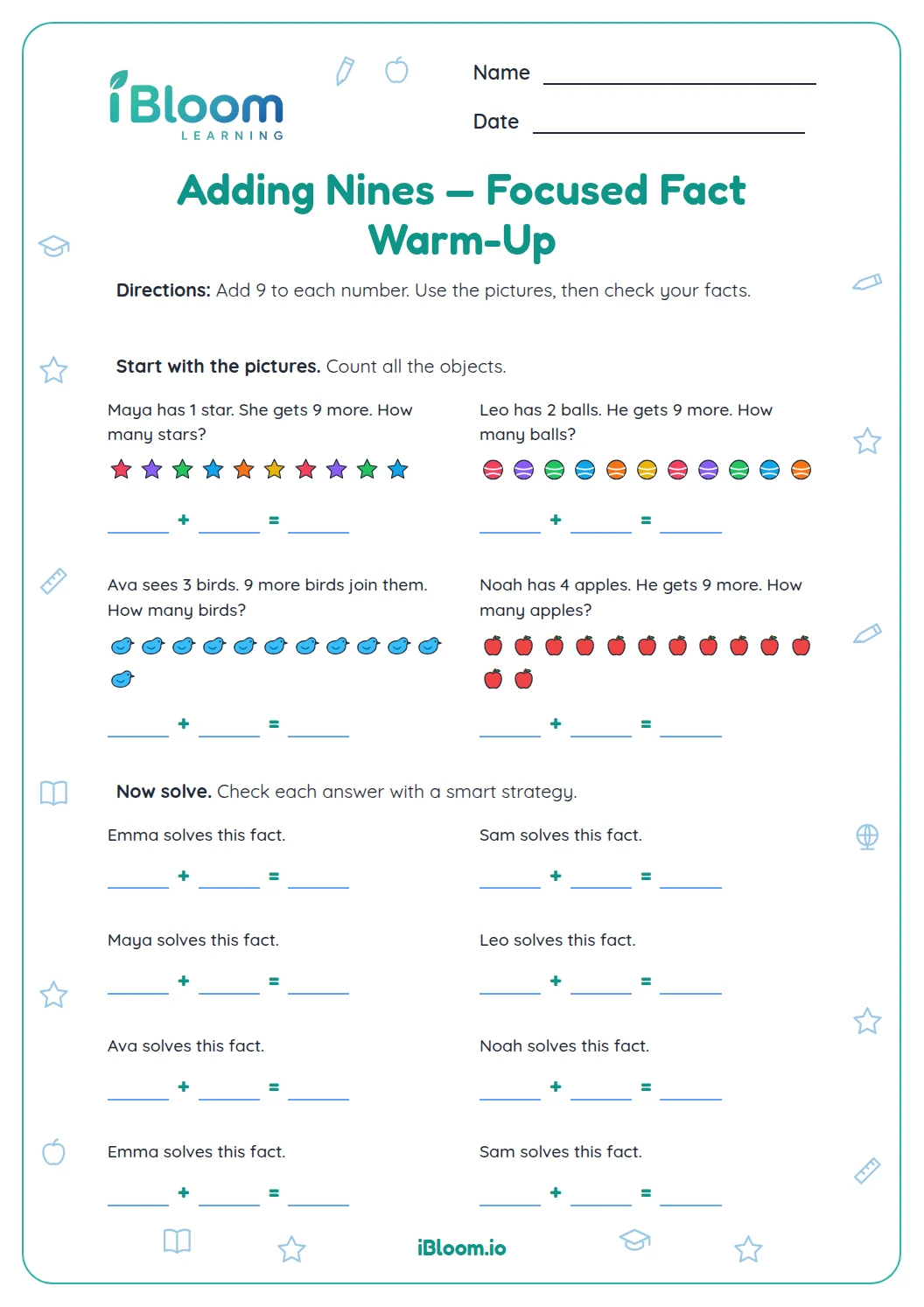
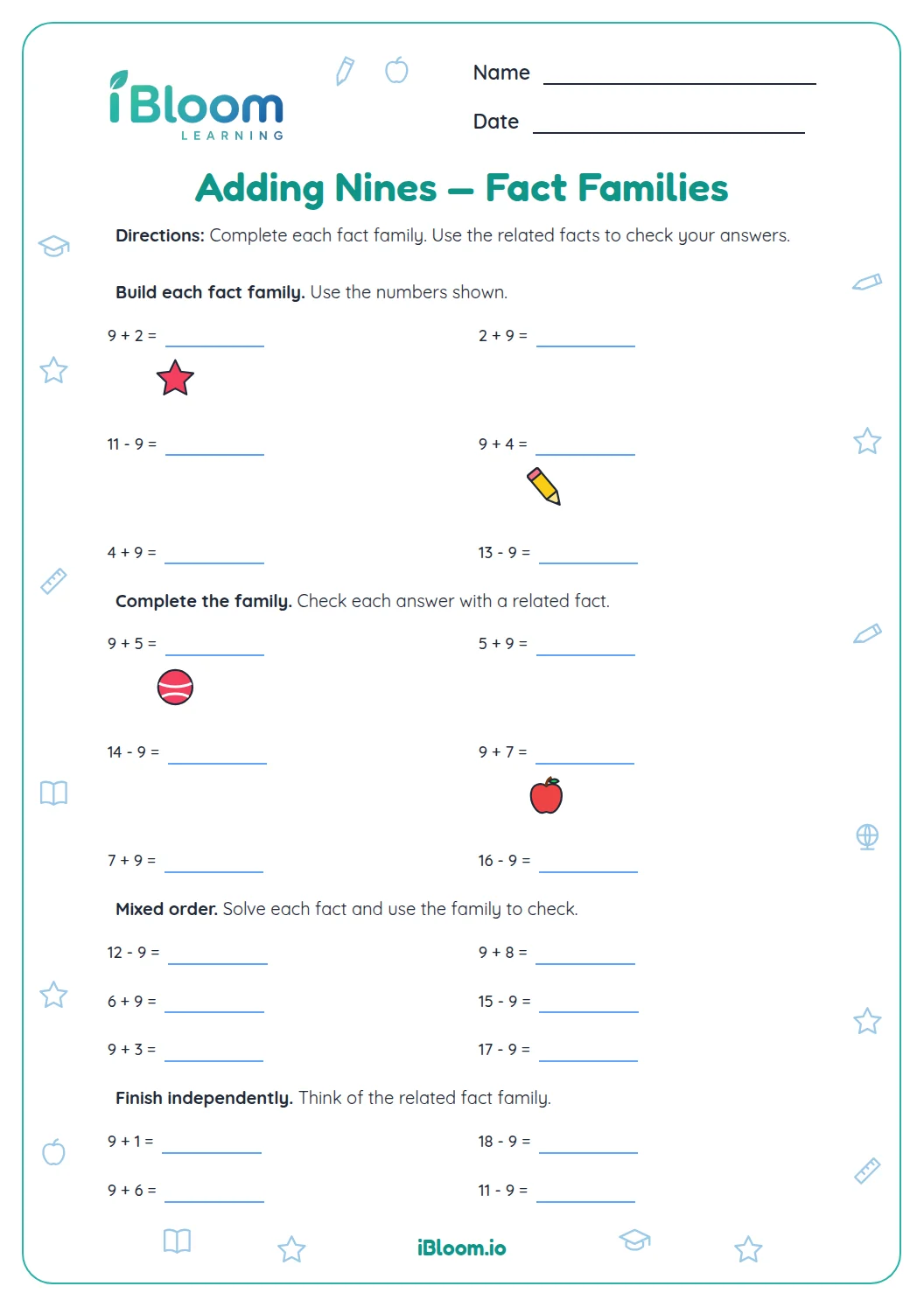
This printable gives Grades 1–2 focused practice with pairs that add to 9. Children complete missing-addend equations, read number bonds, and answer a mixed-order set of facts. An optional timing suggestion lets families or teachers notice fluency without making speed the goal. The 16 questions stay within 10 and practice CCSS 1.OA.C.6, adding and subtracting within 20 with strategies such as making a ten. The answer key is separate.
Aligned to 1.OA.C.6
What does it mean to complement 9?
Two addends complement 9 when their sum is 9. For example, 6 needs 3 more because 6 + 3 = 9. Saying the pair together can help children remember both directions.
How does a number bond show the pair?
The whole is 9 and the two parts are addends. If one part is 7, the other part must be 2.
- 1Whole: 9; one part: 4
- 2Think: 4 + ? = 9
- 3Answer: 5
How does the optional drill work?
First complete the facts carefully. If useful, an adult may time one round after the child understands the facts. Use the time only to notice progress; accuracy and confidence come first.
How to use this worksheet
- 1Read the whole number in each equation or bond.
- 2Ask how many more are needed to make 9.
- 3Use the partner fact in either order, such as 2 + 7 and 7 + 2.
- 4Check the sum before moving to the next fact.
- 5Try timing only if it feels encouraging; untimed practice counts too.
Common mistakes and quick fixes
The mistake
Subtracting the known addend from 10 instead of 9.
The fix
Point to the stated whole and find the partner that reaches 9.
The mistake
Writing the whole number as the missing part.
The fix
Add the known part and your answer to confirm the total is 9.
The mistake
Rushing and switching the two numbers.
The fix
Read the equation in order and check that both addends still total 9.
Common Core alignment
This sheet gives children direct practice with the stated grade-level skill.
Use addition facts and a missing addend to make 9.
On this sheet: The worksheet builds fluency with addition facts and missing addends that make 9.
Show the official wordingHide the official wording
Add and subtract within 20, demonstrating fluency for addition and subtraction within 10. Use strategies such as counting on; making ten (e.g., 8 + 6 = 8 + 2 + 4 = 10 + 4 = 14); decomposing a number leading to a ten (e.g., 13 − 4 = 13 − 3 − 1 = 10 − 1 = 9); using the relationship between addition and subtraction (e.g., knowing that 8 + 4 = 12, one knows 12 − 8 = 4); and creating equivalent but easier or known sums (e.g., adding 6 + 7 by creating the known equivalent 6 + 6 + 1 = 12 + 1 = 13).
What to practice next
Make more practice
Further reading
Questions parents and teachers ask
Which facts are included?
Every missing-part and addition fact is built around a total of 9. Children see the number pairs in more than one order and use a number bond to connect the parts with the whole. Reread each prompt and check the answer key when the work is complete.
Is the timed drill required?
No. Timing is optional and can be skipped. Children can complete the same facts at a comfortable pace, focusing first on accuracy and understanding how the two addends make 9. Reread each prompt and check the answer key when the work is complete.
How can I explain a complement to 9?
Ask, “How many more do we need to reach 9?” For 5, count 6, 7, 8, 9: four more are needed. Then check with 5 + 4 = 9. Reread each prompt and check the answer key when the work is complete.
What if a child writes the pair in reverse order?
A reversed pair is still a true addition fact because changing the order of addends keeps the sum the same. When a question has a blank in a specific place, though, write the missing number in that blank. Reread each prompt and check the answer key when the work is complete.
Does the answer key include the number bond answers?
Yes. It lists the missing part for each bond and the value that completes each equation. Children can use it to check the partner and then confirm that the total is 9. Reread each prompt and check the answer key when the work is complete.