

About this worksheet
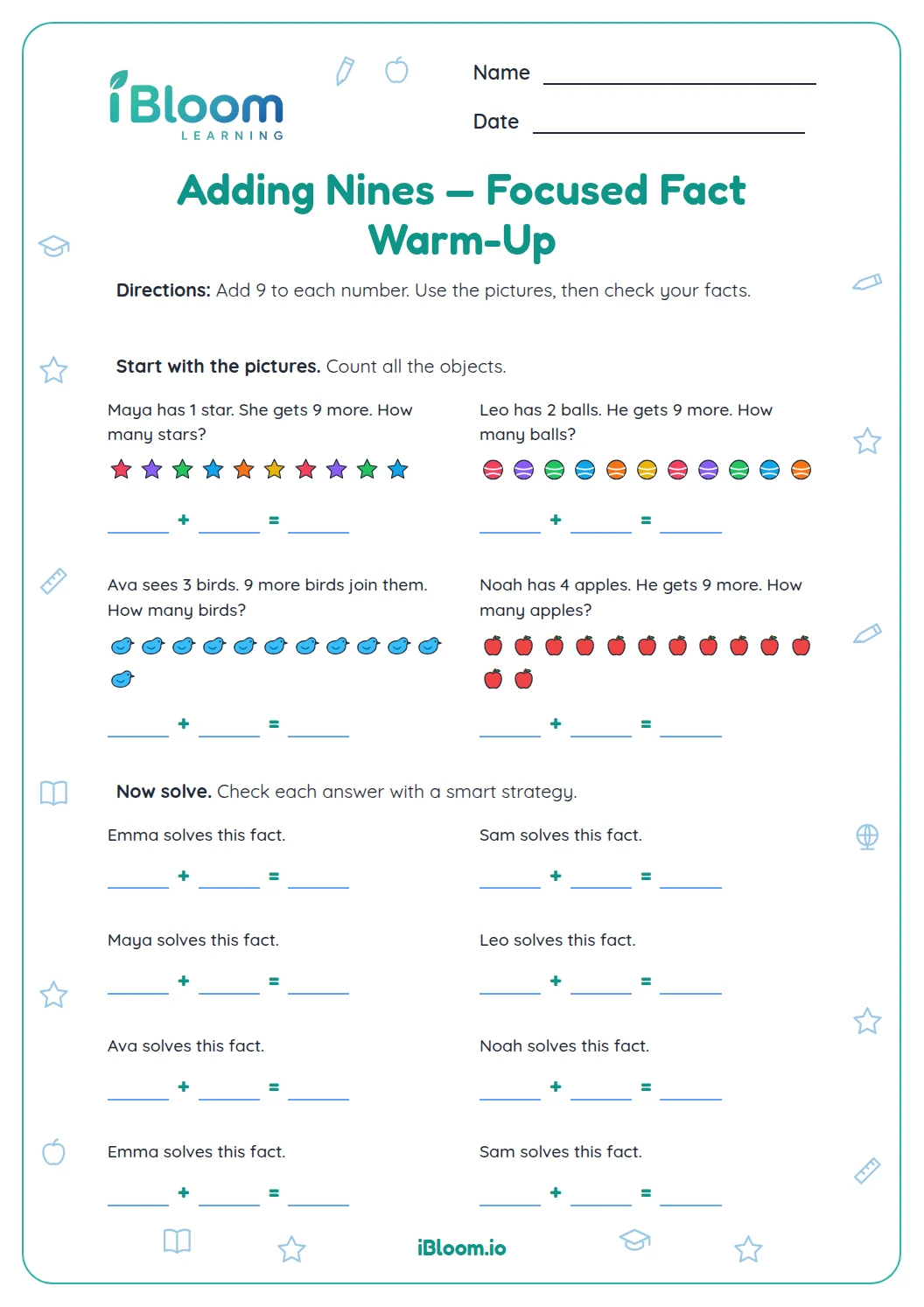
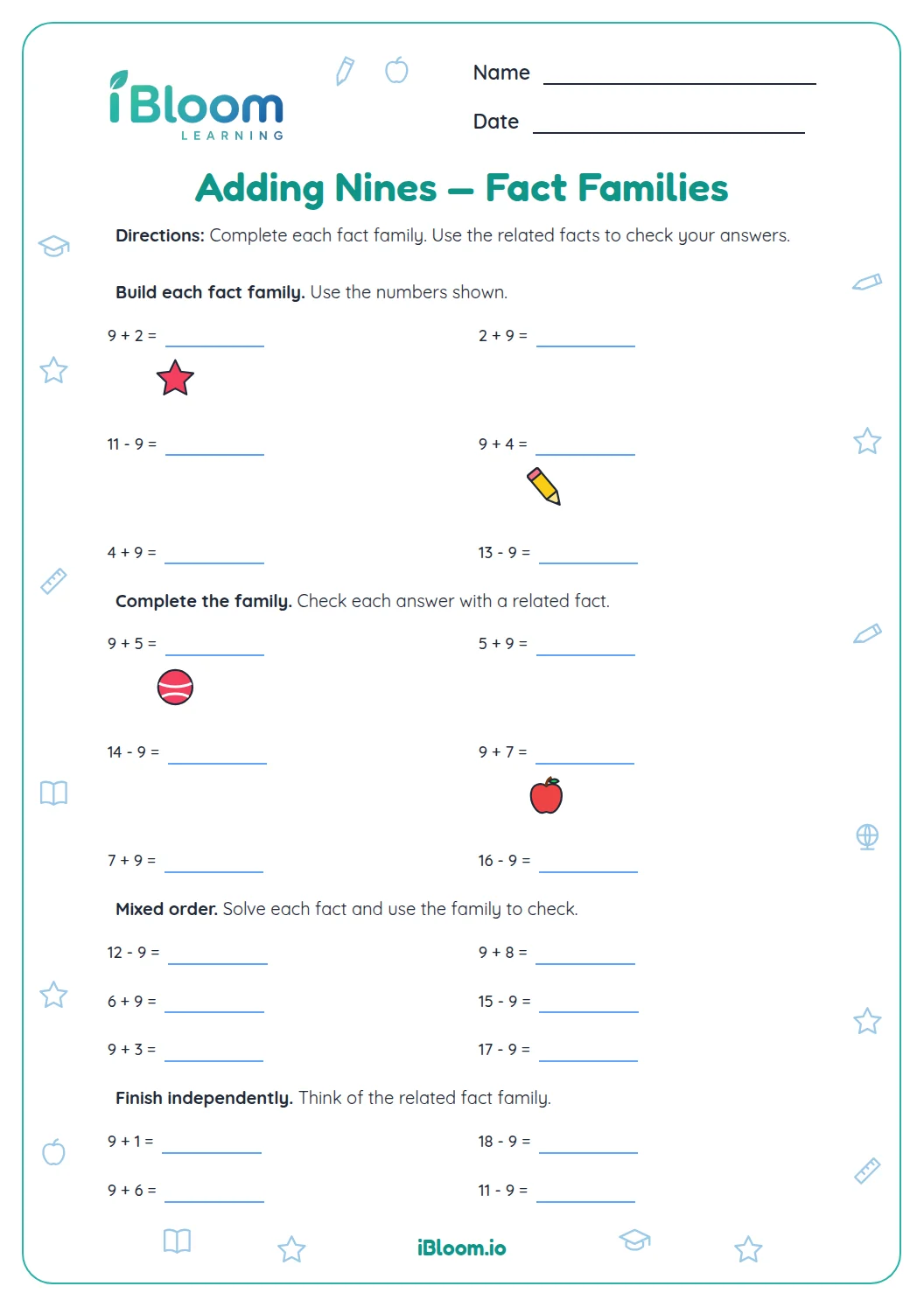
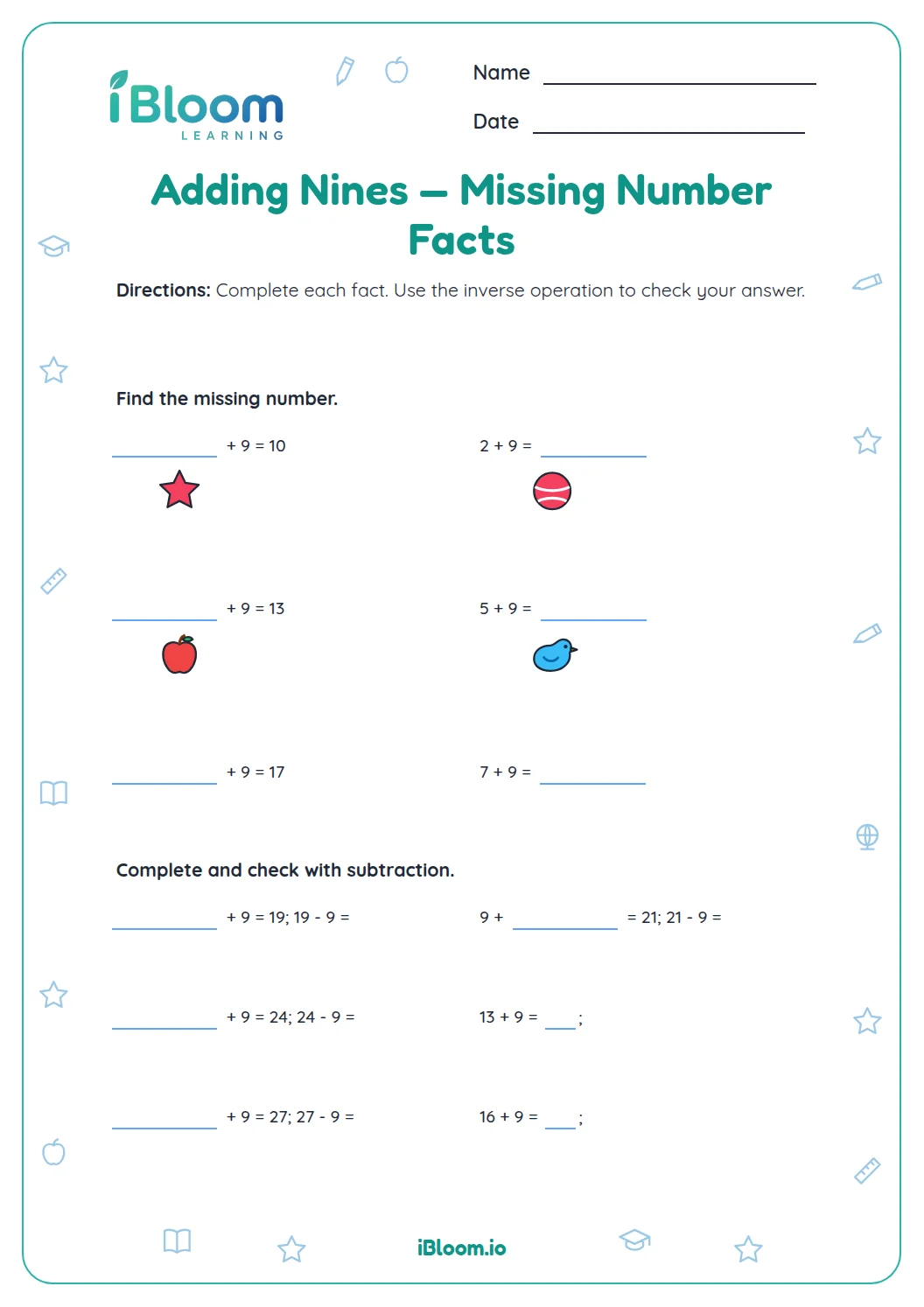
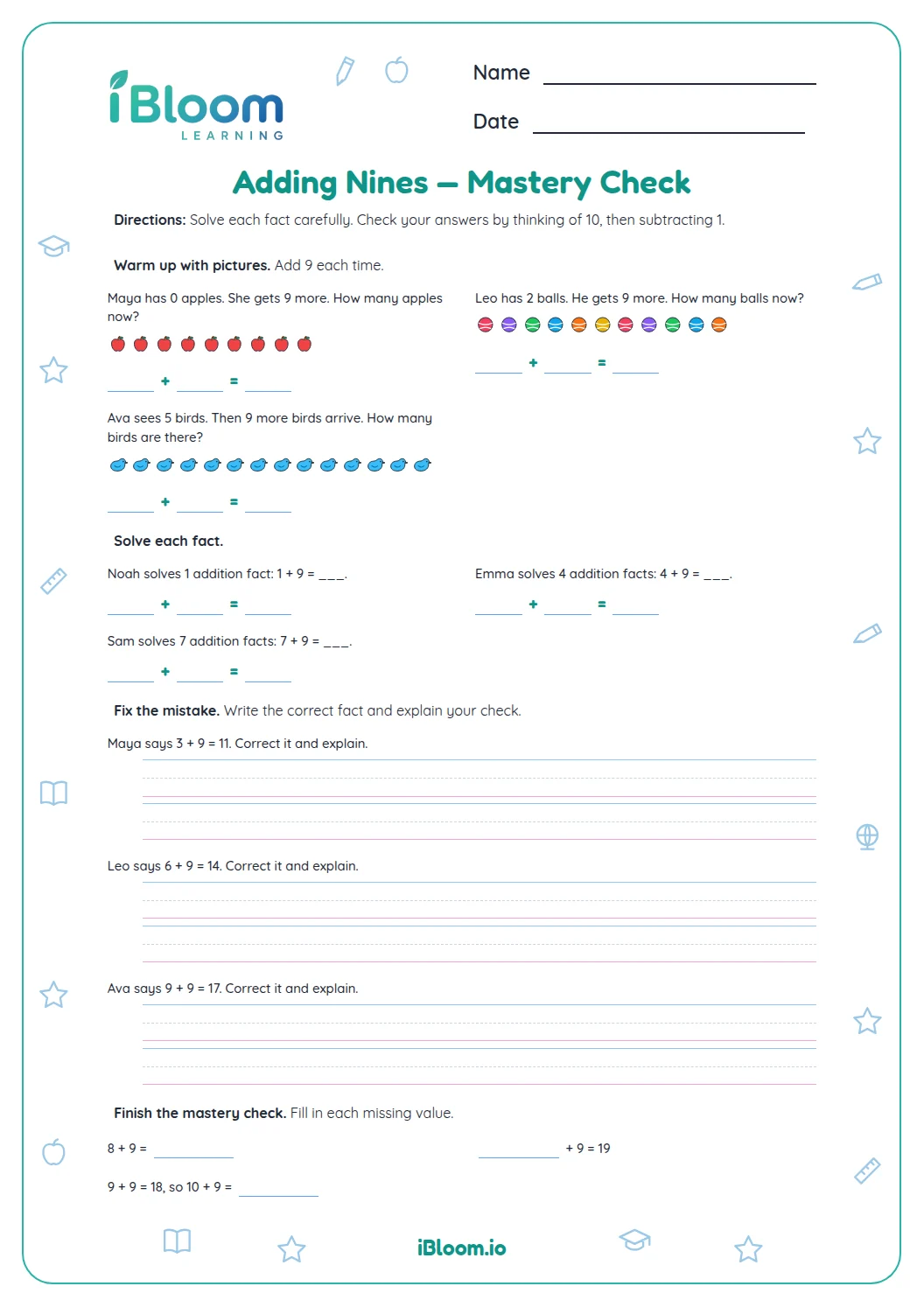
This free printable gives Grades 1–2 students 23 mixed-order facts that add 9 to partners from 0 through 11. Every sum is within 20; students can use the make-ten idea (add 10, then subtract 1) or a fact they know. The sheet replaces picture-led warm-ups with direct fluency practice, and a separate two-page key lists the sums.
Aligned to 1.OA.C.6
What does the adding-nines sheet include?
The two-page drill has 23 fill-in facts. It uses partners from 0 to 11 and places 9 first and second where the addends differ, so students recognize the same skill in mixed order. Every sum is within 20.
- 19 + 6
- 210 + 6 = 16; 16 − 1 = 15
- 3So, 9 + 6 = 15.
How does the make-ten strategy help?
Nine is one less than ten. Replacing 9 with 10 makes an easier sum, and subtracting 1 restores the original amount. Students may also use a known fact or count on.
How can a child check a sum?
Use the switched addend order as a check when both forms appear, or add 10 to the partner and subtract 1. Then compare the result with the matching item in the answer key.
How to use this worksheet
- 1Read each number sentence and find the two addends.
- 2For a fact with 9, add 10 to the other number.
- 3Subtract 1 from that easier sum.
- 4Write the missing total and move to the next fact.
- 5Use the key to check answers and retry any missed facts.
Common mistakes and quick fixes
The mistake
Adding 10 and stopping.
The fix
Take 1 away because the addend is 9, not 10.
The mistake
Subtracting 1 from the other addend.
The fix
First add 10 to the partner; subtract 1 from the total.
The mistake
Changing the answer when the addends switch places.
The fix
Addition order can change without changing the sum: 9 + 4 = 4 + 9.
Common Core alignment
This worksheet practices the listed Common Core skill.
Add within 20 using strategies or known facts.
On this sheet: Every fact adds 9 to a partner within 20.
Show the official wordingHide the official wording
Add and subtract within 20, demonstrating fluency for addition and subtraction within 10. Use strategies such as counting on; making ten (e.g., 8 + 6 = 8 + 2 + 4 = 10 + 4 = 14); decomposing a number leading to a ten (e.g., 13 − 4 = 13 − 3 − 1 = 10 − 1 = 9); using the relationship between addition and subtraction (e.g., knowing that 8 + 4 = 12, one knows 12 − 8 = 4); and creating equivalent but easier or known sums (e.g., adding 6 + 7 by creating the known equivalent 6 + 6 + 1 = 12 + 1 = 13).
What to practice next
Make more practice
Further reading
Questions parents and teachers ask
How many problems are on the worksheet?
There are 23 fill-in addition facts across two worksheet pages. Each has 9 as one addend, and the partner numbers run from 0 to 11. A separate two-page answer key lists the corresponding sums, including the double-nine fact.
How can a child add 9 mentally?
Add 10 to the other number, then take away 1. For example, 9 + 6 becomes 10 + 6 − 1, or 15. A child can also count on or recall the fact, then check the result against the key.
Do the addends always appear in the same order?
No. The drill mixes facts such as 9 + 4 and 4 + 9 so students see that switching addends leaves the sum unchanged. The partner range also includes 10 and 11, with the double fact 9 + 9 shown once.
Is there a timer?
No timer is printed or required. Students can work steadily and focus on accurate sums, then use the separate answer key to check their work. This page is for practice, not a timed test, so accuracy comes first.
What grades is this worksheet for?
The page is labeled Grades 1–2 and focuses on addition facts with sums no greater than 20. The partner range includes 0 through 11, so students also practice the larger partners within that limit and use a make-ten strategy.