

About this worksheet
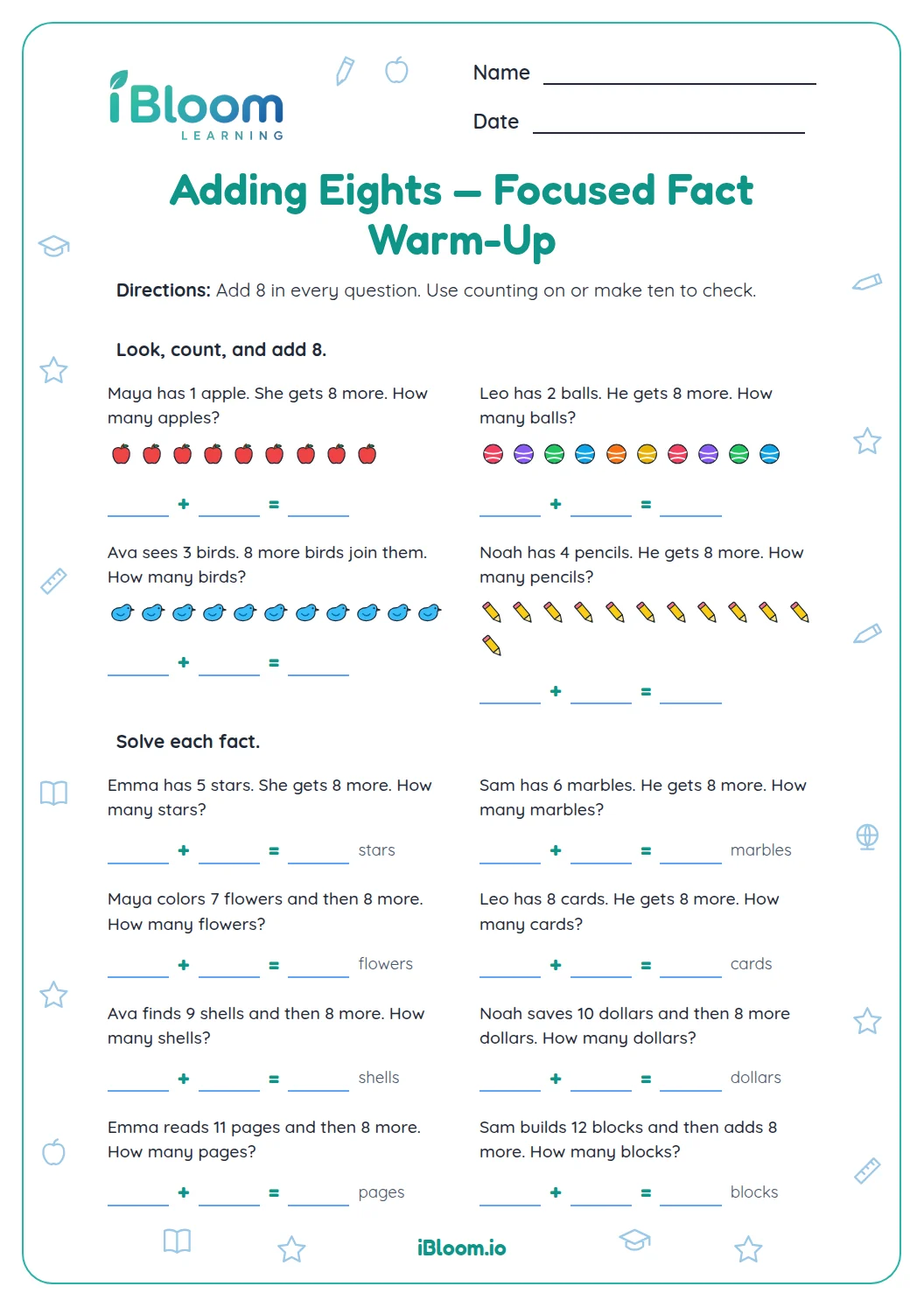
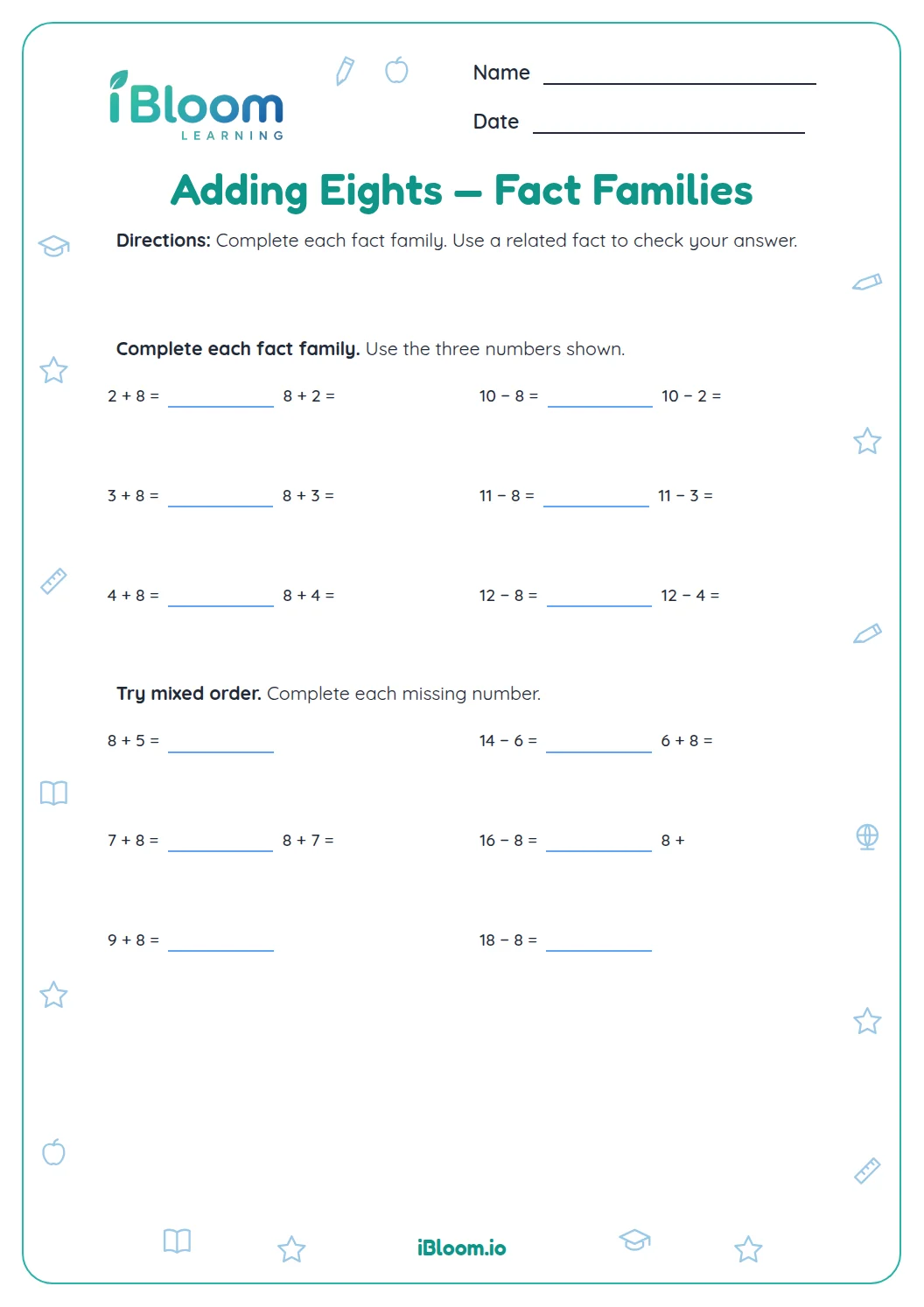
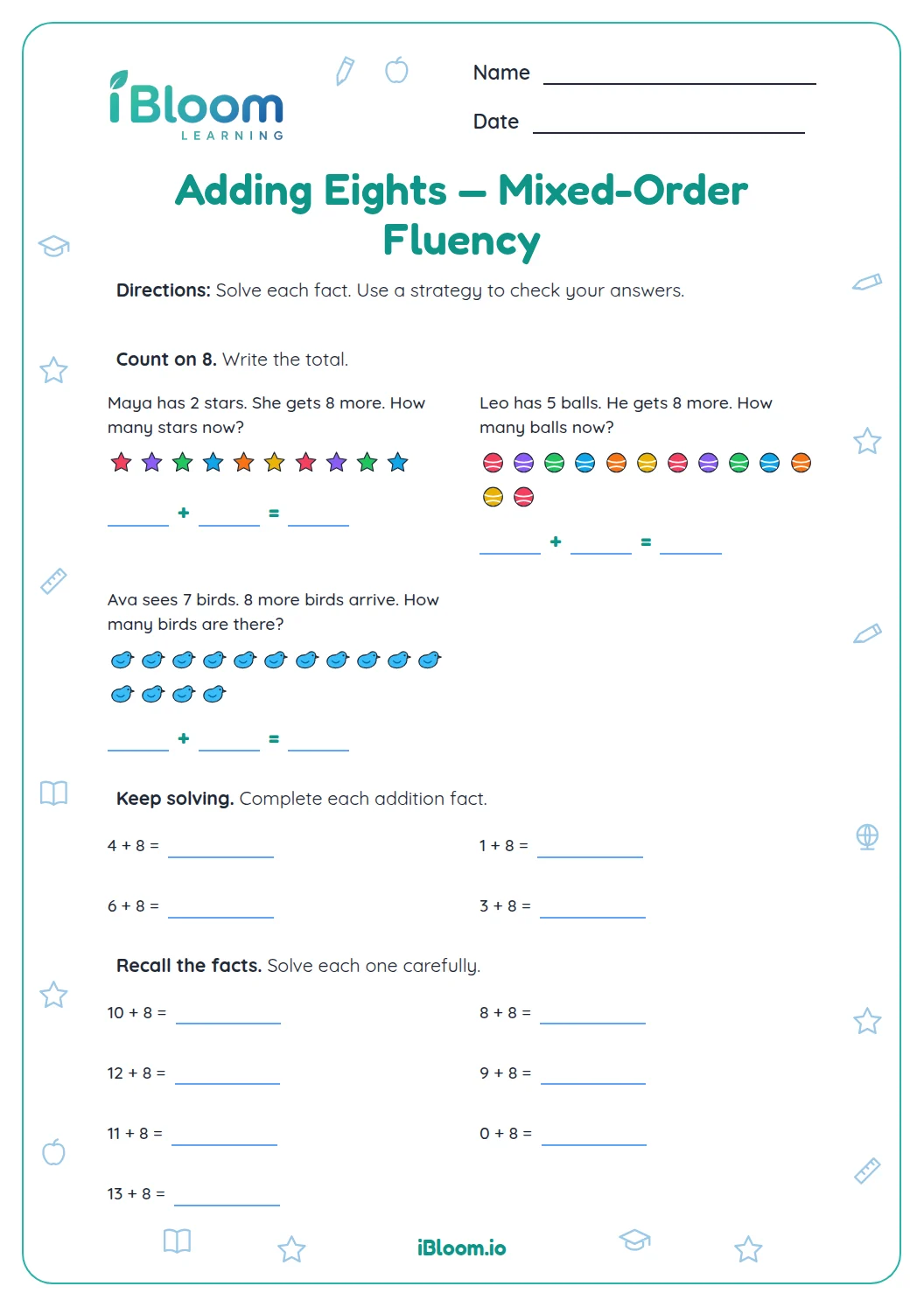
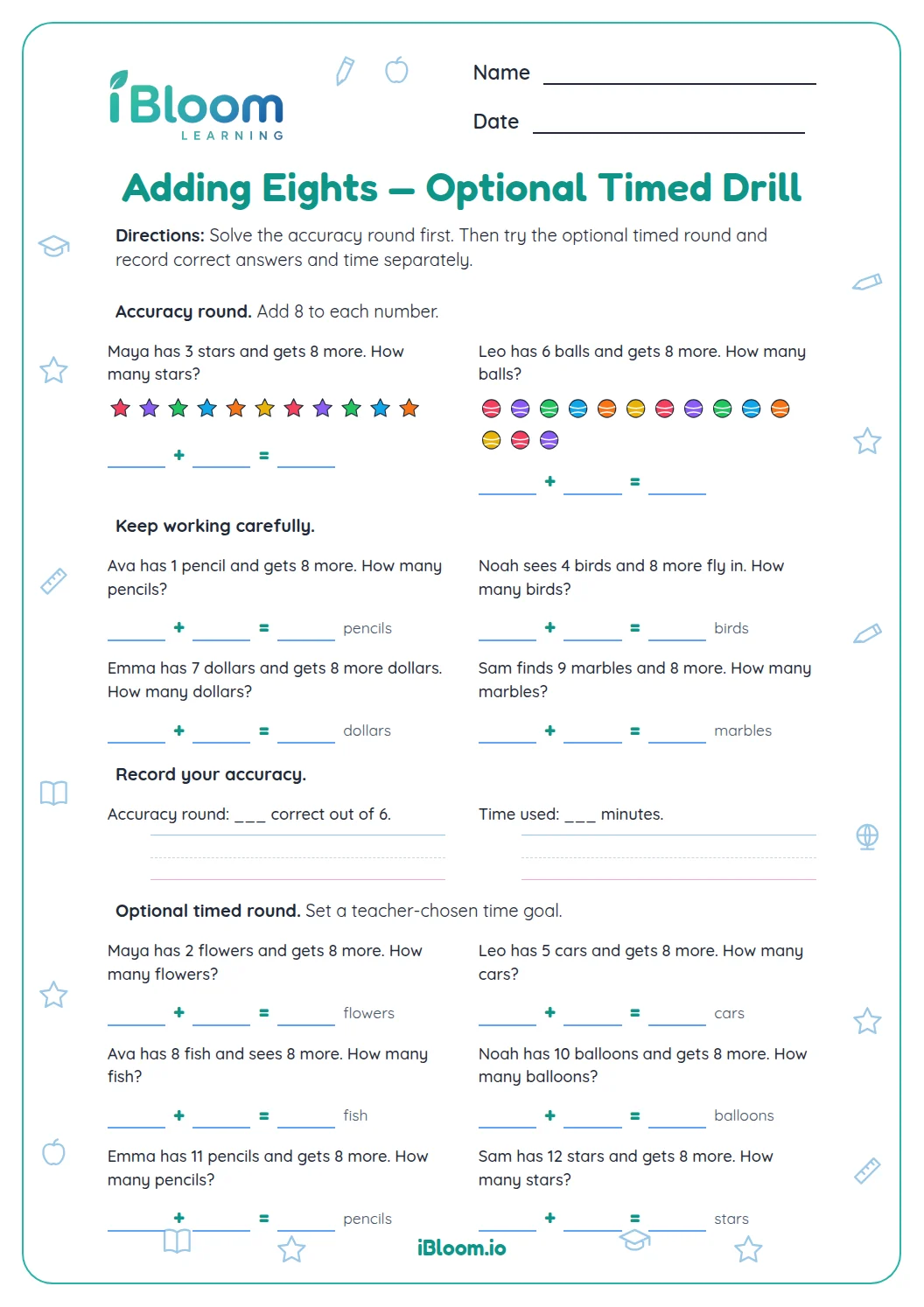
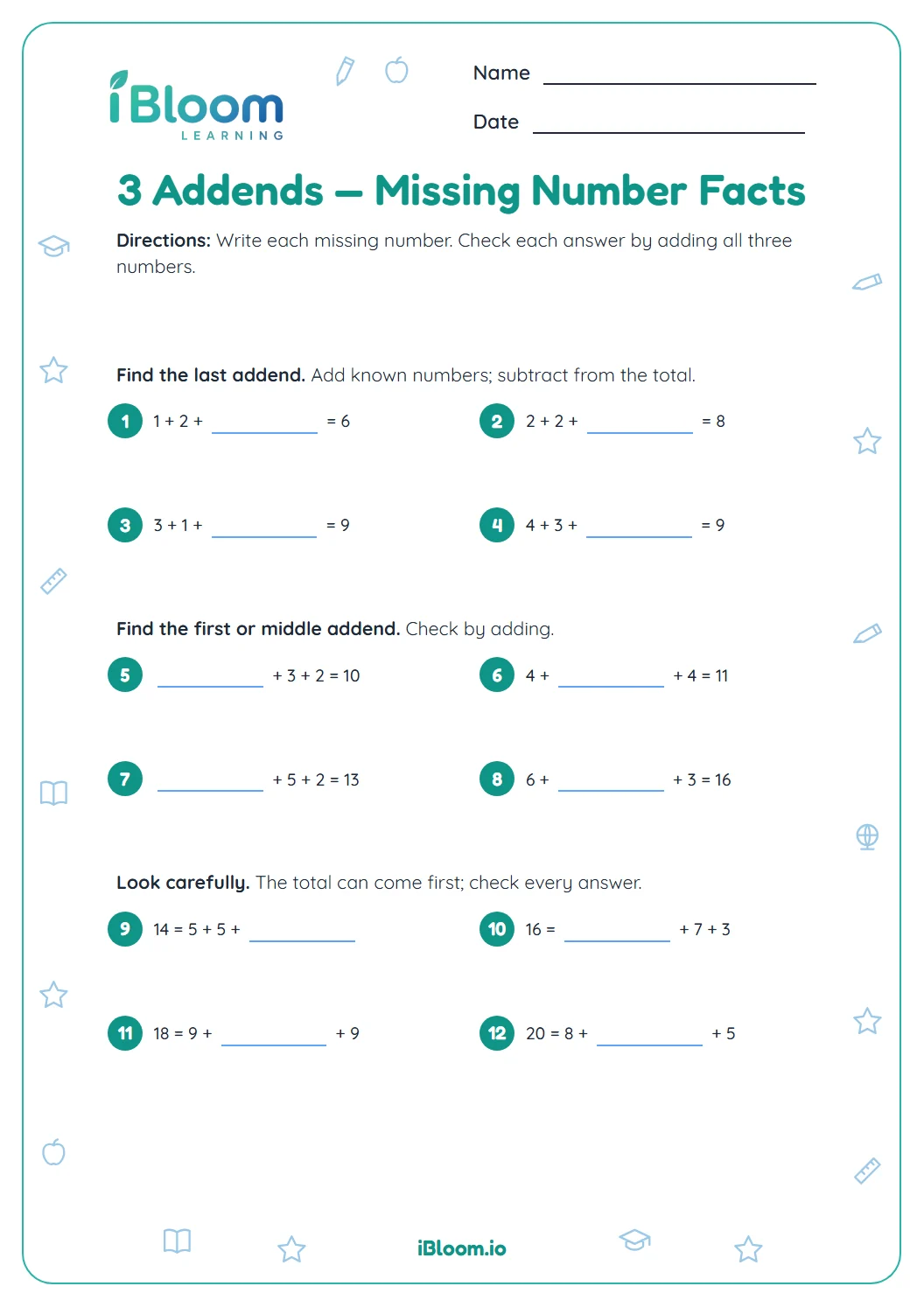
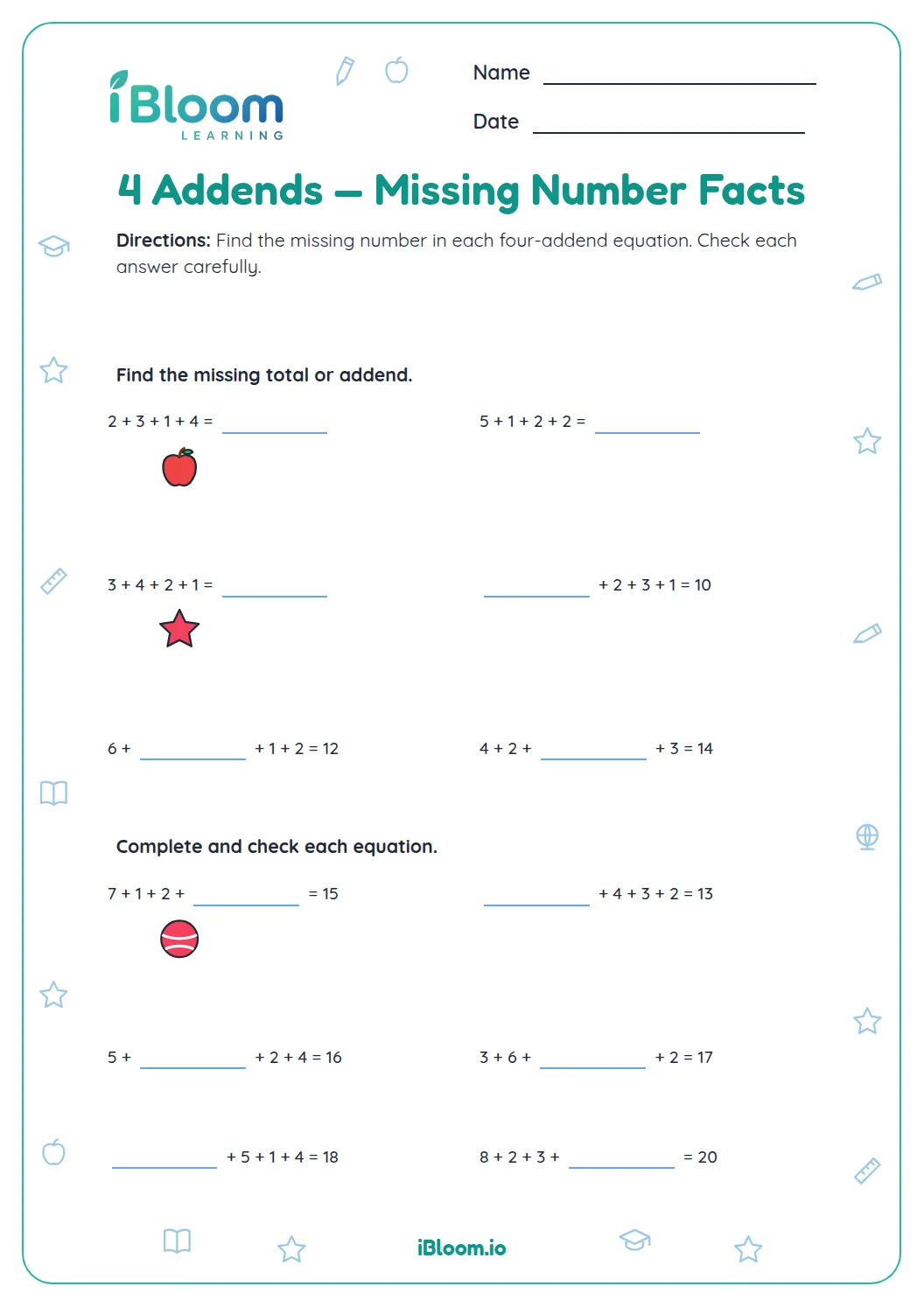
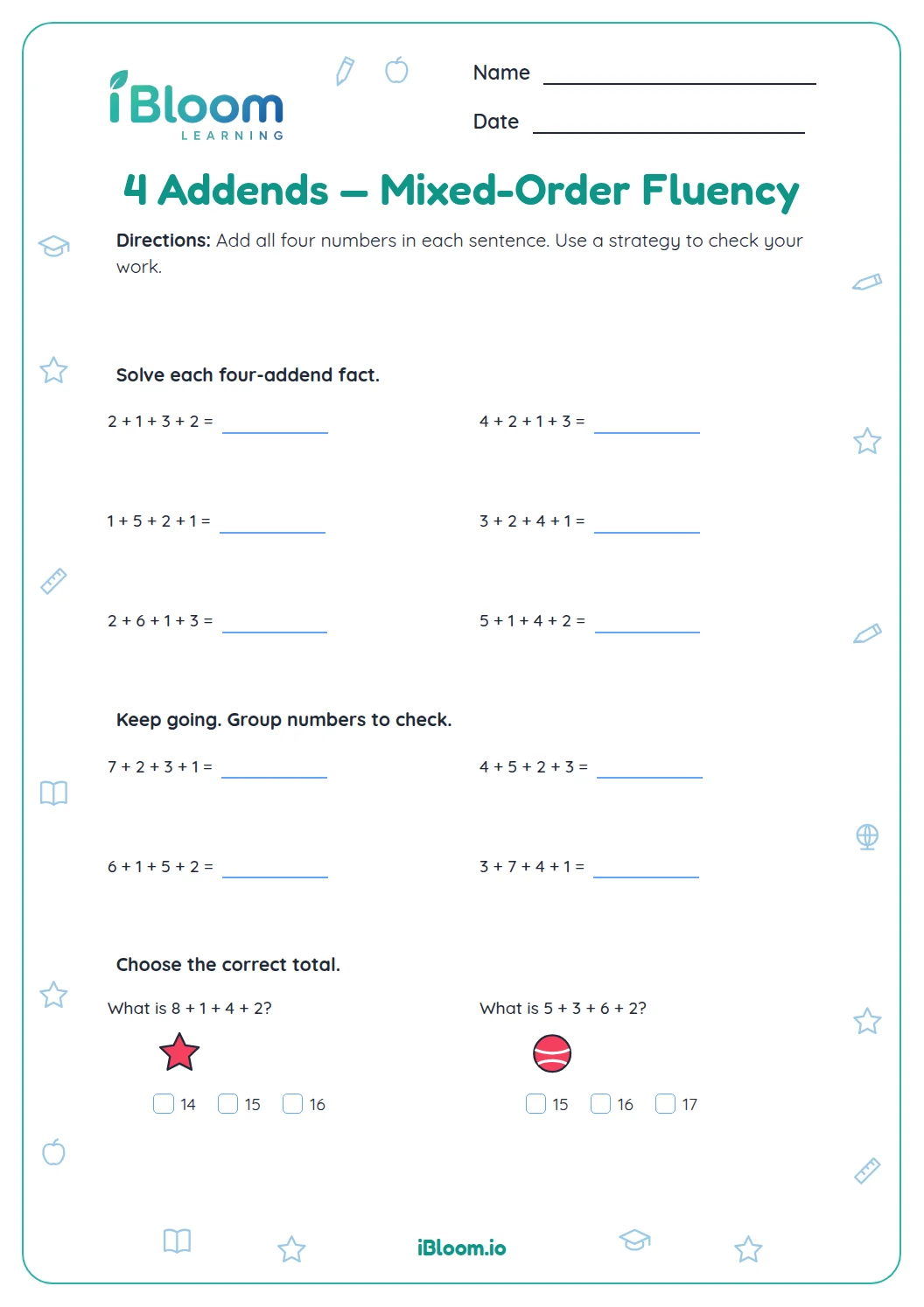
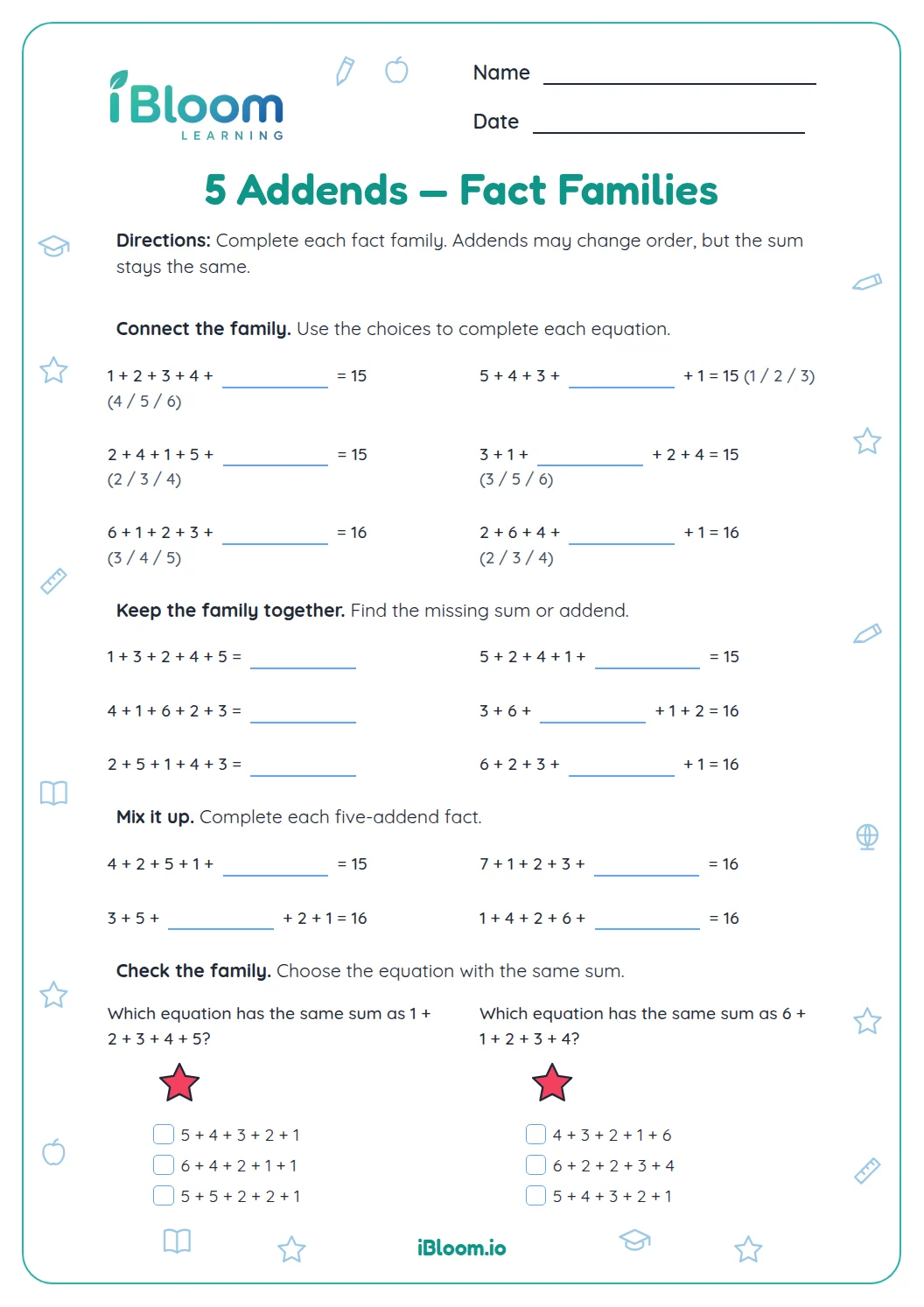
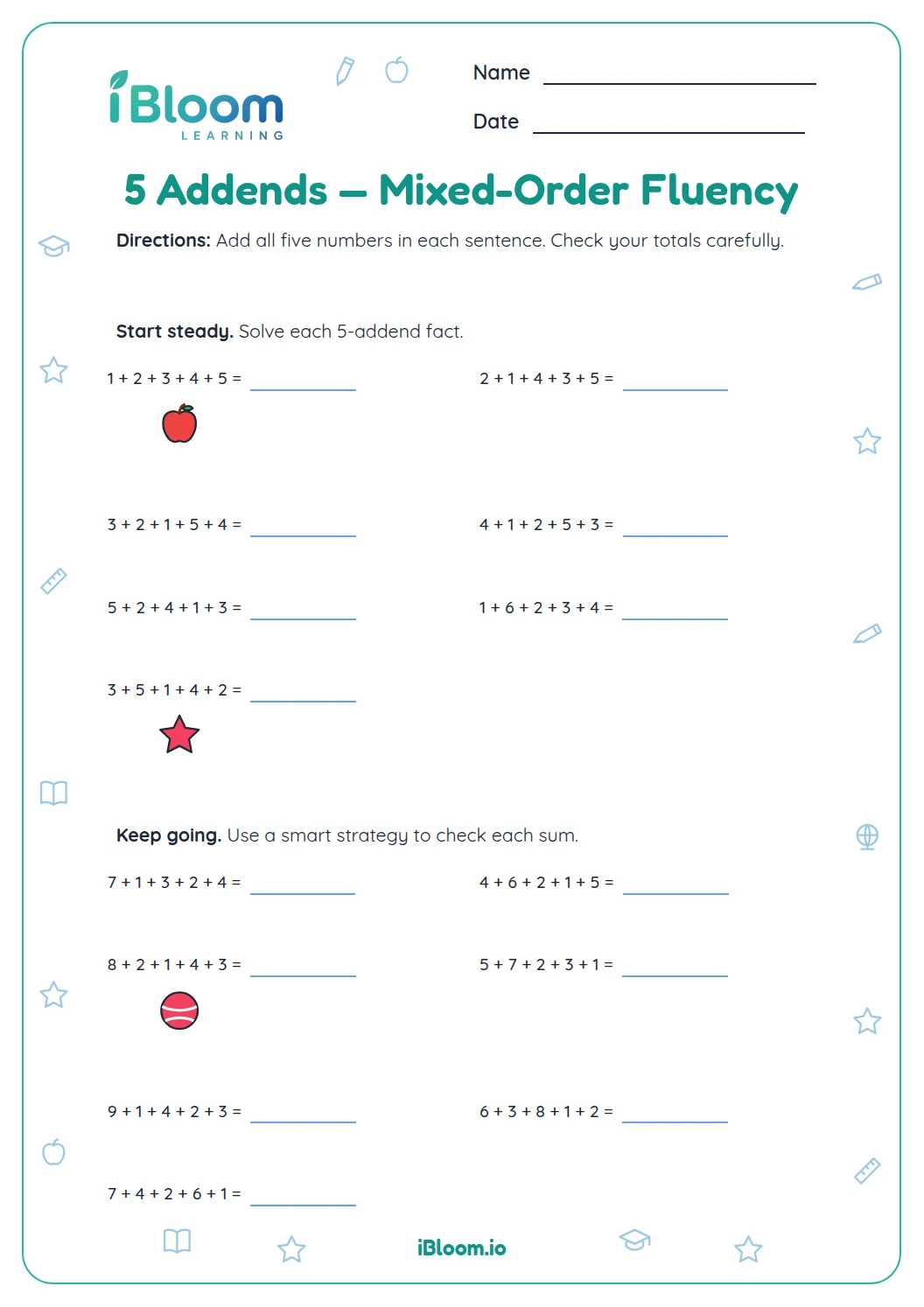
This Grade 1 printable helps children find a missing addend when one addend is 8. Twenty number sentences vary the known addend and the position of the blank; two number bonds connect the total with its parts. A separate key gives the missing number for every fact.
Aligned to 1.OA.D.8
How can a child find the missing addend?
A number sentence is true when its two addends combine to make the total.
- 18 + ___ = 12 12 − 8 = 4 The missing addend is 4.
What will children practice?
The 20 facts use 8 as an addend, with the blank in either position. Two number bonds show how the whole and parts fit together.
- Part A: 10 missing-addend facts
- Part B: 10 more facts using the related subtraction idea
How can an adult support the practice?
Invite the learner to count on from 8 or subtract the known addend from the total. Ask them to put the answer back into the equation to check the sum.
How to use this worksheet
- 1Read the total and the addend you know.
- 2Count up from 8 or subtract the known addend.
- 3Write the missing number in the blank.
- 4Add the two parts to check the total.
Common mistakes and quick fixes
The mistake
Subtracting the total from the known addend.
The fix
Start with the total, then subtract the addend you know.
The mistake
Treating the blank as the total.
The fix
The blank is an addend; the total is the number after the equals sign.
The mistake
Counting the starting number as one jump.
The fix
When counting on, count the moves after the starting addend.
Curriculum alignment
This worksheet practices the following standard.
Find an unknown whole number in an addition equation.
On this sheet: Each fact has a missing whole-number addend.
Show the official wordingHide the official wording
Determine the unknown whole number in an addition or subtraction equation relating three whole numbers.
What to practice next
Make more practice
Further reading
Questions parents and teachers ask
What does the blank represent?
The blank stands for the addend that makes the equation true. For example, in 8 + ___ = 12, the missing number is 4 because 8 and 4 make 12. The answer key lists the number for each equation. Ask the learner to point to the equation, picture, or situation that supports the answer.
Can children use subtraction to solve these facts?
Yes. Subtract the known addend from the total to find the other addend. For 8 + ___ = 12, calculate 12 − 8. Children can add the result back to 8 to check their work. Ask the learner to point to the equation, picture, or situation that supports the answer.
Why are some blanks before the 8?
Addition facts can place the missing addend on either side of the plus sign. The missing number stays the same because changing the order of two addends does not change their sum. Ask the learner to point to the equation, picture, or situation that supports the answer.
How many facts are included?
There are 20 facts in two parts. Each asks children to find a missing addend in an addition sentence, and two questions also show a number bond that relates the parts to the whole. Ask the learner to point to the equation, picture, or situation that supports the answer.
Is there an answer key?
Yes. A separate answer key gives the missing number for every fact. It can be used after the student completes the sheet, or to check one item at a time while learning the related subtraction strategy. Ask the learner to point to the equation, picture, or situation that supports the answer.