
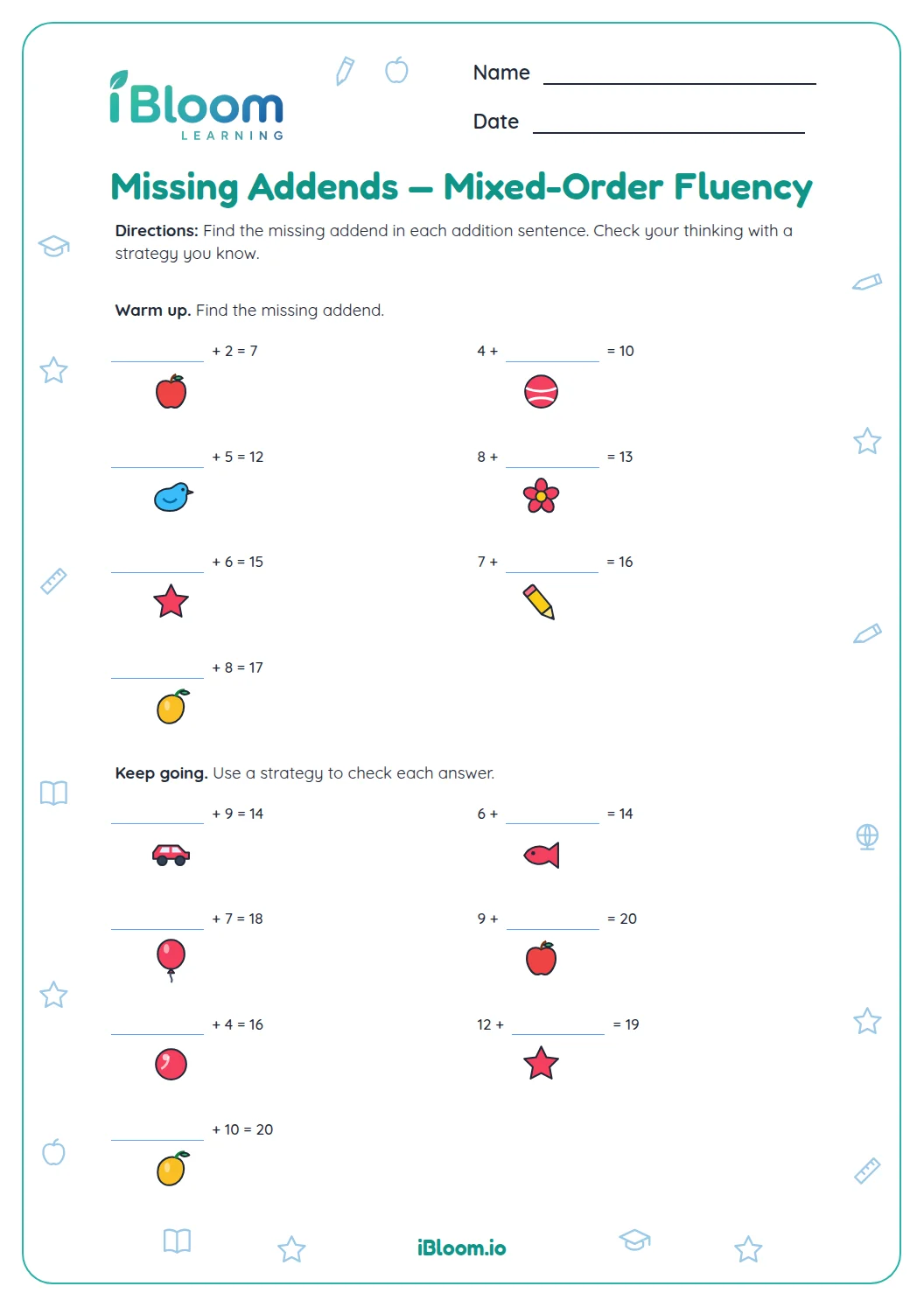
About this worksheet
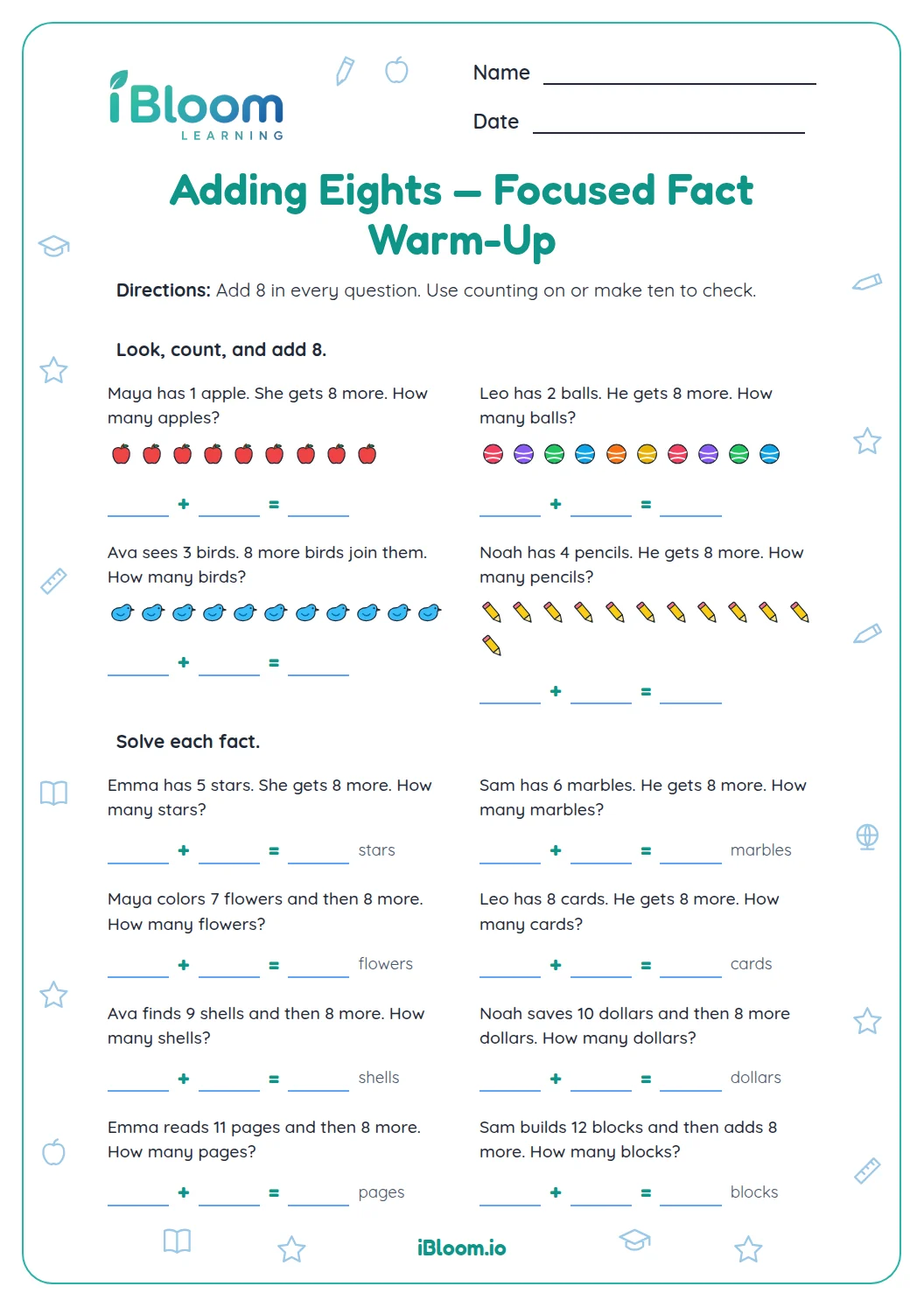
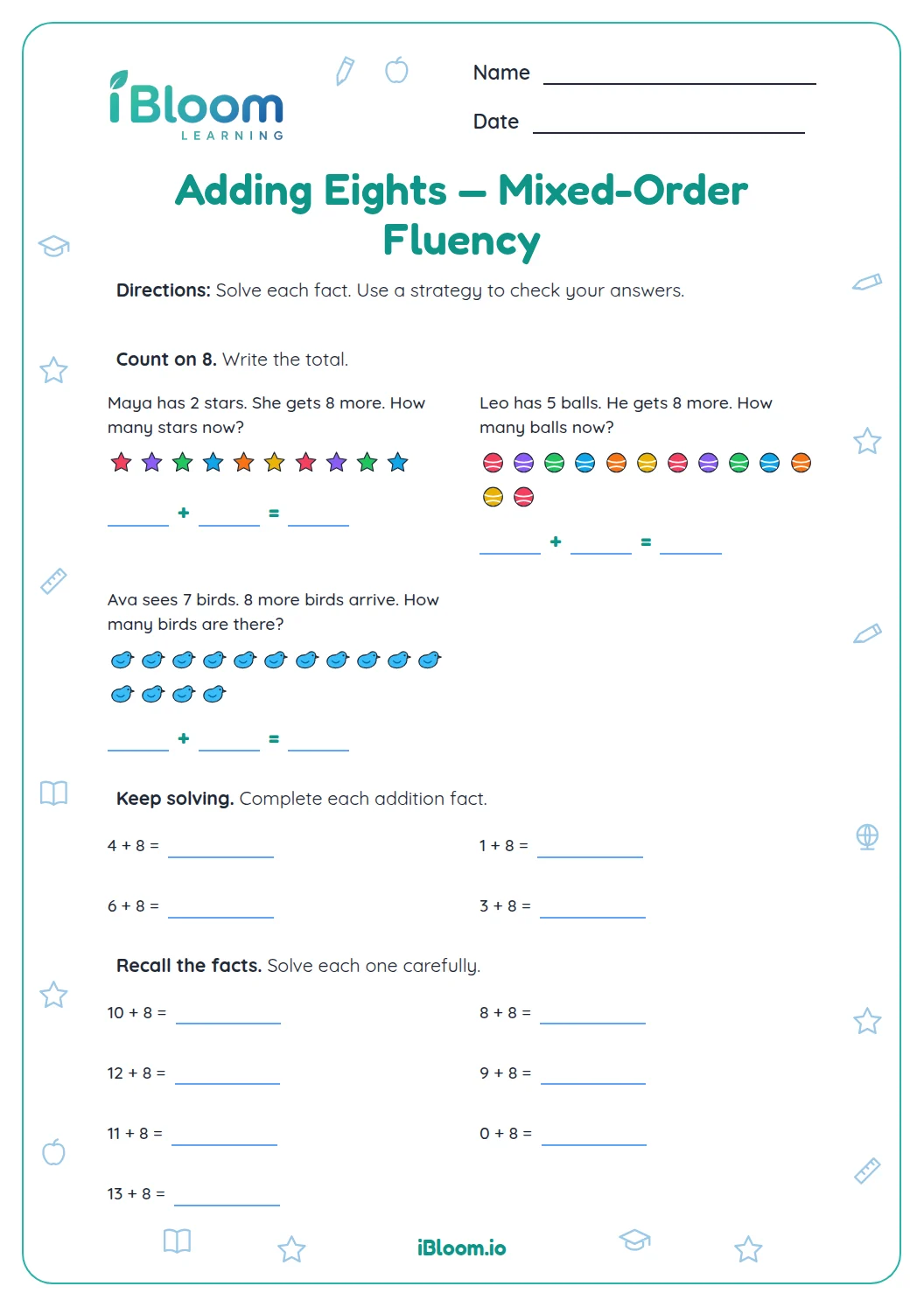
This mastery check for Grades 1–2 gives students 20 focused facts with 8. Part A uses six multiple-choice questions; Part B asks students to write six sums; Part C reverses the equation and asks for eight missing addends. The mix checks whether learners can recall a sum and use the same fact family when the unknown changes position. It aligns with CCSS 2.OA.B.2 and includes a separate answer key.
Aligned to 2.OA.B.2
What does the first part check?
The first six questions give three possible sums. Students can use a known fact or a mental strategy such as making ten, then select the result.
- 11) 8 + 0 = ? → 8
- 2Adding zero leaves 8 unchanged.
How can a student solve a sum without choices?
Write the number that is 8 more than the second addend. For 8 + 5, think 8 + 2 = 10, then add 3 more to make 13.
- 111) 8 + 9 = ___ → 17
How do missing-addend facts connect?
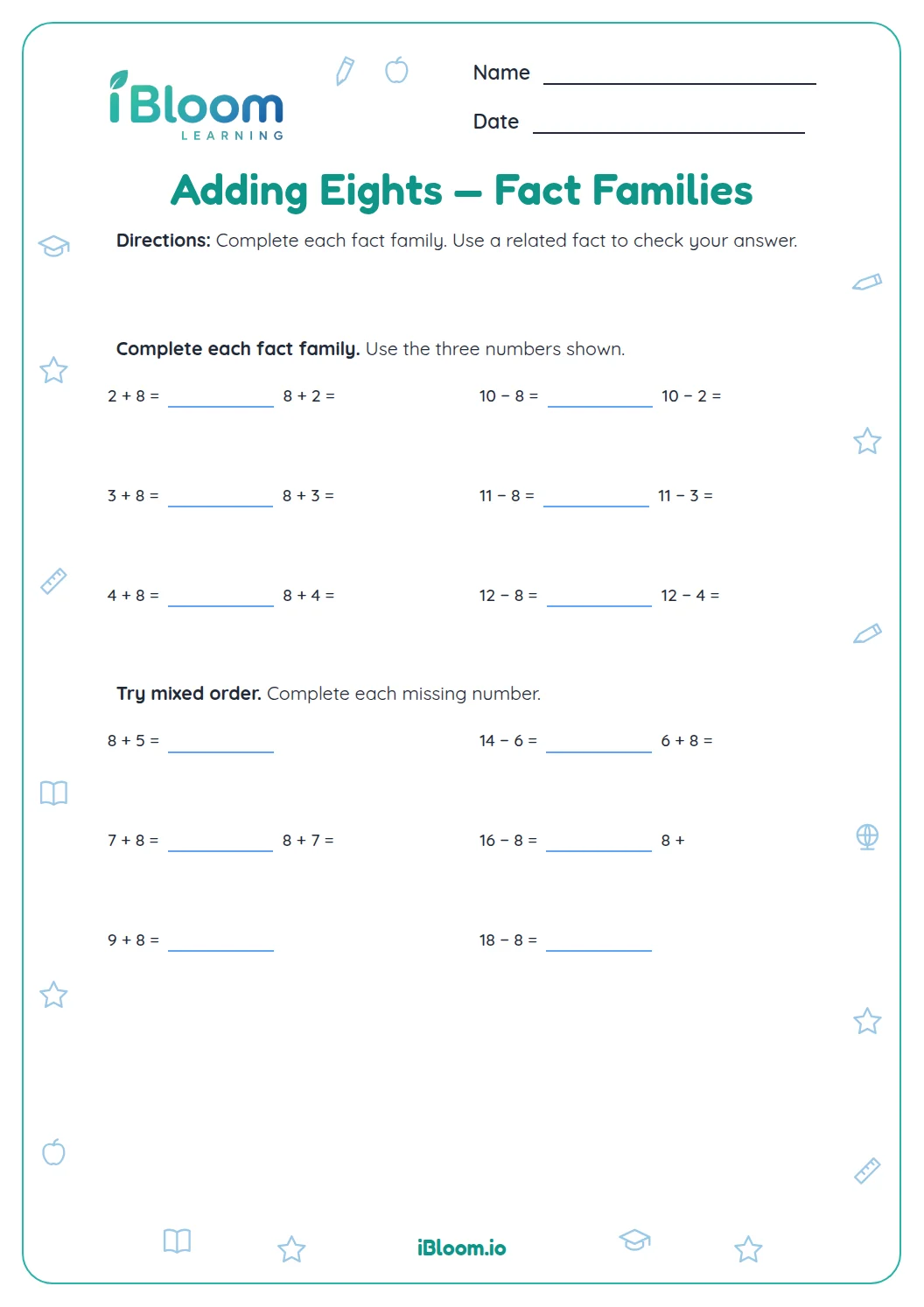
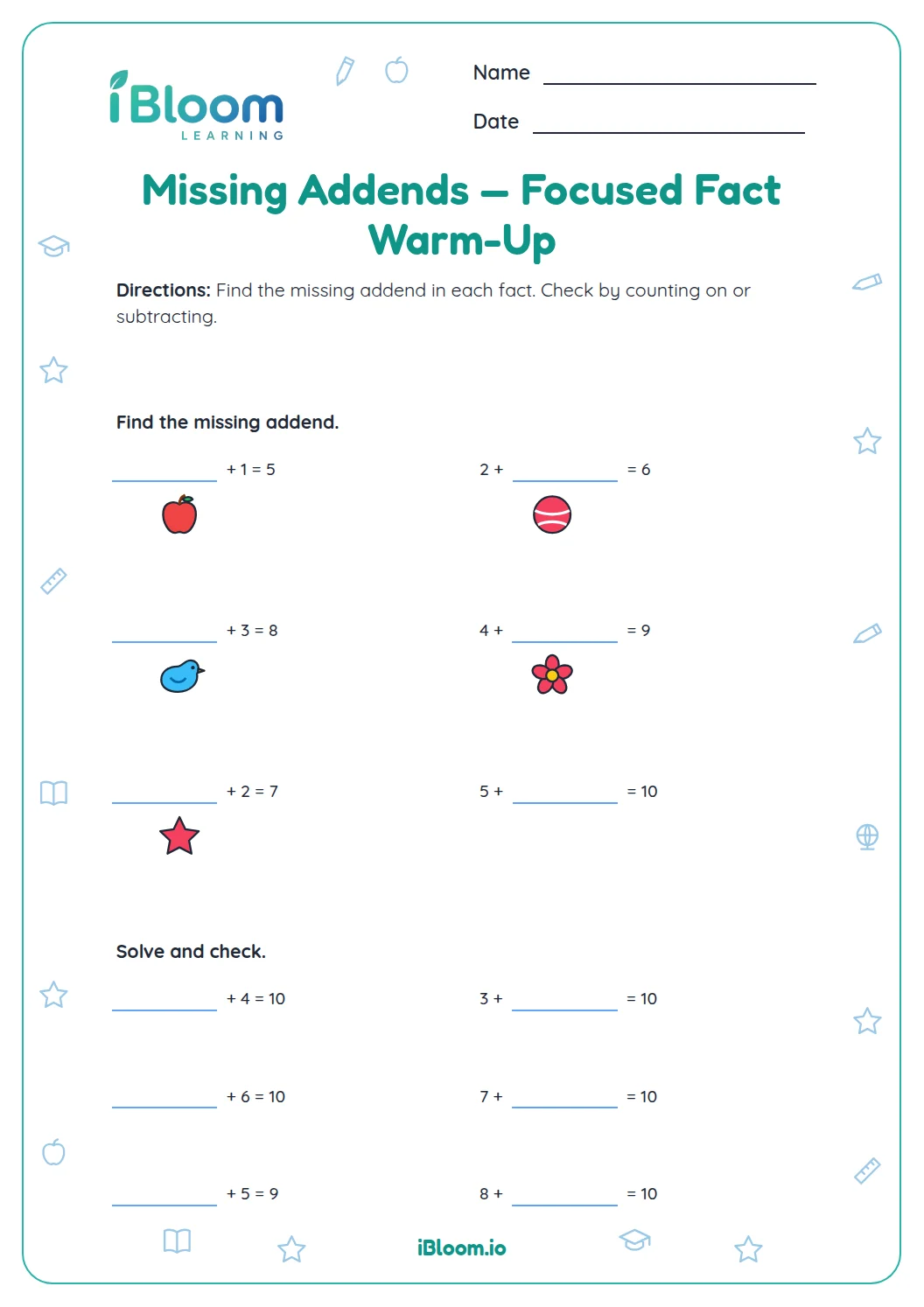
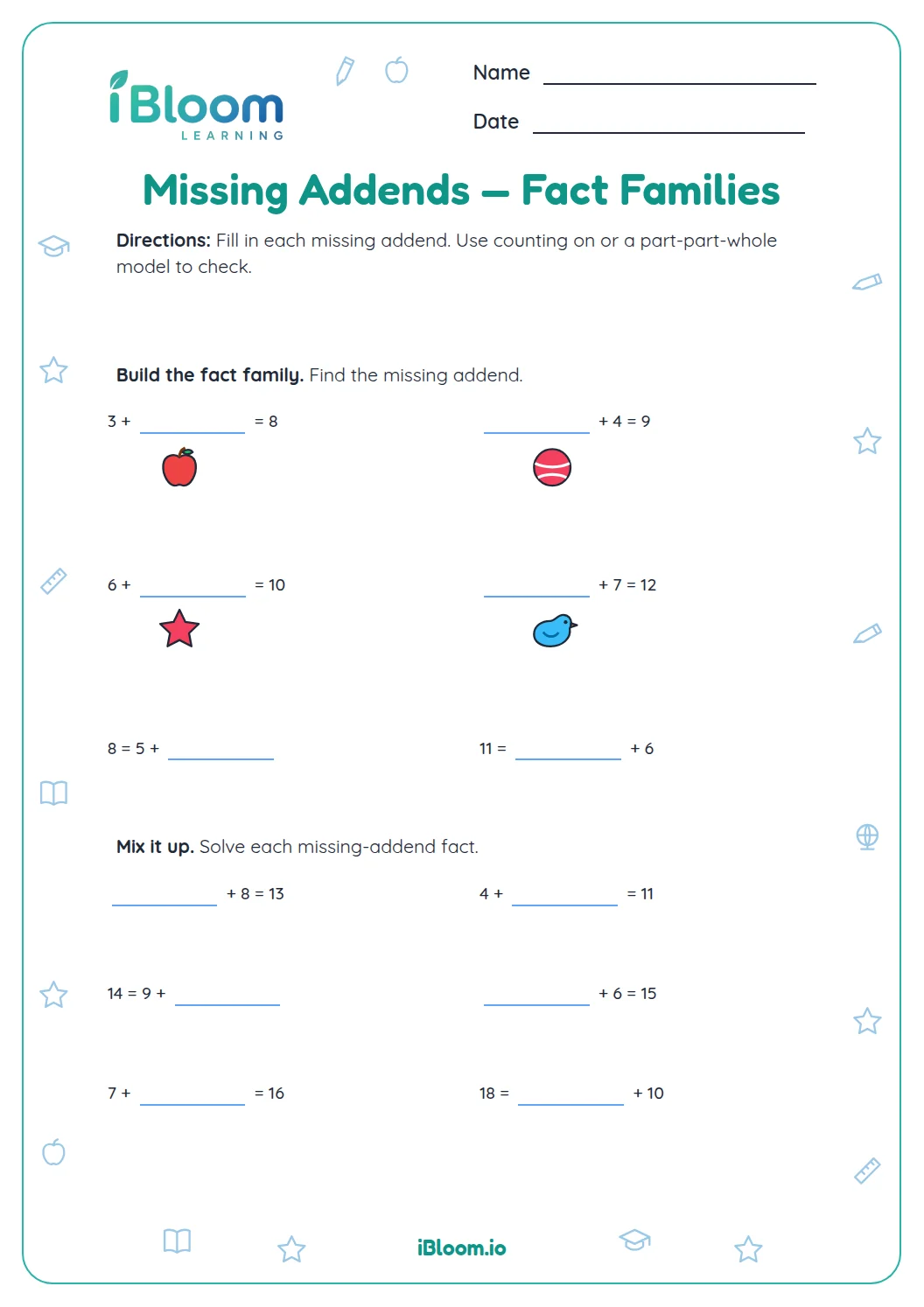
Addition can be reversed to find an unknown addend. If 8 and 7 make 15, then ___ + 8 = 15 has the missing addend 7.
- 113) ___ + 8 = 12 → 4 because 4 + 8 = 12.
How to use this worksheet
- 1Let the student solve the multiple-choice facts without a timer first.
- 2For each written sum, say the two addends aloud before answering.
- 3For a missing addend, ask which number joins 8 to make the total.
- 4Check every fact in the answer key and revisit any incorrect pair with counters or a number line.
Common mistakes and quick fixes
The mistake
Adding 8 and the second addend but writing one number too many.
The fix
Count on carefully or make ten, then add only the remaining amount.
The mistake
Writing the total as the missing addend in ___ + 8 = 12.
The fix
Ask what number plus 8 equals 12; check by adding the proposed addend and 8.
The mistake
Reversing digits in a teen sum, such as writing 71 for 8 + 9.
The fix
Say the sum as “seventeen” and write 1 in the tens place and 7 in the ones place.
Common Core alignment
These standards describe the grammar, reading, writing, or math skills practiced on this page.
Fluently add and subtract within 20 using mental strategies.
On this sheet: Students solve one-digit addition facts with 8 and recall sums within 20.
Show the official wordingHide the official wording
Fluently add and subtract within 20 using mental strategies. By end of Grade 2, know from memory all sums of two one-digit numbers.
What to practice next
Make more practice
Further reading
Questions parents and teachers ask
What facts does this adding-eights worksheet include?
The sheet practices 8 + 0 through 8 + 11, then eight equations with a missing addend. Students choose six sums, write six sums, and solve eight unknown-addend problems. The key shows each total or missing number. The sums range from 8 to 19.
How many questions are on the mastery check?
There are 20 questions across three parts. Six ask students to choose a sum, six ask them to write a sum, and eight ask them to find the missing addend. The answer key gives the correct value for every fact.
Should I time the worksheet?
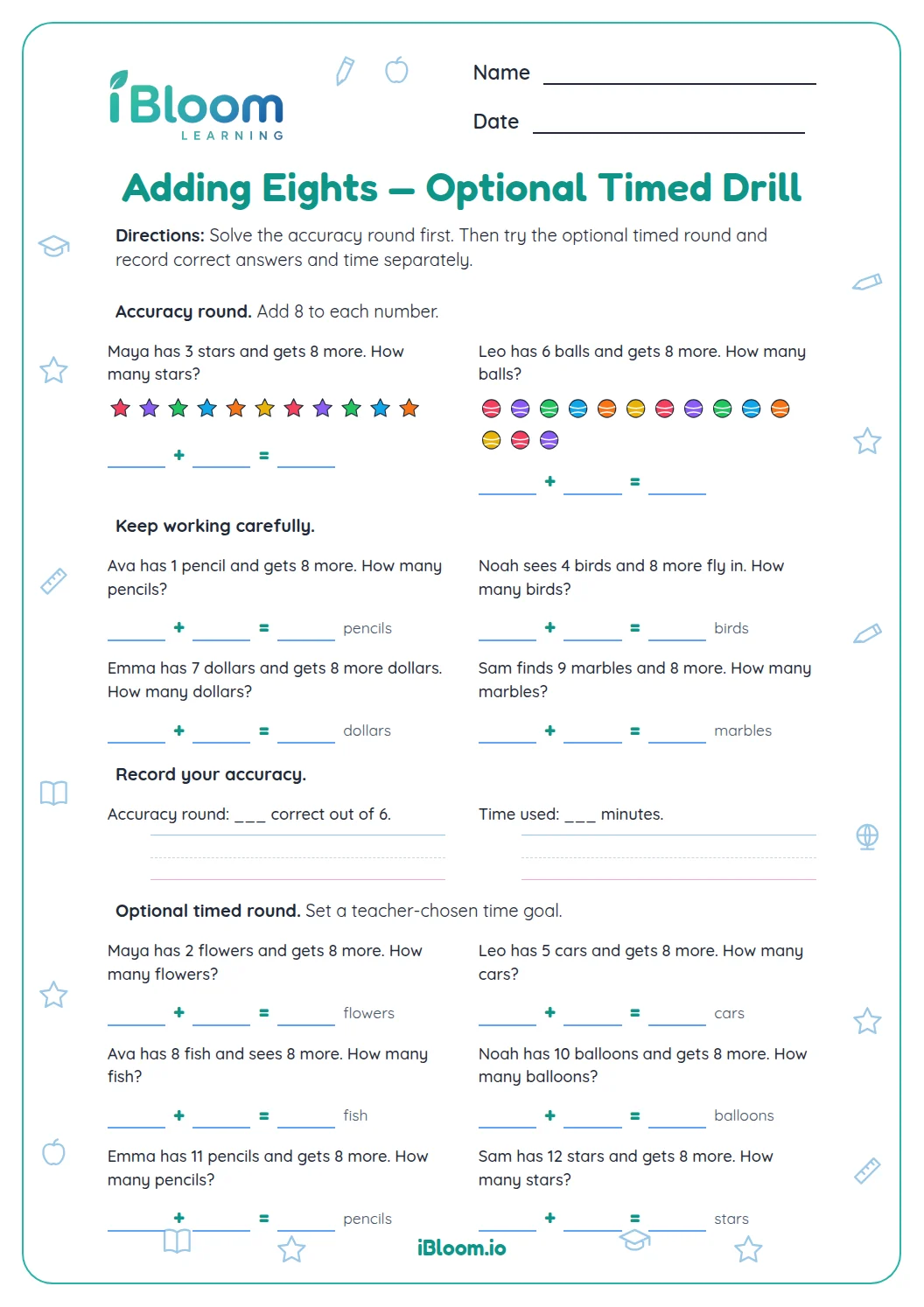
Start without a timer so you can see whether the facts are accurate. If the student already solves them comfortably, an optional short timing round can track personal progress. Accuracy and understanding come first; the page includes a mix of familiar facts and unknown-addend equations.
What is a useful strategy for 8 + 5?
Make ten by splitting 5 into 2 and 3. Add 2 to 8 to make 10, then add 3 to make 13. Question 6 asks for 8 + 5, so students can use this strategy or recall the sum.
How do missing-addend questions help?
They ask students to use a known sum in a different arrangement. In ___ + 8 = 12, think of 8 + 4 = 12, then check that 4 + 8 equals 12. This sheet includes eight equations with the missing number before the plus sign.
What should a student practice next?
Try adding sevens or adding nines to work with neighboring fact families. The linked Missing Addends worksheet offers more practice deciding which number belongs in an incomplete addition equation. Students can use the same strategy of checking the completed fact.