

About this worksheet
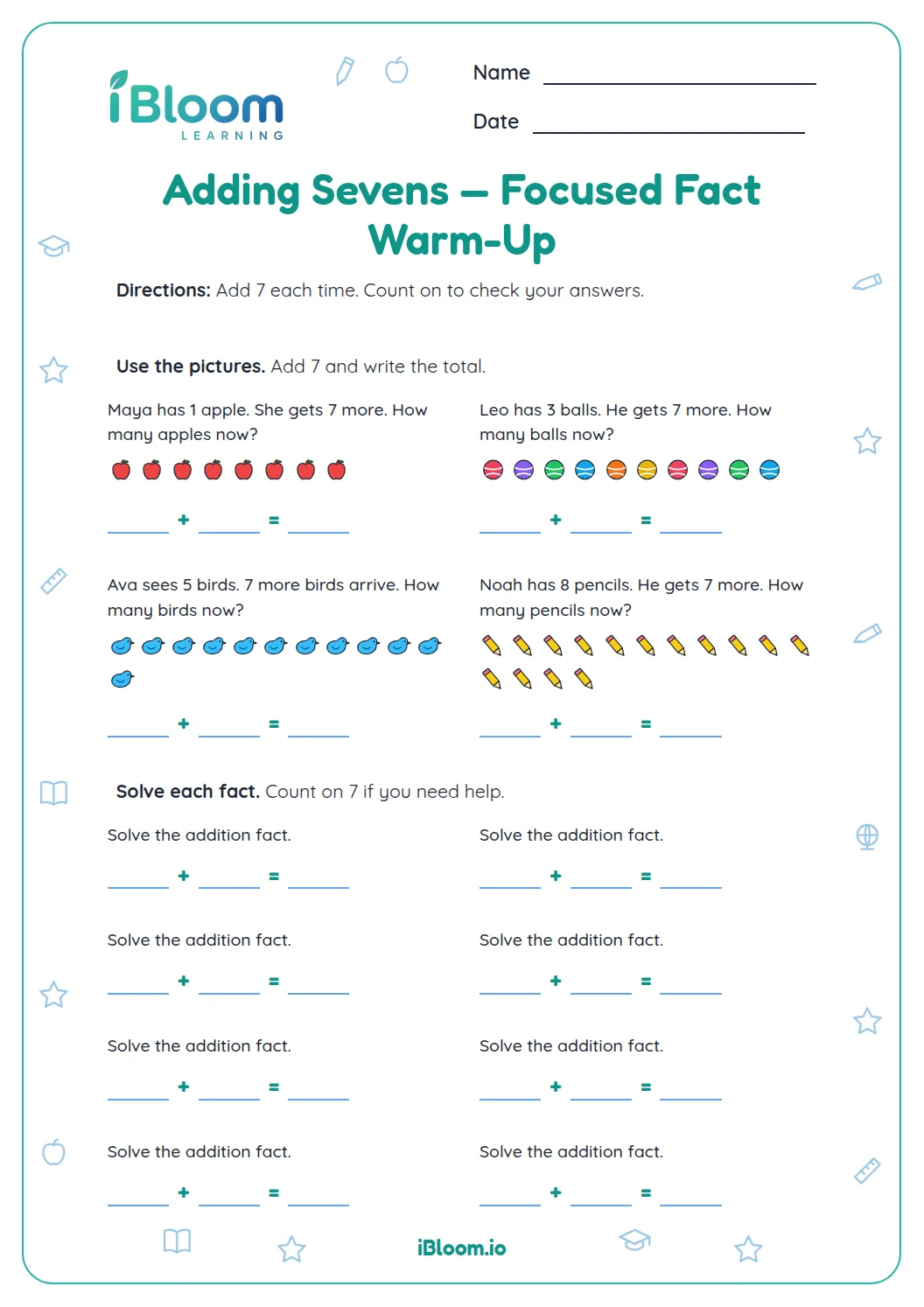
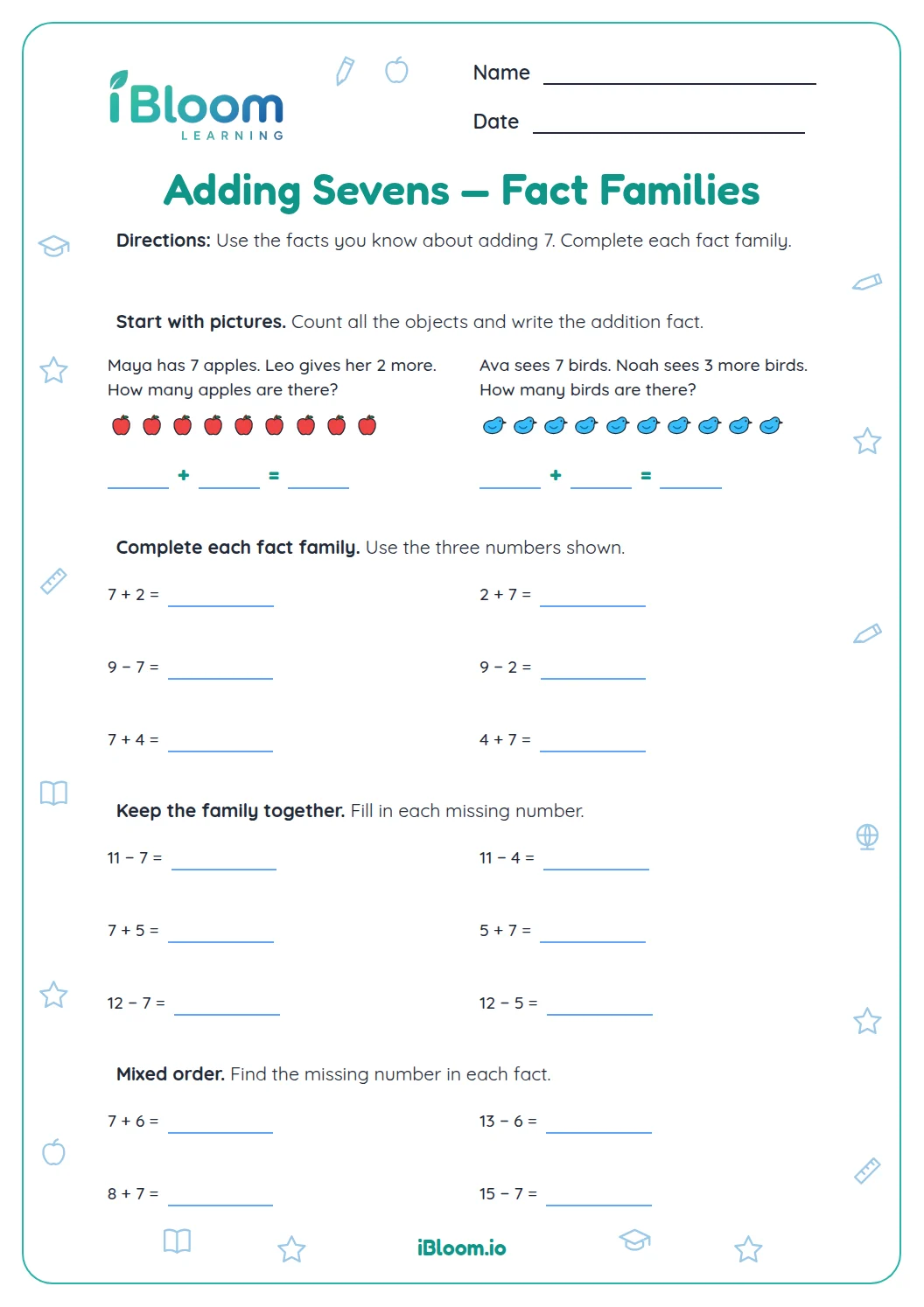
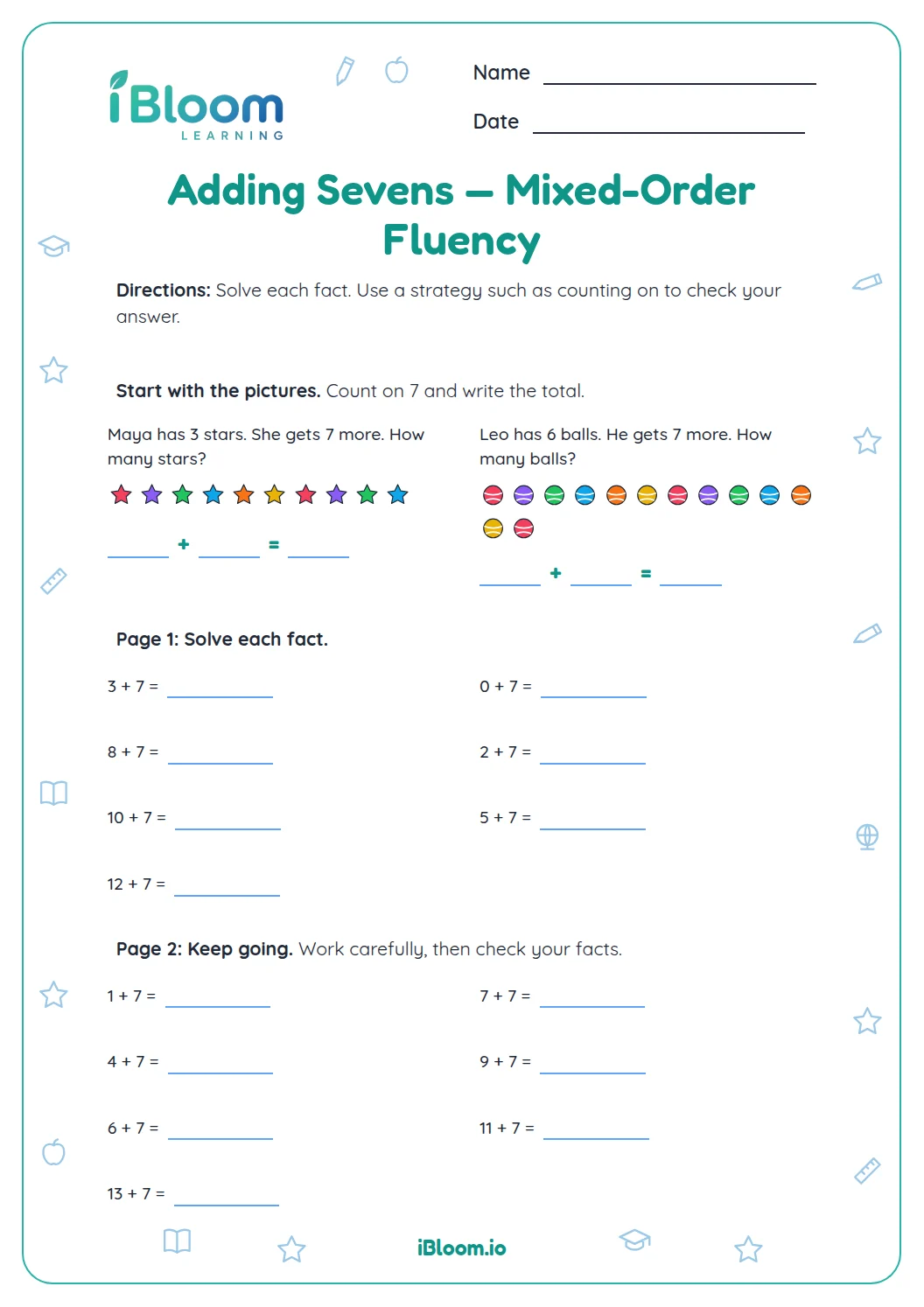
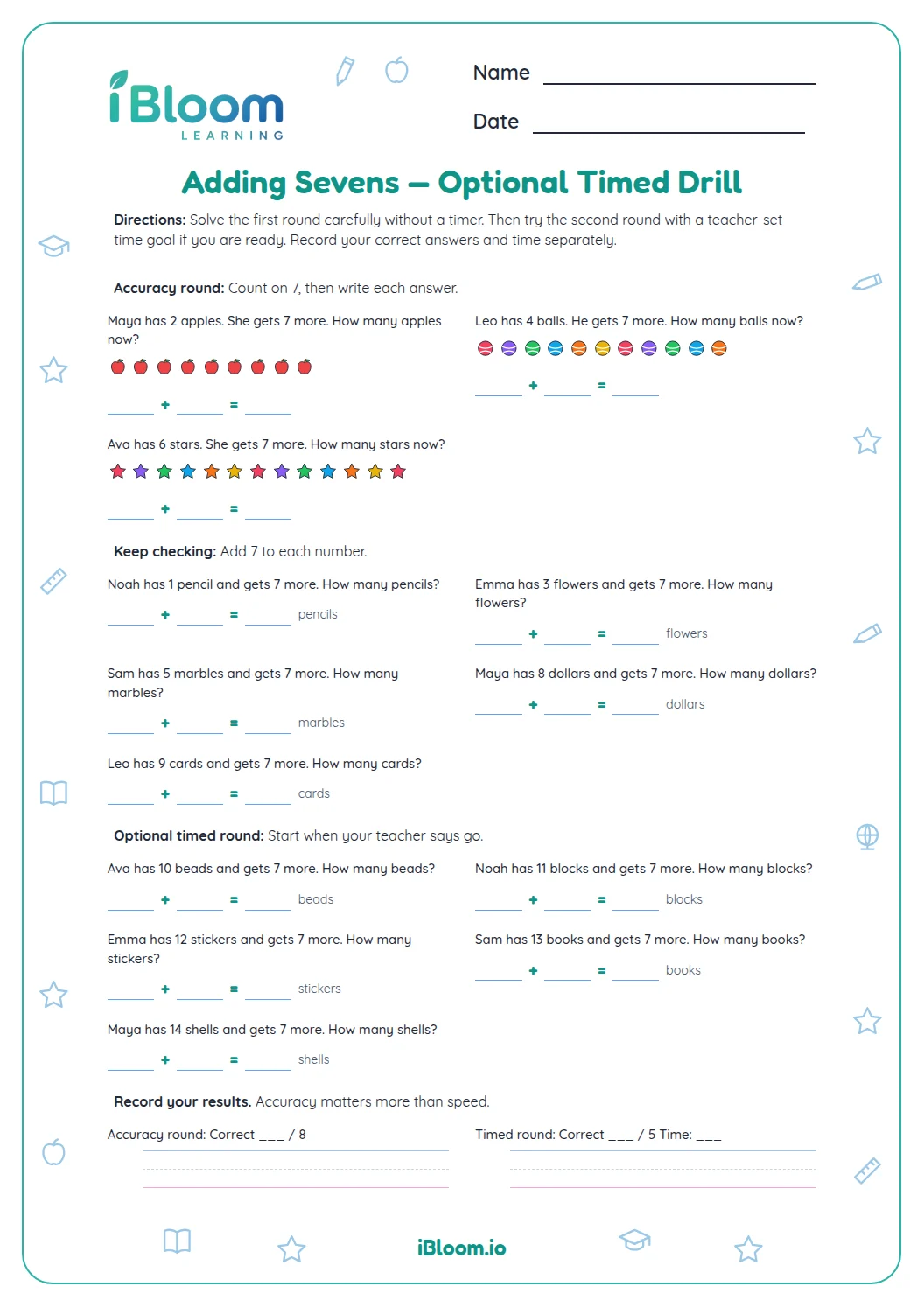
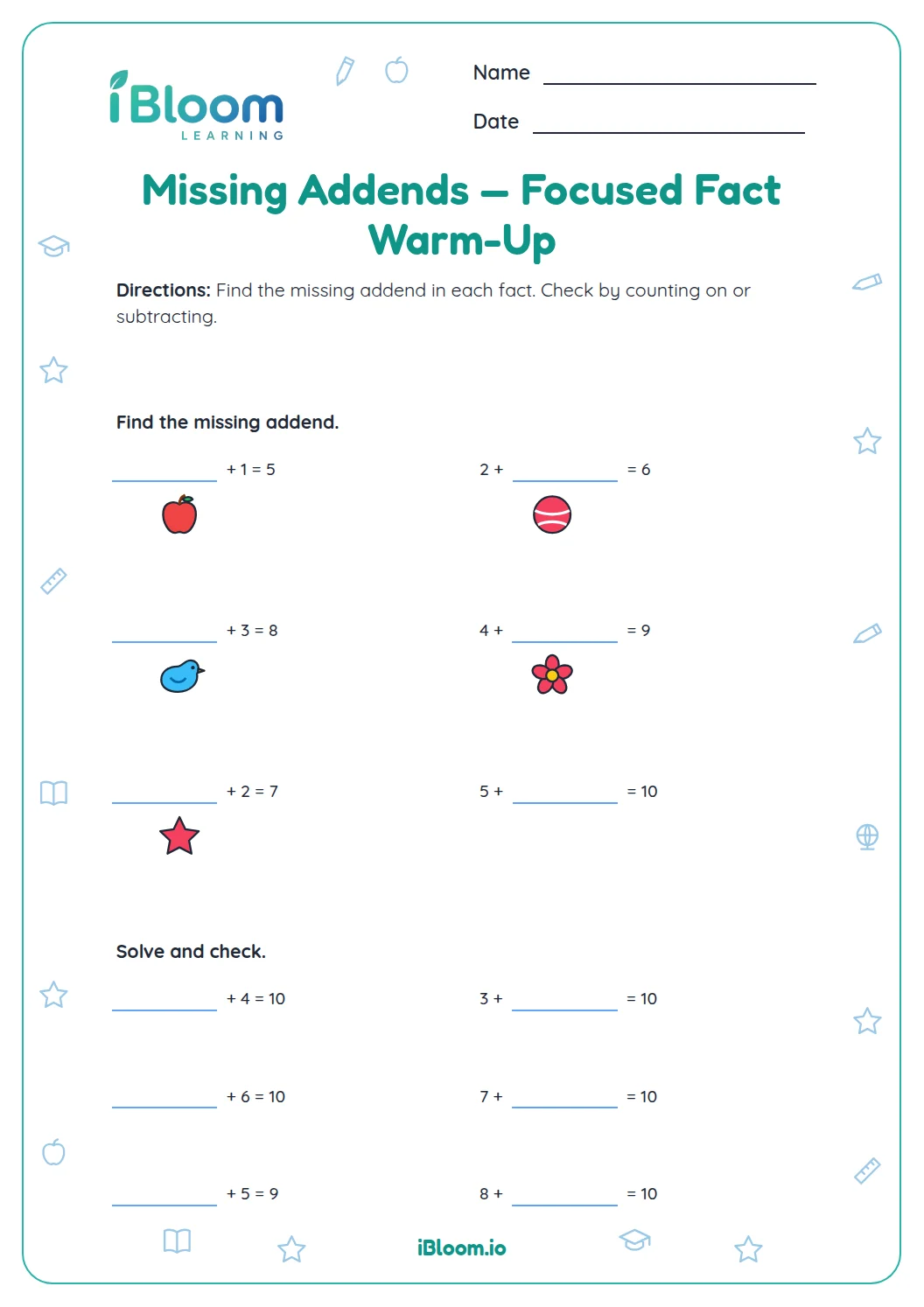
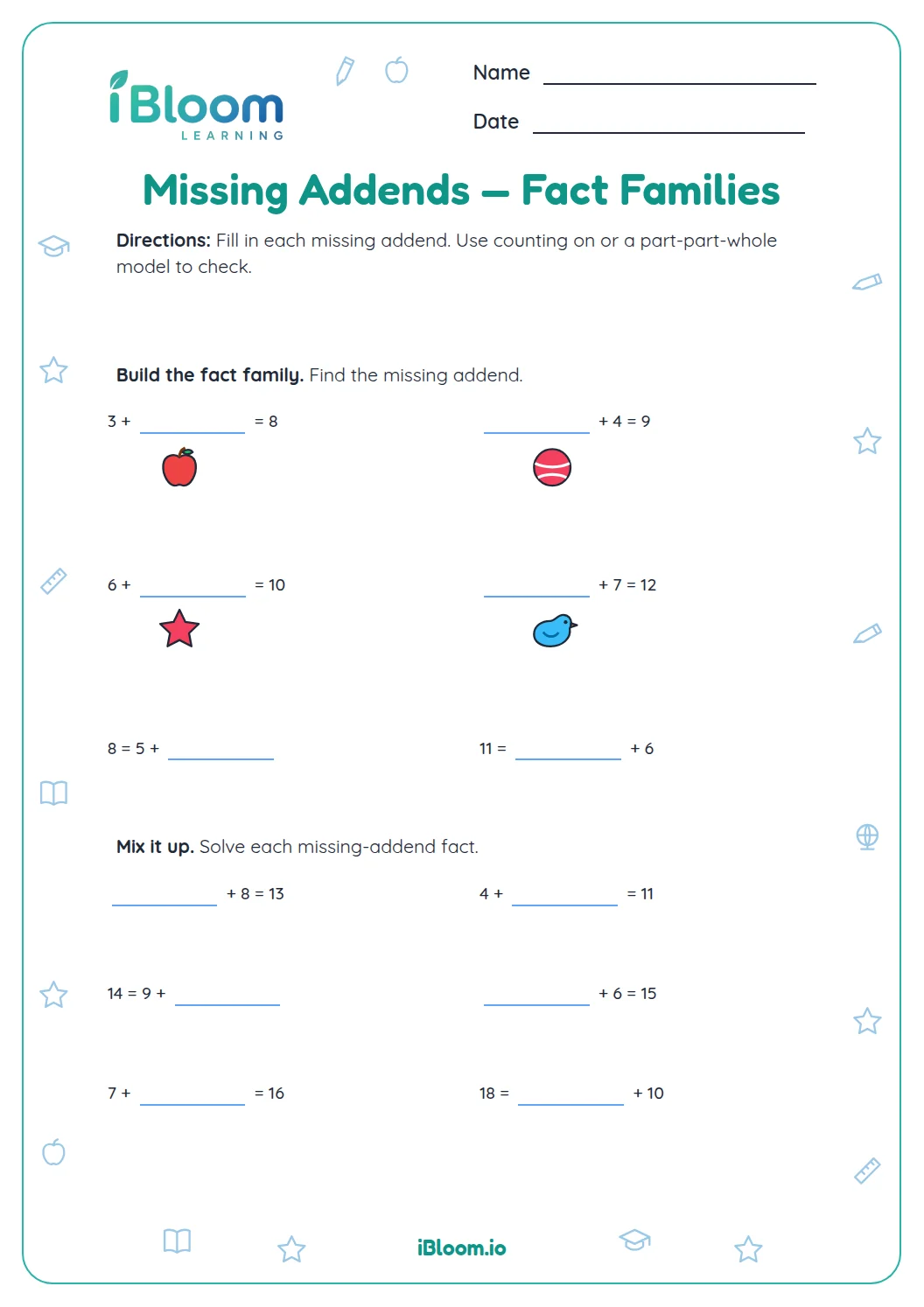
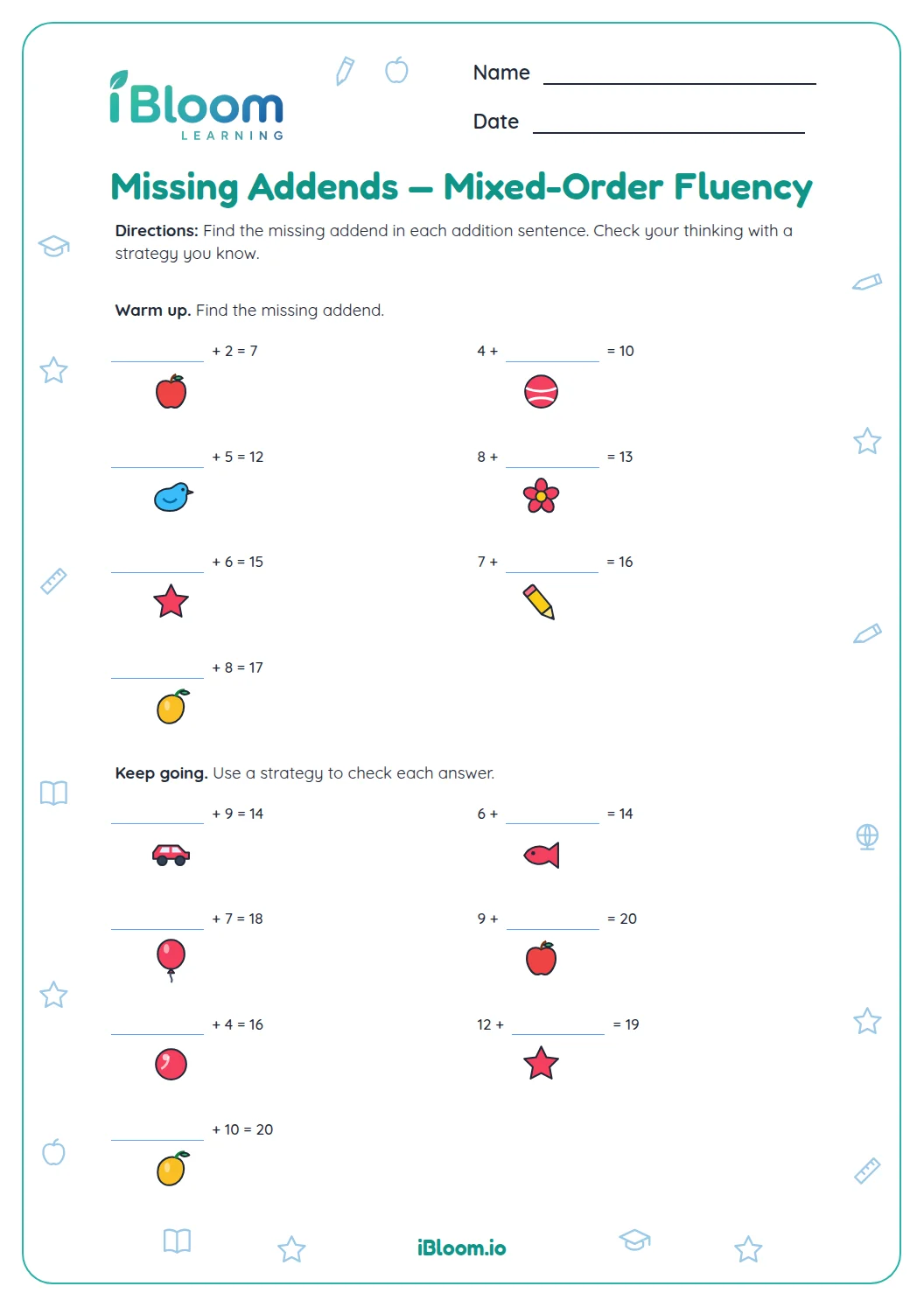
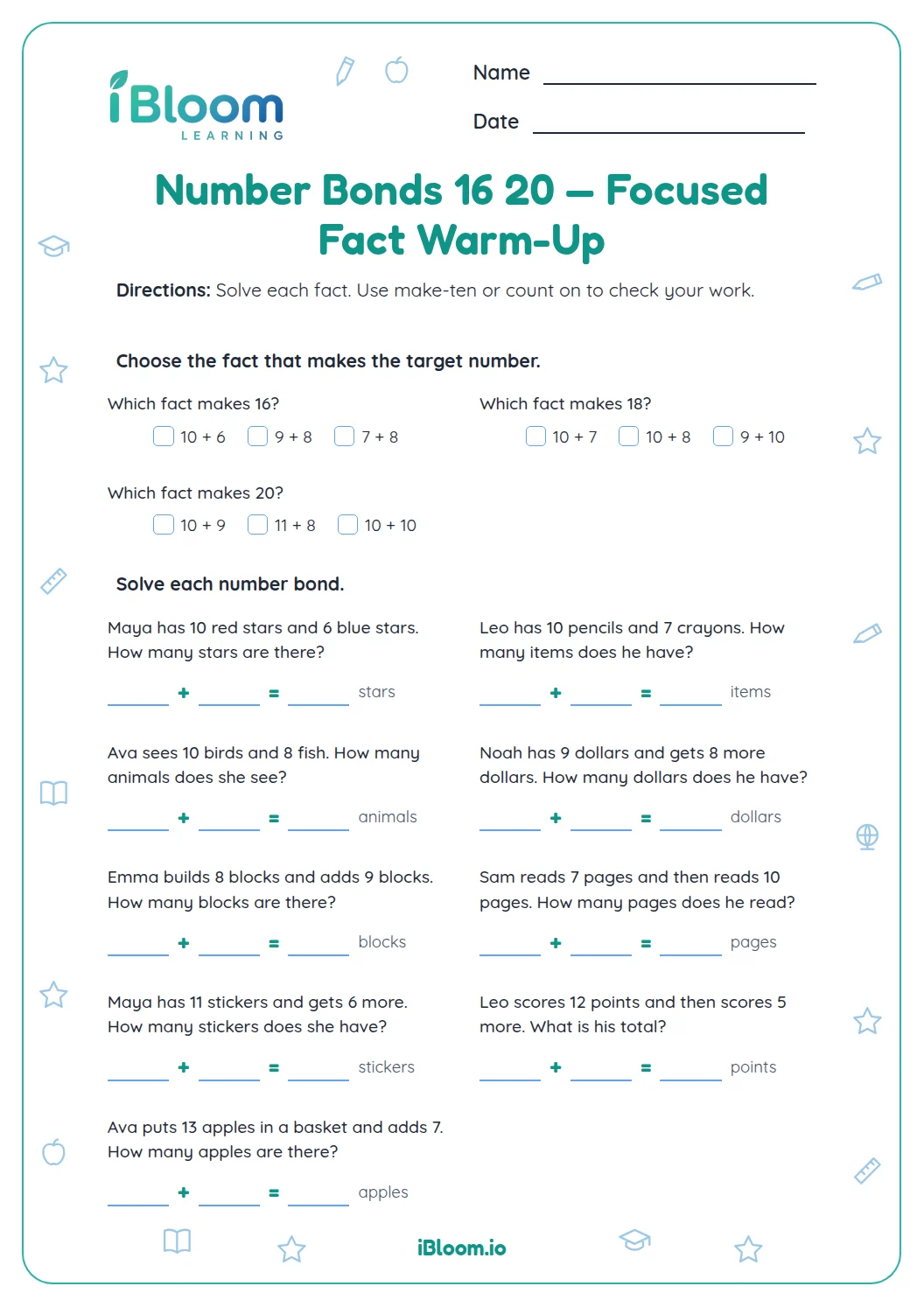
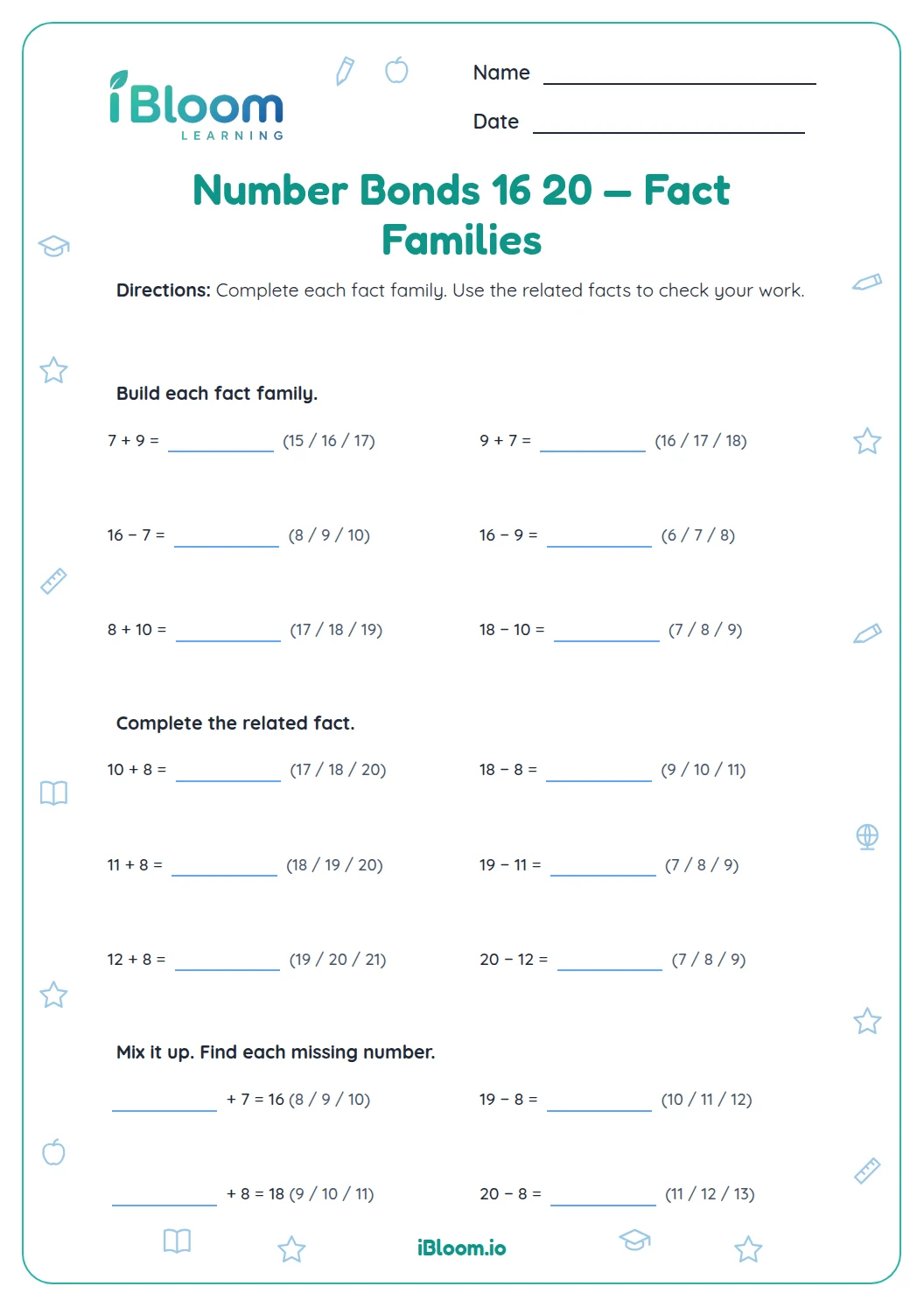
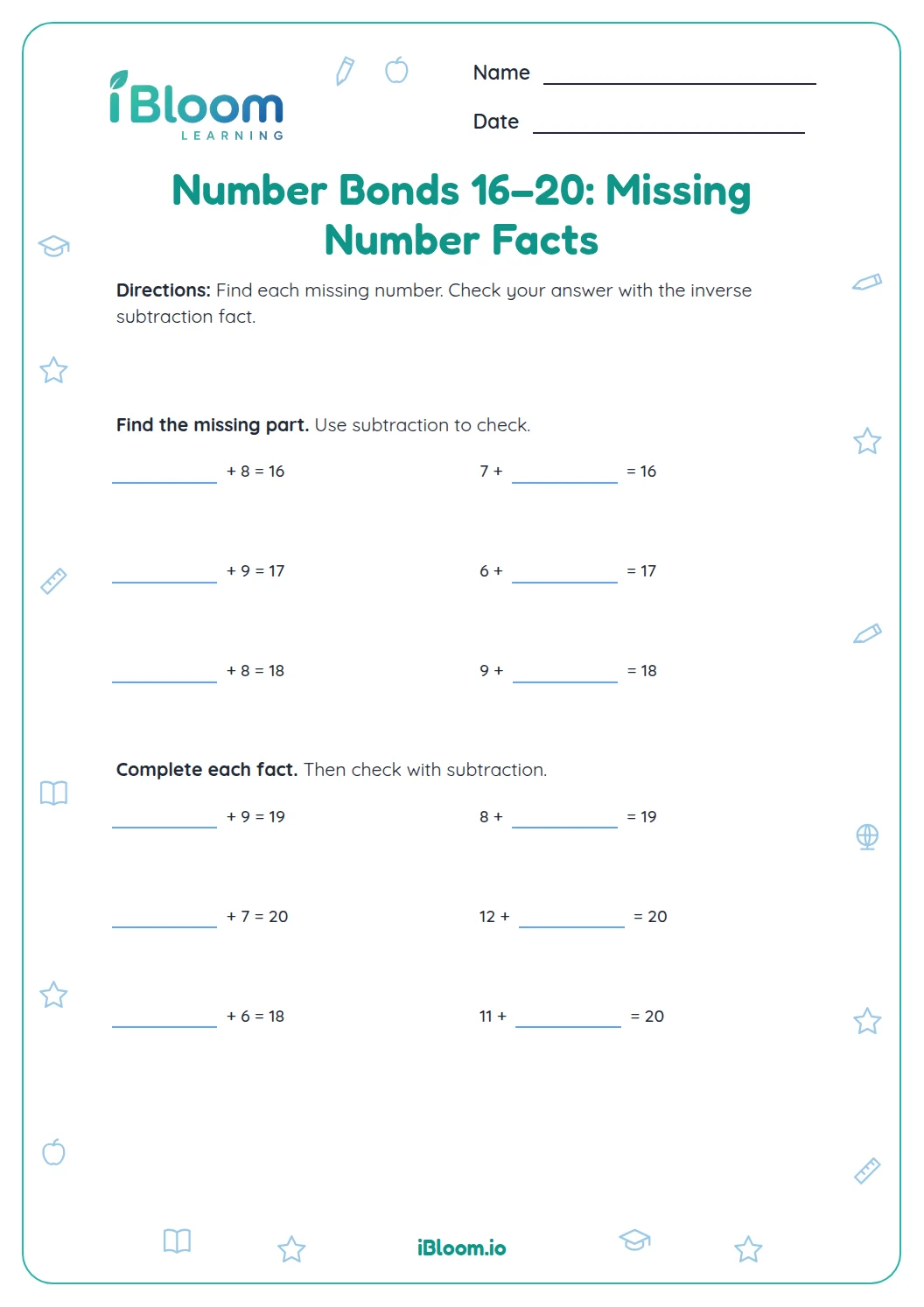
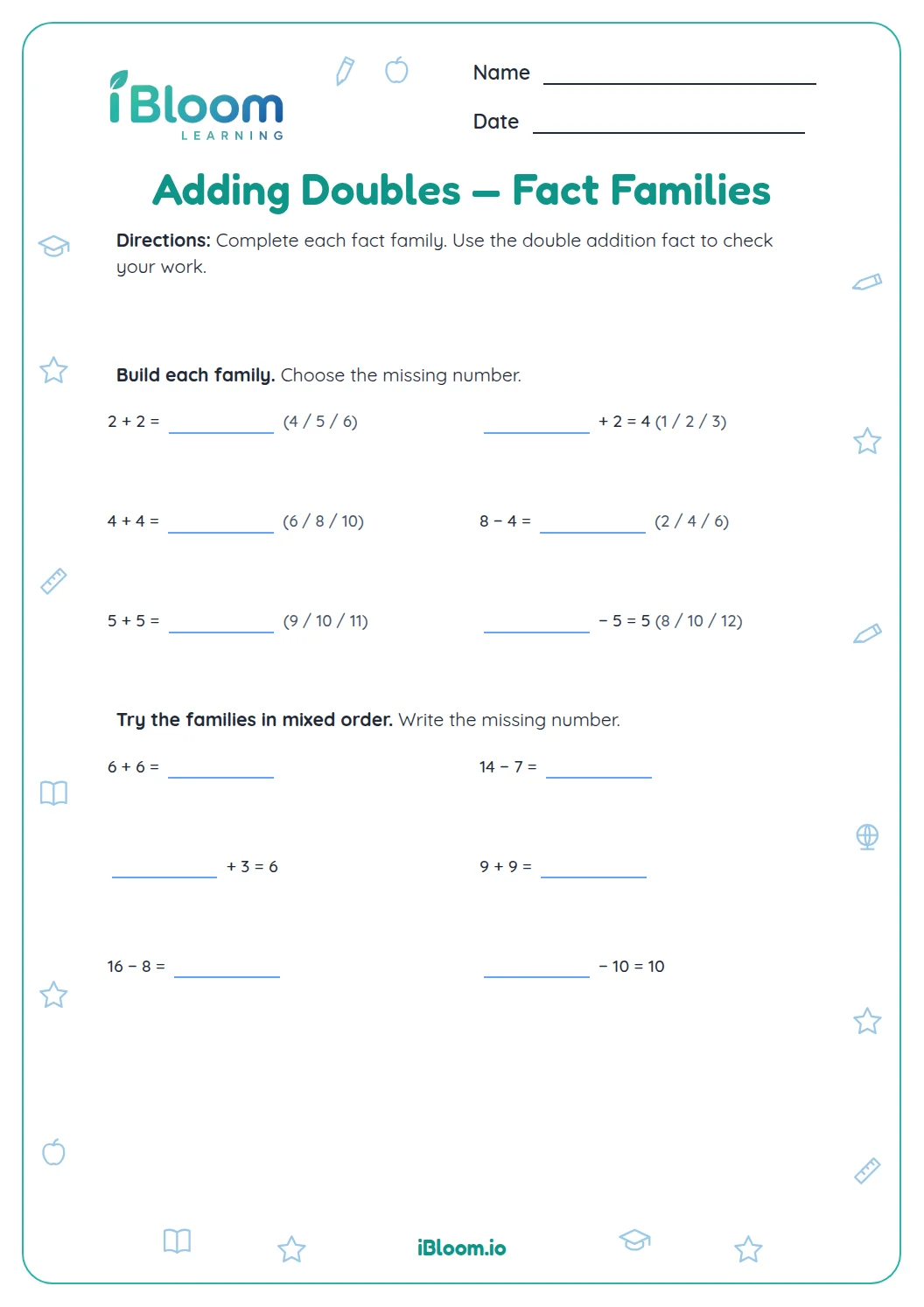
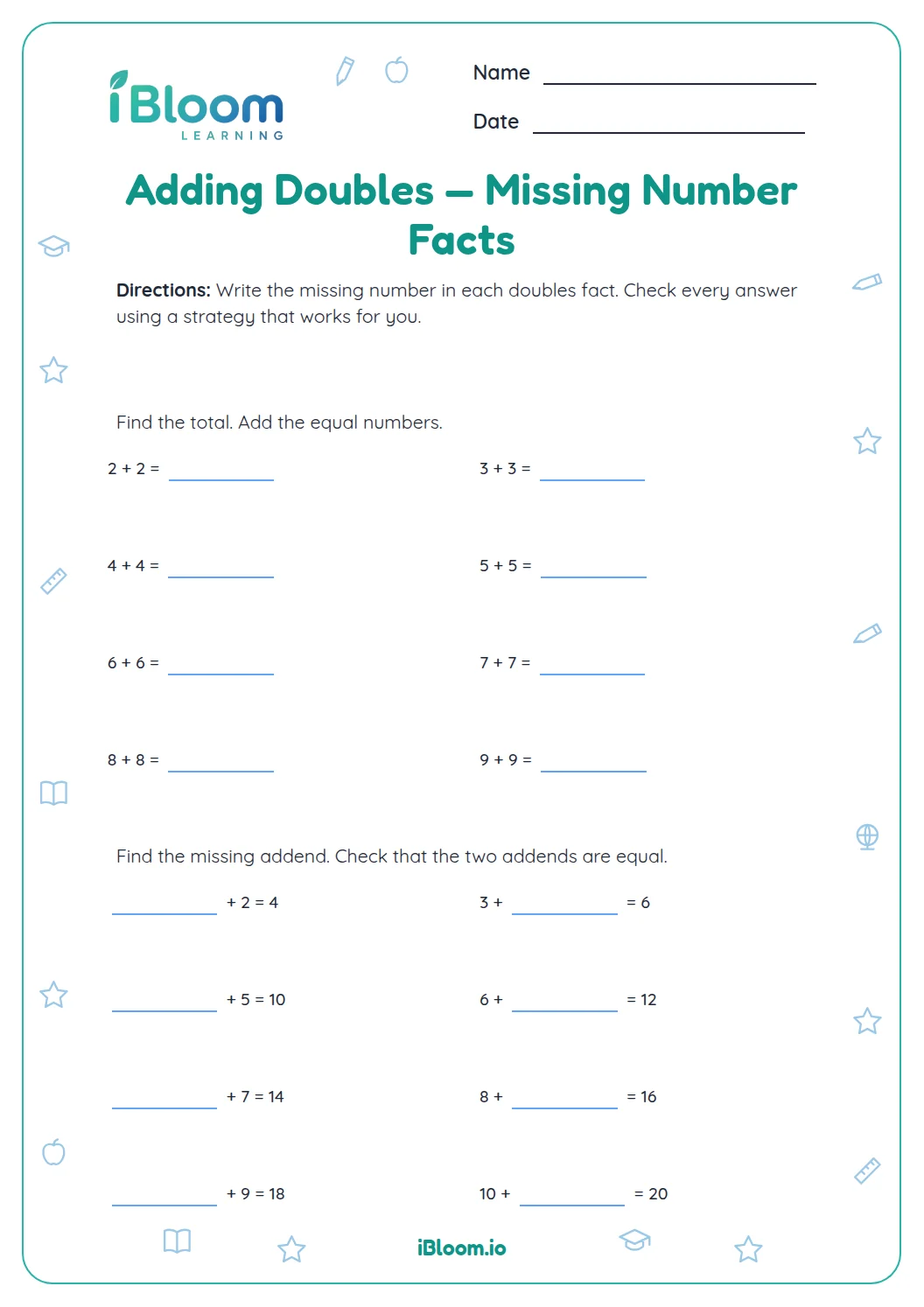
This worksheet practices missing addends in equations that use 7. Learners solve facts with the blank on either side of 7, then use number-bond models to check the whole and its parts. It includes 20 questions and a separate answer key.
Aligned to 1.OA.D.8
How do you find a missing addend?
An addition equation names a whole and one addend. To find the other addend, ask what amount joins the known addend to make the whole. For 7 + ___ = 15, count on from 7 or subtract 7 from 15.
What if the blank comes first?
Addition can be written in either order: ___ + 7 = 18 still asks which number combines with 7 to make 18. The unknown changes position, but the relationship stays the same.
What does this drill include?
Part A practices blanks after and before 7 in a steady sequence. Part B varies the positions and target sums. The key lists each missing addend.
Check each fact
- 1Read the whole number after the equals sign.
- 2Think of the number that joins 7 to make that whole.
- 3Write the missing addend.
- 4Add it back to 7 to check the equation.
Common mix-ups
The mistake
Copying the whole as the missing addend.
The fix
Check by adding the two addends; their sum must equal the whole.
The mistake
Subtracting the blank from 7 when the blank comes first.
The fix
The order can switch, but find the difference between the whole and 7.
Curriculum alignment
The drill builds fluency with addition and unknowns in equations.
Find the unknown whole number in addition and subtraction equations.
On this sheet: Each equation asks learners to find an unknown addend that makes the equation true.
Show the official wordingHide the official wording
Determine the unknown whole number in an addition or subtraction equation relating three whole numbers. For example, determine the unknown number that makes the equation true in each of the equations 8 + ? = 11, 5 = _ − 3, 6 + 6 = _.
What to practice next
Make more practice
Questions parents and teachers ask
What is a missing addend?
A missing addend is the unknown number being added. In 7 + ___ = 15, ask what number joins 7 to make 15. The answer is 8, and adding 7 + 8 confirms the total. The total and the known addend together determine one missing number.
Can the blank come before 7?
Yes. The worksheet includes equations such as ___ + 7 = 18. Addition can be written in either order, so find the number that combines with 7 to make the total. Read the complete equation before solving. The answer key lists the value that completes each equation.
How can I check a missing addend?
Add the known addend and your answer. If the sum matches the number after the equals sign, the equation is correct. For example, if the blank in ___ + 7 = 18 is 11, check 11 + 7 = 18.
Are number bonds included?
Yes. The final four questions pair an equation with a number bond. The total is the whole, 7 is one part, and the blank is the other part. Use the model to see how the addends combine. The last four items provide this visual check alongside the equation.
How many questions are included?
There are 20 questions in three parts. The first two parts use equations with the unknown in different positions, and the last part adds number-bond models. The separate answer key lists each missing addend. It is organized from direct equations to a visual check with number bonds.