

About this worksheet
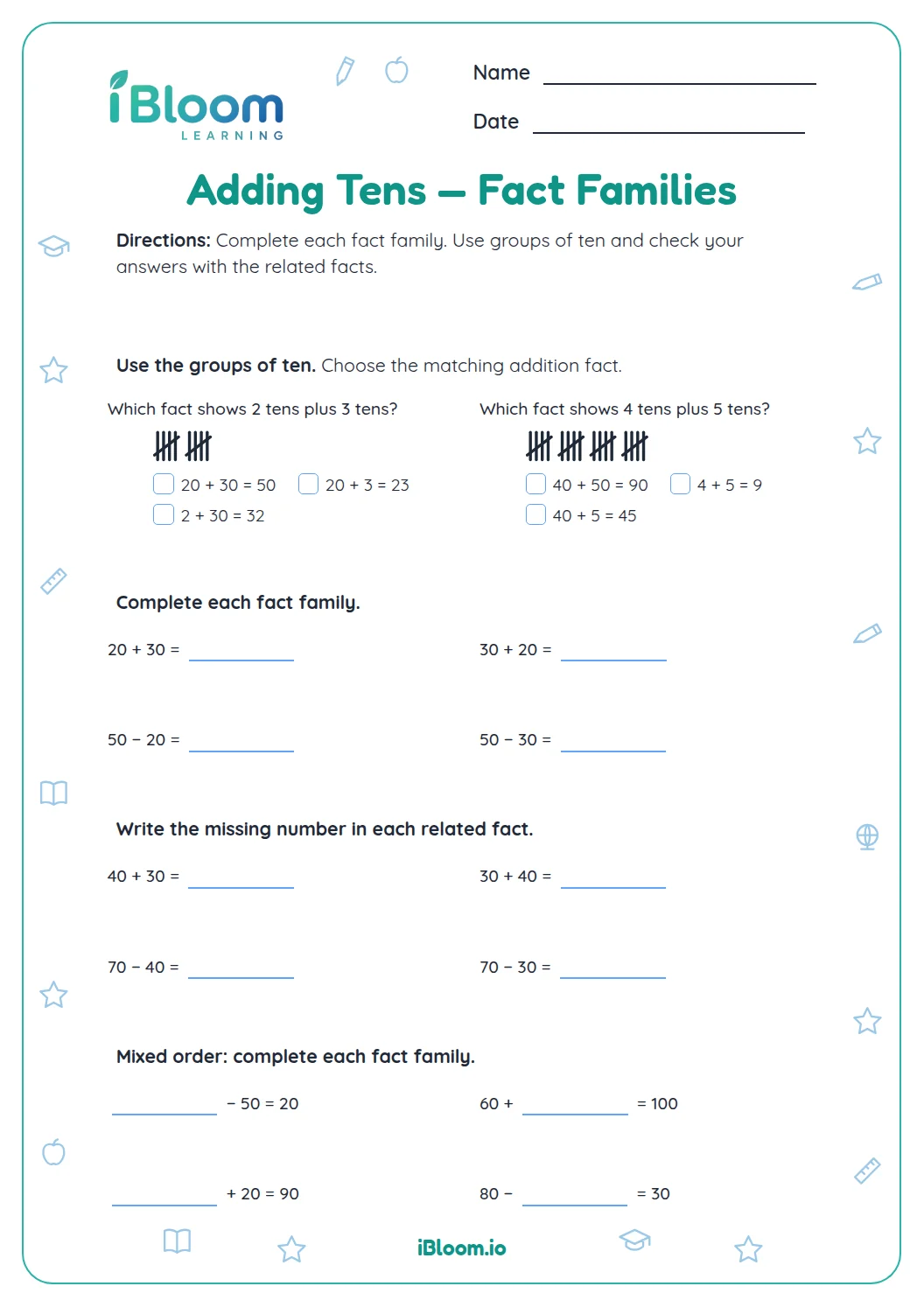
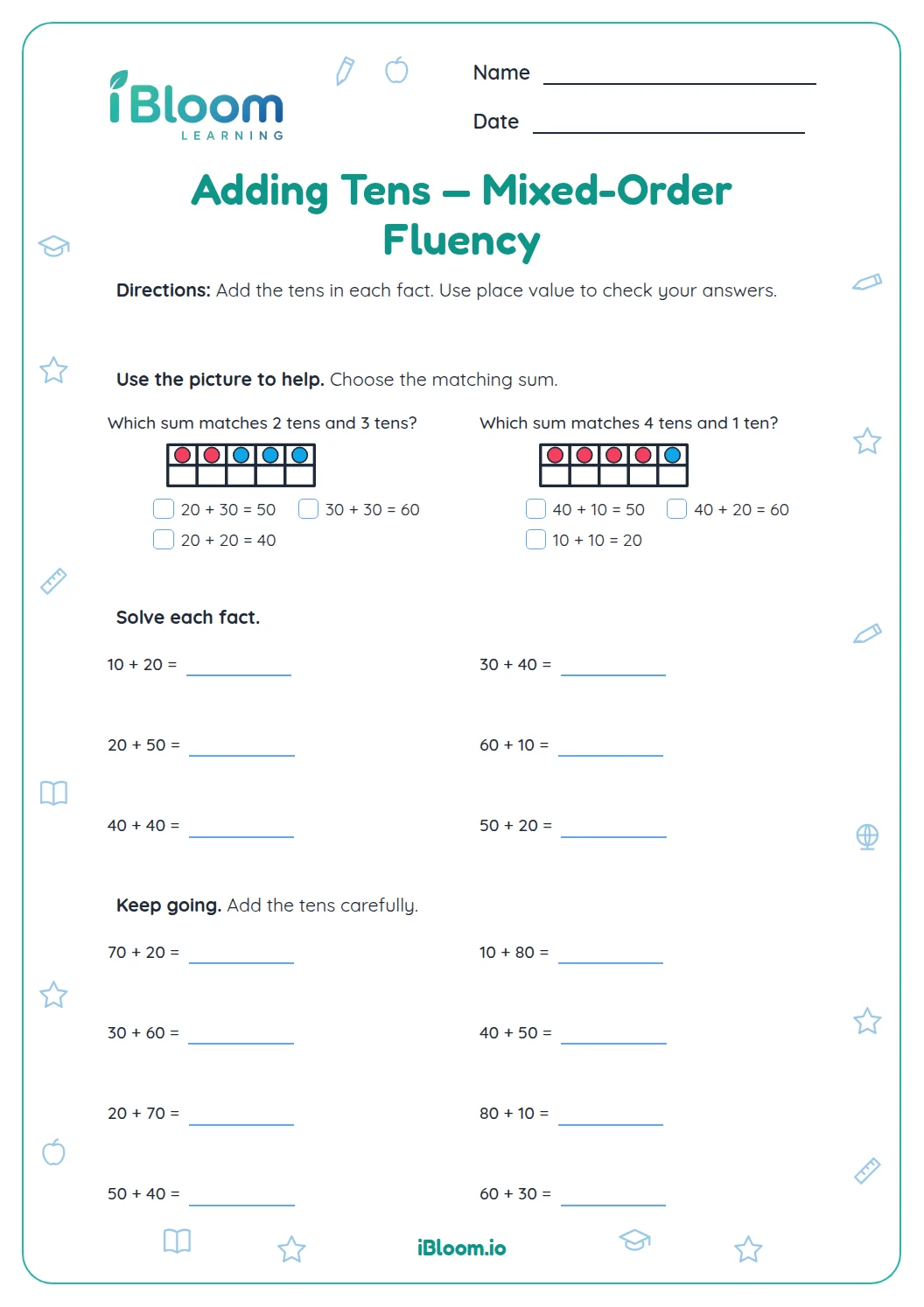
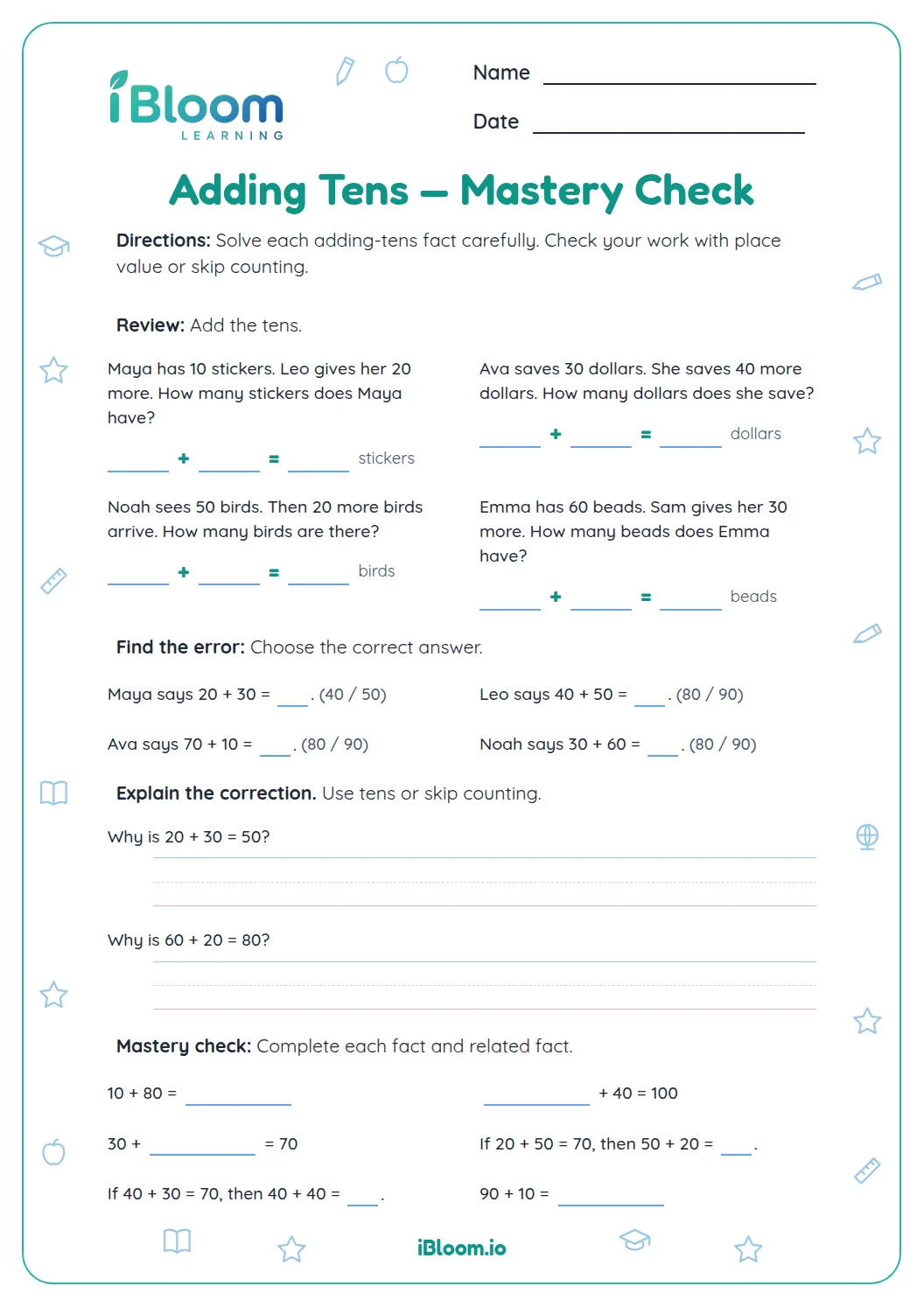
This two-page printable helps Grades 1–2 learners add tens while keeping track of any ones. Part A mixes two-digit numbers with whole tens and includes sums such as 50 + 18; Part B asks learners to find missing addends; Part C uses four counter stories. The separate two-page key shows the answers. The practice aligns with CCSS 1.NBT.C.4, including adding a two-digit number and a multiple of 10.
Aligned to 1.NBT.C.4
How do you add a whole ten to a number?
Keep the ones digit, then add the tens. For 26 + 40, add 4 tens to 2 tens to make 6 tens, and keep the 6 ones: 66. Part A also includes a few sums with ones in both addends.
- 126 + 40 = ___
- 22 tens + 4 tens = 6 tens; keep 6 ones.
- 3So 26 + 40 = 66.
How can you find a missing addend?
Compare the known addend with the total. In 43 + ___ = 83, count up four tens from 43 to 83, so the missing addend is 40. Check by adding 43 + 40.
What should you do with a counter story?
Join the two groups by writing an addition sentence, then solve it. For 30 red counters and 40 blue counters, write 30 + 40 = 70. Name the total number of counters.
How to use this worksheet
- 1Read the directions and name the tens and ones in each addend.
- 2Solve Part A by adding tens before combining any ones.
- 3For Part B, find the difference between the known addend and total.
- 4In Part C, write an addition sentence for the two counter groups.
- 5Check each result with the separate answer key.
Adding-tens slips to watch for
The mistake
Adding 26 + 40 as 46.
The fix
Add the four tens to the two tens; keep the 6 ones for 66.
The mistake
Treating 43 + ___ = 83 like 43 + 83.
The fix
Find how many more than 43 reach 83: 40.
The mistake
Reporting only one counter color in a story.
The fix
Add both groups to find the total number of counters.
Common Core alignment
Practice adding tens and ones using place value.
Add tens and ones by using place value and addition strategies.
On this sheet: The equations add whole tens and two-digit numbers within 100.
Show the official wordingHide the official wording
Add within 100, including adding a two-digit number and a one-digit number, and adding a two-digit number and a multiple of 10, using concrete models or drawings and strategies based on place value, properties of operations, and/or the relationship between addition and subtraction; relate the strategy to a written method and explain the reasoning used. Understand that in adding two-digit numbers, one adds tens and tens, ones and ones; and sometimes it is necessary to compose a ten.
What to practice next
Make more practice
Further reading
Questions parents and teachers ask
What happens to the ones when you add 40 to 26?
The 40 adds four tens, and the 6 ones stay the same. So 26 + 40 is 66. Part A practices this place-value pattern alongside sums such as 50 + 18, where learners also combine the ones. The learner can write each place-value step before checking the total.
How can a child solve 43 + ___ = 83?
Find the distance from 43 to 83. Counting up four tens gives 83, so the missing addend is 40. Check it by adding 43 + 40 and confirming the total is 83. Compare the equation with its total to confirm the tens jump.
What does Part C ask learners to do?
Each of its four stories describes two groups of counters. Learners write an addition sentence and solve it, such as 30 + 40 = 70 for 30 red counters and 40 blue counters. Writing the two addends first can make the groups easier to track.
Does every problem only add whole tens?
The sheet combines multiples of ten with sums that include ones in both addends, such as 7 + 5 and 50 + 18. These examples help learners keep tens and ones organized while still practicing a focused adding-tens skill. Then check the total.
How many questions and pages are included?
There are 16 questions across three parts, printed on two worksheet pages. The separate answer key also takes two pages and includes the sums, missing addends, and story totals. The key also helps spot whether a tens jump was missed.