
About this worksheet
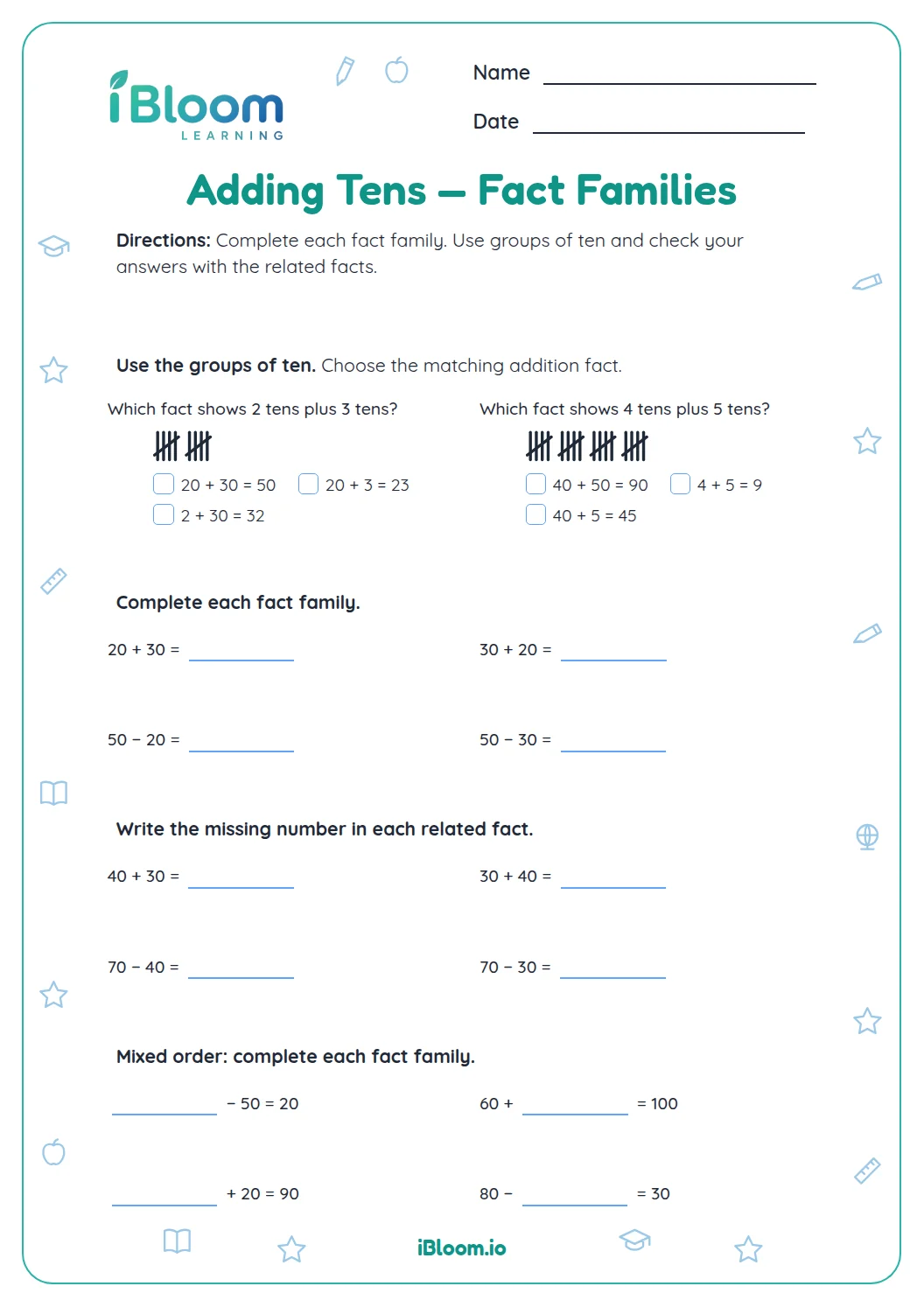
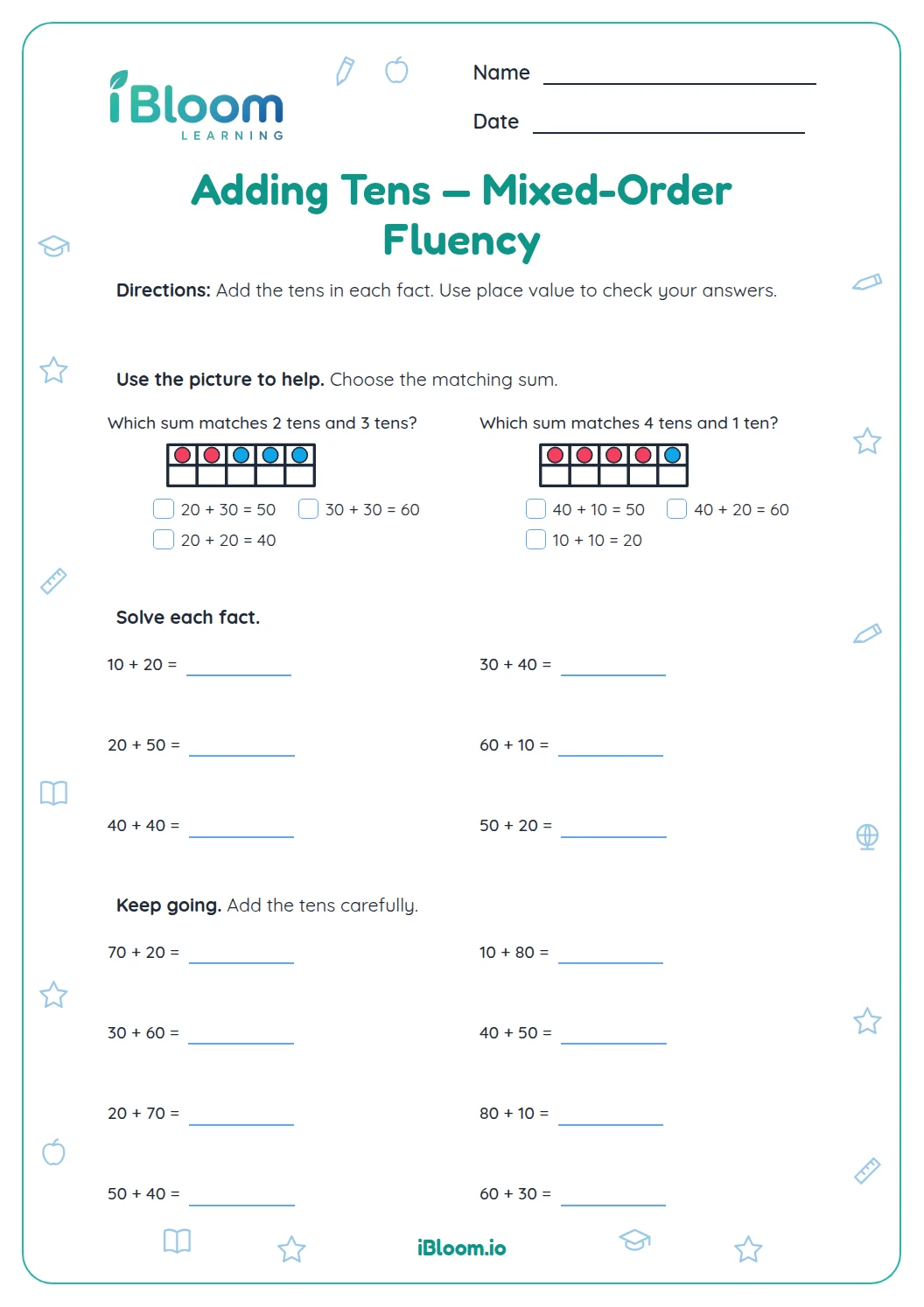
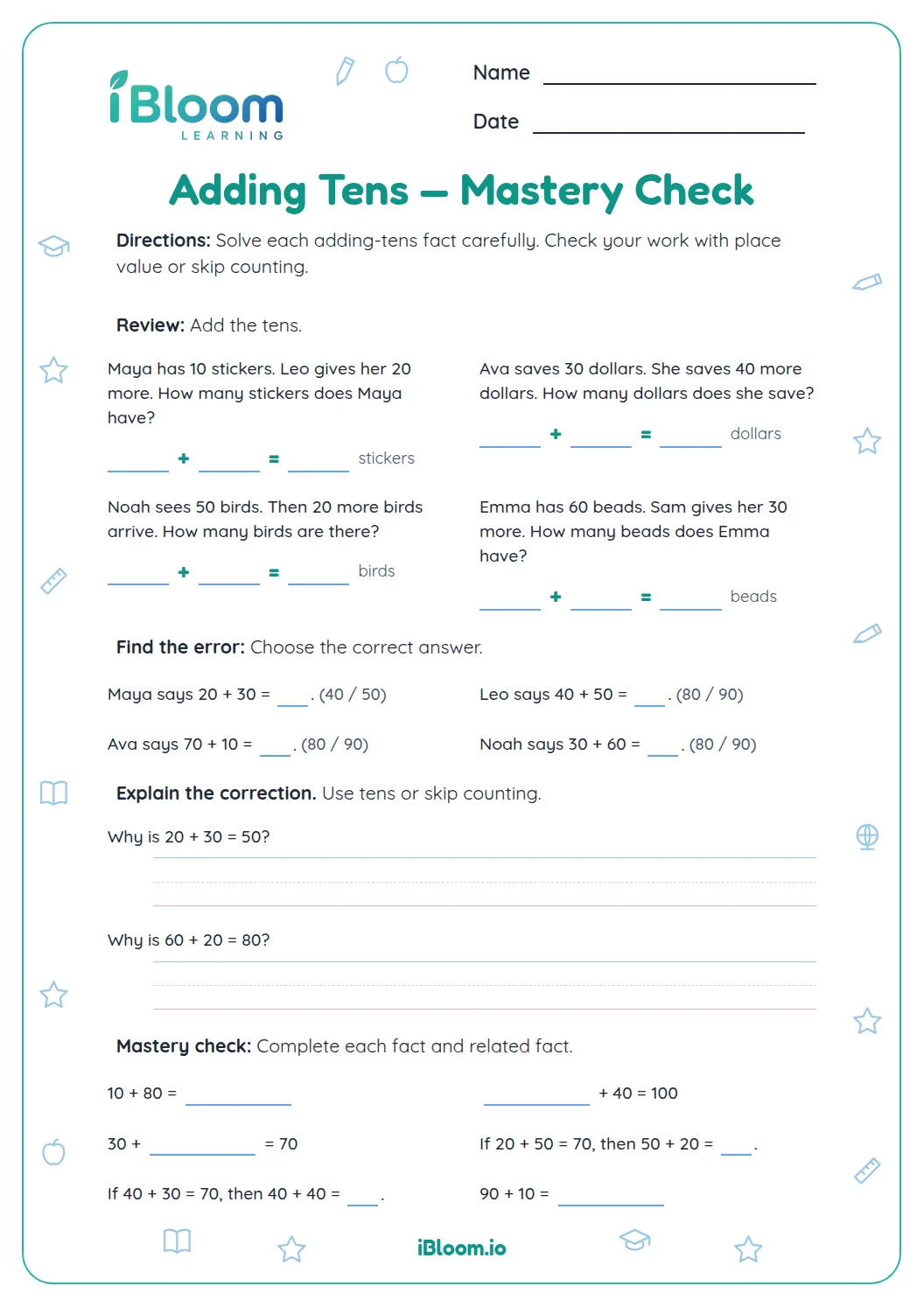
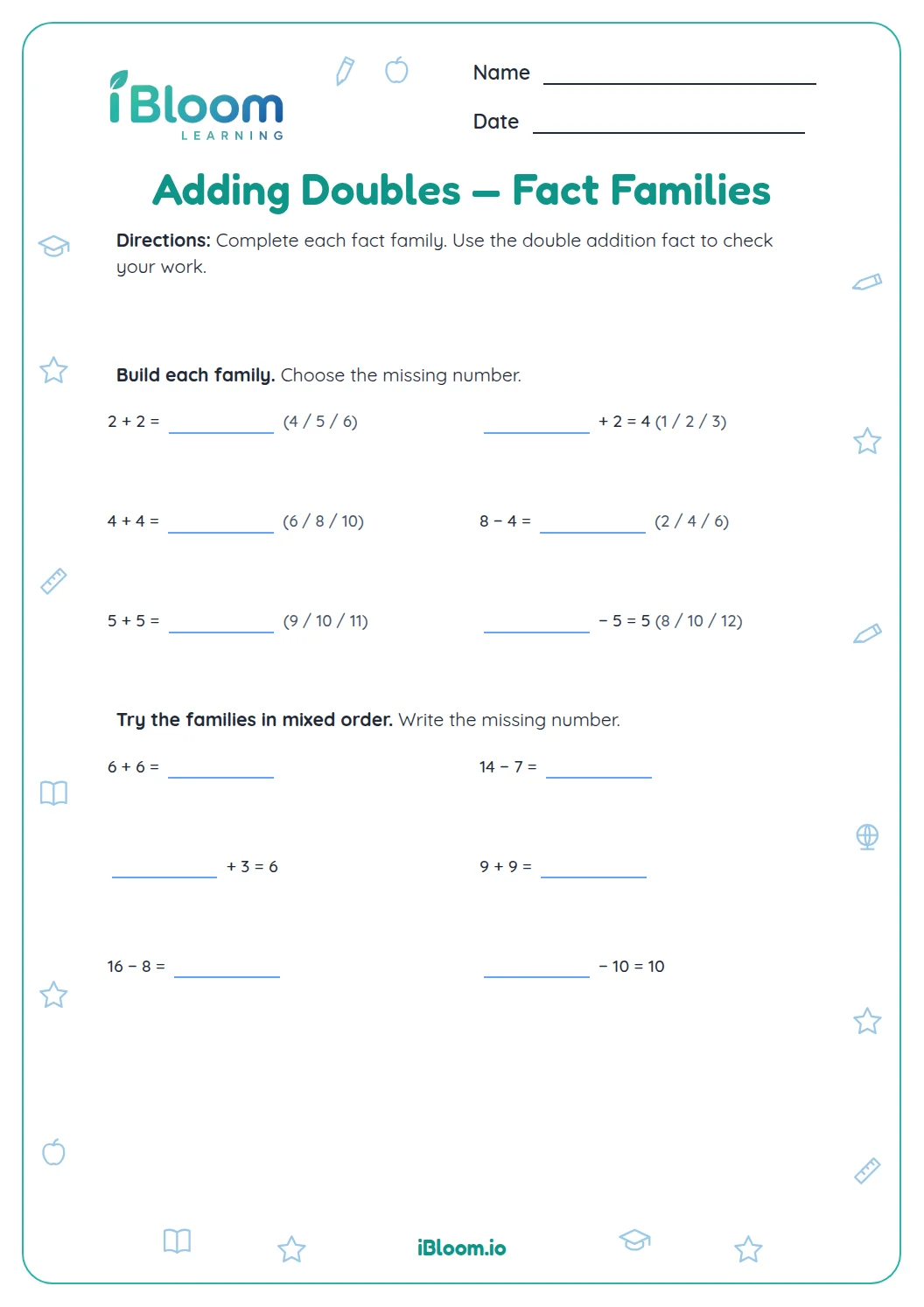
This two-page addition worksheet helps Grades 1–2 learners add multiples of ten and solve missing-addend facts. Children first combine tens, then use counting by tens or subtraction to find a number that completes an equation. The 20 questions stay within 100, and the separate answer key lists every missing number. The practice aligns with Common Core place-value addition standards.
Aligned to 1.NBT.C.4 and 2.NBT.B.5
How do you add tens?
Think of 20 as 2 tens and 30 as 3 tens. Two tens plus three tens make five tens, or 50. In this worksheet, every addend is a multiple of ten, so children can focus on the tens digit and keep zero in the ones place.
Question 1 is 20 + 30 = ___. Add 2 tens and 3 tens to get 5 tens, so the missing total is 50.
- 120 + 30 = ___
- 22 tens + 3 tens = 5 tens
- 3The total is 50.
How can you find a missing addend?
When a total and one addend are given, count on by tens or use subtraction. For 20 + ___ = 70, start at 20 and count five tens to 70; the missing addend is 50. A number line with jumps of ten can help make the distance visible.
What does this worksheet practice?
The 20 equations include missing totals and missing addends, with answers from 50 to 100. The questions begin with complete addition sentences, then ask children to find either addend. A separate key lists each missing number.
How to use this worksheet at home or in class
- 1Say each number as a number of tens.
- 2For a total, add the tens and write zero in the ones place.
- 3For a missing addend, count by tens from the known addend to the total.
- 4Check by adding the two addends.
- 5Use the answer key to check each equation.
Common mistakes and quick fixes
The mistake
Adding only the tens digits but forgetting to write the zero, such as 2 + 3 = 5 for 20 + 30.
The fix
Say “2 tens plus 3 tens is 5 tens,” then write 50.
The mistake
Adding the total and known addend instead of finding the gap.
The fix
Count up from the known addend to the total or subtract the known addend.
The mistake
Putting a missing addend in the wrong place and changing the equation.
The fix
Keep the equal sign true: the two addends together must match the total.
Common Core alignment
This page connects the printed practice to the grade-level skills named below.
Add multiples of 10 by combining tens and complete missing-addend facts.
On this sheet: Add multiples of 10 by combining tens and complete missing-addend facts.
Show the official wordingHide the official wording
Add within 100, including adding a two-digit number and a one-digit number, and adding a two-digit number and a multiple of 10, using concrete models or drawings and strategies based on place value, properties of operations, and/or the relationship between addition and subtraction; relate the strategy to a written method and explain the reasoning used. Understand that in adding two-digit numbers, one adds tens and tens, ones and ones; and sometimes it is necessary to compose a ten.
Use place-value strategies to add tens within 100 and solve missing-addend equations.
On this sheet: Use place-value strategies to add tens within 100 and solve missing-addend equations.
Show the official wordingHide the official wording
Fluently add and subtract within 100 using strategies based on place value, properties of operations, and/or the relationship between addition and subtraction.
What to practice next
Make more practice
Further reading
Questions parents and teachers ask
What does adding tens mean?
Adding tens means combining amounts such as 20 and 30, which are two tens and three tens. Together they make five tens, or 50. The worksheet practices totals and missing addends using multiples of ten through 100. Children can check a response by counting the tens aloud or using subtraction to find the missing addend.
How do I help with 20 + ___ = 70?
Start at 20 and count by tens until reaching 70: 30, 40, 50, 60, 70. That is five jumps of ten, so the missing number is 50. You can also ask what number added to 20 makes 70.
How many questions are included?
The worksheet has 20 missing-number addition facts on two pages. Six ask for the total, five hide the second addend, and nine hide the first addend. The separate answer key gives the number that completes each equation. It also makes it easy to spot whether a child is adding the tens or finding the distance to the total.
Can children use a number line?
Yes. Mark the known addend and make jumps of ten until reaching the total. For 30 + ___ = 100, seven jumps of ten reach 100, so the missing addend is 70. The drawing is optional; the worksheet itself uses number sentences.
Why do answers end in zero?
Every addend in this practice is a multiple of ten, so the total also has zero ones. For example, 40 is four tens and 30 is three tens; seven tens make 70. The answer key can help check that both the tens and ones places make sense.