
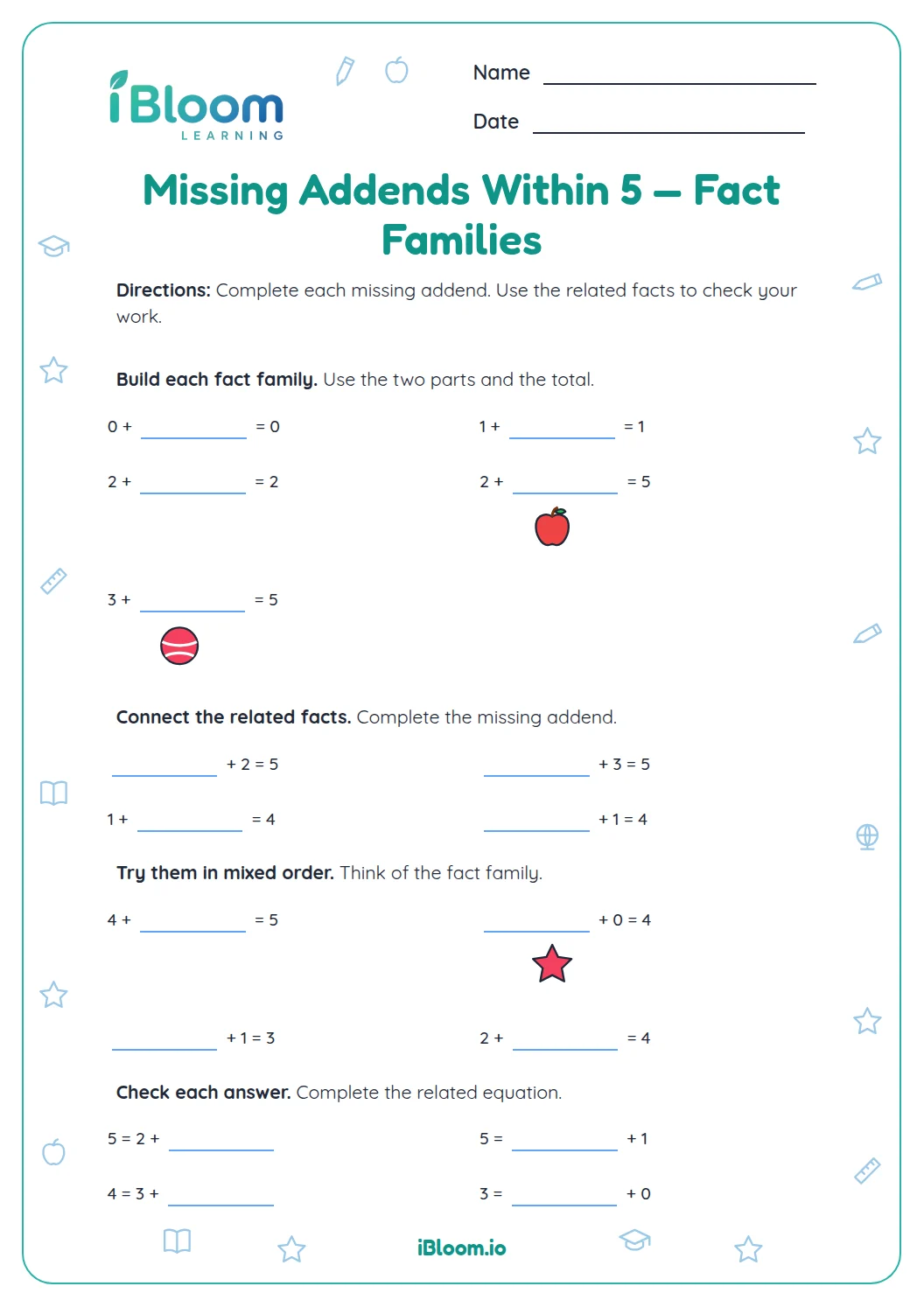
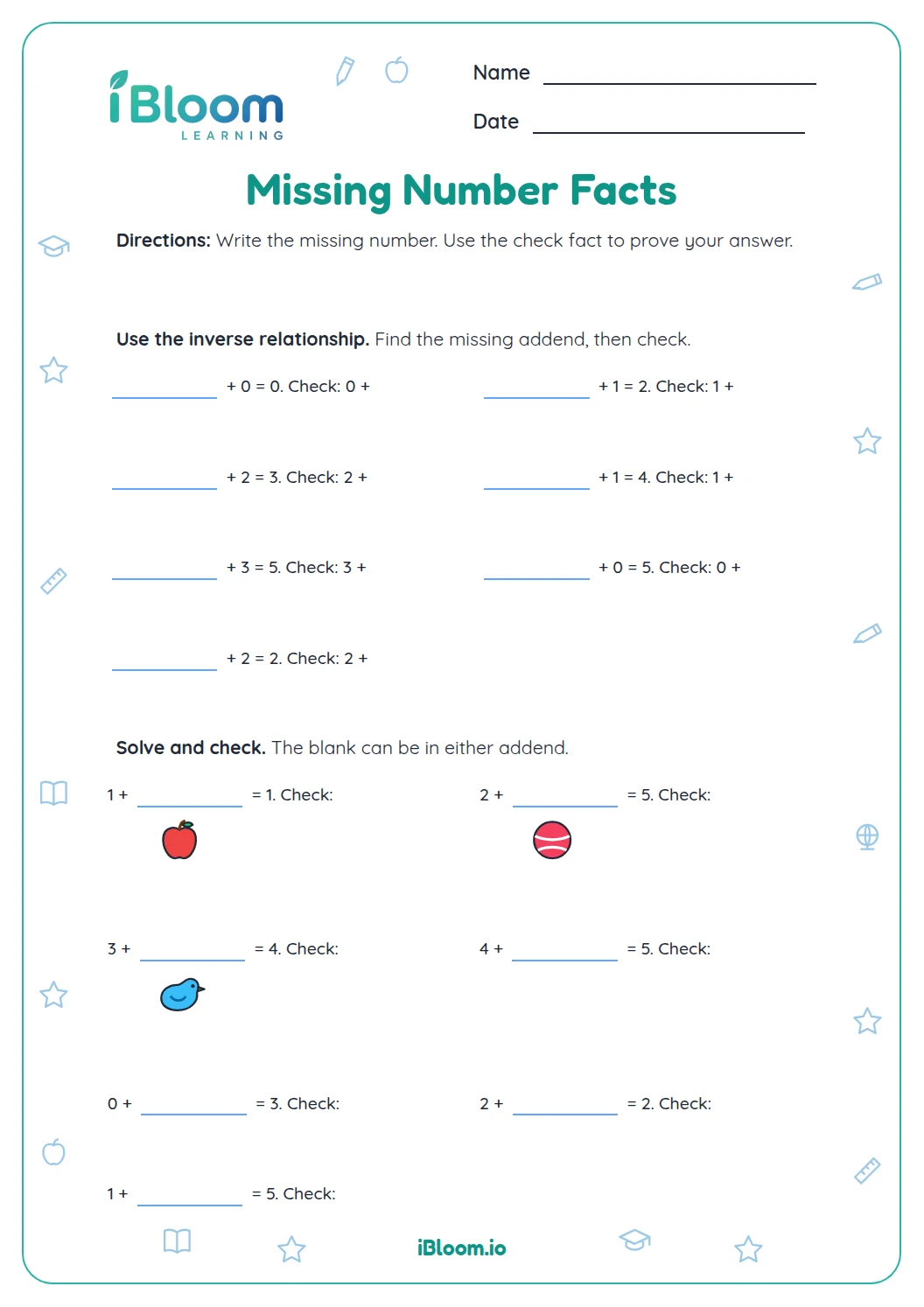
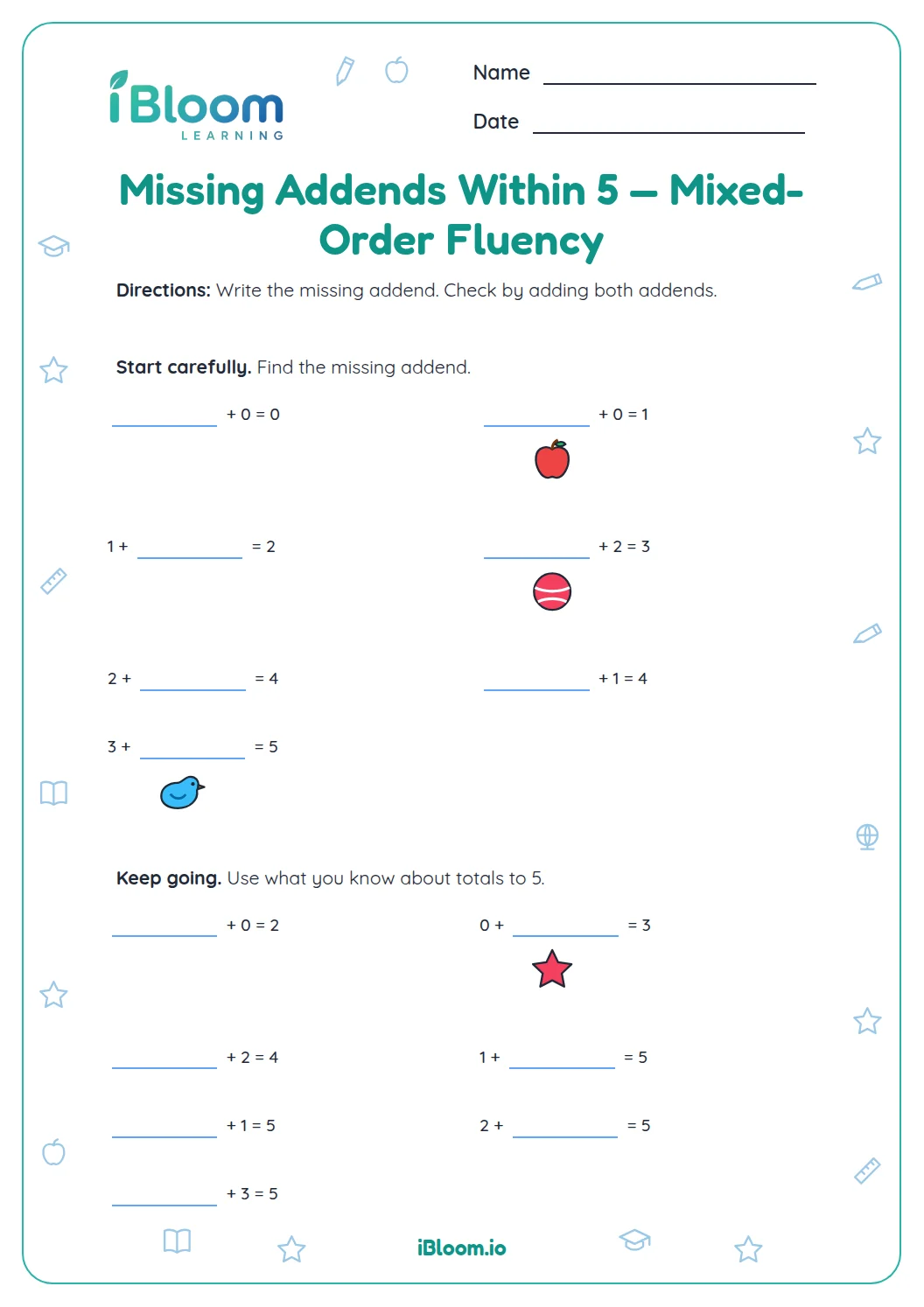
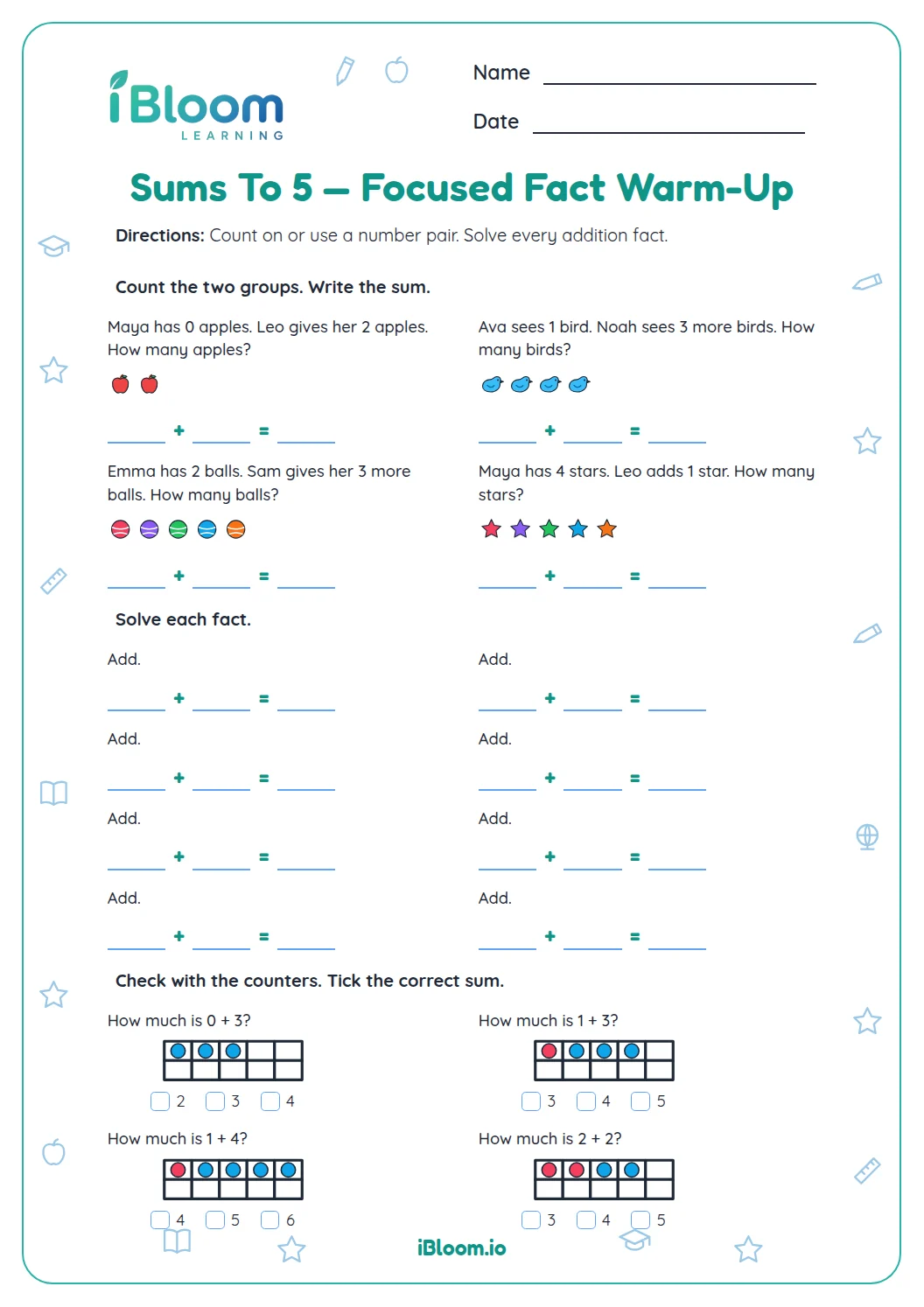


About this worksheet
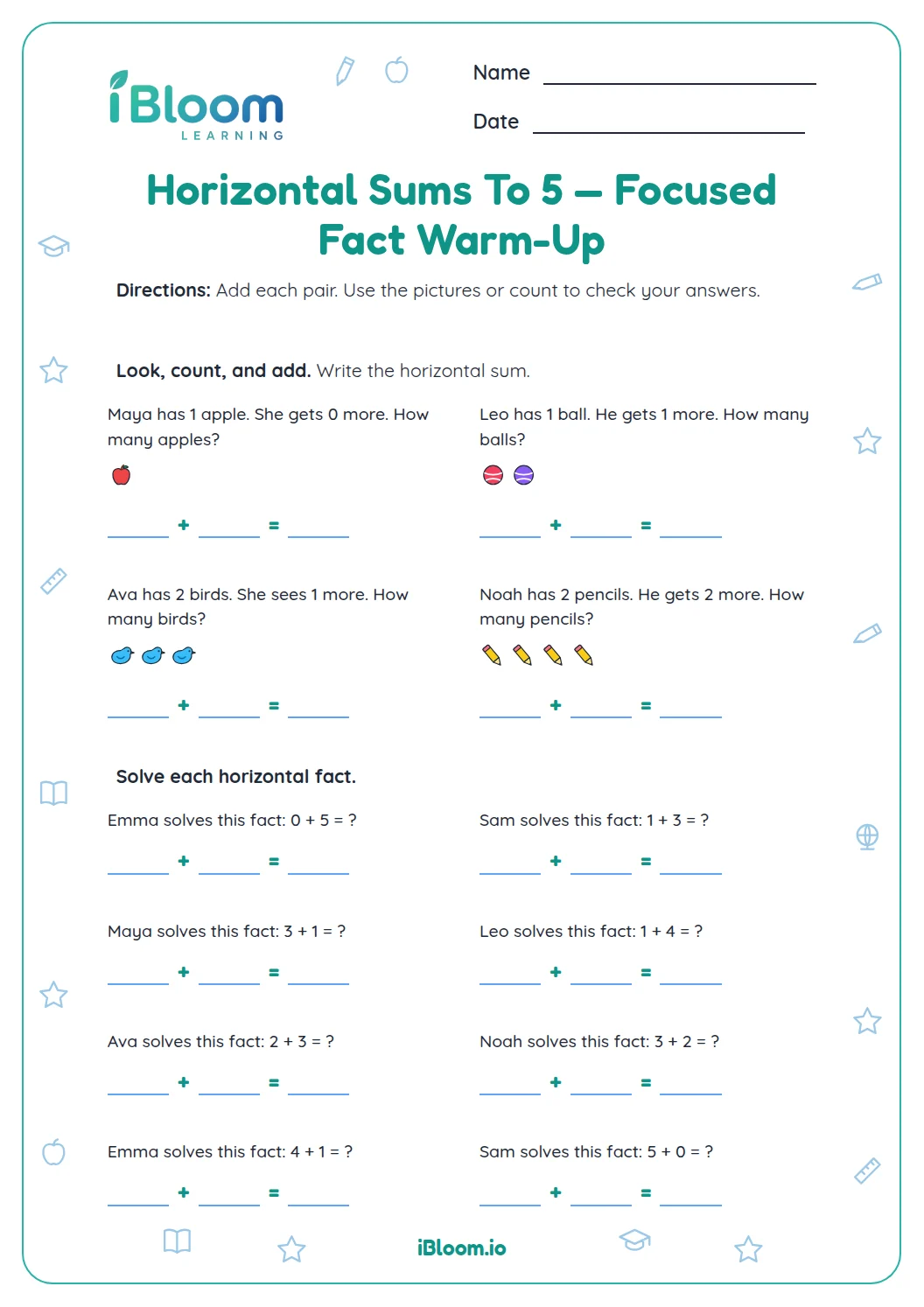
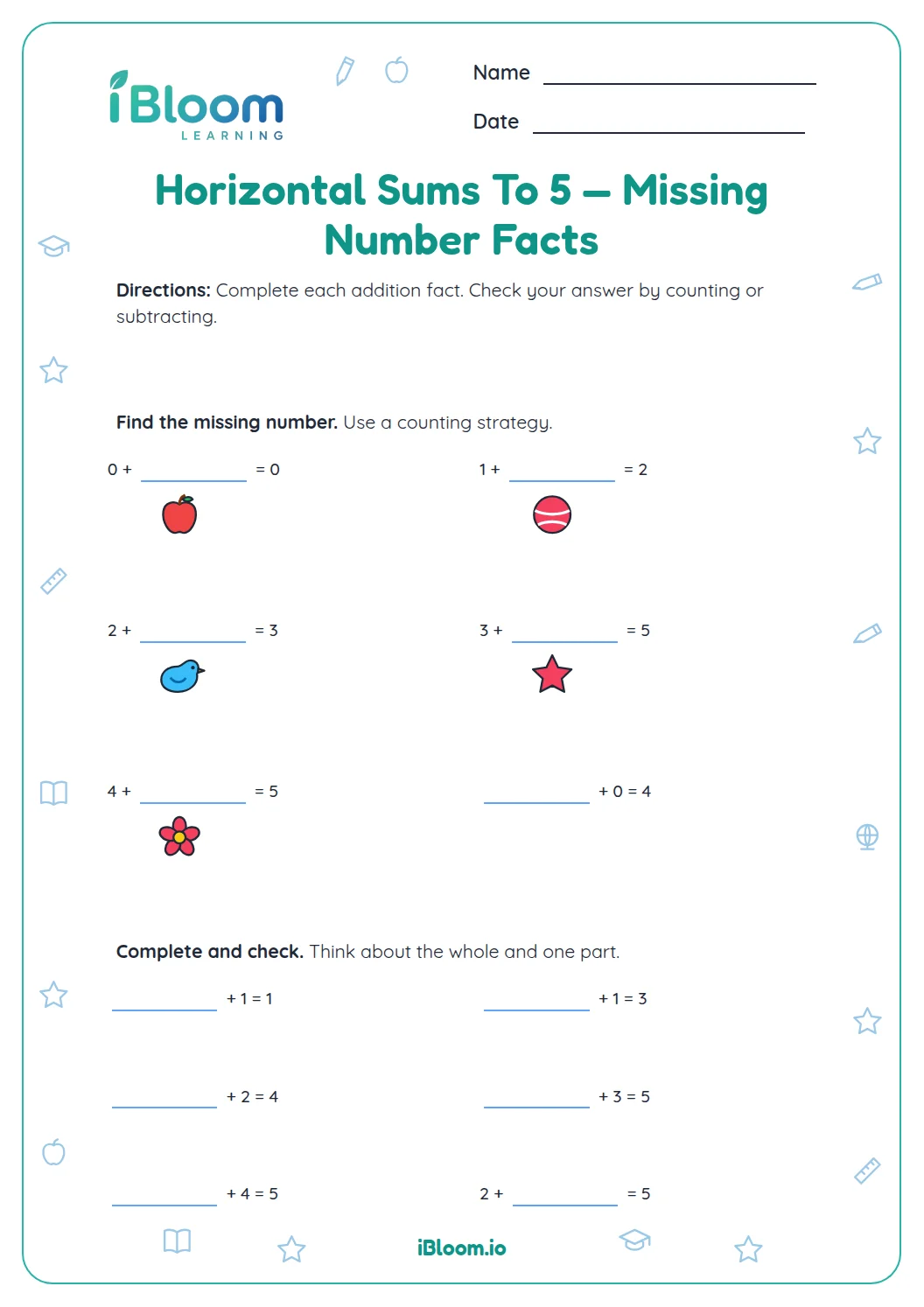
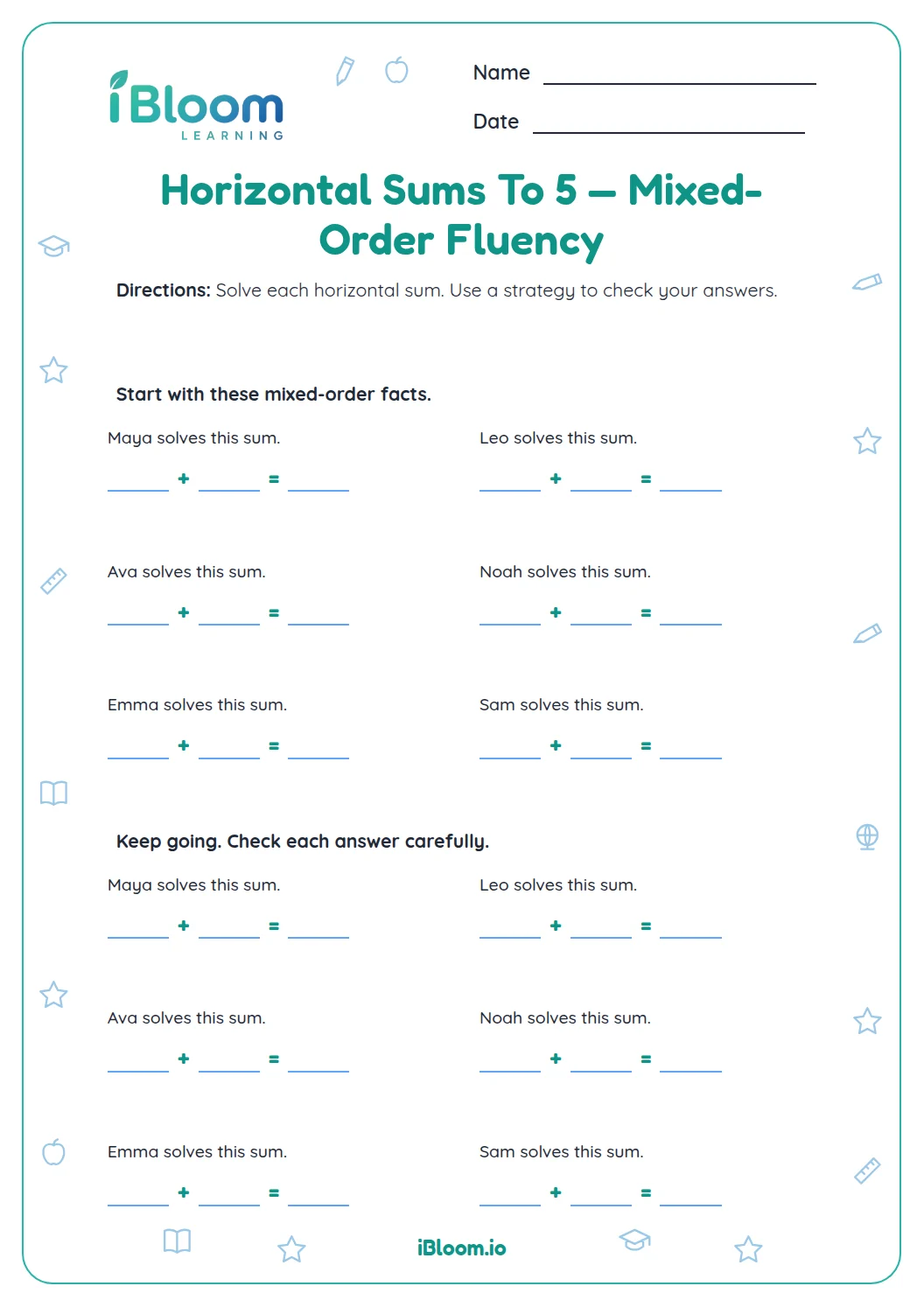
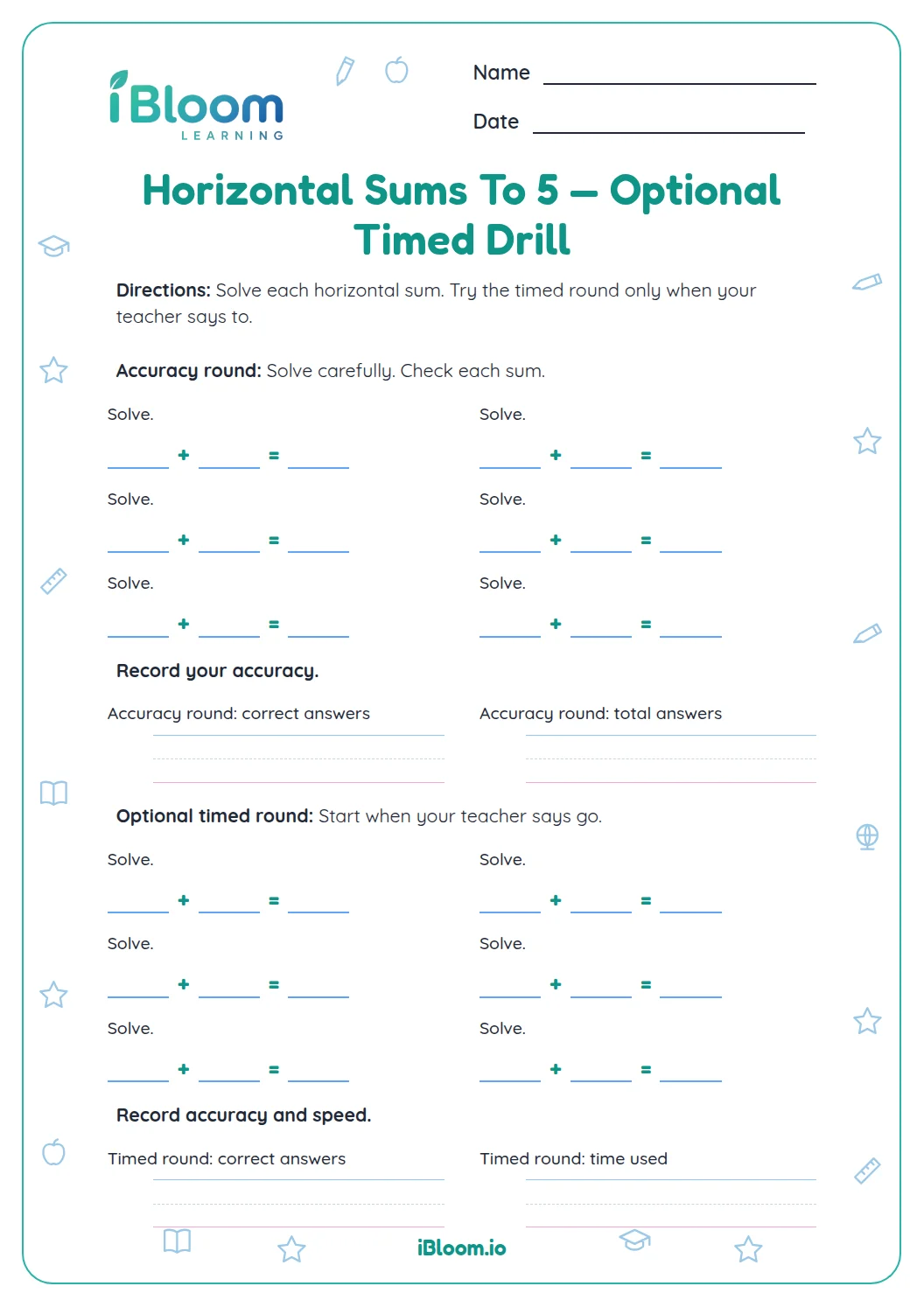
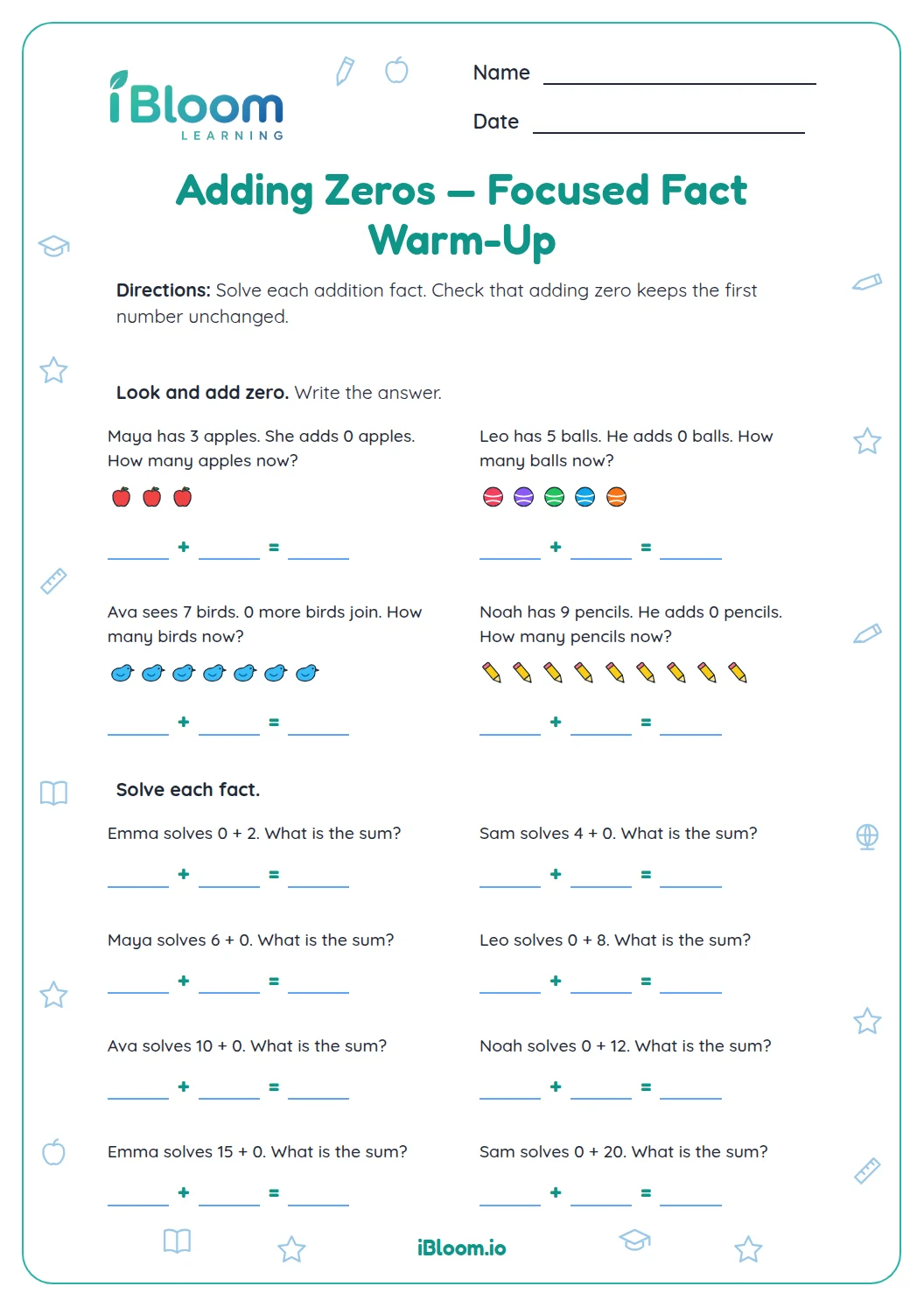
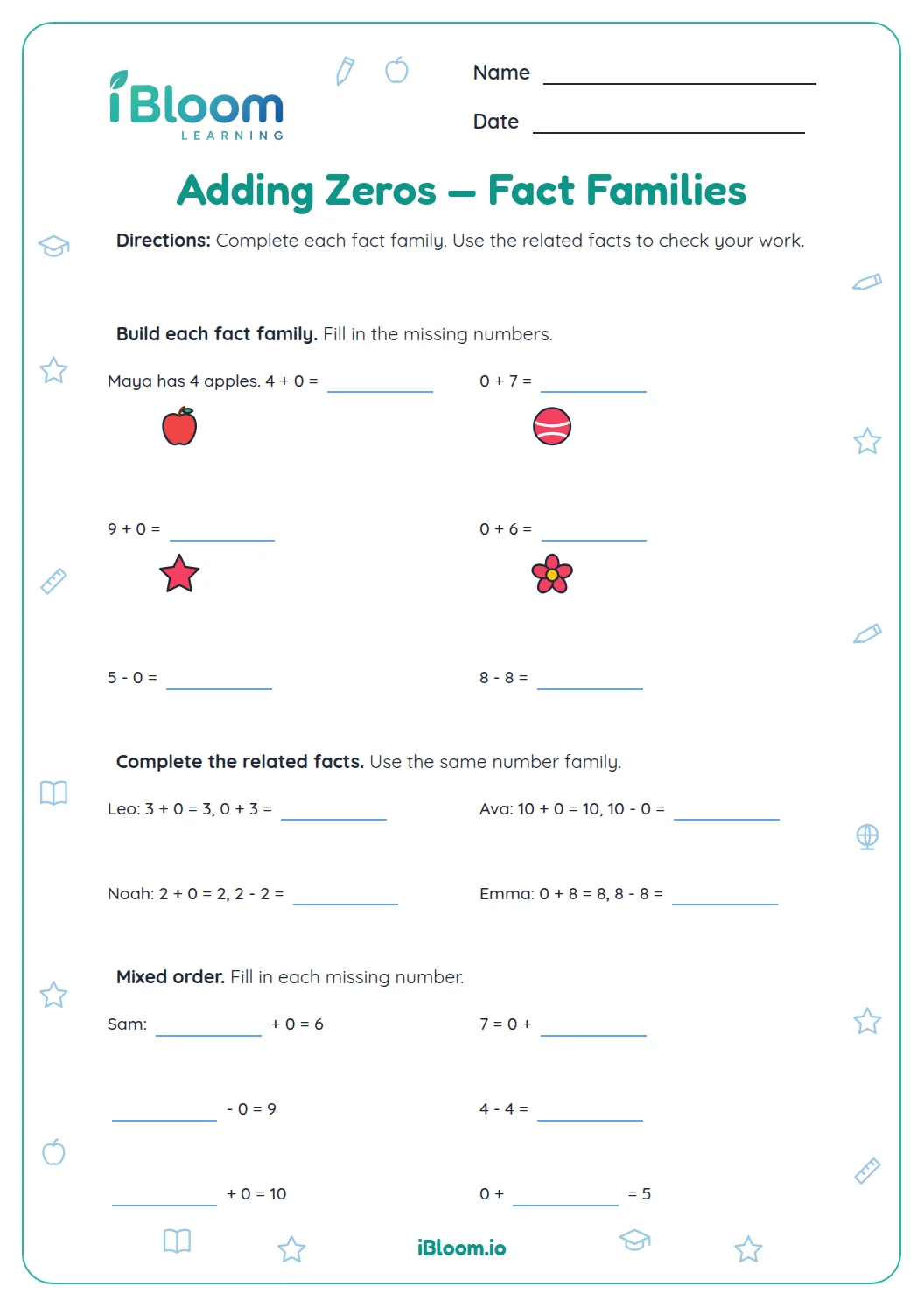
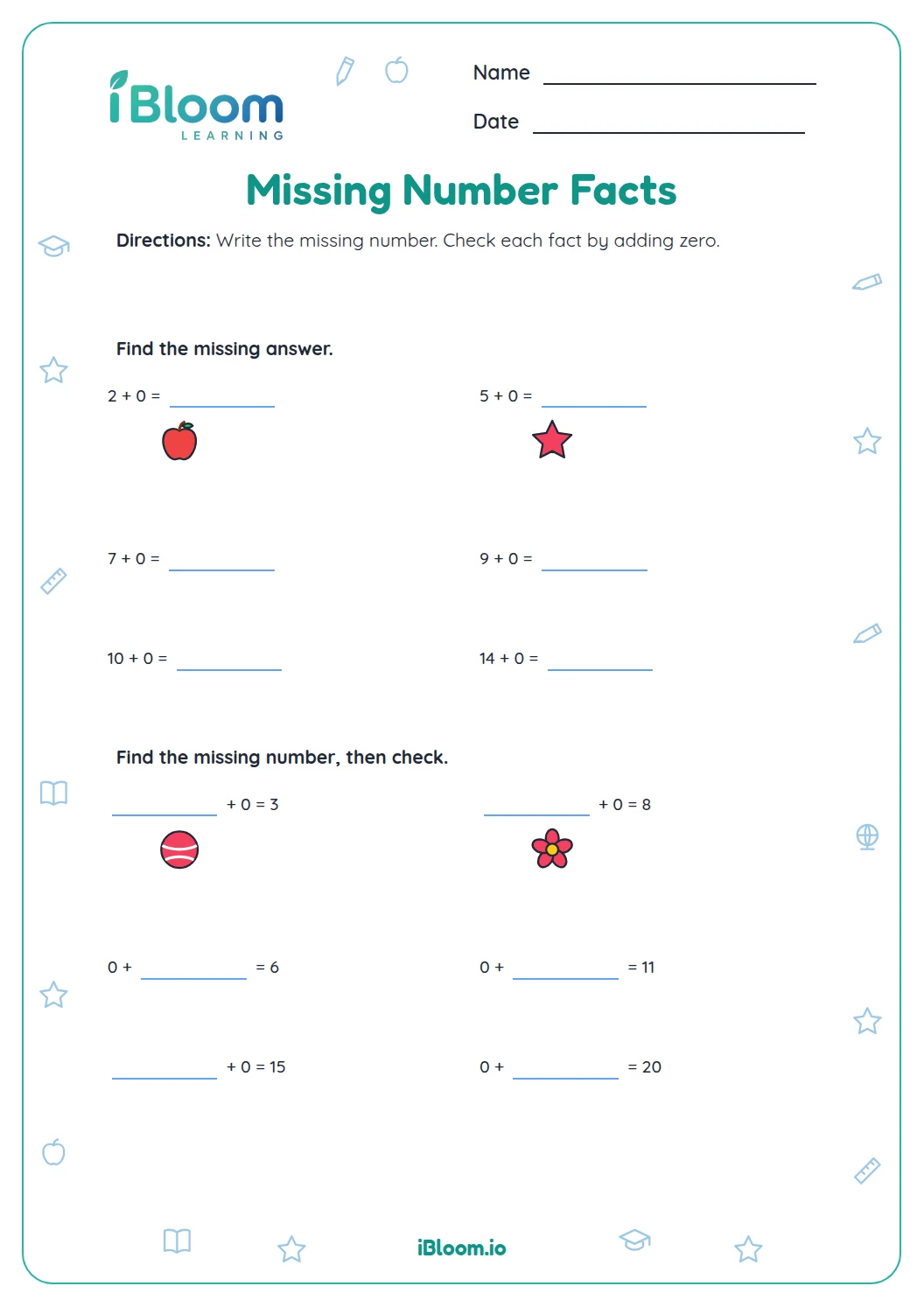
This Grade 1 printable builds fluency with horizontal addition facts whose sums are 5 or less. Students solve six facts, check four calculations, explain why two facts work, and complete four related-fact or missing-addend items. The answer key includes model explanations for the two open responses. The practice aligns with Common Core 1.OA.C.6.
Aligned to 1.OA.C.6
How can students check sums to 5?
Part A practices six addition facts through 5. Part B asks learners to choose a true fact that corrects each claim. Part C includes two brief explanations, and Part D has four missing-addend facts.
- 12 + 2 = ___
- 22 + 2 = 4
- 6 addition facts
- 4 error-check choices
- 2 explanations and 4 missing addends
What does the fact-check section ask?
For 2 + 3, count on three from 2: 3, 4, 5. In the correction choices, pick the true sentence that uses the same addends.
- 1Claim: 2 + 3 = 4
- 2Correction: 2 + 3 = 5
What are the 16 questions?
Part A has six sums, Part B has four fact checks, Part C has two explanations, and Part D has four missing-addend or related-fact prompts. The key includes sample wording for the open responses.
How to use this worksheet
- 1Solve each horizontal addition fact before moving to the next part.
- 2For a sum, count on from the larger addend or use a fact you know.
- 3In Part B, calculate both choices and select the true equation.
- 4Explain the zero pattern and a counting-on example in your own words.
- 5Finish the missing addends, then use the key to check each response.
Common mistakes and quick fixes
The mistake
Adding zero as if it changes the number.
The fix
Read the other addend as the starting amount: 4 + 0 stays 4.
The mistake
Stopping the count-on sequence too soon.
The fix
For 2 + 3, say three counts after 2: 3, 4, 5.
The mistake
Thinking that switching addends changes the sum.
The fix
Check both orders: 1 + 4 and 4 + 1 each equal 5.
Common Core alignment
This practice connects the worksheet skill with the stated Common Core standard.
Use counting on and known addition facts to solve sums within 5.
On this sheet: The questions use addition facts within 5, counting on, zero, related facts, and missing addends.
Show the official wordingHide the official wording
Add and subtract within 20, demonstrating fluency for addition and subtraction within 10. Use strategies such as counting on; making ten (e.g., 8 + 6 = 8 + 2 + 4 = 10 + 4 = 14); decomposing a number leading to a ten (e.g., 13 − 4 = 13 − 3 − 1 = 10 − 1 = 9); using the relationship between addition and subtraction (e.g., knowing that 8 + 4 = 12, one knows 12 − 8 = 4); and creating equivalent but easier or known sums (e.g., adding 6 + 7 by creating the known equivalent 6 + 6 + 1 = 12 + 1 = 13).
What to practice next
Make more practice
Further reading
Questions parents and teachers ask
How many questions are on the sheet?
Each addition fact has a total from zero through five. The sheet has six direct facts, four correction choices, two brief explanations, and four missing-addend questions. A separate answer key lists the responses so a learner can check each part after finishing.
Does every addition fact have a sum of 5 or less?
A ten-frame can make small groups easier to count. On this sheet, solve each number sentence by counting on, counting both parts, or using a known fact. Then compare the total with the answer key, which lists the response to every item.
What should a student write for the explanation questions?
Answers can vary. For 2 + 3, a student might count on three counts from 2: 3, 4, 5. For 4 + 0, a student can say that adding zero leaves 4 unchanged. The answer key shows sample wording rather than the only acceptable sentence.
What does the fact-check part practice?
Students compare a true addition equation with an incorrect one and select the accurate calculation. For example, 2 + 3 equals 5, so the choice stating 2 + 3 = 4 is the error. These items ask children to verify a fact instead of only filling a blank.
Is an answer key included?
Yes. A separate answer-key page lists all 16 responses and sample explanations for the two open-response questions. Students can try the worksheet first, then use the key to find which fact or step needs another look. The key follows the same item order as the worksheet, making each response easy to locate.
Which standard does the worksheet practice?
The sheet practices CCSS 1.OA.C.6 through addition facts within 5, counting-on reasoning, and related facts. The standard calls for strategies that support fluency within 10; the worksheet’s smaller sums give focused practice with part of that skill. The smaller number range keeps the work focused while students practice these strategies.