



About this worksheet
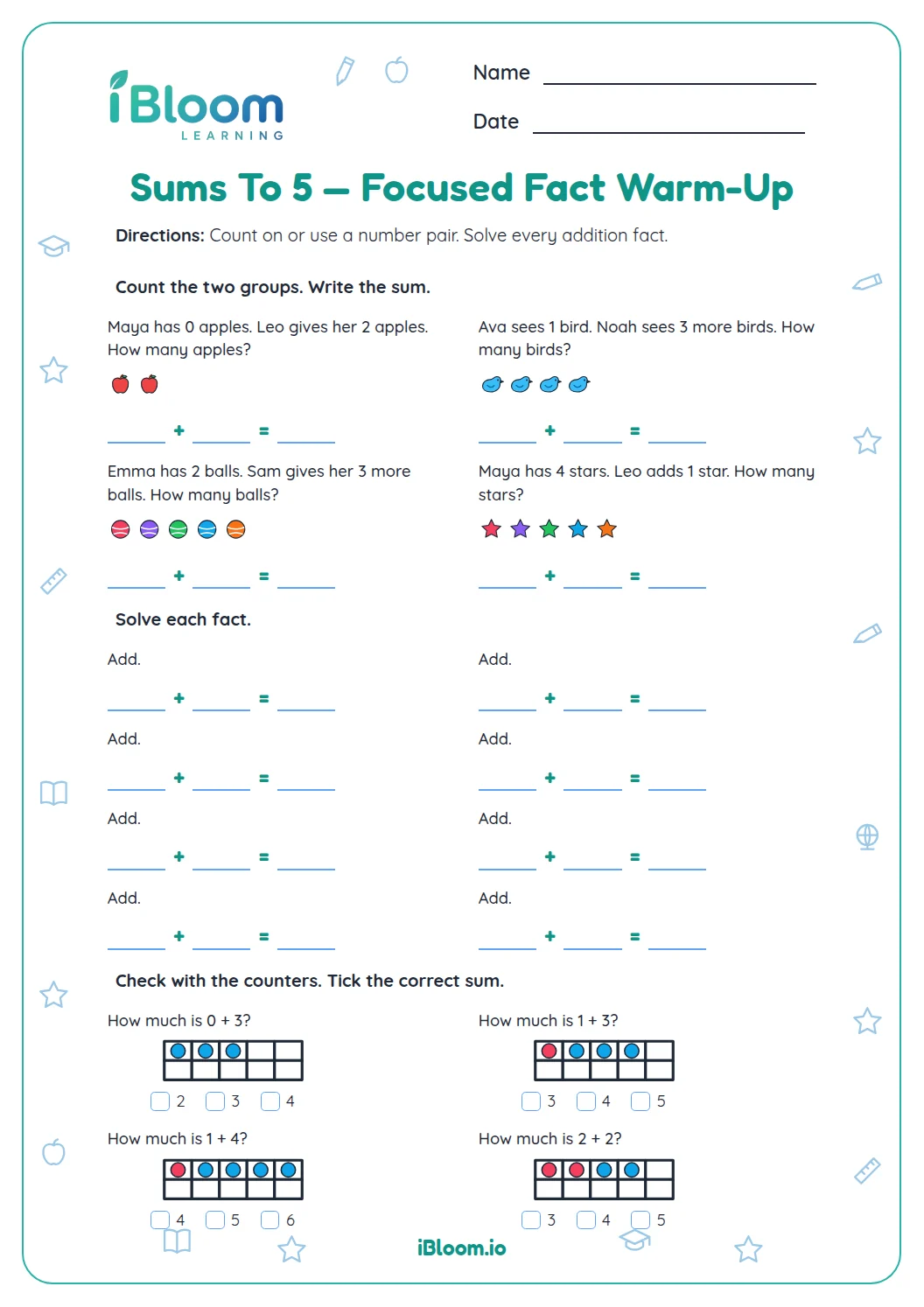
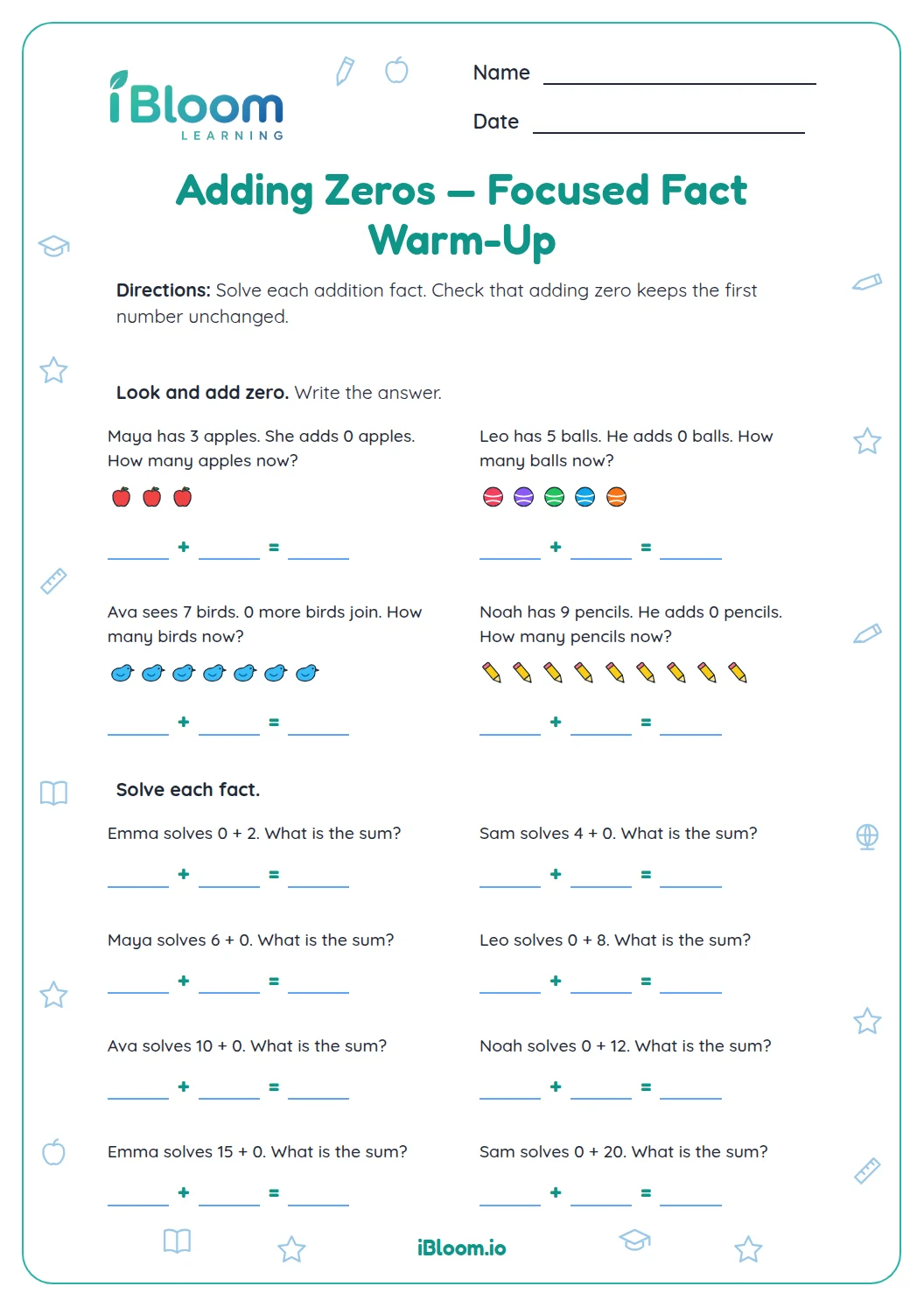
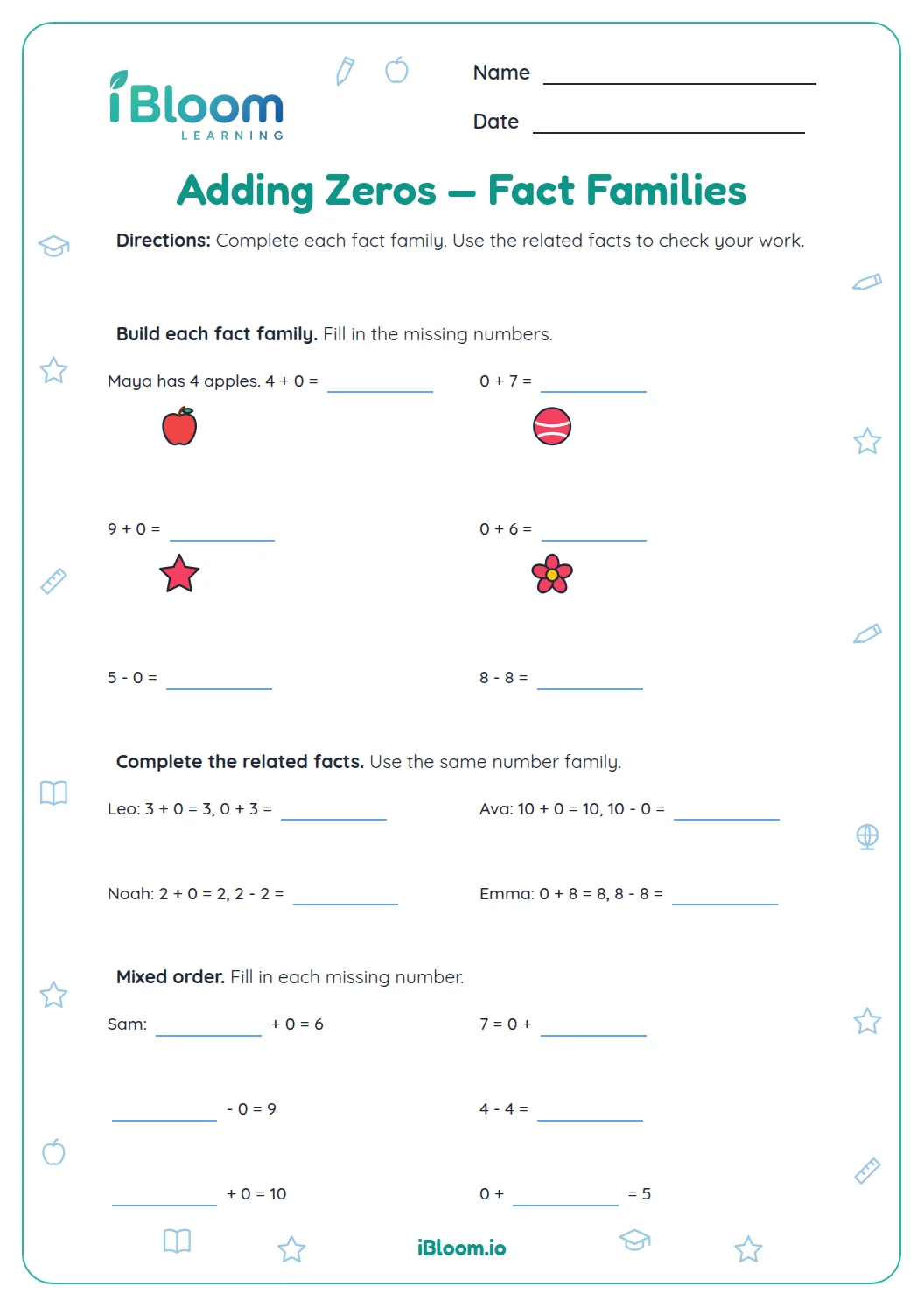
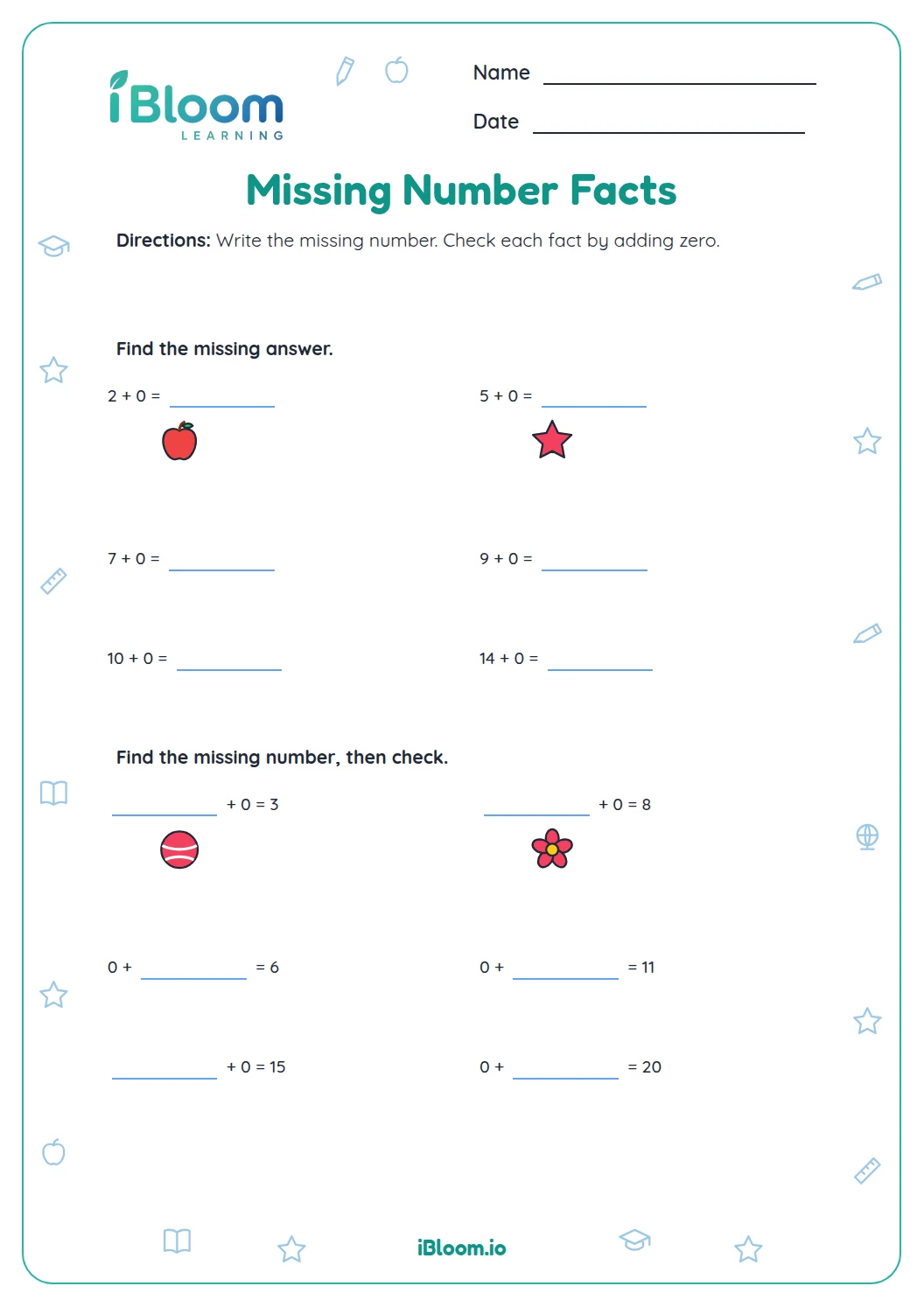
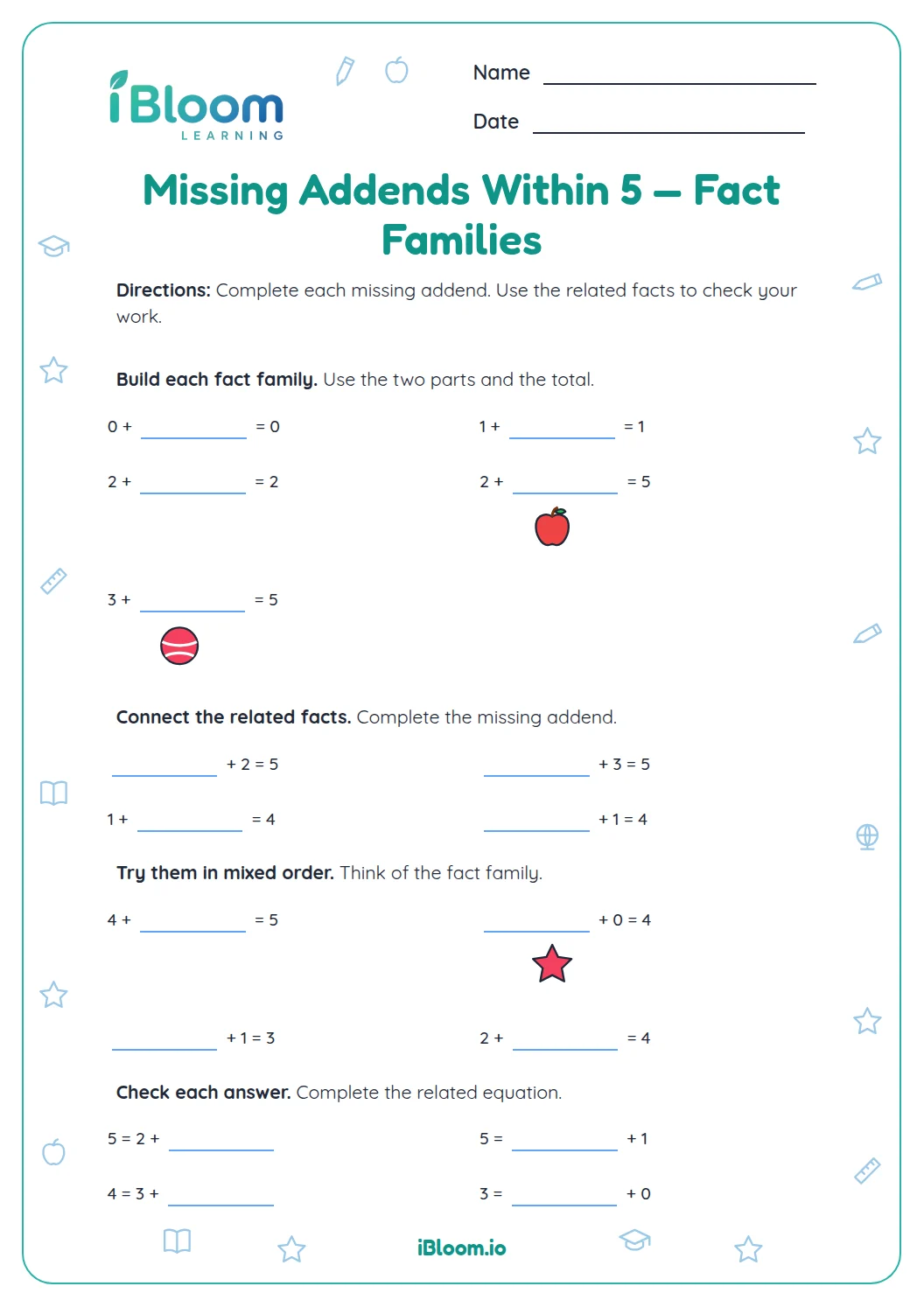
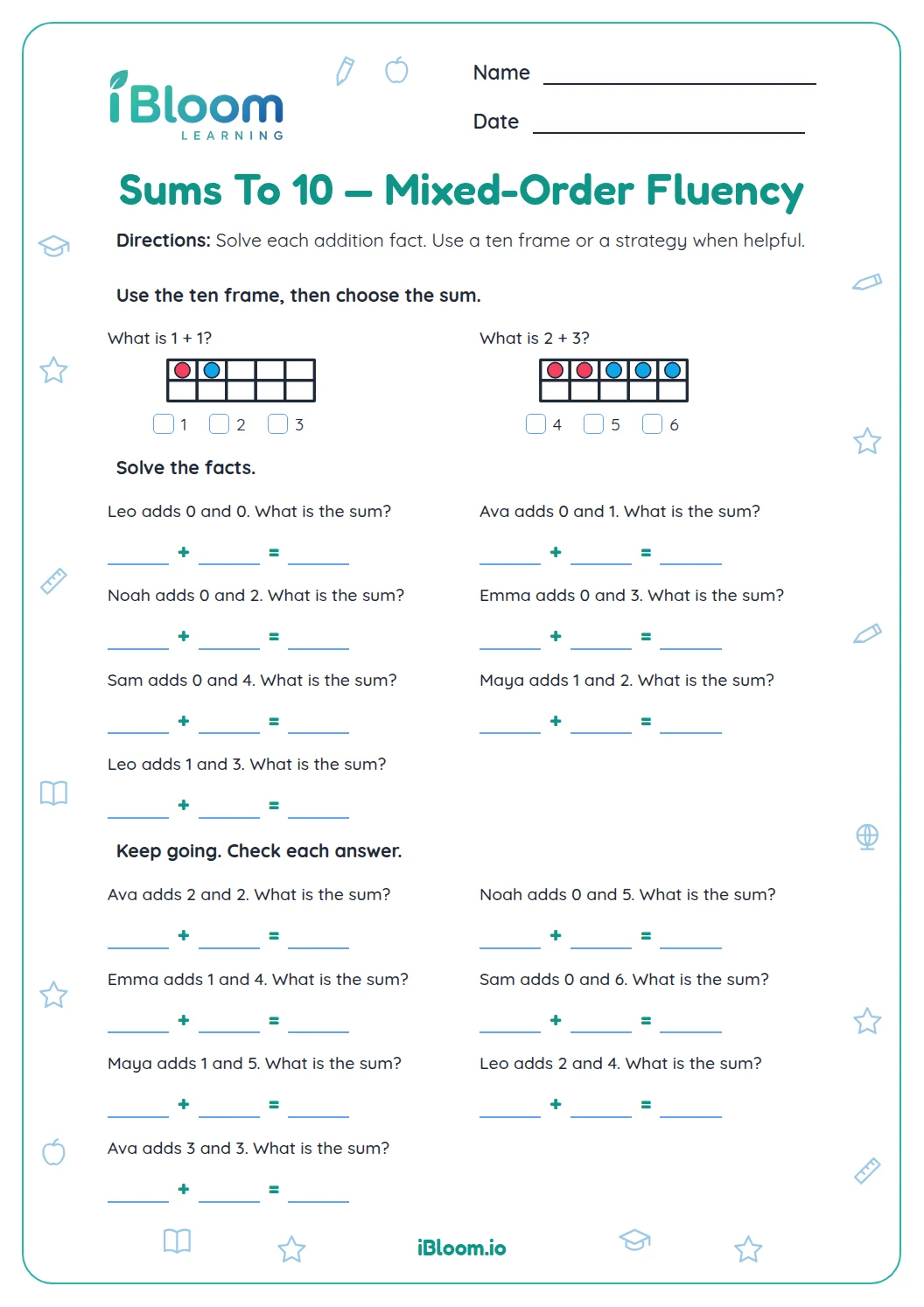
This free printable addition worksheet gives children in Grades 1–2 a short practice round with totals from 0 through 5. Part A has 24 addition facts in mixed order, including zero facts and doubles. Part B has four missing addends, so children use the same small totals to work backward. The sheet practices Common Core 1.OA.C.6 through counting on and the relationship between addition and subtraction. Children can use fingers or counters before answering from memory. A separate answer key makes it easy to check each fact, and timing is optional.
Aligned to 1.OA.C.6
Why mix the order of addition facts?
A list of changing facts asks children to attend to each equation. The totals here move up and down rather than following a counting pattern. Zero appears as either addend, and 2 + 2 gives practice with a double.
Use the first attempt to find which facts need support. A child who pauses at 2 + 3 can start at 3 and count on two: 4, 5. Return to that fact after a few other questions.
How do children find a missing addend?
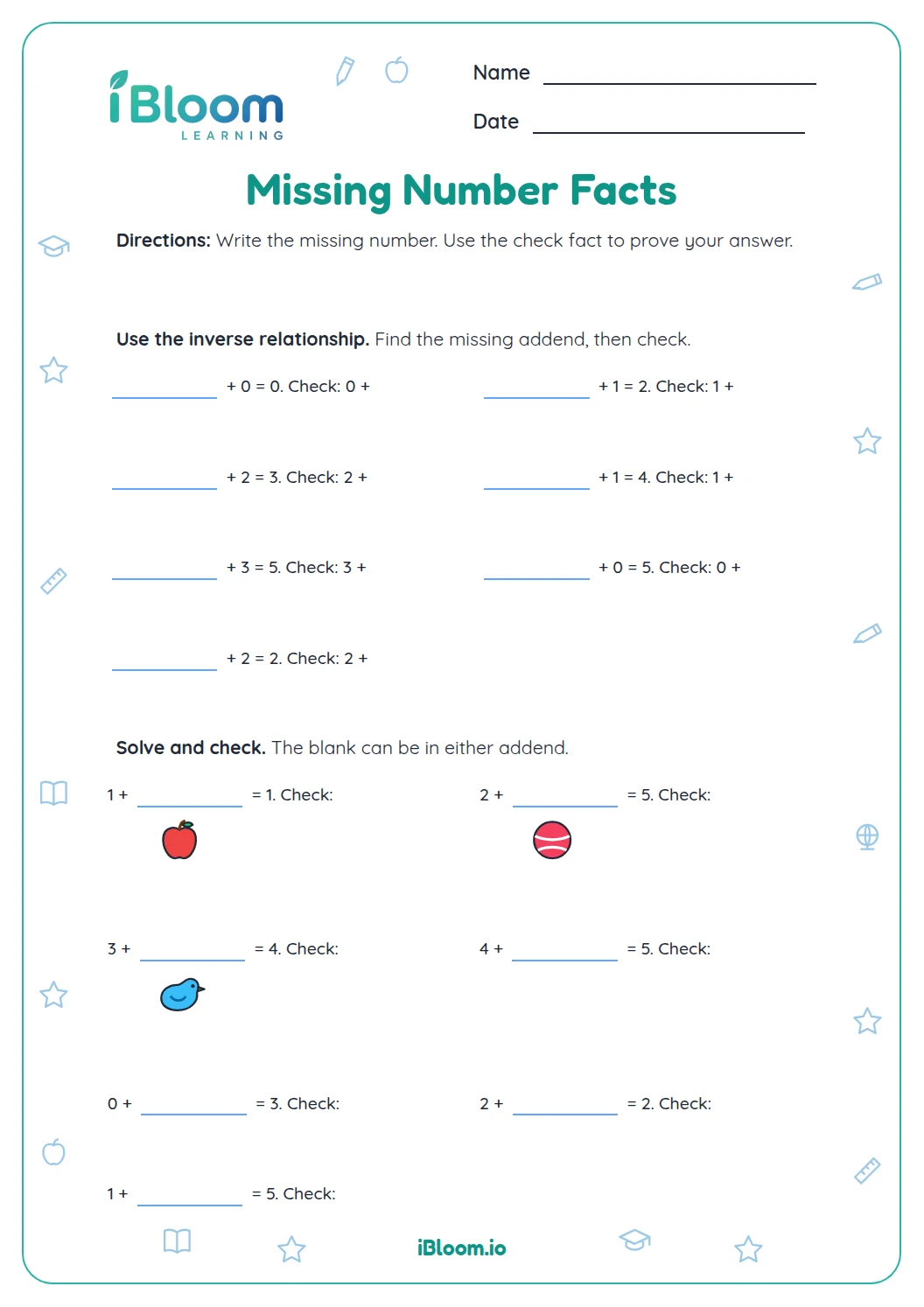
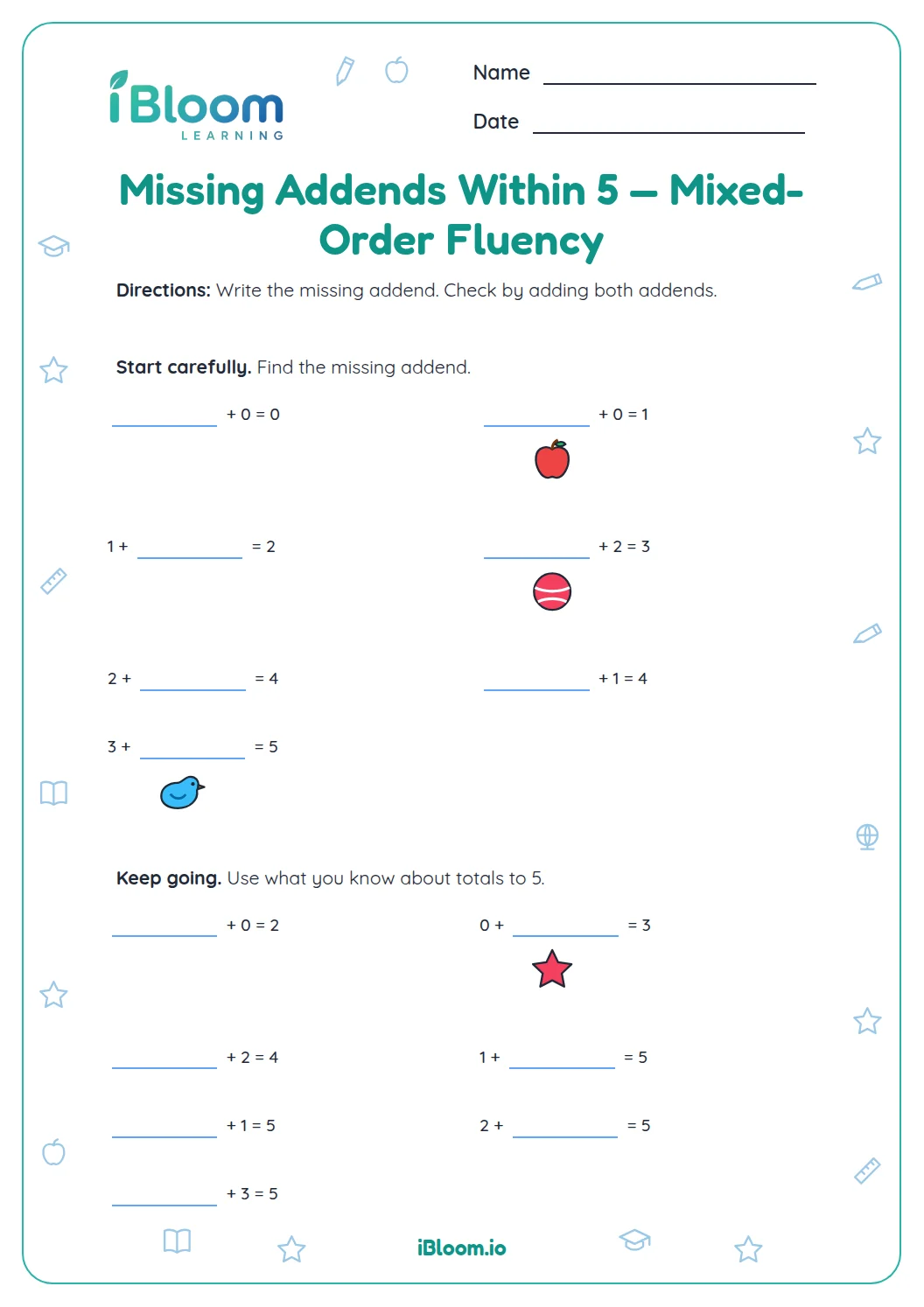
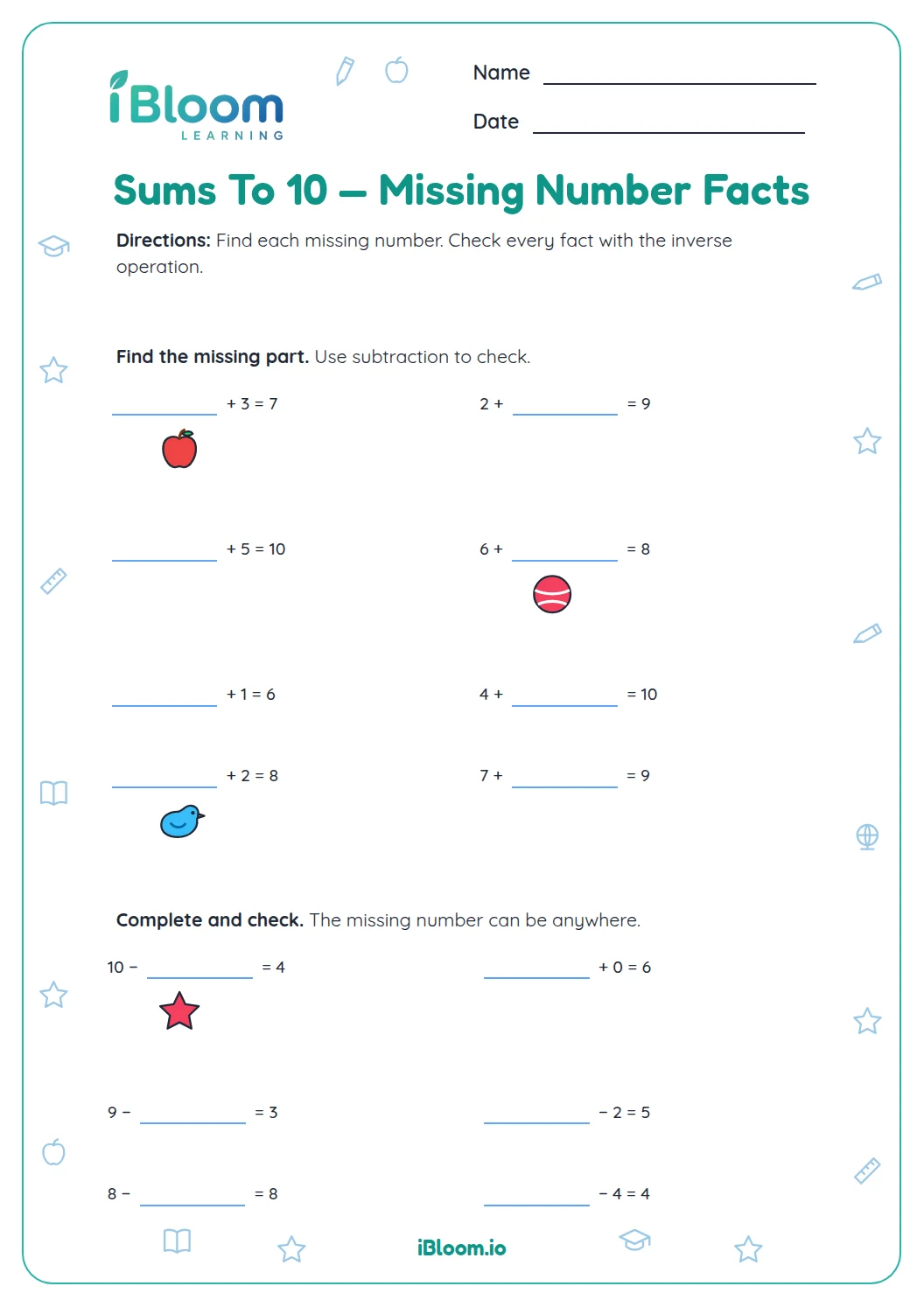
The number after the equals sign is the total, even when the blank comes earlier. In question 25, children know the starting amount and the total; they find how much needs to be added.
- 12 + ___ = 5
- 2Start with 2 counters. Add 3 more to make 5.
- 3Write 3 in the blank.
- 4Check: 2 + 3 = 5.
How should I check this fluency sheet?
Check accuracy first, then ask how the child solved one fact that took thought. Part A checks totals; Part B checks whether the child can use those totals flexibly.
If you reuse the sheet, compare the facts the child can now explain or recall. A stopwatch is optional. Correct, understood answers give you a useful next teaching step even without a speed score.
How to use this worksheet
- 1Read the directions and point to the two addends and the total in question 1.
- 2Let the child complete Part A, using counters for facts they do not yet recall.
- 3Before Part B, explain that the blank is an addend rather than the total.
- 4Check all 28 answers with the key and rebuild any missed fact with counters.
- 5Ask the child to say a related addition fact for one corrected answer.
Mistakes to check and ways to help
The mistake
Writing 4 for 0 + 3 because adding must make a number bigger.
The fix
Set out 3 counters and add none; the total stays 3.
The mistake
Writing 4 for 2 + 3 by counting 2 as the first step.
The fix
Start at 2, then take three new counting steps: 3, 4, 5.
The mistake
Writing 5 in the blank in 2 + ___ = 5.
The fix
Read the equation with the chosen number, then test whether the two addends really make 5.
Common Core alignment
Build addition fluency with small totals and use related facts to find missing addends.
On this sheet: The two parts practice addition within 5 and finding an unknown addend from a known total.
Show the official wordingHide the official wording
Add and subtract within 20, demonstrating fluency for addition and subtraction within 10. Use strategies such as counting on; making ten (e.g., 8 + 6 = 8 + 2 + 4 = 10 + 4 = 14); decomposing a number leading to a ten (e.g., 13 - 4 = 13 - 3 - 1 = 10 - 1 = 9); using the relationship between addition and subtraction (e.g., knowing that 8 + 4 = 12, one knows 12 - 8 = 4); and creating equivalent but easier or known sums (e.g., adding 6 + 7 by creating the known equivalent 6 + 6 + 1 = 12 + 1 = 13).
What to practice next
Make more practice
Further reading
Questions parents and teachers ask
Are all the answers 5?
No; the totals range from 0 through 5. Part A mixes facts such as 0 + 0, 1 + 2 and 2 + 3. Part B gives the total and asks for a missing addend, so the number children write may be smaller than the total.
Should I time this addition drill?
Timing is optional. Let the child finish accurately first, and ask how they solved a fact that felt hard. The sheet has 28 questions, so a short untimed practice session works well. If you later use a timer, keep checking the answers and discussing mistakes.
Can my child use fingers or counters?
Yes, fingers or counters can help children check these small totals. For 2 + 3, make a group of two and a group of three, then count all five. After checking, ask the child to say the complete fact before moving to the next question.
Why are there missing numbers in Part B?
Part B asks children to use a known total to find one addend. For 2 + ___ = 5, the missing number is 3. This gives another way to practice the same small addition facts and helps you see whether the child understands what the equals sign means.
How can I use the answer key after a mistake?
Use the key to identify the fact, then let the child rebuild it. If 0 + 3 was answered as 4, place three counters down and add none. Ask the child to correct the answer and say why adding zero leaves the total unchanged.