


About this worksheet
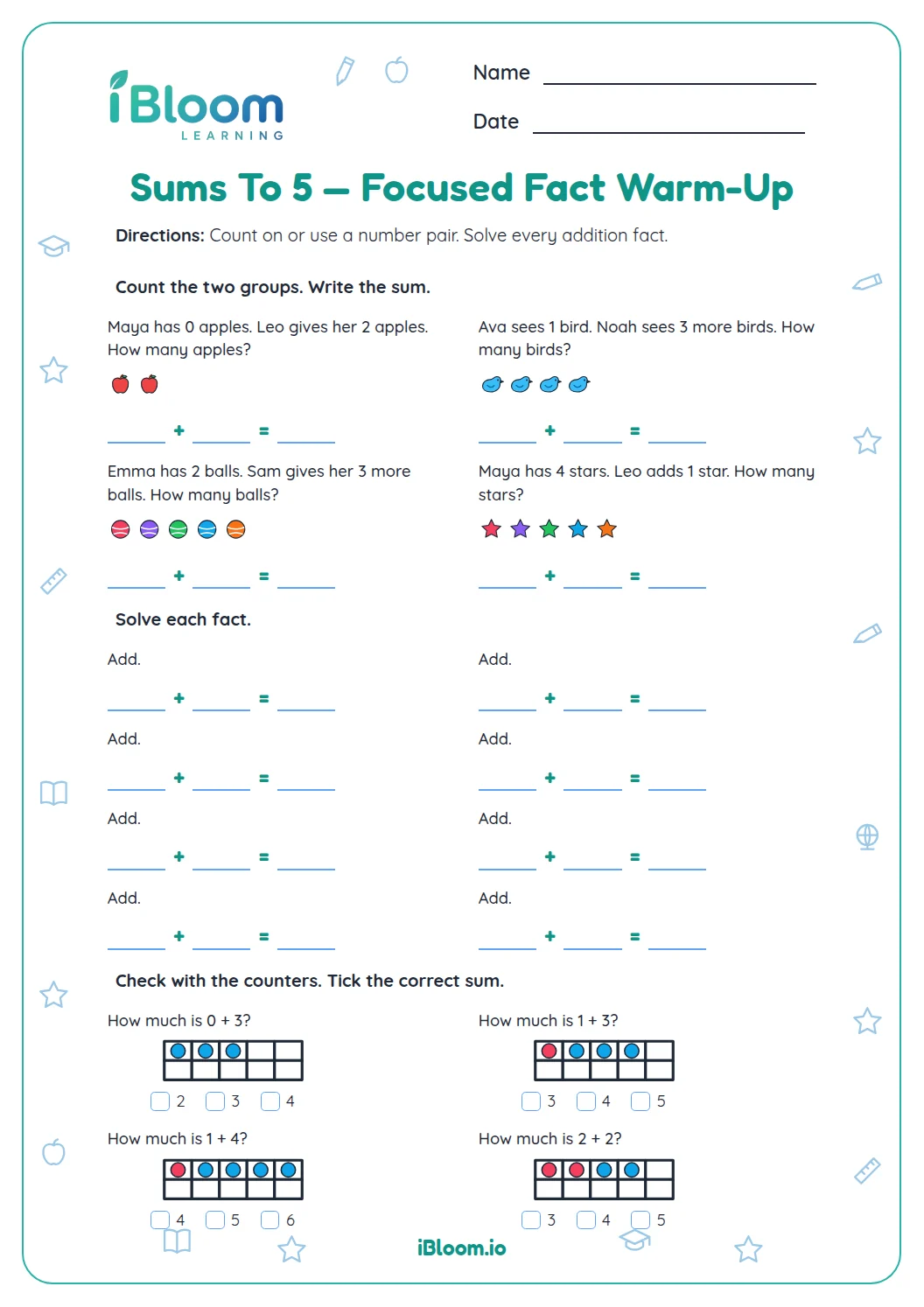
This printable gives learners 16 addition facts with totals from zero through five. Children can count on, count both addends, or use a related fact to find each total. The two-page answer key lists the answers. The facts practice CCSS K.OA.A.5.
Aligned to K.OA.A.5
What facts are included?
The 16 addition equations include zero facts, doubles, and other pairs with totals from zero through five. Each item is a number sentence to solve.
How can a child solve an addition fact?
For question 4, start at 1 and count on two more numbers: 2, then 3. So 1 + 2 = 3. Counting both addends is another way to find the total.
What does a zero addend do?
Adding zero leaves the other number unchanged. For example, 0 + 3 = 3. Check that fact by counting on three from zero or recalling the zero-addition rule.
How can the total be checked?
Count on from one addend, count both groups, or use a related fact. Check that the answer is the total and that it is no more than five.
How to use this worksheet
- 1Read both addends in the equation.
- 2Count on or combine the two amounts.
- 3Use a ten-frame when one is pictured.
- 4Write the total in the blank.
- 5Check the equation and compare with the answer key.
Common mistakes and quick fixes
The mistake
Counting the first addend again when counting on.
The fix
Say the first addend, then count only the next addend’s steps.
The mistake
Writing an addend instead of the total.
The fix
Combine both parts and put their total after the equals sign.
The mistake
Changing the total when adding zero.
The fix
Remember that adding zero leaves the other addend unchanged.
Common Core alignment
Practice addition facts with totals from zero through five.
On this sheet: Each of the 16 equations asks learners to add two numbers with a total of five or less.
Show the official wordingHide the official wording
Fluently add and subtract within 5.
What to practice next
Make more practice
Further reading
Questions parents and teachers ask
What does sums to 5 mean?
Every equation has a total from zero through five. This sheet includes 16 addition facts, including zero facts, doubles, and different pairs that make five. The separate answer key lists every total so a learner can check each number sentence after trying it.
How can a child count on?
Start with one addend and count forward by the other addend. For 1 + 2, start at 1 and say two, three. The answer is 3. Counting on avoids recounting the first amount and works for the small totals on this sheet.
Can children count on or count all?
Yes. Counting all means counting both amounts from one. To count on for 1 + 2, say one and count two more numbers: two, three. Either approach finds the total, and each answer on this sheet stays at five or below.
Why does adding zero keep the same number?
Zero means no extra objects join the group. If there are three objects and zero more are added, there are still three. The worksheet includes zero facts among its 16 equations so learners can practice this idea. An adult can read the prompt aloud and review the choices with the learner.
How long does this addition sheet take?
The 16 short equations take about 10 minutes for many learners, with extra time if they use counters or talk through a strategy. The two-page answer key gives the total for each equation and supports a quick review. An adult can read the prompt aloud and review the choices with the learner.