


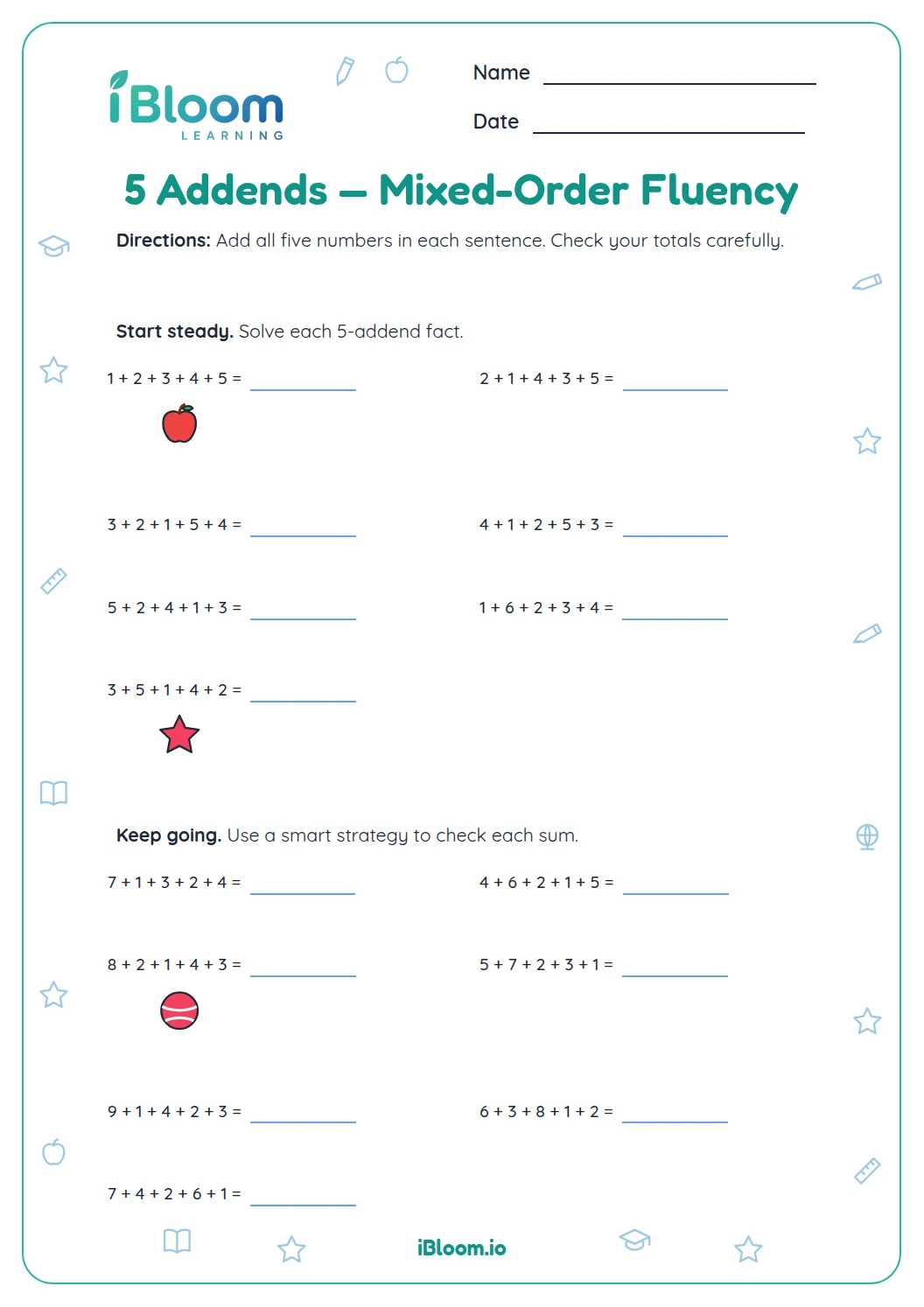
About this worksheet
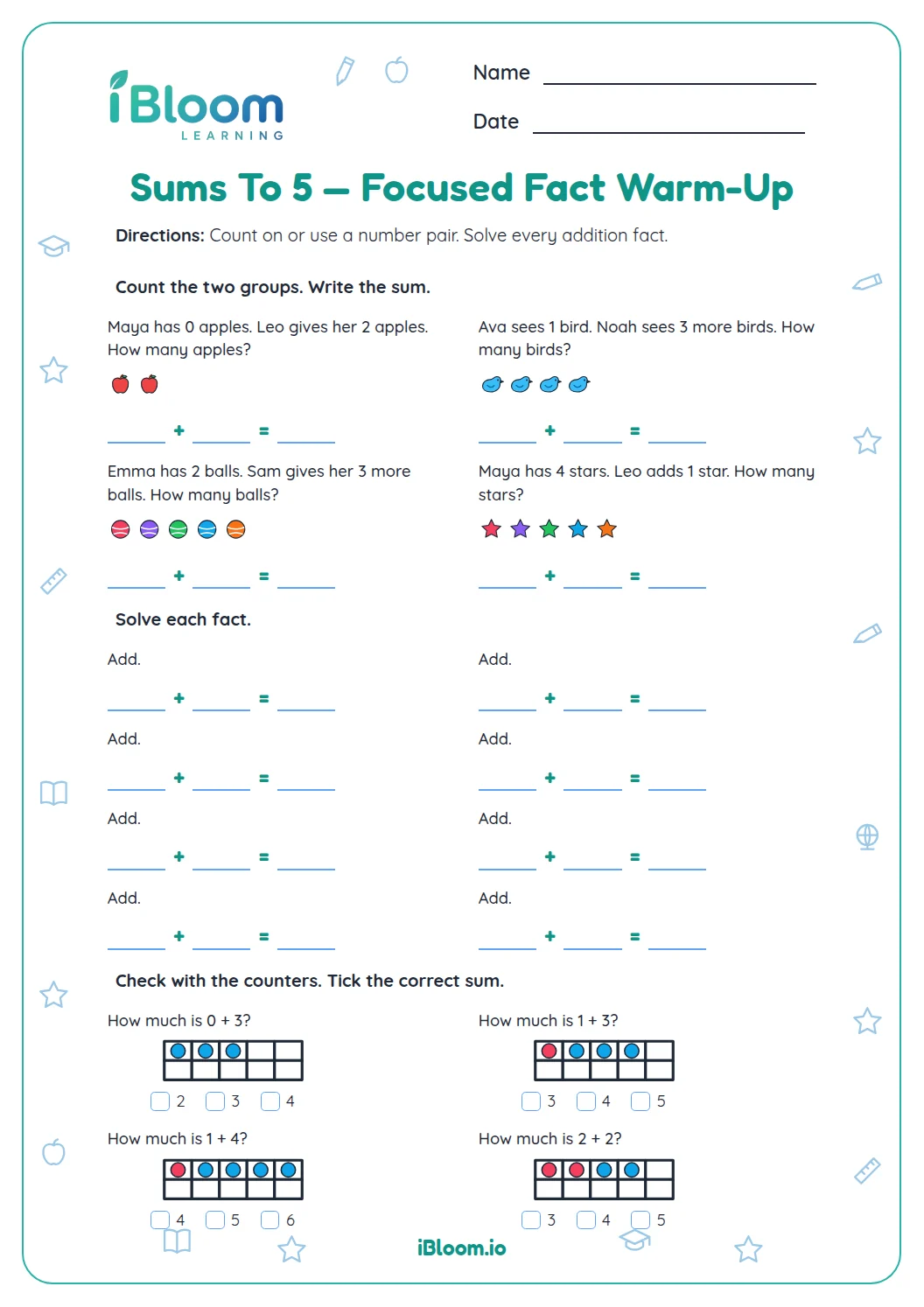
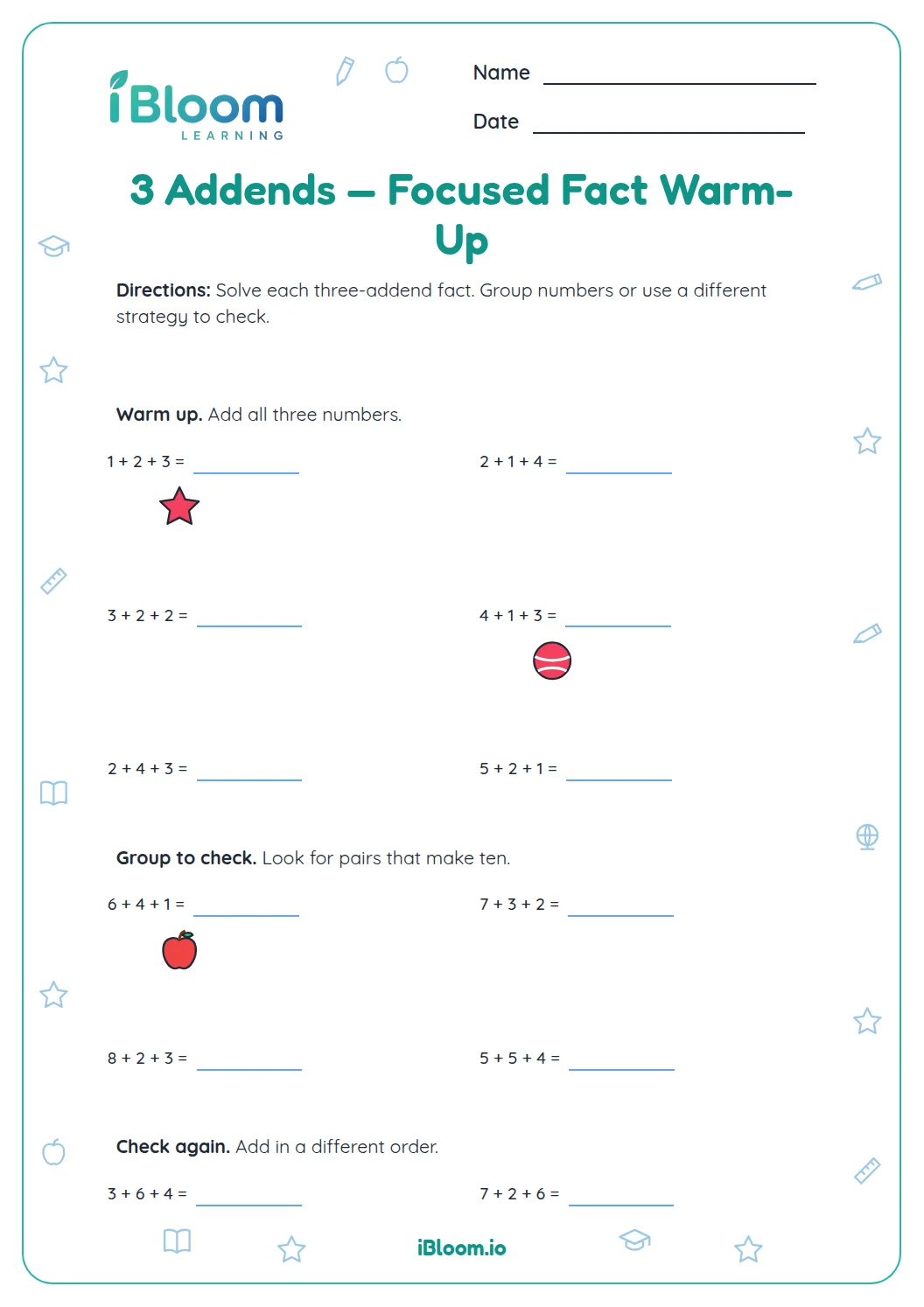
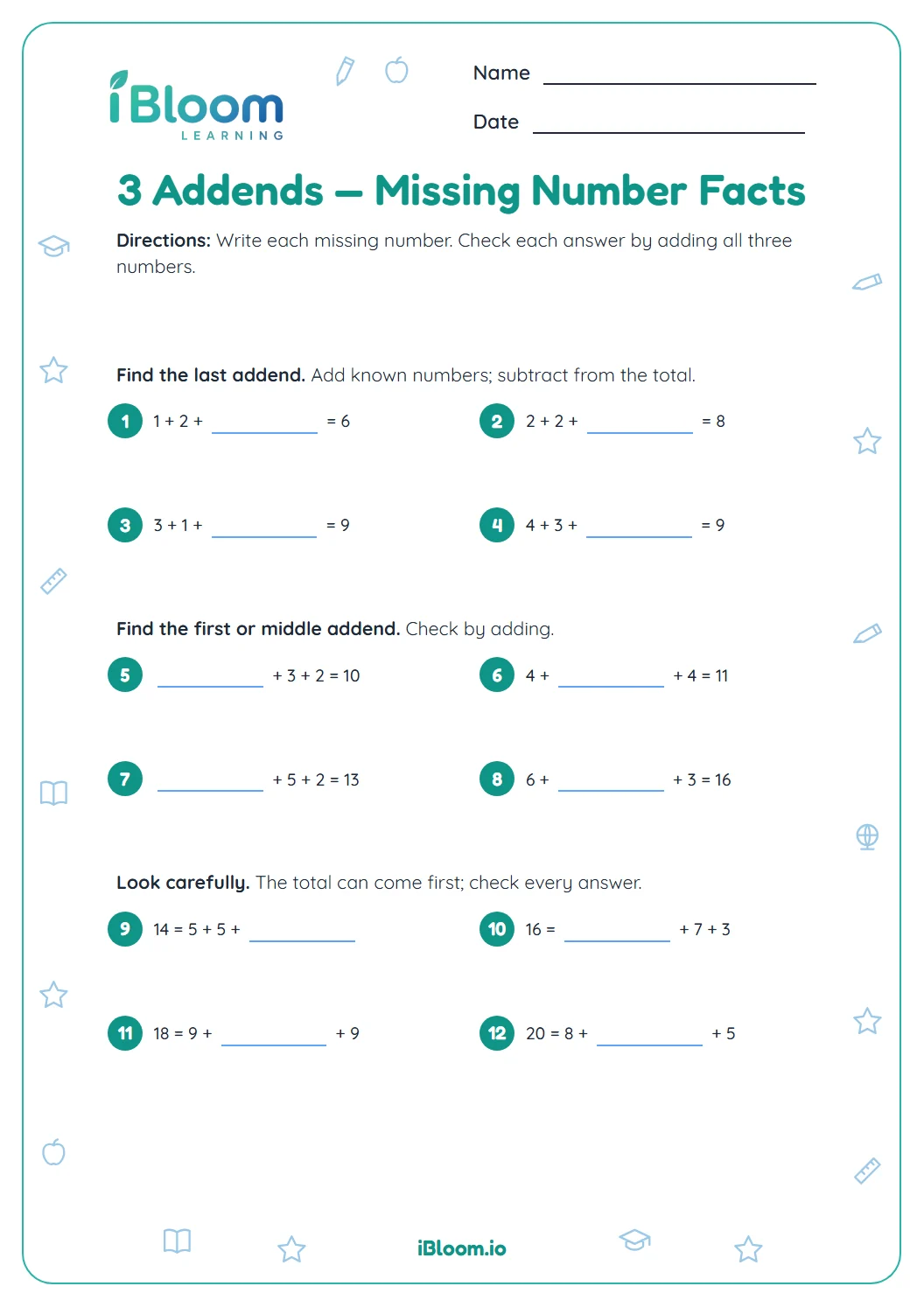
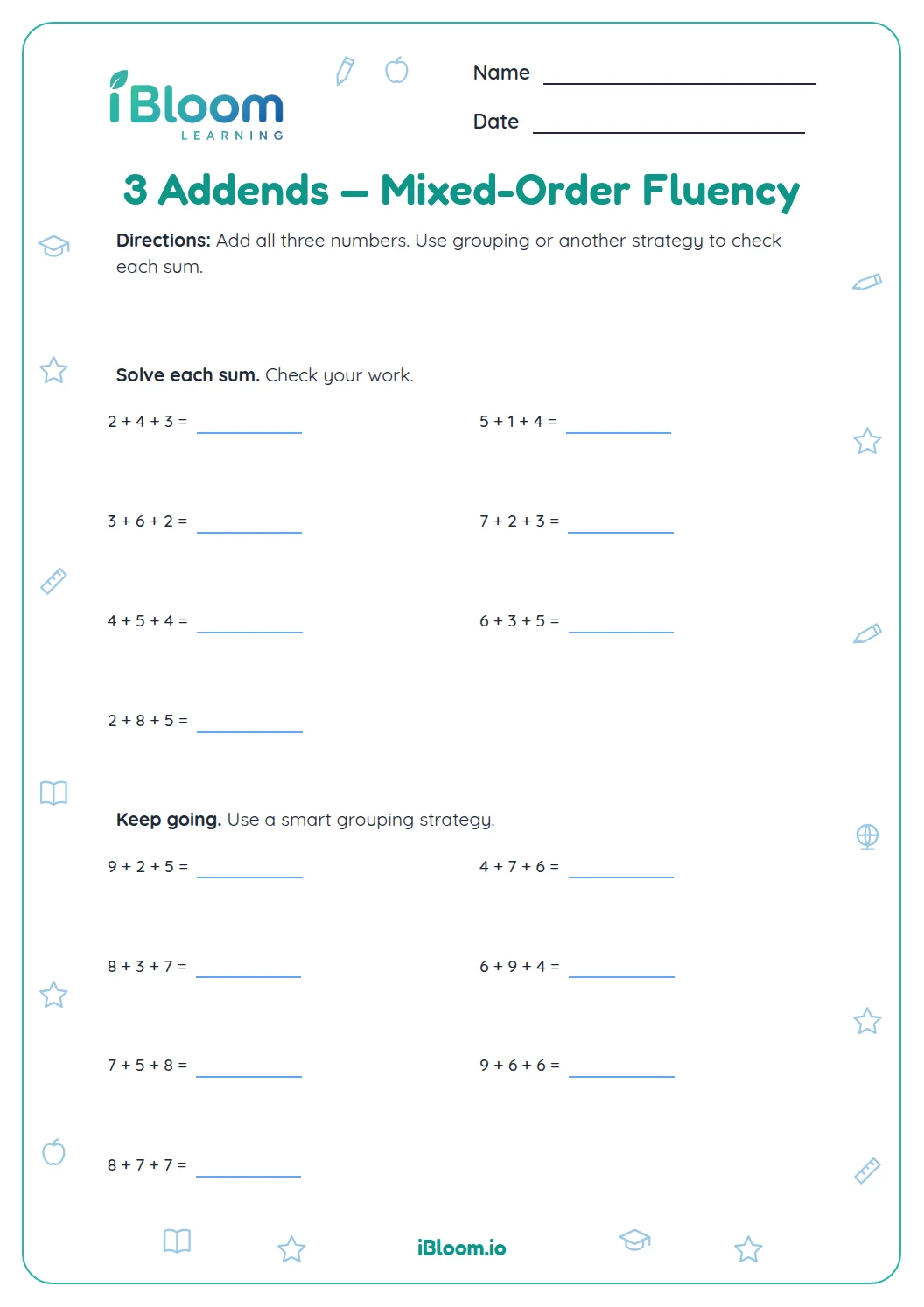
This Grade 1 printable builds missing-addend practice with totals of 5 or less. The 20 equations vary the addends, totals, and position of the blank instead of repeating only one fact. Two number bonds show how the addends make a whole, and a separate answer key lists each missing number.
Aligned to 1.OA.D.8
How can a child find the missing part?
The total names the whole amount. Subtracting a known addend reveals the other part.
- 13 + ___ = 5 5 − 3 = 2 The missing addend is 2.
What will children practice?
The 20 facts include totals from 1 to 5, including zero addends and blanks on either side of the equation.
- Part A: 10 missing-part facts
- Part B: 10 related facts and checks
How can an adult support the practice?
Point to the total and the addend that is already known. Count on or subtract to find the missing part, then add the two parts to check.
How to use this worksheet
- 1Read the total after the equals sign.
- 2Find the addend you already know.
- 3Count on or subtract to find the other part.
- 4Fill the blank and check by adding.
Common mistakes and quick fixes
The mistake
Using the total as the missing addend.
The fix
The total is the sum; the missing number is one of its parts.
The mistake
Forgetting that adding zero leaves a number unchanged.
The fix
If one addend is zero, the other addend equals the total.
The mistake
Counting the first number as a jump.
The fix
When counting on, count each number after the starting addend.
Curriculum alignment
This worksheet practices the following standard.
Find the unknown whole number in addition and subtraction equations.
On this sheet: Each number sentence asks learners to find a missing addend or total.
Show the official wordingHide the official wording
Determine the unknown whole number in an addition or subtraction equation relating three whole numbers.
What to practice next
Make more practice
Further reading
Questions parents and teachers ask
What totals appear on the page?
The facts use totals from 1 through 5. Every equation asks for a missing addend, and the missing value may be zero or a positive whole number. The answer key lists the value for each blank. Ask the learner to point to the equation, picture, or situation that supports the answer.
How can I explain the blank to a child?
The blank is one part of the total. Ask what number combines with the known addend to make the total, then check by adding the two parts together. Ask the learner to point to the equation, picture, or situation that supports the answer.
Can a missing addend be zero?
Yes. For example, 4 + ___ = 4 has a missing addend of 0. Adding zero does not change the other number, so this is a useful fact to include in the set. Ask the learner to point to the equation, picture, or situation that supports the answer.
Are number bonds included?
Yes. Two questions show a number bond with the whole and one part already labeled. Children use the relationship between the whole and its parts to find the missing number. Ask the learner to point to the equation, picture, or situation that supports the answer.
Is an answer key provided?
Yes. A separate key includes all 20 missing numbers. It can help an adult review the work after completion or guide a child through checking a number sentence. Ask the learner to point to the equation, picture, or situation that supports the answer.