


About this worksheet
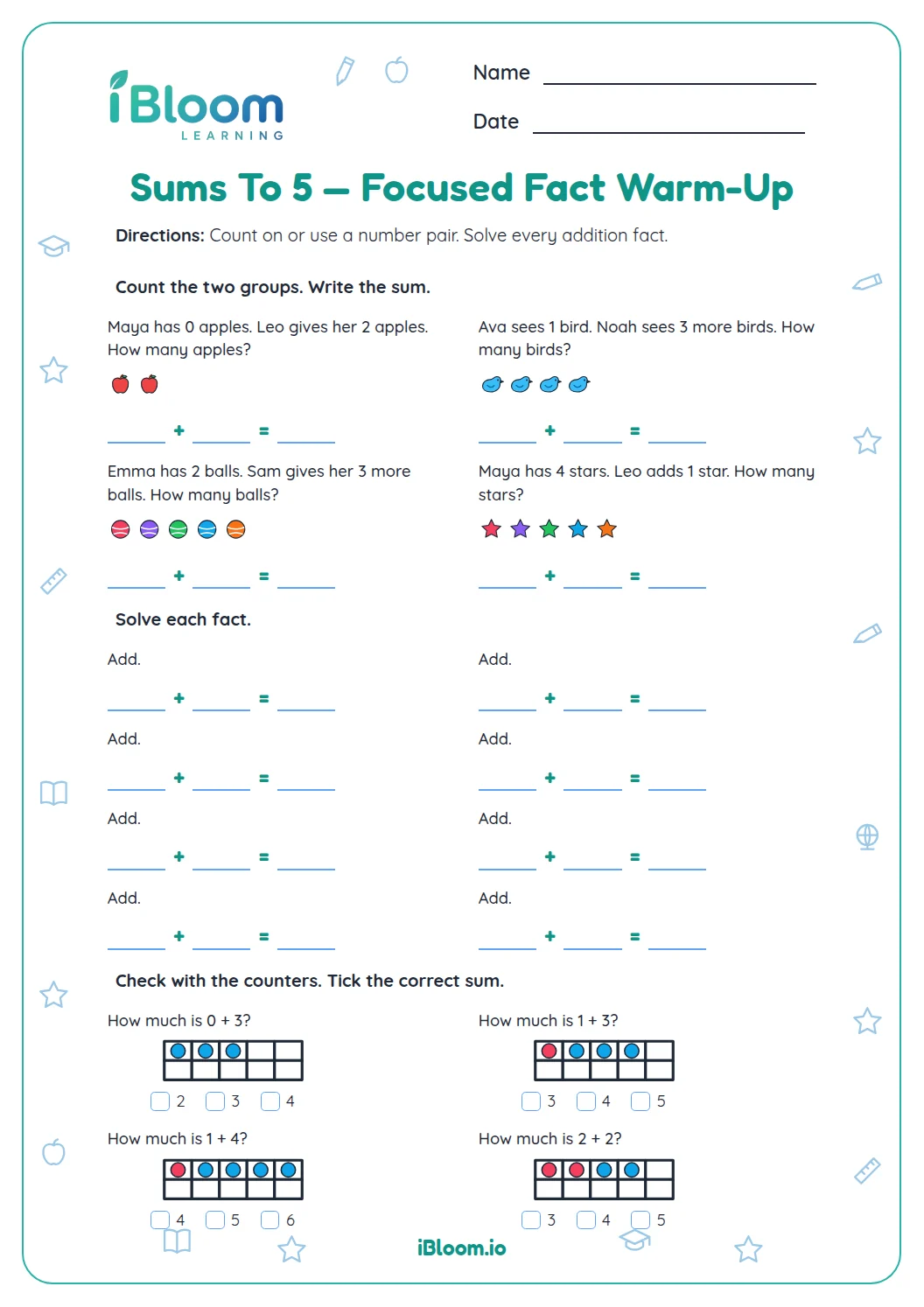
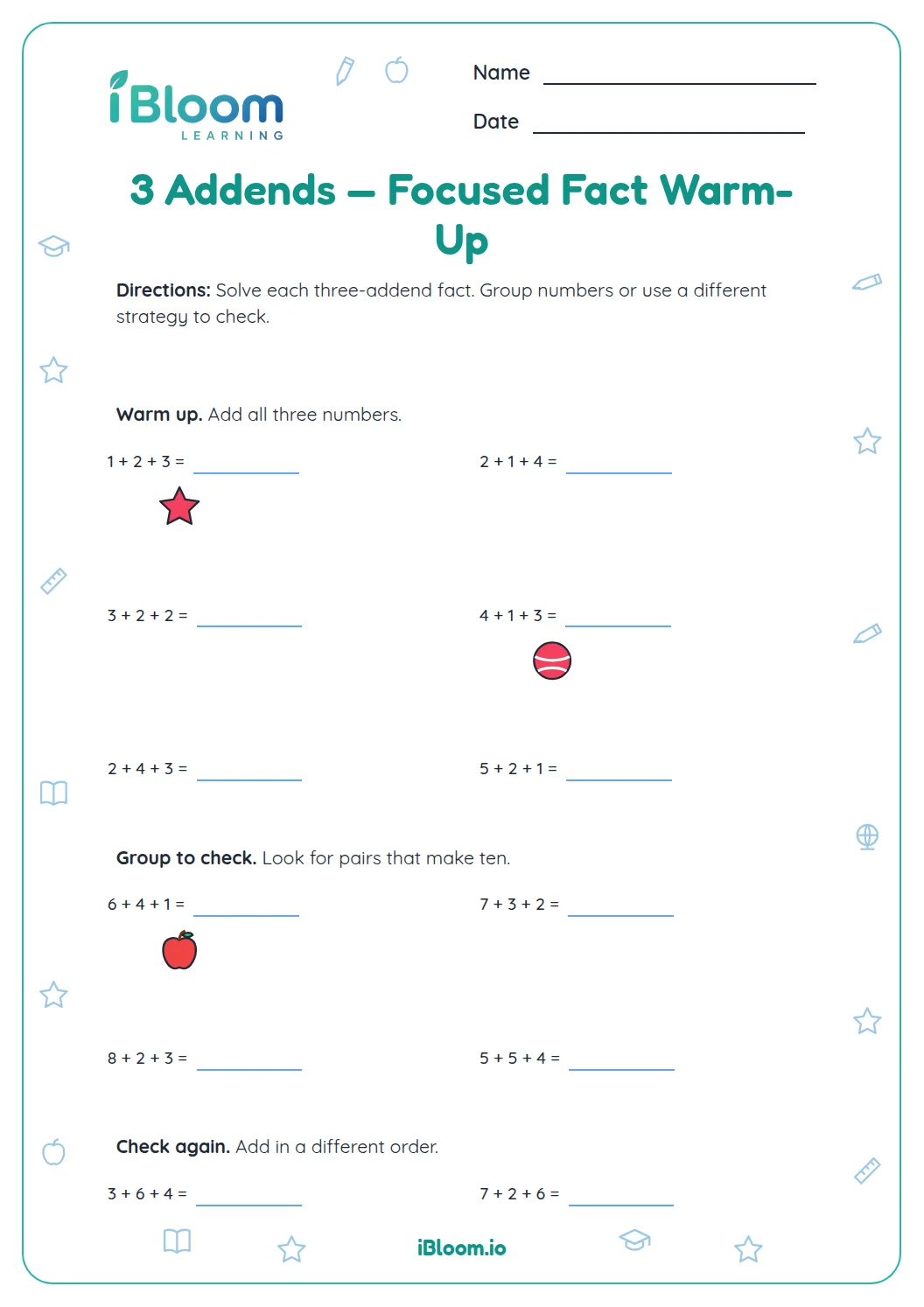
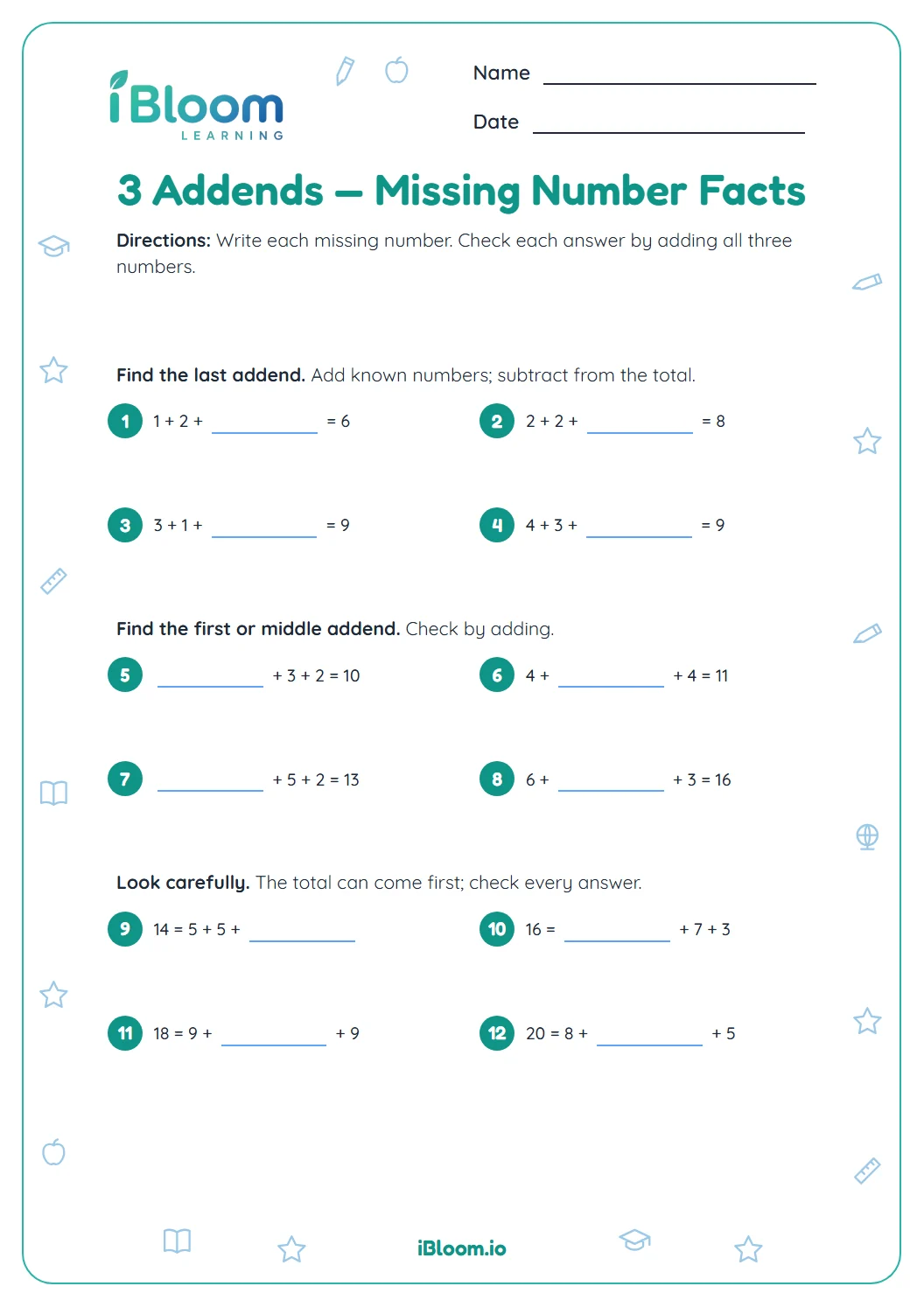
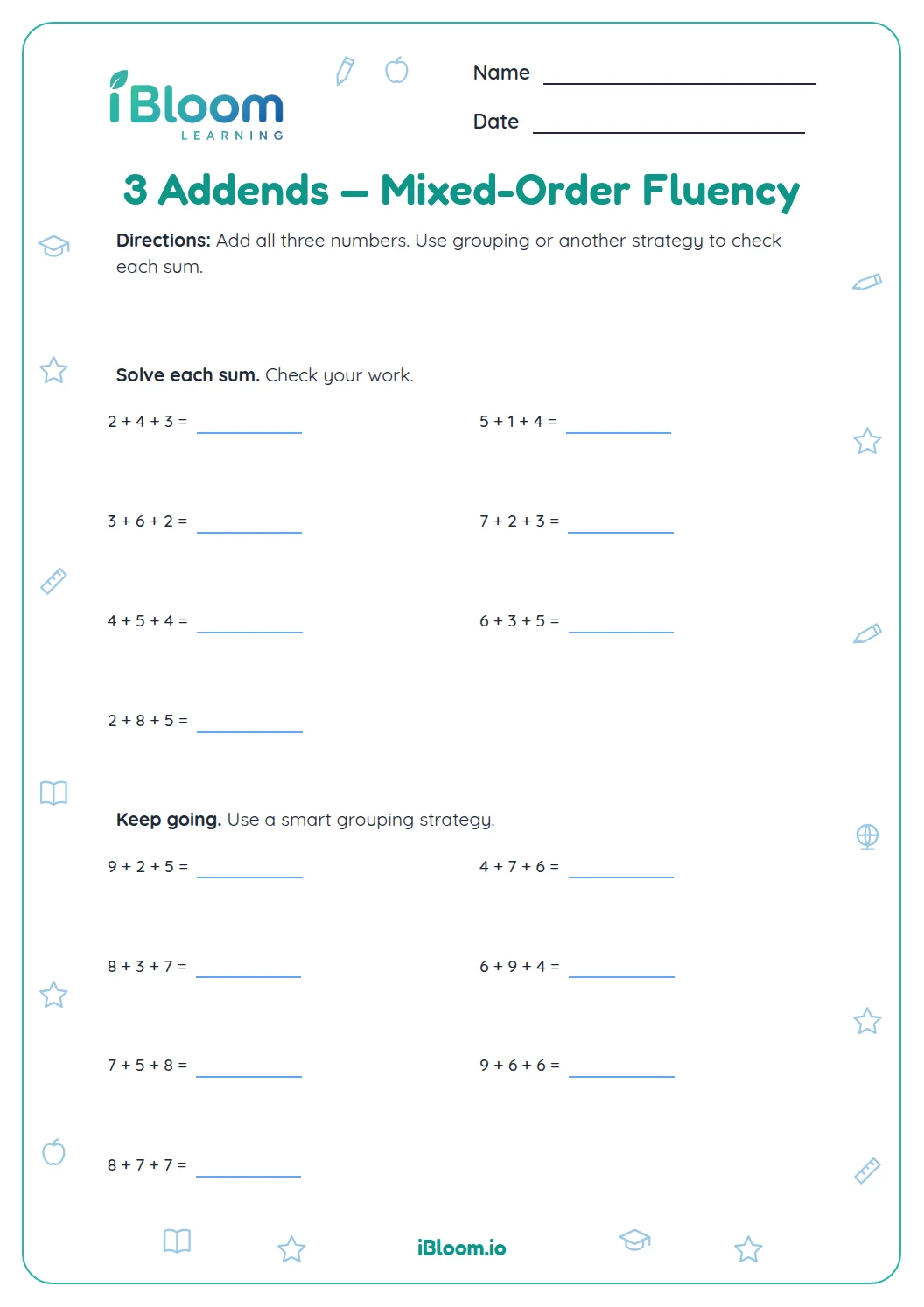
This Grade 1 addition printable has 18 questions: 16 facts with sums of 5 or less and two short stories. The first round focuses on accuracy; a second round offers more facts, with timing optional. Learners also record correct totals and time separately. The answer key lists each sum.
Aligned to 1.OA.C.6
What is in the accuracy round?
Round 1 contains eight facts, including pairs that make 5 and smaller totals. Learners record the number correct before moving on.
For 2 + 3, count on three from 2 to reach 5.
How does the optional timed round work?
Round 2 has eight more sums to 5 or less. A time can be recorded if the learner is ready, but it is optional.
Encourage the learner to solve at a comfortable pace and record accuracy separately from time.
How do the story problems use sums to 5?
Two short stories ask learners to combine blocks and add a bird. Both totals stay within 5.
Ask which two groups are being joined, then write or say the matching addition sentence.
How to use this worksheet
- 1Solve the facts at a steady pace.
- 2Use counters or fingers if a fact is not automatic yet.
- 3Check that each sum is 5 or less.
- 4Write an equation for each story problem.
- 5If using a timer, record the time as a personal reference, not a goal.
Common mistakes and quick fixes
The mistake
Answering before reading the full prompt.
The fix
Read every word and identify exactly what the question asks.
The mistake
Skipping a clue, sound, or calculation step.
The fix
Point to the evidence or write the number sentence before answering.
The mistake
Changing an answer without checking it.
The fix
Compare the answer with the prompt and explain why it fits.
Common Core alignment
This practice connects the worksheet activities to the standard below.
Build fluency with addition facts whose sums are 5 or less.
On this sheet: Build fluency with addition facts whose sums are 5 or less.
Show the official wordingHide the official wording
Add and subtract within 20, demonstrating fluency for addition and subtraction within 10.
What to practice next
Make more practice
Further reading
Questions parents and teachers ask
Is the timed round required?
No. The second round is labeled optional, and a learner may complete it without timing. The first round is for accuracy. If an adult records time, keep it separate from the correct-answer count so the learner can focus on both measures.
How many addition questions are on the sheet?
There are 18 questions: 16 addition facts and two short story problems. Each sum is 5 or less. The sheet also has spaces to record round results and time, but those recording spaces are not extra math questions.
What does the answer key show?
The answer key lists the sums for the two fact rounds and the results of the story problems. Review a missed item by representing the addends with counters or fingers and combining them. Have the learner recount the total.
Can the story problems be read aloud?
Yes. An adult can read the blocks and bird stories aloud. Ask the learner to name the two amounts being combined, then solve. For example, two blue blocks plus three red blocks make five blocks altogether. The learner can model the groups with counters.
How should the timing be used?
Use timing only if it feels useful to the learner. Record accuracy first, and treat time as optional information rather than a goal they must meet. Learners can repeat the facts untimed to build confidence before trying a timed round.