


About this worksheet
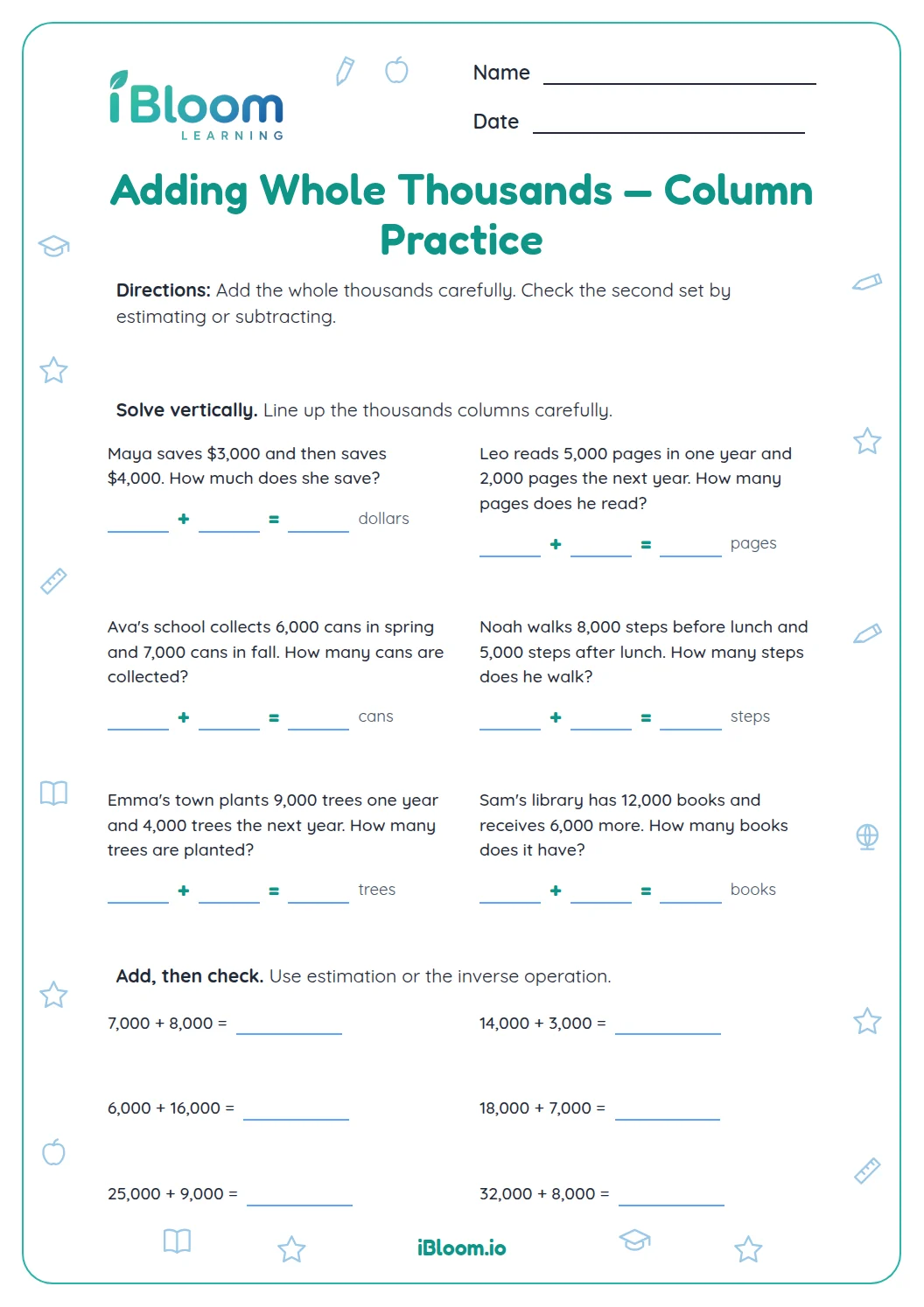
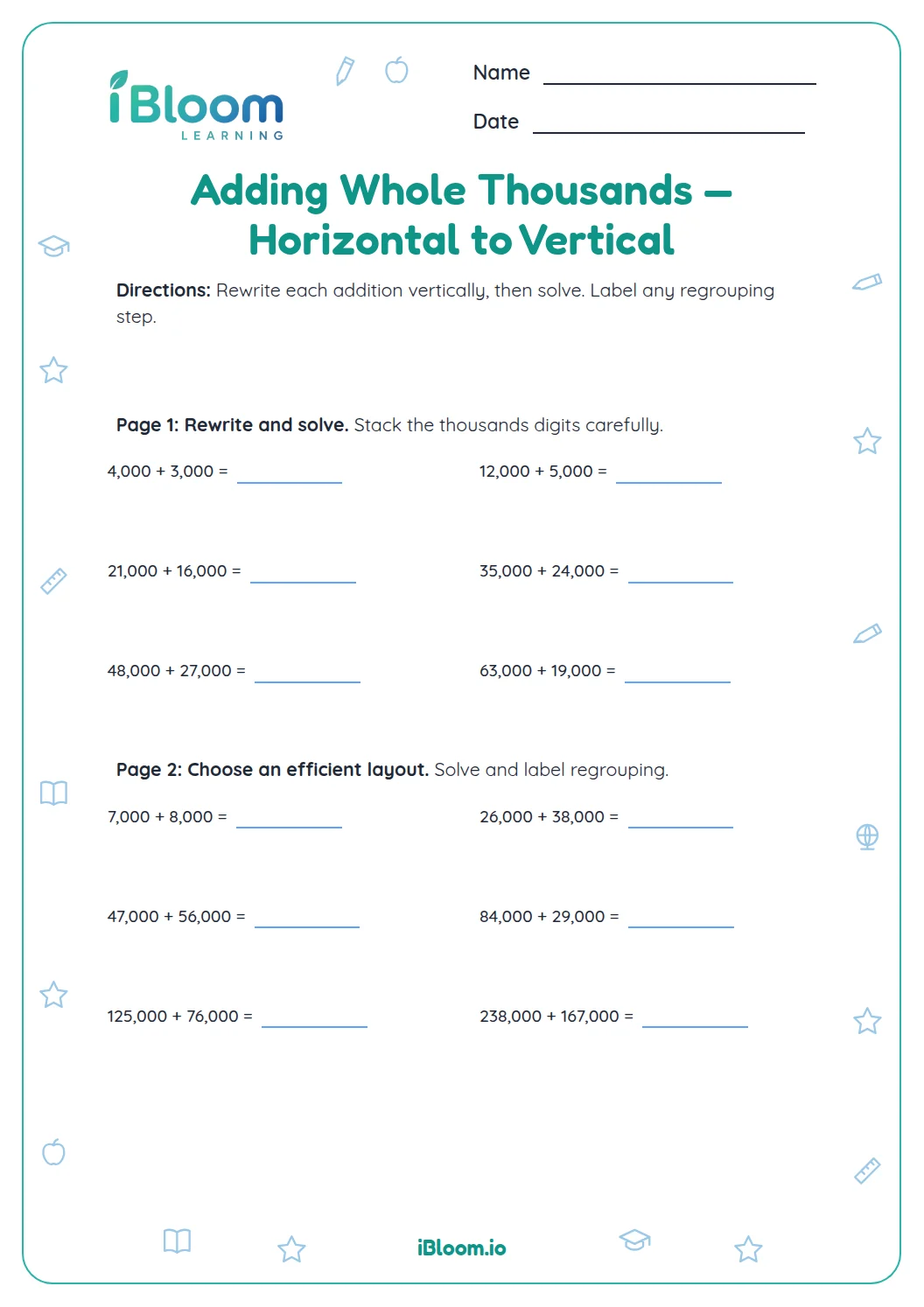
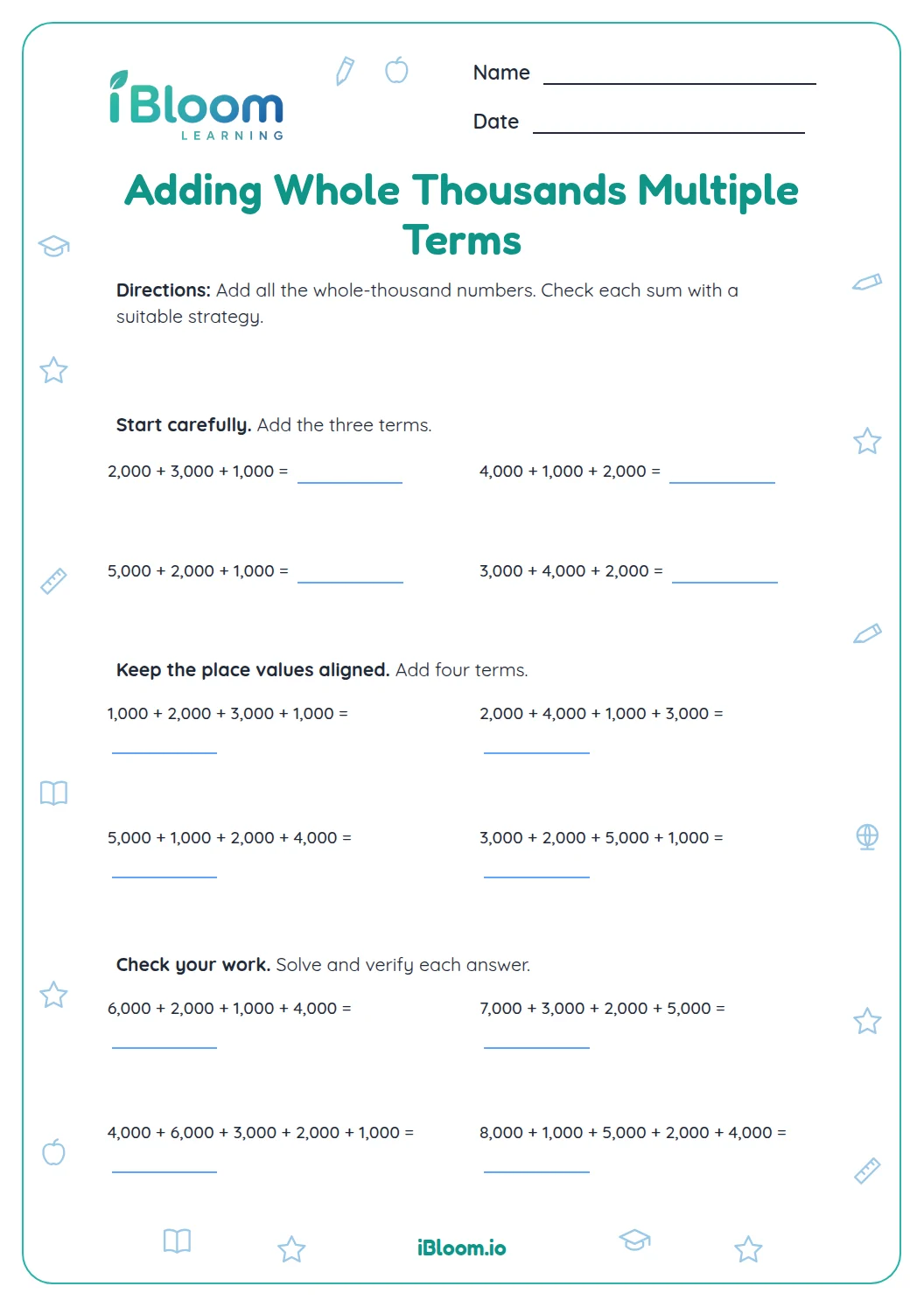
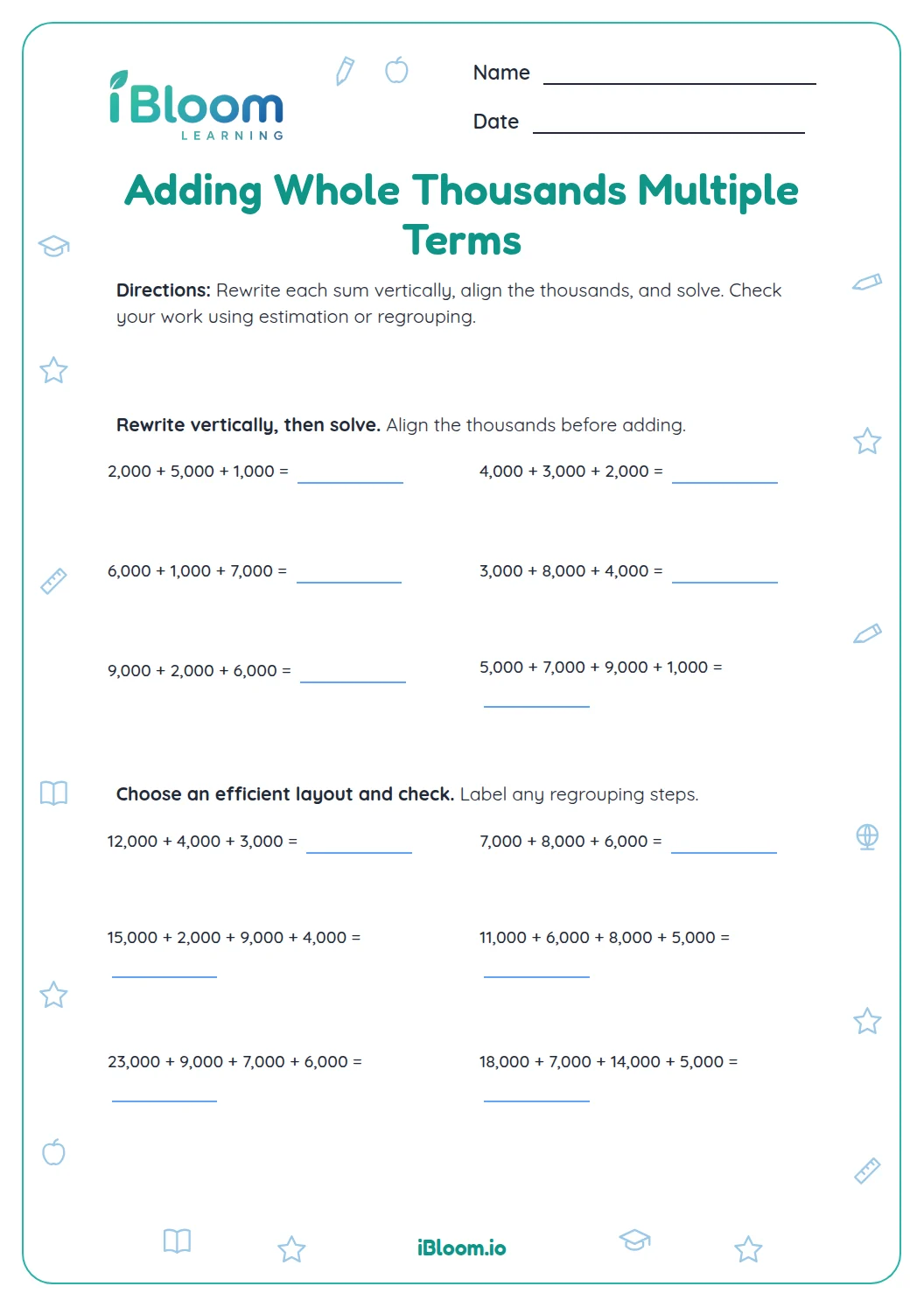
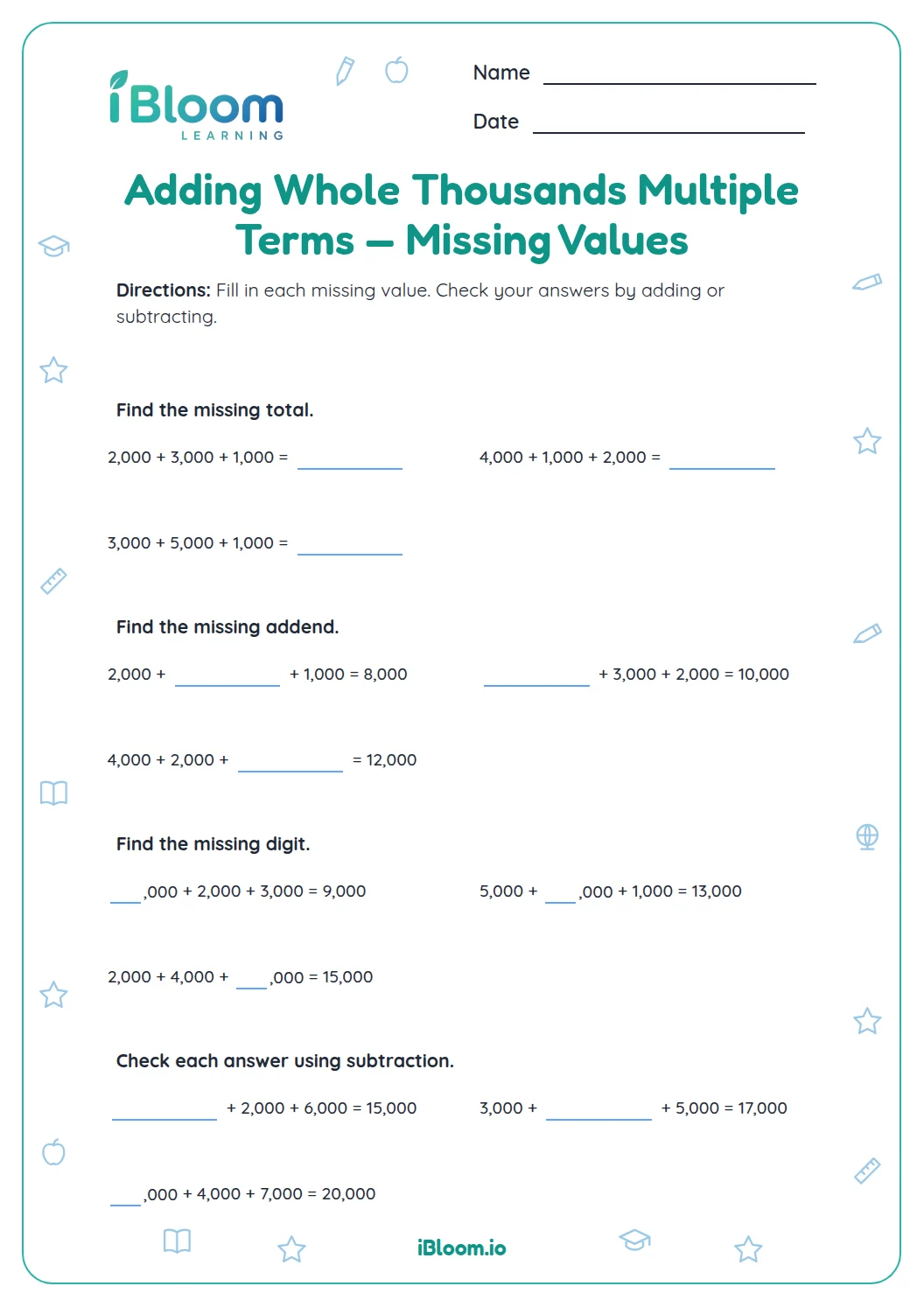
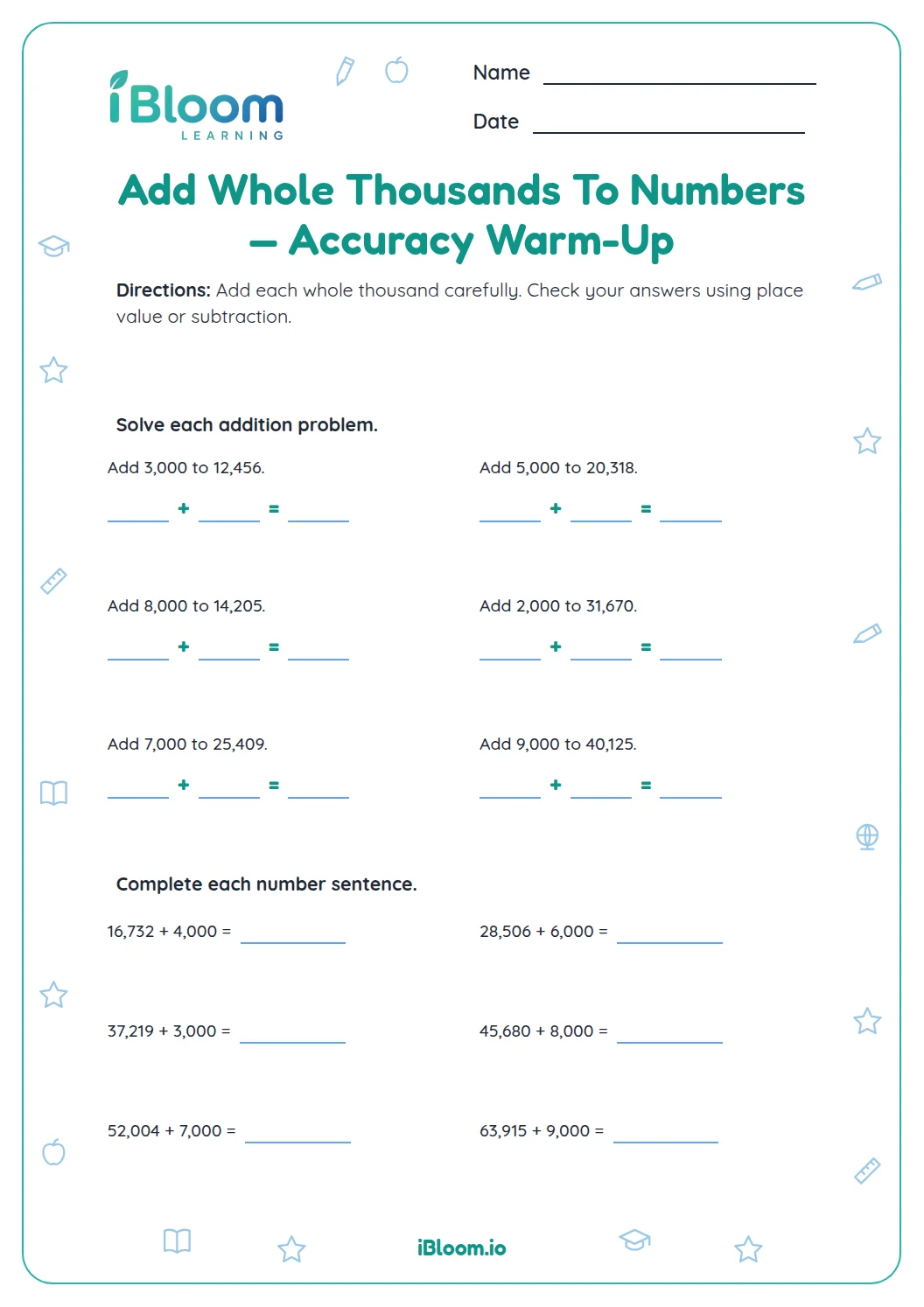
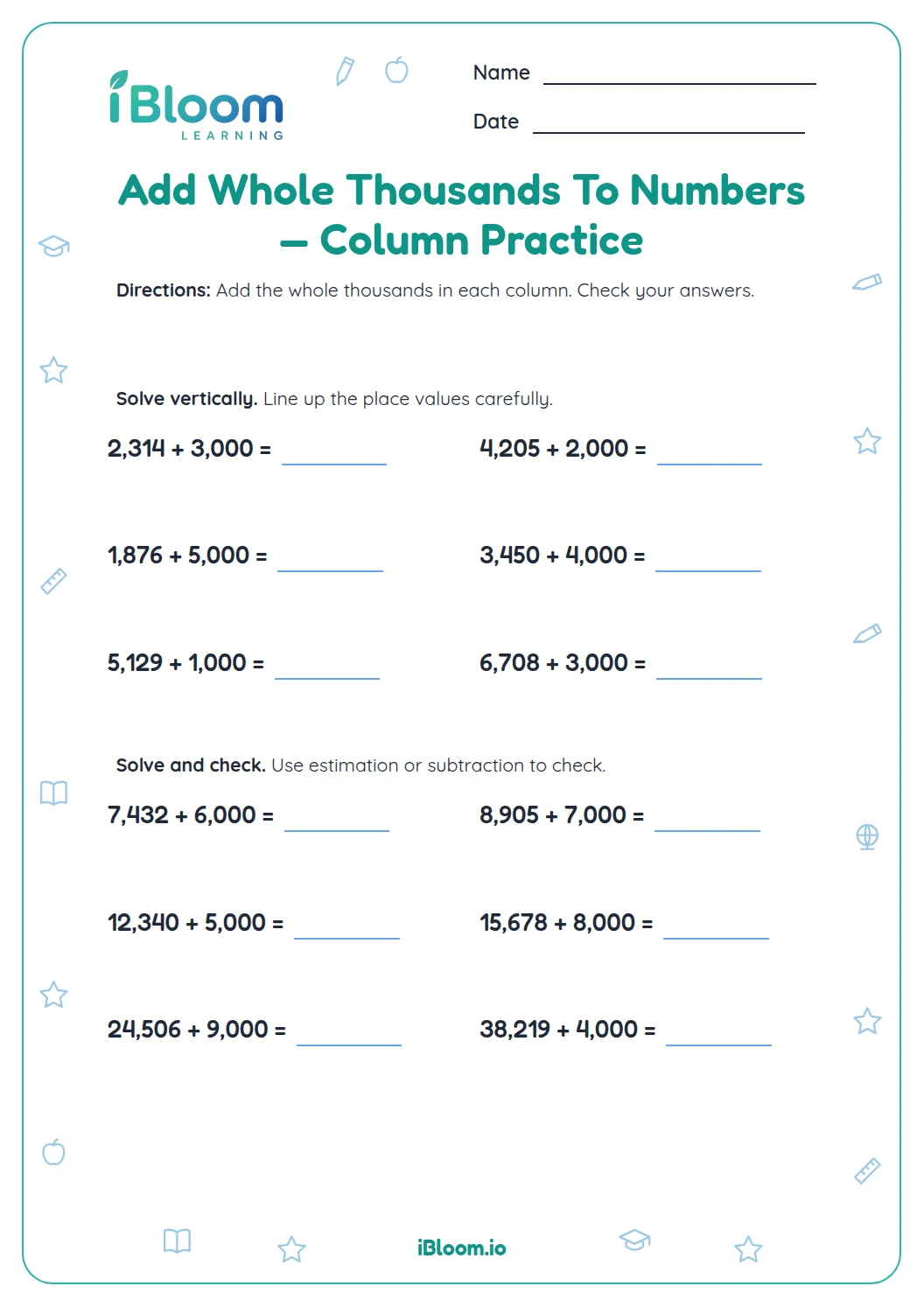
This Grades 5–6 drill contains 16 whole-thousand addition questions in three parts: two-term sums, missing addends, and three-term sums. Students work with numbers from thousands through one million and can check results with subtraction or estimation. The answer key provides exact results.
How do you add two whole-thousand terms?
Part A begins with 3,000 + 4,000 = ___. Add the thousands: 3 + 4 = 7, so the sum is 7,000. Later items use larger addends and totals.
- Keep the thousands place aligned when recording work.
How do you find a missing addend?
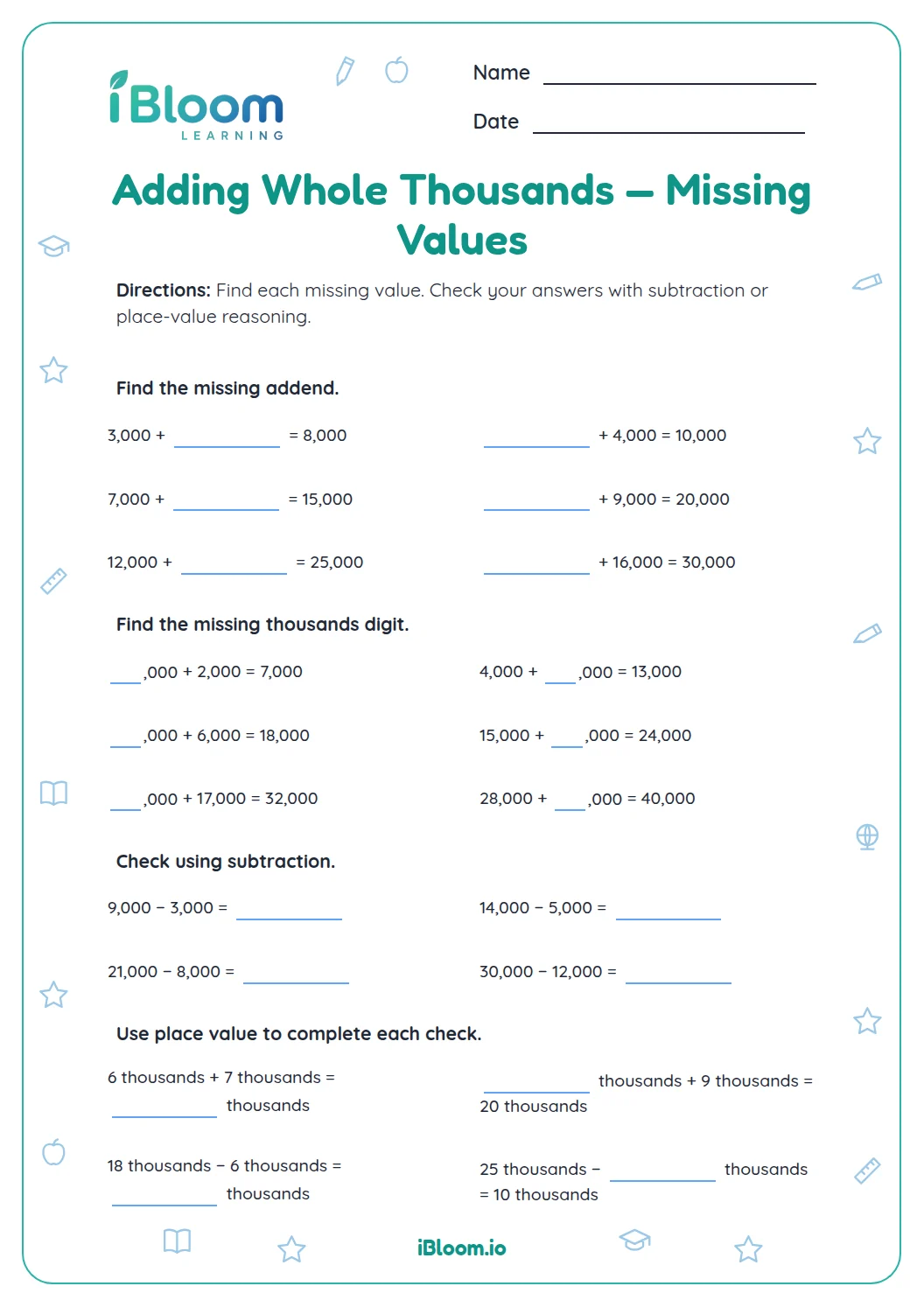
Part B asks for the missing part. For 17,000 + ___ = 26,000, subtract 17,000 from 26,000 to get 9,000, then add to check.
- Subtract the known addend from the total.
What changes with three addends?
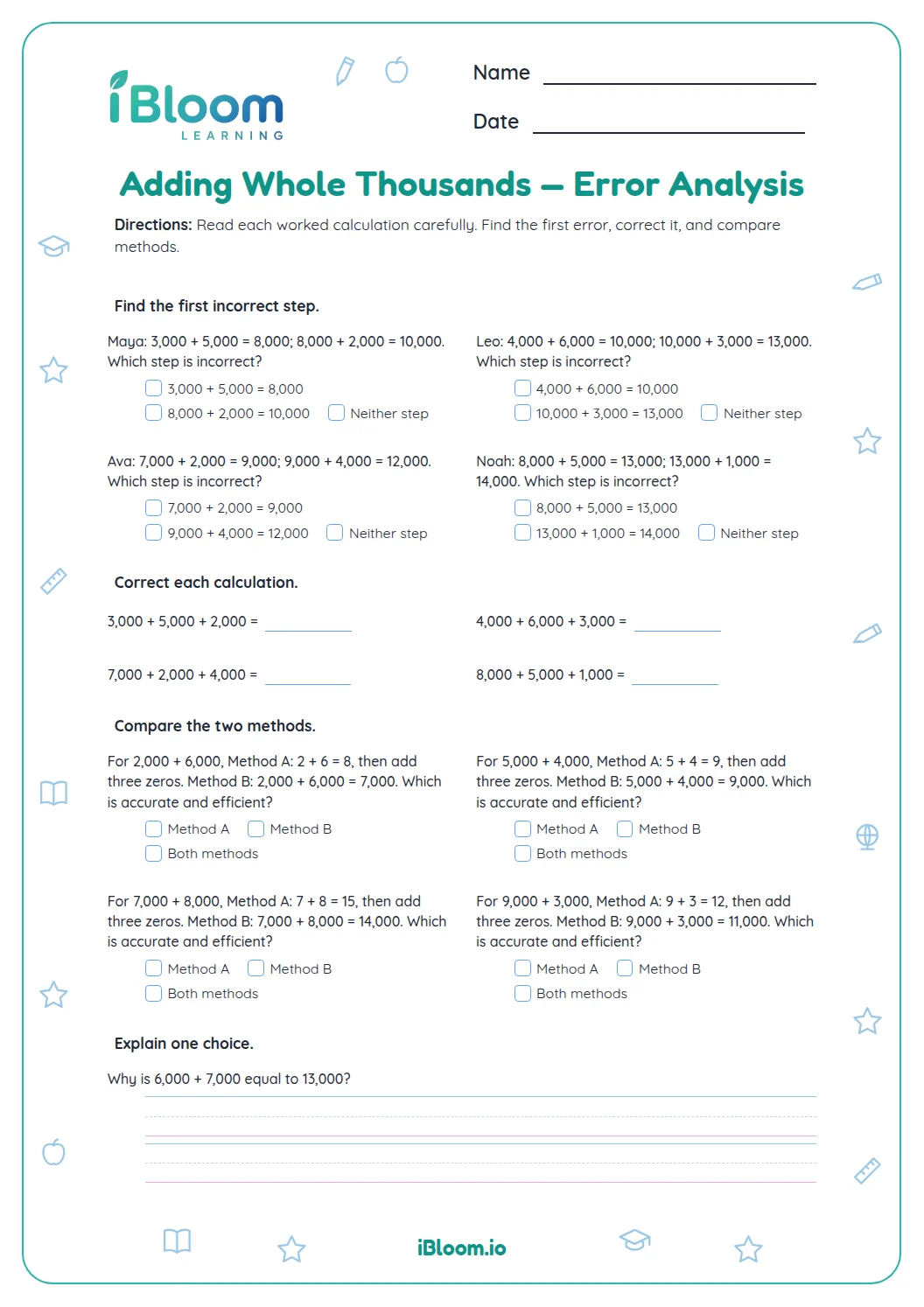
Part C has three terms. Add two first, then add the remaining term, or group terms that make a convenient total. For 4,000 + 6,000 + 3,000, combine 4,000 and 6,000 to make 10,000, then add 3,000.
- Check the complete sum with an estimate or subtraction.
How to use this worksheet
- 1Read each addend and note its place value.
- 2Add two terms, keeping the thousands aligned.
- 3For a missing addend, subtract the known part from the total.
- 4For three terms, add two and then the third.
- 5Check the result by estimating or using subtraction.
Common mistakes and quick fixes
The mistake
Dropping a zero when adding thousands.
The fix
Say the number in thousands, then write all three zeros.
The mistake
Adding the known addend to the total in a missing-addend item.
The fix
Subtract the known addend from the total.
The mistake
Stopping after adding only two of three terms.
The fix
Count the addends in Part C before checking the total.
What to practice next
Make more practice
Questions parents and teachers ask
What is a whole-thousand number?
A whole thousand is a multiple of 1,000, such as 48,000 or 725,000. Every addend in this drill is a complete thousand. The problems build from two-term sums to missing addends and then sums with three terms. The answer key can be used to confirm the calculation after the check.
How can subtraction check a sum?
Subtract one addend from the total. For example, if 48,000 + 35,000 = 83,000, then 83,000 − 35,000 should return 48,000. This checks that the stated total and addends belong together. The answer key can be used to confirm the calculation after the check.
How should students approach a missing addend?
Use the total and the addend that is already given. For 17,000 + ___ = 26,000, subtract 17,000 from 26,000 to get 9,000. Add 17,000 and 9,000 to verify that the result is 26,000. The answer key can be used to confirm the calculation after the check.
Does the drill include word problems?
Yes. The final four items present addition situations about books, water, pencils, and donations. Each asks students to add whole-thousand amounts and record a total with the appropriate unit. The answer key can be used to confirm the calculation after the check.
How can a student estimate a whole-thousand sum?
Add the thousands mentally or round the addends to nearby thousands for a quick reasonableness check. For exact answers on this drill, add each stated term carefully and compare the result with the answer key or a subtraction check.