



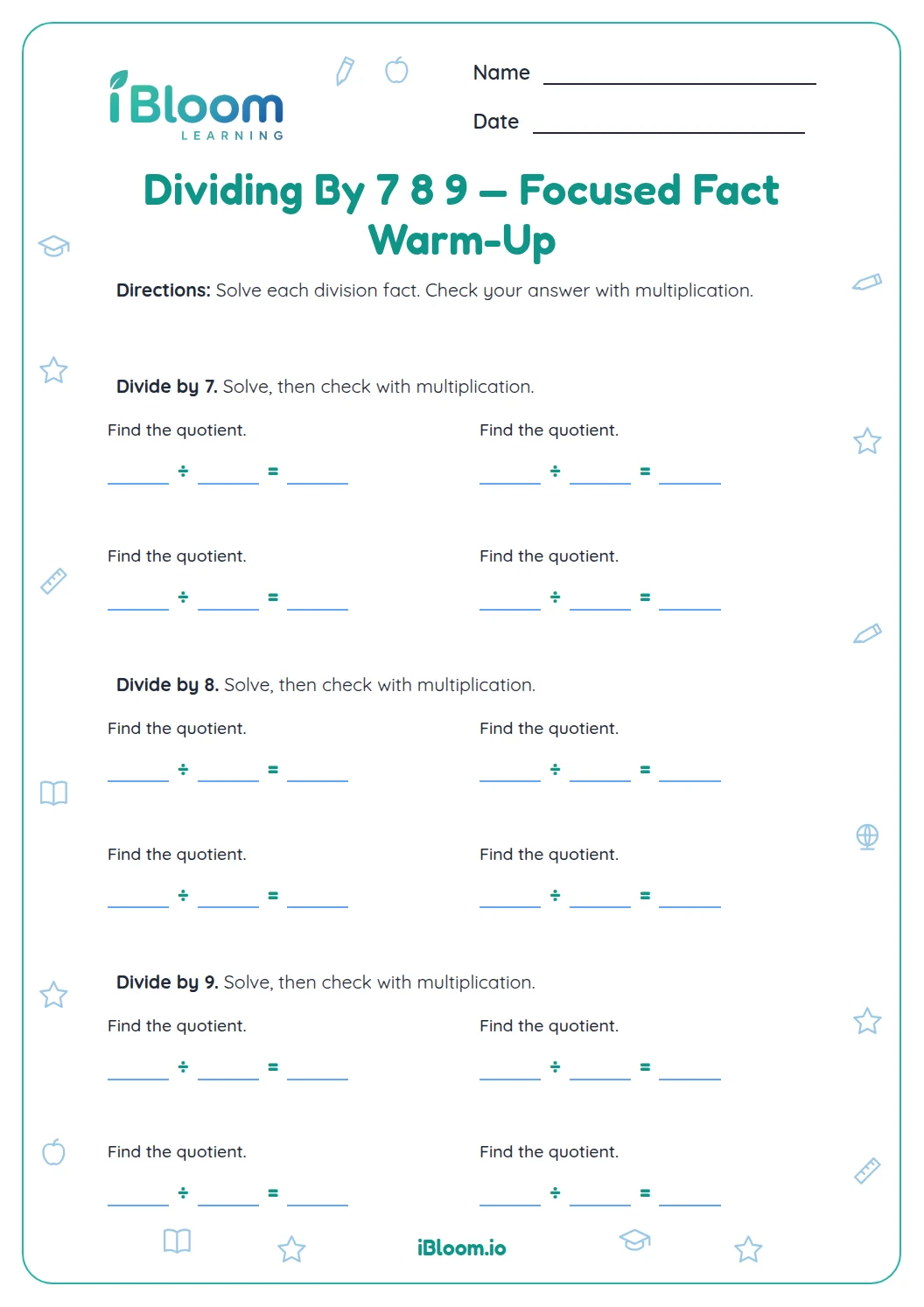
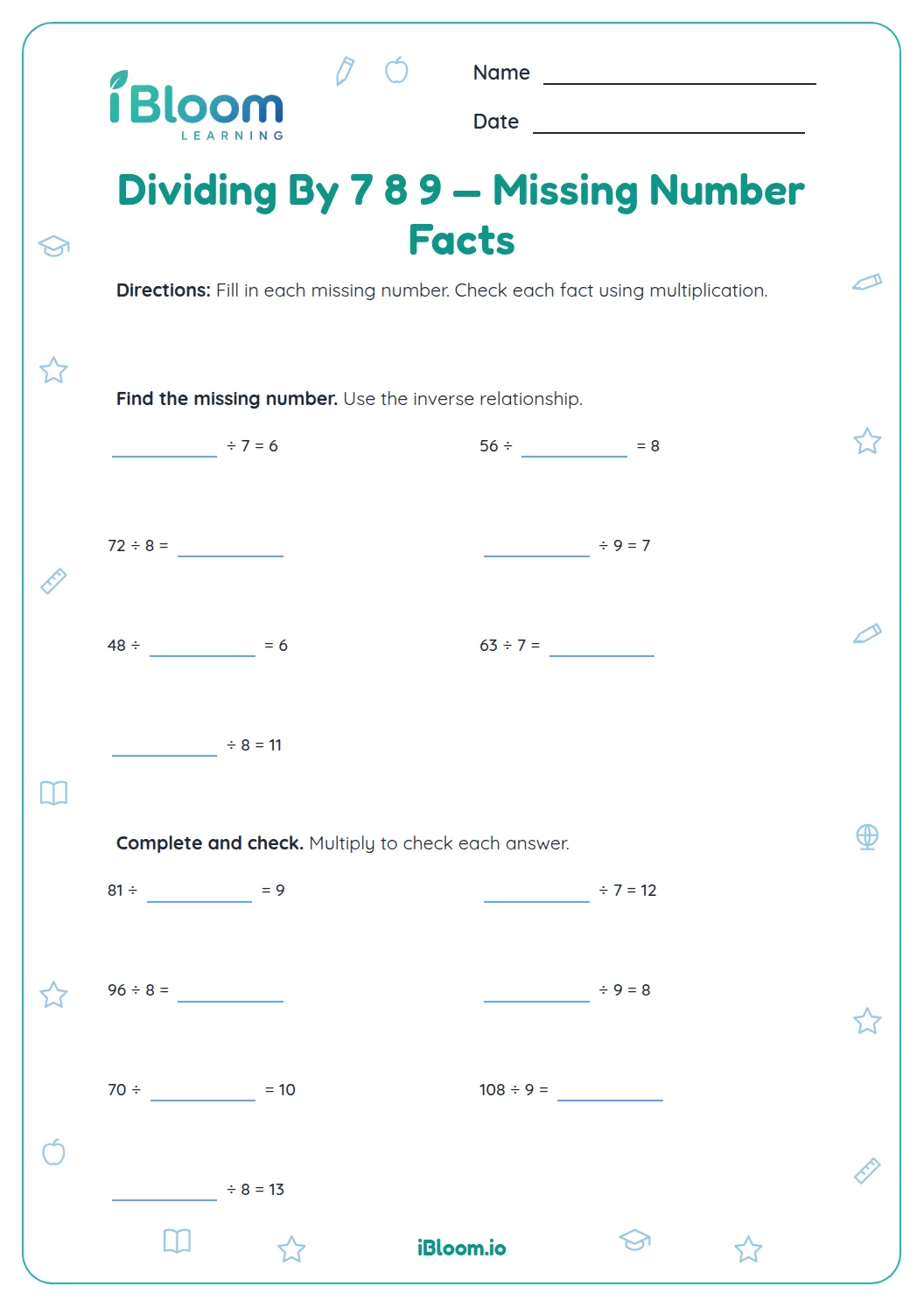
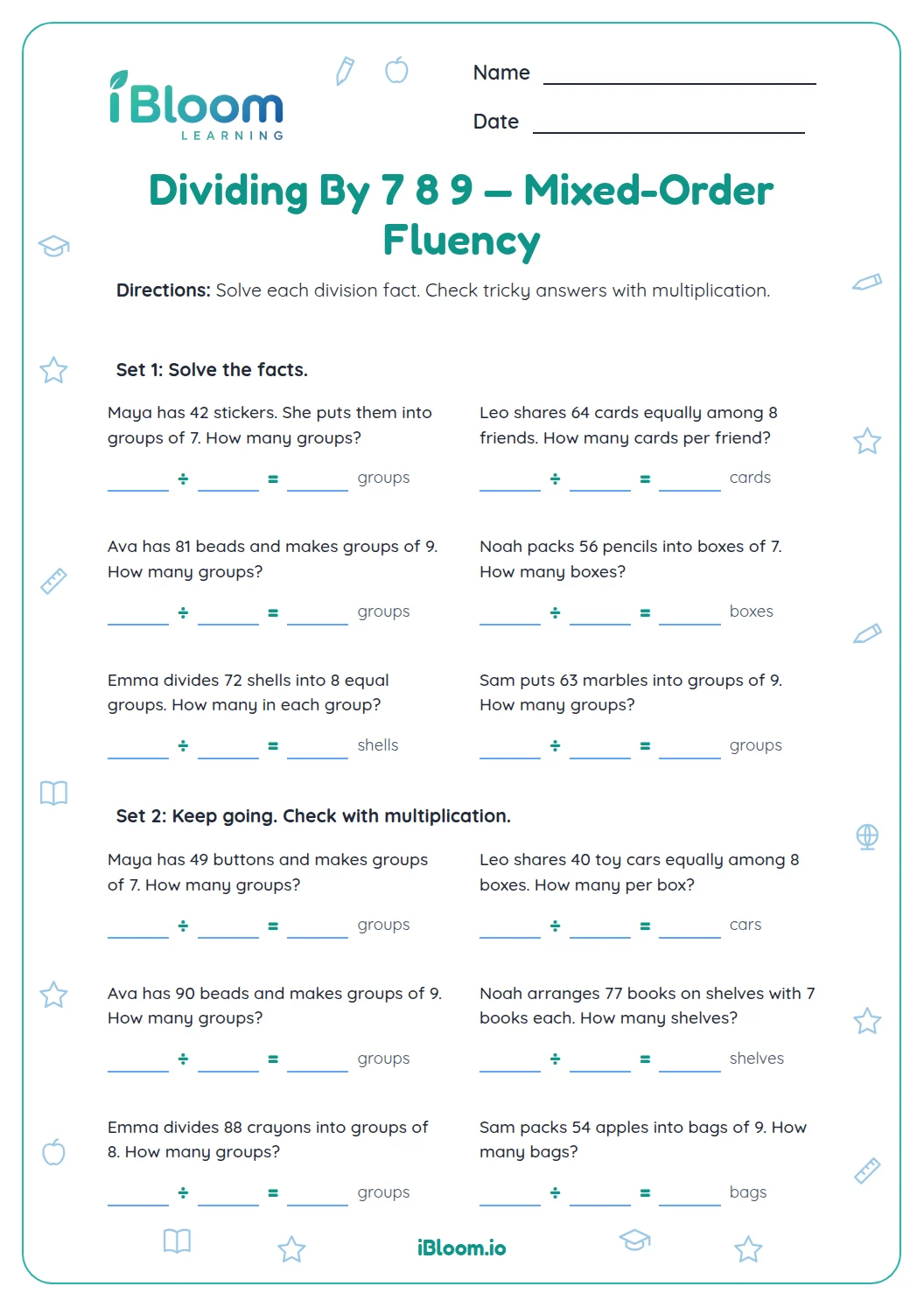
About this worksheet
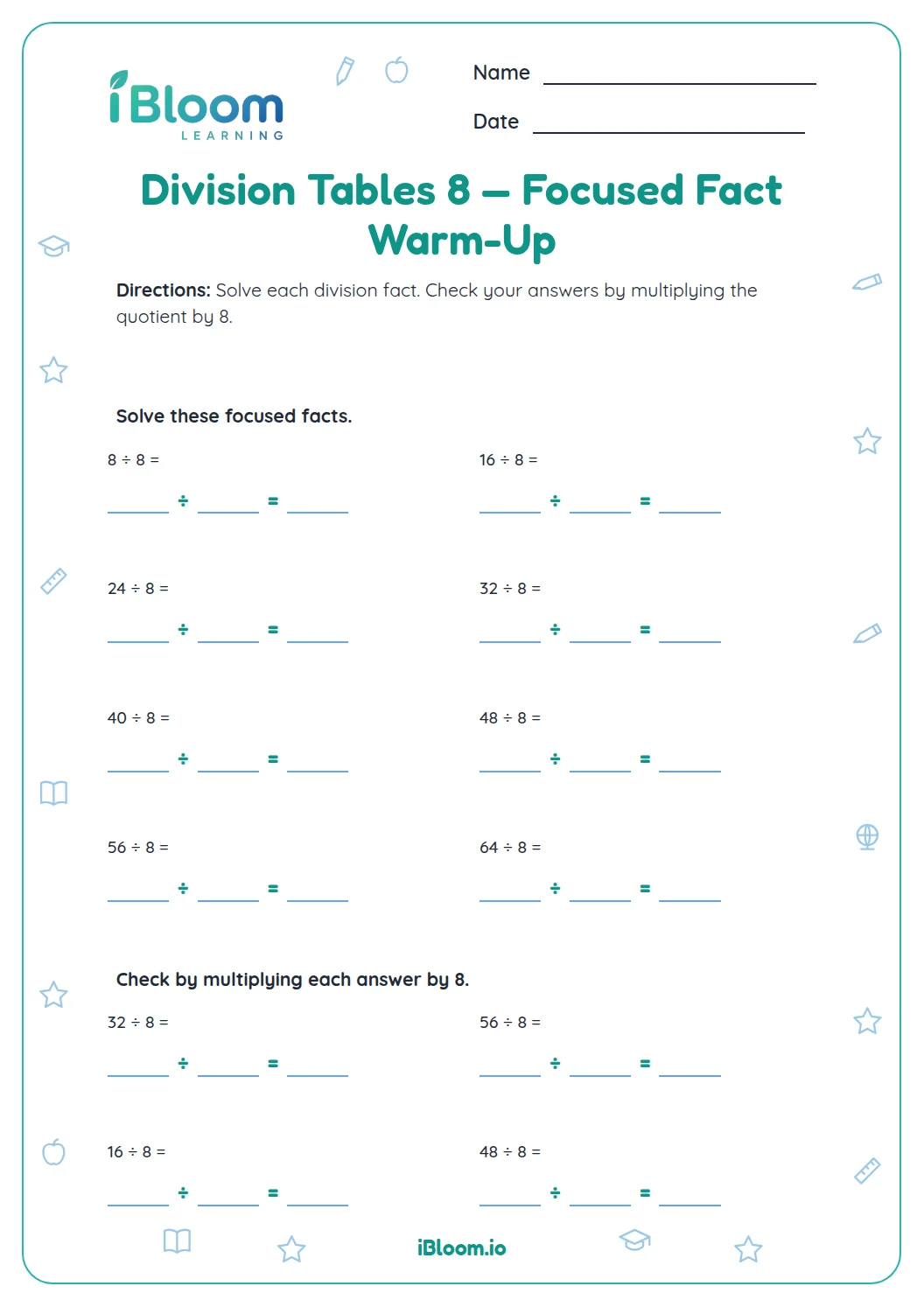
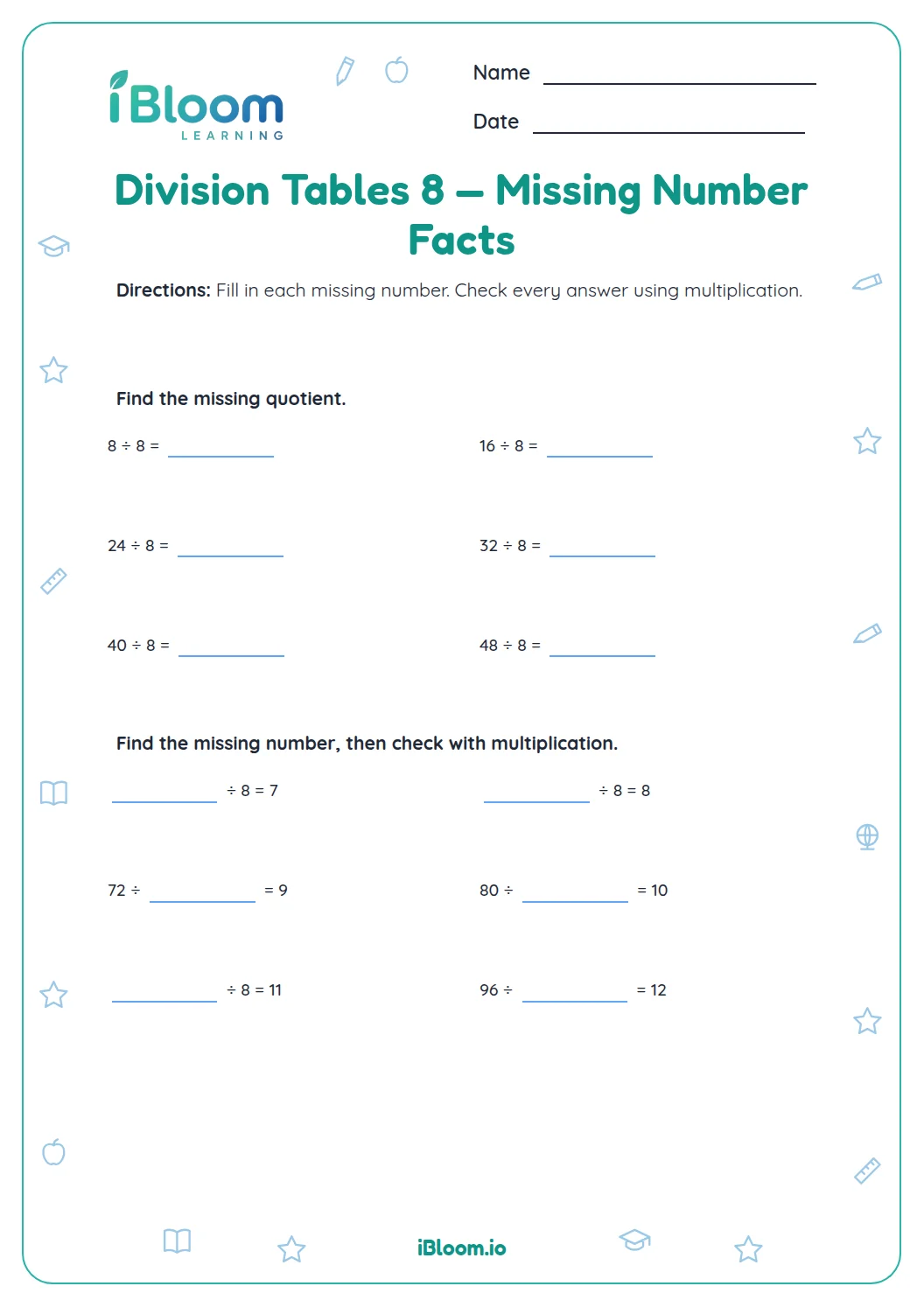
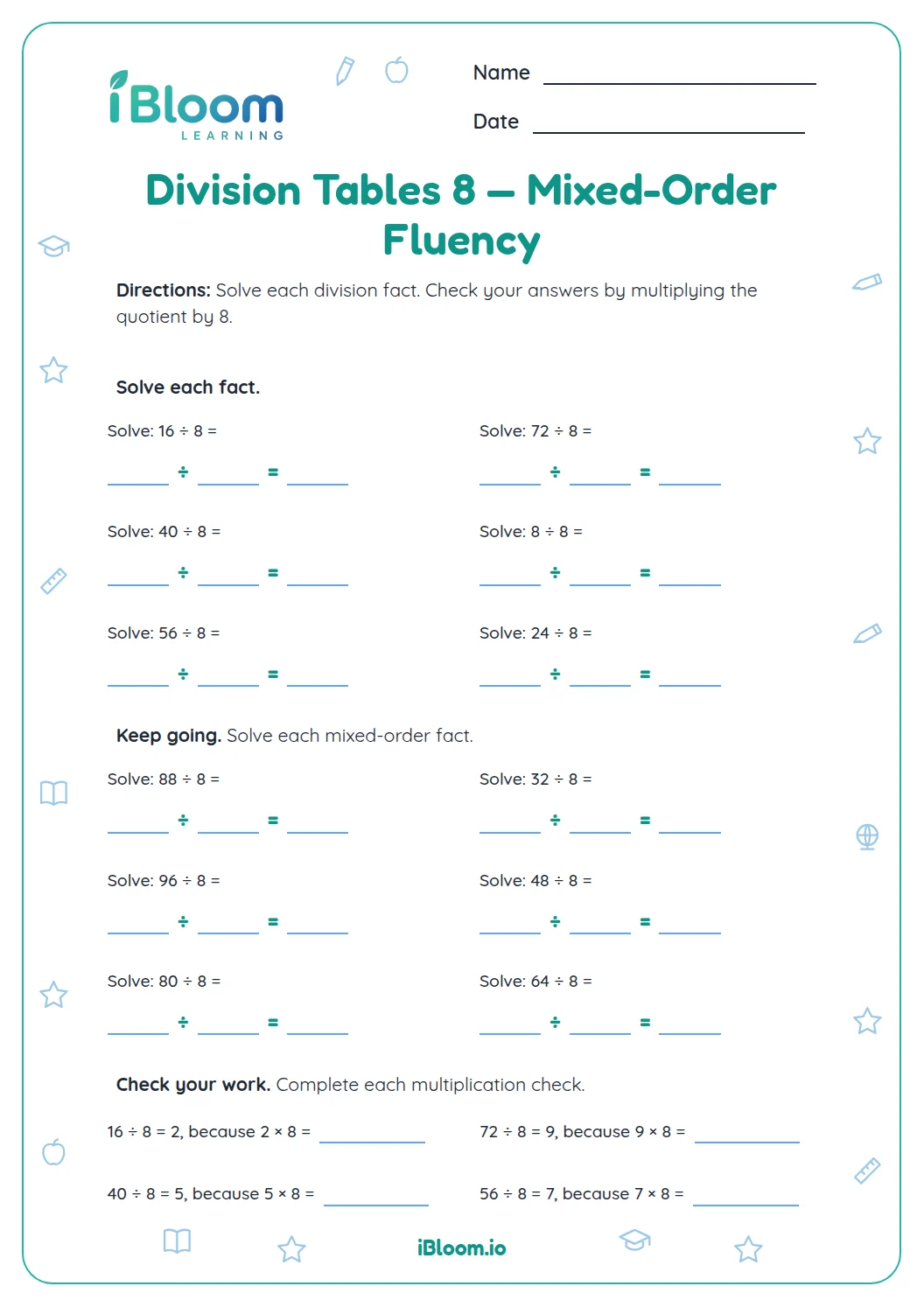
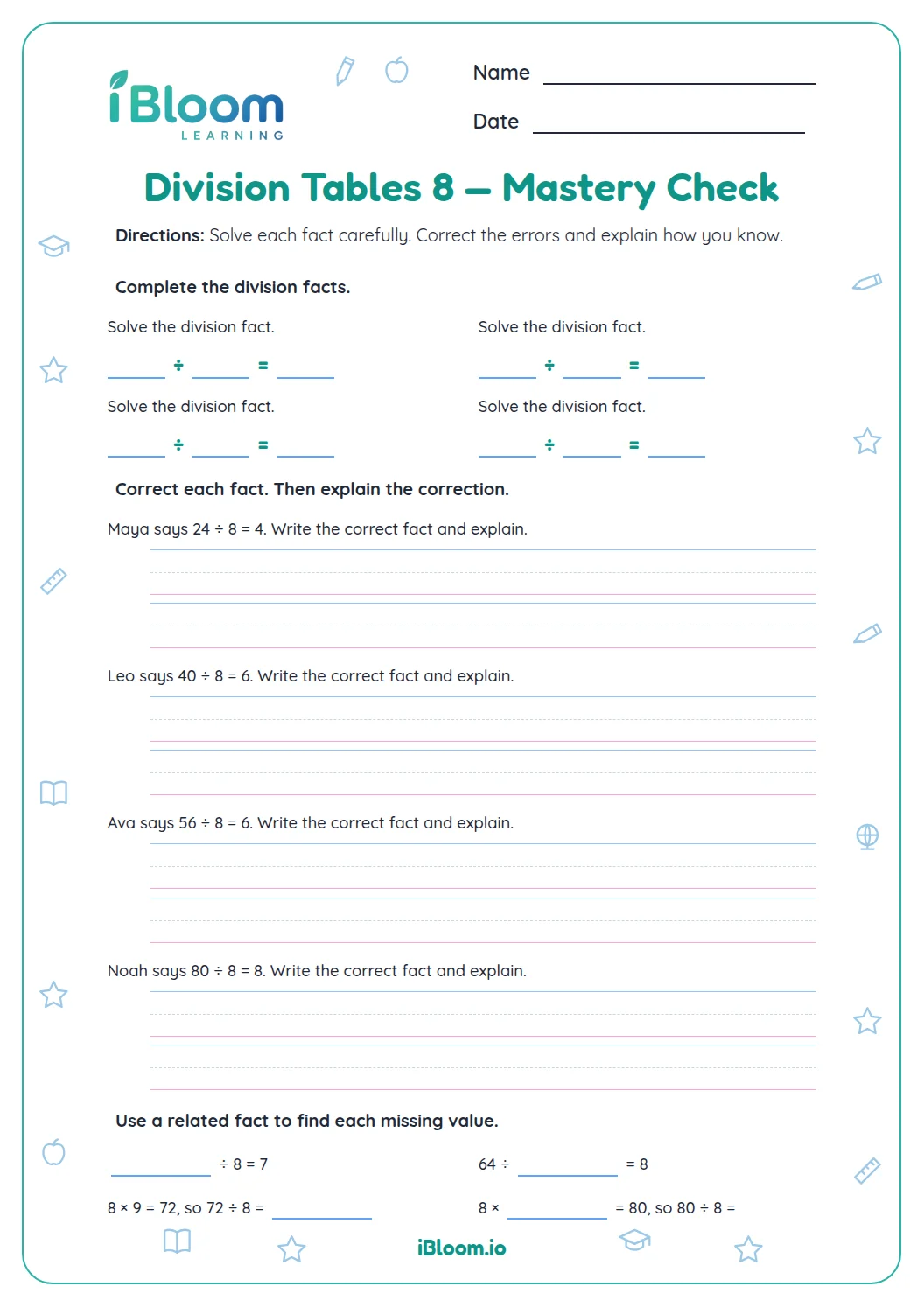
This free printable division-by-eight worksheet gives Grade 3 and Grade 4 students two sets of four short stories, each followed by a retry. Children translate equal-sharing and grouping situations into division equations, using facts from 16 ÷ 8 through 72 ÷ 8. They solve each set without a timer first, check accuracy, then repeat the same stories with or without timing. The sixteen responses practice division within 100 and multiplication–division relationships under Common Core 3.OA.C.7. A separate answer key gives each equation.
Aligned to 3.OA.C.7
How does a story become a division equation?
Identify the total and what eight represents. In question 1, sixteen stickers are shared among eight friends, so 16 ÷ 8 gives the number of stickers each friend receives. In question 2, twenty-four pencils are put in groups of eight, so 24 ÷ 8 gives the number of groups.
- 116 stickers shared equally among 8 friends
- 216 ÷ 8 = 2
- 3Each friend gets 2 stickers.
- 4Check: 8 × 2 = 16.
When should I start the optional timer?
Parts A and C are practice rounds to complete without timing. Check each set before moving to its retry: Part B repeats Part A, and Part D repeats Part C.
For a timed retry, start a stopwatch at the first story in that part and stop after the fourth. Record the part letter, elapsed time and score out of four beside the name. Students may also complete both retries at their own pace.
Why do the same stories appear twice?
Repeating a set lets students use their corrections in another attempt. The first set covers 16, 24, 32 and 40 divided by eight; the second covers 48, 56, 64 and 72 divided by eight. Each fact appears twice.
Check what the quotient counts as well as its value. In the pencil and card stories, it counts groups or packs. In the sticker and marble stories, it gives the amount in each share. Ask the child to explain the number after writing the equation.
How to use this worksheet
- 1Complete Part A without timing, writing a division equation for each story.
- 2Check the four answers and say a matching multiplication fact for any correction.
- 3Retry the stories in Part B, using a stopwatch only if wanted.
- 4Complete and check Part C before moving to Part D.
- 5For a timed retry, record the part letter, elapsed time and score out of four beside the name.
- 6Review accurate equations before comparing retry times.
Mistakes to notice and fix
The mistake
Multiplying the total by eight.
The fix
The total is already known. Divide it by eight to find the size of a share or the number of groups.
The mistake
Writing only 8 because every story mentions eight.
The fix
Ask which number times eight gives the total; that number is the quotient.
The mistake
Not knowing what the quotient counts.
The fix
Read the story again: 24 ÷ 8 gives 3 groups, while 16 ÷ 8 gives 2 stickers per friend.
Common Core alignment
Use multiplication facts to divide multiples of eight within 100.
On this sheet: Students use multiplication facts to write division-by-eight equations and repeat them for fluency.
Show the official wordingHide the official wording
Fluently multiply and divide within 100, using strategies such as the relationship between multiplication and division (e.g., knowing that 8 × 5 = 40, one knows 40 ÷ 5 = 8) or properties of operations. By the end of Grade 3, know from memory all products of two one-digit numbers.
What to practice next
Make more practice
Further reading
Questions parents and teachers ask
Is a timer required for this drill?
No, every problem can be completed without timing. Parts A and C are untimed practice rounds, followed by retries in Parts B and D. If you choose to time a retry, record its elapsed time and score beside the name, then discuss accuracy before speed.
Which division facts are included?
The worksheet uses 16, 24, 32, 40, 48, 56, 64 and 72 divided by eight. Each fact appears in a short story and is repeated in a retry round. That gives sixteen responses altogether, with quotients from two through nine to find and check.
Should students write an equation or just the answer?
Students should write a complete division equation in each blank. For the sticker story, 16 ÷ 8 = 2 shows the total, number of friends and amount each friend receives. After writing it, ask the child to explain that the answer means two stickers per friend.
How do the two kinds of division stories differ?
Some stories give eight equal shares and ask how much goes in each share. Others give a group size of eight and ask how many groups can be made. Both use division by eight, but the quotient counts different things: two stickers per friend differs from three groups of pencils.
How should I use the retry rounds?
Check the first attempt before beginning its retry. Ask the child to explain any correction with a multiplication fact, then cover the completed practice answers. Repeat the same four stories in the next part. Keep both accuracy and any elapsed time when discussing the second attempt.